How do you build a better place? It takes effective transportation solutions, good Urban Design, good planning, and the political will to make it happen.
Image via WikipediaWell, we knew it was only a formality, but the city of Salt Lake City and UTA have signed the agreement to allow construction of the Airport TRAX line. The line will operate from downtown via North Temple to the airport. Sadly the westside's inferiority complex was allowed to make a transportation decision so the line will use 400 West instead of making a direct connection to the Intermodal Hub via 600 West.
This line will provide a critical link that will allow people to access the airport easier especially with the connection to Front Runner plus make it easier for airport employees to leave their cars at home.
Saldy, in this time of high gas prices and problems in the airline industry I cannot say that having a connection to intercity rail passenger service was important since it Amtrak service in Salt Lake is a joke.
Salt Lake City will join Portland, San Francisco, Chicago, Philadelphia, Washington DC (BWI and National), Atlanta, Burbank and St. Louis as having rail connections with the airport. LAX in Los Angeles, Miami International and Fort Lauderdale have short shuttle rides to rail transit service. In addition Seattle will be joining the list late next year.
Personally I have flown into/out of Burbank, Portland, Miami, and Fort Lauderdale using transit connections and for the most part they have worked well. For example a couple of years ago my wife and I flew into Portland, picked up our luggage walked right to the MAX light rail train, got off at our stop and walked to our motel.
Yesterday, I had a meeting to attend to in Downtown so I thought it would be a good time to go get some pictures at the Intermodal Hub, Central Station.
I started off on the 213 getting one of the 2006 Opus buses which is the perfect bus to be assigned to this route. I then took TRAX to the Intermodal Hub.
On my way back I took TRAX to the Stadium Station and onto the 220. I cannot wait until they build something at the Stadium TRAX station. I just hope it has something like a convenience store because yesterday I was getting pretty thirsty waiting for the 220 but of course I would have missed the bus if I had to walk over to stores on 1300 East and 200 South.
But then came the 220 with bus 9214 assigned. One of the last of the Orion V buses still on the road for UTA. The bus itself is better than any of the low floor buses built today, but what was really irritating was the wrap. Now anyone who has read my blog for any length of time knows how much I despise wraps but this one was even worse than most. As you can see from the picture you cannot see a thing out the window. This is why I hate wraps so much.
Image via WikipediaI miss the apartment I was living a few years ago. From my apartment I could walk to a local grocery store, a pizza parlor, Circle K, a hardware store, dry cleaners, postal service annex and a newstand that had a couple of really cute girls employed. I could also catch the bus from in front of the complex to the main downtown area which in this town was called "uptown" to give it a little better name. This complex was not designed as a transit oriented development but it worked much the same way. Everything was designed to be in walking distance including transit service.
While I could not use the bus service for regular transportation since it most of the routes radiated out of uptown area and provided generally poor service (you couldn't even blame light rail for this one since Charlotte just opened their first light rail line early this year). In addition I was working for Oldsmobile in the racing arena at the time and transit just didn't fit the needs although I would have used it if it worked.
What did work was my wonderful apartment. The convenience of not having to get in the car to go to the grocery store or run everyday errands. That is the essential elements of Transit Oriented Development.
Today in many cities around the nation you can live near a light rail or bus station, have all your services convenient to you, and not only be able to run your errands without using the automobile but also have the luxury of hopping transit to work, dinner, a movie, or a many other activities.
They exist in Portland, Seattle, San Francisco, San Jose, Denver, and of course the older transit cities such as Chicago, New York, Boston and Toronto.
Monday's development conference hopefully will spawn some developments here in Salt Lake City. I have already talked about some actions that can be taken along the major bus routes that will help out with not only providing affordable housing but increase bus ridership by making bus service more convenient.
We have already seen a new vision come out of the University of Utah and hopefully we will see many more in the next couple of years. We need housing and services to become more convenient to each other were walking and transit become easy options, not something that is an afterthought.
Image via WikipediaArticle in the Trib today about plans of the University of Utah to turn itself into a more pedestrian friendly campus. Plans include replacing much of the surface parking with parking garages and concentrating development along the TRAX lines.
The University should be applauded for its efforts over the years to encourage its students to take TRAX and the bus. While Universities much like airports gain revenue from parking which many times will cloud their judgment when it comes to promoting transit service, it is clear that the U of U has seen that transit plays an important role in moving its students.
The boldest part of the plan is to replace the parking lot between the Stadium TRAX station and the Stadium itself with a huge mixed used complex that will include residential, office, retail, restaurants and entertainment. Not only will this benefit students at the U, it will also help those of use who transfer from TRAX to buses at that location. I often transfer from TRAX to the 213 or 220 and it will be nice to be able to do something while waiting for the bus or TRAX. You add the streetcar from my earlier proposal and you have a major entertainment destination. I hope that the University will encourage locally owned businesses to be a major part of this complex and doesn't give into chain phobia.
Another outstanding part of the plan is to replace temporary buildings near the Fort Douglas TRAX stop and replace them with new housing. This will put students directly on the TRAX line and allow them easy access to downtown shopping and entertainment and further reduce the need for the automobile.
By the way lets put some basic economics here. These developments will encourage transit use, not only TRAX but also the bus. It will encourage more people to ride them thus creating more revenue, revenue that then could be used to improve the bus system. As I have stated, the present problem is not the management at UTA, it is the fact that it is hard to take the bus in the Salt Lake Valley and once again not because of the route structure but because our streets, sidewalks and developments do not encourage transit use. Heck, as I have stated a million times, here we are in the 21st Century and when it is dark you need a flash light to flag down a bus do to the lack of streetlights. We have problems in Salt Lake, but the problems isn't were some misguided people think they are.
Craig Mecham's development in Sugarhouse was controversial to start out with. Taking an area with unique character and bull dozing it to build another gentrified development of chain stores and no character. Now instead of have a unique blend of eclectic shops, we have a big hole in the ground and very little progress being made.
As I have pointed out on several occasions, the Salt Lake City Council and planners seem to give into whatever the developers or big chain stores want no matter the determent to the community. So now we have what was a pedestrian friendly, home to locally owned stores neighborhood that has been torn up and once something actually gets built with be auto centric and not have the feeling the neighborhood once did.
The city council and the planning commission should be working toward building more pedestrian, transit friendly areas. They talk good about them but when all is said and done the city of Salt Lake gets a big F when it comes to acting.
Its time to stop giving too many breaks to developers.
Apparently the bus riders union is getting desperate. Having lost its bid to stop the fuel tax surcharge, now it is attacking light rail head on posting an article by Randal O'Toole describing how Light Rail is a failure.
I have spent the last few hours deciding if I should even bother with this, but considering the bus riders union is trying to pass off this misinformation campaign I decided I should go over the facts.
O' Toole has long been a apposed to transit, especially rail transit and uses the fact that he is a foamer to qualify himself as an expert. For those who don't know the term foamer it is used to describe rabid railfans, the types you see carrying the scanners and in general wearing shirts and hats from current or dead railroads.
So lets go over what O' Toole claims and go over some facts.
1. His first point is that Light Rail Cost tax dollars to build.
Well yes, it does cost money to build but so does any infrastructure project. How many billions will go to the new Mountainview Corridor highway? However, clearly the taxpayers of the counties affected have seen the benefits of the projects and support them.
2. Light Rail does not get people out of cars.
Just look at the numbers created by TRAX. TRAX is now carrying 33% of all transit riders in the 6 counties that UTA serves. That's right folks, even though the bus network covers six counties an hundreds of miles, our 24 mile light rail system is carrying 33% of the entire transit load. Also, consider that TRAX by 2000 was carrying the same number of passengers as every major bus route including routes such as Redwood, 900 East and Highland that did not directly compete with TRAX. Also, since ridership did not dip that much on these routes it is clear that TRAX was carrying
Here is another illustration using Los Angeles, the Blue Line between Los Angeles and Long Beach is now carrying upwards of 80,000 people per day (while a nearby busway carries 5,000). If you were to replace that line with buses you would have to run articulated buses with crush loads every 60 to 120 seconds to carry the numbers that the Blue Line is carrying. The Blue line replaced an express bus (that originally replaced the red car interurbans), that ran every 20 to 30 minutes and only carried a few thousand passengers a day plus a local route that carried even less.
Light rail does attract those out of cars.
3. Light Rail can inconvenience riders.
O' Toole tries to claim that transit systems that put in light rail lines loose overall ridership. Clearly this is not true as ridership on UTA has gone up substantially. Even a better indicator is that revenue has gone up consistently since TRAX has gone into service. Yes some people have to transfer who didn't previously, but overall service is improved. Also, the problem with buses being cut isn't the cost of light rail since it cost less per passenger than buses, its that there is not enough people riding the current bus system with shows other issues besides the light rail.
4. Light Rail increases congestion.
Apparently because lights are timed for light rail trains it increases congestion. However, if you were running BRT, then you would have buses holding signals so wouldn't that increase congestion also? Also the lack of light rail would put more buses in the downtown region so that would also create more congestion. In other words we are grasping at straws here.
5. Light Rail benefits Downtown Property Owners at the expense of others elsewhere.
O' Toole uses one study to say that money is repositioned to downtown thanks to Light Rail. Could it be that people are more likely to come to downtown when they don't have to deal with traffic and parking issues. Personally, I only went downtown once or twice in the two years before TRAX started but after it started running I would go downtown much more frequently because the parking and traffic hassles were history.
6. Light Rail Does not stimulate local economic development.
More nonsense from O'Toole here. He claims that the only economic development is created by taxpayer subsidies to developers. Of course you will never here O' Toole mention the subsidies that go to big box retailers and other developments that are not transit related since they are apparently OK.
7. Light Rail Increases Energy Consumption And Greenhouse gases.
Here he attacks the TRAX directly saying because of TRAX buses are running empty causing energy consumption to go up. Then he says that bus ridership in Salt Lake went down 50% when TRAX started although the truth is bus ridership has remained relatively flat for 15 years. Of course there was areas that were loosing riders namely the Ogden area and Provo/Orem but the last time I checked TRAX did not go into those areas.
8. Light Rail diverts tax dollars that could go to more worthy transportation projects.
Here is were O'Toole and the BUS riders union shows its true colors. He states that money should be going to highways that buses could use and not rail transit. Apparently he believes the voters of Utah and other areas are stupid because they support transit. We already know that the BUS riders union will seek the support of those who want to steel the TRAX funds to support highways and this is even more proof.
Here is another episode of Perils for Pedestrians. This one talks about what is happening in Washington DC including the on again off again Purple Light Rail Line.
There is also a discussion with a representative from a county planning organization that covers the county that includes Charleston, South Carolina. One of the problems we face here in Salt Lake City is the lack of a metropolitan planning organization that provides more cohesive planning than the wide range of city planning agencies we currently have. While we do have the Wasatch Front Regional Council, it is not a primary planning organization for the area.
Finally there is an interview with a traffic engineer that gives some explanation on how pedestrian signals are timed and some of the terms used.
Image via WikipediaA recent comment about the pedicabs got those wheels turning again. The question is, despite the existing of a couple of organizations to promote local business including Vest Pocket and Buy Local First Utah, is Salt Lake City anti-small business?
Lets take a look at the Smith's at 900 East and 2100 South in Sugarhouse. As regular readers of this blog know, I often hold this as example of giving into the blackmail of a big business and not sticking to plans and the neighborhood. The question is, if that had been a small grocery store would have Salt Lake City given in or would they have stood their ground? If they would have stood their ground that means that they would have discriminated against the smaller business.
We also have the example of Wal-Mart at 300 West and 1300 South which in is a community with a high percentage of non-car owners. The store is designed for people to drive in and out of and pedestrians (especially those coming from TRAX) have to risk their lives to reach the store as the driveways are high speed routes for drivers and pedestrians have to use them to reach the store.
Another example of this is the food carts that have populated the downtown area. It seems like some bigger businesses (for example the Taco Time at 8th south and State) don't like the competition from the smaller carts and have been pushing for regulations against them including ones that have recently passed.
Some even try to demonize they carts by giving names link with food created diseases. I find this kind of ironic considering I have never had a problem eating food from one of the these carts but have gotten sick after eating from major restaurant chains.
Now instead of trying to regulate these carts out of business, how about supporting the small entrepreneurs and encourage them so long as they pass health regulations? I noticed in Denver the food carts were nicely integrated into the 16th Street Transit Mall.
If anything Salt Lake City should be promoting small business more. It is ironic that cities such as Salt Lake, Sandy and others work so hard to attract big box retailers and other chain stores when it reality they end up cost more than they bring in. According to studies done the cost of police, fire and other city services cost more than what sales tax dollars come in. That doesn't even take into consideration all the hidden cost of big box retailers such as infrastructure cost such as the 80 million that now has to be spent in Springville since people don't notice those kind of things.
The ultimate irony is the fact that small business contribute more to the local economy, actually pay higher wages on average, create more sales tax dollars per square foot of space, do not increase cost of city services, are generally safer, and fit better into the fabric of the community.
Salt Lake City should working harder to help small businesses and build a comprehensive plan that includes transportation, planning and the promotion of small business.
When most people think of Pedicabs Japan and China come to mine as big user of Pedicabs. However, pedicabs are slowly being accepted in certain areas around the country. So how about pedicabs in Salt Lake City? With our wide streets Pedicabs would be able to be in the curb lane while automobiles could use the other lanes.
The big benefit of pedicabs is that they are cleaner since they do not have motors plus they offer a unique travel experience. However, some people don't like the Pedicabs especially the automobile cab industry who usually fight against pedicabs including a vicious fight going on in Los Angeles. In New York pedicabs have become too successful and many groups are trying to get them restricted to benefit of the Pedicab opponents.
Pedicabs would make getting around downtown that much easier plus offer a unique Asian influence to the area. Say you just have a nice dinner at one of our nicer independently owned restaurants, you could use one of the pedicabs to get you a the couple of blocks over to the nearest light rail station.
Pedicabs, a another possible piece of our transportation puzzle.
Image via WikipediaYou know that old tired argument that certain people who shall remain nameless because they should always use about rail transit being outdated because it is 19th Century technology?
Since there have been so many serious postings lately, I thought it was time to lighten up the mood and here is some great information to the people that use that outdated technology bogus argument.
OK, so when was the first electric rail transit line started? 1891
Your right man that is old technology lets throw it our right? Here is some more really old technology that maybe should be thrown out:
1885: The first automobile patented that used Karl Benz's Otto Gasoline Engine. That's right folks the automobiles are older technology than electric streetcars!! (Picture is of Karl Benz's auto)
1879: Karl Benz patents the two stroke engine.
1823: First internal combustion engine is patented.
1806: First automobile propelled by Hydrogen and Oxygen
Around 1769: The first horseless carriage is developed. That's right the automobile dates back all the way to the 18th Century!!
So there it is folks. The next time you hear someone throws that old tired argument that streetcars are outdated technology, you can ask them if automobiles should be thrown out too because they are OLDER technology.
Image via WikipediaA few articles of note from todays media including articles about the BRT line on 3500 South, an historical article about rail transit in Utah County and a land owner that is not happy with the offer he is getting for his land. 'Bus Rapid Transit' coming soon to 3500 South
First the article about the so-called bus rapid transit line along 3500 South. There has already been delays to the start up of the service due to problems from the manufacturer Van Hool. Van Hool buses are already being used in Oakland by AC Transit and VIVA an agency outside of Toronto. Hopefully UTA will have better luck than those agencies have had in maintaining a bus that is largely going to be an orphan of the fleet.
UTA is claiming a 15-minute savings over the regular route 35, however probably a third of more of that can be directly contributed to not making the UTA Headquarters jog that the current 35 makes.
It seems that most of the BRT propaganda includes the byline that BRT is just like light rail but only cheaper. However, it should be noted that the cost of BRT is only cheaper if you are not comparing equal systems. However, if you attempt to build a BRT line with the same carrying capacity of Light Rail, your true capital cost would be higher, and you would have to add additional operating cost since Light Rail can carry more people at a lesser cost per passenger.
Ridership numbers will be interesting to watch. Their current estimates of 1500 is about 50% more than the old 37, now 35 did going back many years. However, the best that BRT has seemed to do is attract about 13% new riders to transit and that was create new dynamics such as the case of Los Angele's route 720 that combined the Wilshire Line and the Whittier Blvd line into one market thus giving a one seat ride that didn't currently exist.
Finally there is this article from FOX 13. This is one of those situations that you can see both sides of issue and want to see a fair ending. My guess is the real answer is probably somewhere in the middle. After all most people think what they own is worth more than it actually is. How many people go into car lots to get rid of their car and think it is worth so much more than it actually is? I guess we come attached to something and it takes on more value than reality.
Sorry I haven't posted for a week by last Thursday (15th) was my wife and I's 10th Anniversary so we took a little trip through Colorado, New Mexico, and Arizona to celebrate.
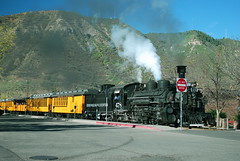
We had the opportunity to ride the famous Durango and Silverton train between those respective towns which was a contrast from Amtrak's Superliners, the Cascade Talgo, and FrontRunner.
Here is a posting from the Overhead Wire about a bill going through Congress on Transportation Funding:
Also, for anyone that still wants proof that turning UTA over to UDOT is a bad idea and could lead to transit funds being stolen for other projects, the Governor of California, you know that actor guy has proposed taking $1 Billion of voter approved moneys and moving into the general fund and then sending some of that funding over to highways. Does anyone really want to give our state legislature that opportunity?
UTA has ordered 77 new light rail cars for the expansion of the system that will be taking place over the next few years.
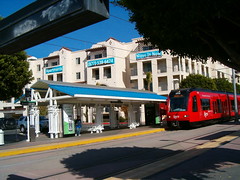
Unlike the previous cars that UTA ordered from Siemens which were SD100 and SD160 models, these new cars will be the S70 low floor model as the one pictured here from San Diego.
San Diego currently uses these cars on their Green line which travels from Old Town out to Santee. Unfortunately I never had the chance to ride one and try them out since every time I hopped the train it was a set of older cars.
Last time I talked briefly about how Ogden could create a nice urban area by putting together the streetcar, a revitalized Washington Blvd, and the Centennial Trail that goes along the Ogden River. Today I was planning to go into a little more detail and build upon those previous ideas.
First of all, the streetcar line will create a new corridor from the FrontRunner Station to WSU. As has been seen in Portland and Tacoma, streetcar lines have the habit of bringing new interest to a community.
Then you have the Centennial Trail along the Ogden River that travels from the Twenty-First Street Pond which in itself has a trail system to the Bonneville Shoreline train that offers even longer trails.
As you can see on the map you have four main streets that connect the streetcar line and the trail system. Turn all four of those streets into pedestrian, bicycle, and transit friendly streets. Now you have created four different corridors to connect the streetcar line to the trail system.
Wall Street is currently in the doldrums but using Wall to connect the FrontRunner Station to the trail system would offer new opportunities to revitalize this street.
Meanwhile we have our diamond in the ruff Washington Blvd. Currently there is a lot of independent businesses along this corridor including a lot of older motels. One of the problems when an area is revitalized is often gentrification comes into play and many of the smaller independently owned businesses are forced out and the chains move in. Yet this would ruin some of the opportunities that Ogden would have to set itself apart from its neighbors to the south.
One way to prevent this is to promote the restoration of some of the older buildings; giving tax incentives to restore instead of bulldoze which overcome the federal tax laws that encourage bulldozing and building new disposable buildings. Imagine a street of beautiful motels and restaurants that are not a bunch of cookie cutter boxes.
Meanwhile Monroe and Harrison are primarily residential streets with small pockets of neighborhood business so making those streets pedestrian/bicycle/transit friendly would be neighborhood improvements that could lead to reinvestment into the area.
This would allow Ogden to set itself apart from its neighbors and give itself its own marketing niche. Ogden could promote its own uniqueness and give new reasons to come to Ogden.
Then in a few years Ogden could run commercials like this:
“Tired of the boring chain stores and restaurants, then hop aboard FrontRunner and come to Ogden where you will enjoy our wonderful pedestrian and bicycle friendly streets, the Ogden Streetcar, and most importantly our many independently owned business that give that each have their own unique flavor. Ogden where unique is good.”
For those of you who did not know it, today is national train day, a day to celebrate our national rail passenger system. Of course those of use here in Utah were we have only one train per day that comes through in both directions at night, there is not much to celebrate and since Utah does not help Amtrak fund a state operation we seemed to get ignored like many other places.
In fact, Amtrak passed its 37th birthday on May 1st; I would scarcely call it a celebration since there is little to celebrate. I guess we can celebrate that we do have some semblance of a rail passenger network in place sense the creation of Amtrak was designed to shut down rail passenger service, not make it survive.
Personally, I support long distance rail passenger service. In the past year I have taken a couple of trips over to Denver on the California Zephyr, plus my wife and I have traveled up to Portland, Seattle and Spokane on the Coast Starlight, Cascade Service, and the Empire Builder respectively.
However, while Amtrak seemed to make progress in its first 10 years especially redoing the run down fleet in found itself with, there has been little progress when it comes to rail passenger service the Carter Administration cut many trains out. Today, the system is in worse shape for the most part than when Amtrak first started on May 1st, 1971.
In fact the only success stories you find is were the states have funded improvements having to bring Amtrak along kicking and screaming.
This episode of Perils for Pedestrians features information from what is happening in Toronto, Ontario.
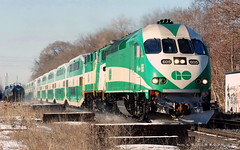
One of the features of the video is talking about GO Transit which has recently celebrated its 30th anniversary. If you look at the picture you will see a ten car train of Bombardier cars similar to the ones now in service on FrontRunner. Consider that this single train can carry 1200 passengers and they are at capacity.
The picture also includes one of GO's new MP40 locomotives. While similar to the ones bought by UTA, these have a higher horsepower rating so that they can run 12 car trains with a capacity of 1440 SEATED passengers.
Apparently Mayor Godfrey up in Ogden is still dreaming of that wonderful urban gondola project instead of looking at what the best transportation options for the city is.
Now let’s take a look at the Gondola comparison prepared by the city of Ogden. The first thing you will notice is that the only project that has been built that even comes close to what Godfrey wants is down in Columbia. Other than that all the other urban gondola projects are pipe dreams.
One thing that is not mentioned anywhere in the comparison is what happens to the urban fabric between the gondola stations.
The first gondola mentioned is the Roosevelt Island Gondola in New York City. This was built before Roosevelt Island had a subway station which opened in 1989. One thing to note is the ridership. Our two TRAX lines carry the same number of passengers in less than two years than the Roosevelt Island gondola has in its 30 years of existence. Also there is no comparison to the urban fabric since the Roosevelt Island gondola primarily travels over the East River.
The next gondola project talked about was MART which was part of the New Orleans Worlds Fair. This is another gondola that traveled over water so had no effect on the urban fabric it passed over. An interesting point about this gondola is that there was plans to continue operating it after the fair but that last less than six months and was later torn down on the orders of the Coast Guard. Another interesting facet is that ridership during the fair boom was less than half of what projected by the backers of the system.
The next one compared is Telluride Colorado which travels from the historic city to the MountainVillage area. Once again it is hard to compare as this one is designed to carry people from the historic town which is located in a narrow valley up to the village which sits 1800 feet higher than the historic village. Once again there is no real urban fabric that the gondola travels over.
The third gondola compared is the only one that comes close to what Godfrey is trying to build and that is the urban gondola in Medellin, Columbia. This one is designed to take people from a poor section of town to the main transportation hub. Of course the gondola like Miami’s Metromover travels over city streets and does little for the urban fabric is passes over.
The fourth project talked about once again is a poor comparison to Godfrey’s dream which is the Portland Ariel Tram. Like the telluride situation this gondola is designed to carry passengers from the waterfront area up a steep incline to the Oregon Health and ScienceUniversity which is located on a cliff area to the west of the waterfront area. As a side note this does not replace a streetcar route but connects the Portland Streetcar to the University area.
The line does travel along Gibbs Street which lies between the cliff and Interstate 5, but once again because the gondola travels over this isolated area, it is doing nothing to help this neighborhood.
The next couple of gondola’s mentioned join Godfrey’s as pipe dreams which includes proposals in Baltimore, Maryland and Camden, New Jersey.
What it comes down to is a gondola is good for point to point transportation especially for situations that involve huge elevation changes. What it is not designed to do is blend into the urban fabric of a community. How will 25th Street benefit from the Gondola? Instead imagine a streetcar traveling along the street bring people from FrontRunner to shop and dine in Ogden.
What Godfrey should be working on is bringing a new vision to the city, one that focuses on the character of the city, provides the opportunity for independently owned retail stores and restaurants which would give residents of Salt Lake City an alternative to the chain stores and restaurants of Gateway and other developments. Ogden could build something really unique that would cause people to want to travel to the city. Between the river walk, 25th Street, and Washington BlvdOgden has an outstanding opportunity to develop a unique destination that will bring new life to the city.
Or will Godfrey take the opportunity that Ogden has and squander it on some pipe dream?
Here is the videos that were produced for the former Southern California Rapid Transit District and the Los Angeles County Transportation Commission (which were merged to form the current Metro) when they were trying to bring trolley buses back to Los Angeles in 1991.
With fuel prices going through the roof and the UTA having to consider a fuel surcharge due to those prices, is it time for transit systems such as the UTA to look at Trolley Buses again?
Trolley buses have been around almost since the time of the first streetcar, although the became very popular in the 30's and 40's but like streetcars disappeared by the 60's due to cheap diesel prices.
A few cities kept their Trolley buses including Vancouver, British Columbia; Edmonton, Alberta; Seattle, Washington; San Francisco, California; and Dayton, Ohio.
Los Angeles looked into starting new trolley bus routes in 1992 and 1993 but NIMBY's in one corner of the route decided they did not want the trolley buses in their neighborhood due to the wires, despite the fact it would have eliminated diesel exhaust from their neighborhood. Otherwise except for a few extensions of the San Francisco and Seattle systems there has been little thought about the trolley bus.
Besides NIMBYism, the other factor that kept new systems being put in was the initial capital cost and the higher price paid for trolley buses over standard buses.
Lets look at some of the advantages of trolley buses over standard buses:
-First of all they are quiet when compared to standard buses.
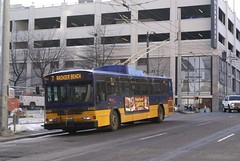
-Second, electrical components will last longer. About 5 years ago Seattle replaced their 25 year old trolley buses. However, they did not replace them with entirely new vehicles. While the bodies on the buses were worn out, the electrical components only needed refurbishing. So their ordered new bus bodies from Gillig (shown in the picture) and refurbished the electrical components thus getting new buses for substantially less than a new bus.
-Third, if a bus route has service of every 15-minutes or less trolley buses save money over diesel. Now that comes out of San Francisco with higher energy cost than Utah and back when diesel was down right cheap, so the cost savings would probably be even higher now. .
Disadvantages
-Buses are limited to routes with wires
-Need to have off-wire capability for emergencies such as road closures and other events that would cause them to have to "leave the wire".
Would Trolley Buses be more attractive to riders than standard diesel buses? They are quieter as noted so they actually could attract more riders but that cannot be quantified.
Instead of spending money on Bus Rapid Transit, putting money into Trolley buses could be an alternative worth looking at especially on the many UTA routes that now run every 15-minutes.
 Image via WikipediaWell, we knew it was only a formality, but the city of Salt Lake City and UTA have signed the agreement to allow construction of the Airport TRAX line. The line will operate from downtown via North Temple to the airport. Sadly the westside's inferiority complex was allowed to make a transportation decision so the line will use 400 West instead of making a direct connection to the Intermodal Hub via 600 West.