Jarrett over at the Human Transit blog talks about Cul-de-sac's and the difficulty in trying to serve these with transit. In his presentation at Railvolution he also showed how hard it is to service points off the main route.
Airports can often be a form of Cul-de-sac's that can be difficult to service with transit. If you look at most of the airports currently served by or to soon be served by rail transit such as Salt Lake City or Denver, you will see a design that is basically a Cul-de-Sac: you have travel to it from one direction but you have to turn around to get out of the complex.
Last week I flew into Portland and took their excellent light rail service from the airport however, Portland is a perfect example of this principal. The Red Line ends at the airport and without a major reconstruction of the airport and/or the line itself, the line can never reach beyond the airport terminal itself.
This is true of many of the cities that currently have rail service to their airports including Philadelphia, Portland, Chicago (O'Hare), the new line to Denver, the future extension of the Washington Metro system to Washington Dulles, Baltimore and St. Louis. The Airport TRAX line in Salt Lake City will also be a dead end line.
There is a couple exceptions to this rule which includes the SeaTac in Seattle and Chicago-Midway (although both currently end at the airport stations there is planned extensions of both routes). However both of these stations are located at the far end of the parking lot and customers face a long walk to the actual airport terminals. I rode to SeaTac yesterday and despite the fact I walk a couple of hours a day, walking with luggage from the Link station to the airport terminal then to the respective gates can be a grueling experience.
The one exception to the above is Ronald Reagan Airport in Washington where the Washington Metro system is able to service the airport terminals and then continue on.
One of the worst example of providing service to an airport is the San Francisco BART line. First have the line to the airport plus a line that serves the vitally important connection to Caltrain at Millbrae. However, neither station has performed to potential due to the way the lines were designed.
As Jarrett pointed out, trains can either serve the airport, then reverse direction and head to Millbrae, or they can split with one train serving Millbrae and another the airport, or you can have option 2 with a shuttle between the two stations. Every time the schedules change at BART they seem to try something new and nothing seems to work.
Airport lines can provide a important multi-model connection to major airports. However, transit systems must also take into consideration if they are serving a cul-de-sac and whether those precious dollars could be better used for a line that can be expand to more areas in the future.
How do you build a better place? It takes effective transportation solutions, good Urban Design, good planning, and the political will to make it happen.
Showing posts with label Seattle. Show all posts
Monday, October 25, 2010
Sunday, October 24, 2010
Portland Day 6 and Day 7 to Seattle
Today was the final day at Railvolution and the my final day in Portland.
There was two workshops today and I attended the one discussing employment centers near TOD and an introduction to complete streets. The first session had some good information from Los Angeles on the concentration of employment on the subway the sea which was followed by a presentation from a Bellevue, Washington planner discussing how that city is planning to develop two station areas beyond the downtown alignment controversy.
The session on complete streets showed what states have passed legislation mandating complete streets (which also points out how little is being done about it). The session also talked about some of the difficulties being experienced getting road engineers on the program because it isn't part of their "little black book".
Finally I went on my final mobile workshop of Railvolution which discussed some successes and difficulties of developing suburban TOD in the Portland area. We had the opportunity to check out several TOD projects and I will be discussing what was talked about on those tours and some of the things that was not talked about.
That finishes up my time at Railvolution and Portland. On Friday I head up to Seattle on Cascade Talgo operated by Amtrak. For anyone who has not had the opportunity to ride the Talgos in service in the northwest I highly recommned it.
Upon arrival in Seattle I had the opportunity to take my first ride on Link light rail but it was only through the downtown tunnel. From there I picked up a rental car since I will be heading to areas with poor transit service during the week and non-existant service on the weekends.
Monday, August 02, 2010
Split Up UTA?
Image by Atomic Taco via Flickr
In my recent comments on contracting out, someone made a comment that the UTA should be split up into different agencies covering the different counties. While I have shown how that could be done in the past, we also must look at the good and the unintended consequences of this type of action.
First of all lets take a look at the good points.
By splitting up the system, the new agencies would be able to respond more quickly to changes in riding habits in their service area.
In addition, you would know that sales tax dollars generated in those counties are being used for those counties.
On the other hand there is the unintended consequences.
First of all how would the system be administered? Would UTA continue to control the money and then distribute it to the individual agencies? If UTA continues to run inter-county services and rail services how would you distribute the funds between the agencies? Will the state legislature and their self interest control the purse strings and send money to their own pet projects?
Second, the major advantage we have with having UTA is that we don't have a bunch of little agencies that protect their own turf and do a poor job and coordinating service with other agencies. The Cap'n Transit blog talked about the lack of coordination in the New York area and we could face the same problems here:
The Black Hole of Transit Coordination
While the problems here in Utah would in now way shape or form be the same as dealing with the super agencies in the New York City region, we would still face the same problems of agencies not coordinating service for what is best for the riders and not themselves.
Los Angeles is a perfect example of the problems of having too many agencies. Almost every city in the county has a transit service of its own, few will actually coordinate service, fares, or transfers with neighboring areas.
While having some community service is fine (such as what I talked about with Salt Lake working on its own in city service), in Los Angeles the service is extremely balkanized between regional carriers making trips across the region more difficult. For example you have light and heavy rail services operated by Metro, commuter rail service operated by Metrolink, if you are traveling to the San Gabriel valley you have service operated by both Metro and Foothill, etc.
All this creates a system that is confusing for riders unfamiliar with the system and lowers the chances that choice riders will ride the system.
Another problem would be facing is bureaucracy. Not only does bureaucracy lead to the turf wars mentioned above but you also may end up having more of it than before. How much staff would each agency have and would you be duplicating functions in the different agencies causing more money to go to overhead than before.
Seattle is another example of this situation. They have the regional agency Sound Transit that runs service in the Puget Sound region. However, each county also has its own bus service who also have their own planning agencies and do their own thing.
While splitting up the UTA may be a solution to some problems with the agency, would it end up opening a can of worms that could make service worse across the region?
Tuesday, October 06, 2009
Seattle, Portland, and Dallas Open new Light Rail Lines
Image by Oran Viriyincy via Flickr
While I have been away over the last couple of months two cities have opened light rail extensions and my favorite city Seattle has finally opened its first light rail line.
Both Portland and Dallas opened new light rail lines last month and ironically their both referred to as the Green Line.
In Portland the new line goes from Clackamas Town Center to downtown and shares right of way with the existing Blue and Red Lines from the Gateway station to the Rose Quarter. From Rose Quarter through downtown the Green Line shares right of way with a rerouted Yellow line along the former bus mall.
For more information check out the Tri-Met website.
Dallas also opened their new green line and more information can be found on the DART website.
Dallas, like Salt Lake City is working on several new light rail lines and extensions that were approved by the voters a few years ago.
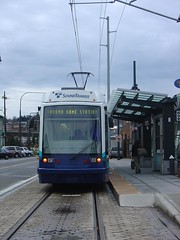
Finally light rail has come to Seattle. Some thought it would never happened but it has finally opened. Ridership has not been what it should be but it will be extended to SEATAC by the end of the year and that should boost ridership. Work is now progressive on the extension to the University of Washington.
For more information check out the Sound Transit website.
Sunday, February 08, 2009
Blog Entries of Note...
Image via Wikipedia
Caltrain Will Boost Bicycle Capacity But It’s Still Not Enough
Caltrain like many other systems including UTA is having issues with the number of bicycles that are trying to use the service.
Columbus and Its Mall: This Marriage Can’t Be Saved
Has our love affair with the malls come to an end and what can be done with these big spaces like the moribund Cottonwood Mall project?
Living a Car-Free Life
Story of a couple from San Francisco living a car free life.
From the California High Speed Rail Blog:
Lindbergh Field HSR Station Plans Emerge
Project to incorporate a new terminal at the San Diego airport that will have direct access to the San Diego light rail system, Amtrak and the high speed rail lines.
From the Xing Columbus Blog:
Cleveland to Build Ohio’s First Bike Station
Nice article about bike stations which we should soon have at Central Station.
From the Transit Miami Blog:
Sprawl is Dead, says Obama
Big talk, but will it lead to any action?
From the Overhead Wire blog:
Sunday Backlog Links
Some great comments about transit in Los Angeles plus other aritcles that you may find interesting.
Three Projects is Waaay Too Many
Apparently the mayor of Charlotte, North Carolina (a city I once lived while working in NASCAR) thinks that working towards three transit projects at once is too much. I guess he would think were positively wacko here in Utah...
Imagine This Story Times Millions
My question is, there is so many property rights advocates coming out of the woodwork especially in Denver because of light rail construction, did these people say anything when people were losing their homes to the interstate highway system?
From Streetsblog LA:
Community Plan for Boyle Heights a Test of Planning’s Promise
Los Angeles City planning has stated it plans to work with neighborhoods to create plans that the citizens want. The new Boyle Heights plan will put that promise to the test.
From Biking in LA: The Pedestrian Free Crosswalk
Pedestrians are banned from a Westwood intersection despite the presence of pedestrian signals. Planning at its finest to improve the life of the automobile.
From Streetsblog:
An Attempt to Create Empathy in Drivers
Will signs make drivers think about pedestrians more?
Streetfilms: A Conversation With Congressman Earl Blumenauer
Interview with the very vocal pro transit and bicycling Earl Blumenauer out of Portland, Oreogn.
From the Sprawled Out Blog:
Kid-friendly senior housing proposed - JSOnline
Most senior developments are designed as being anti-children. However, a growing number of older people are having to raise thier grand children due to various reasons so a development in Milwaukee will be designed for those raising their grandkids.
From the Seattle Transit Blog:
New Zipcar office and city partnership are big steps in company’s effort to expand
Car sharing is being expanded in Seattle but we are still waiting for it in Salt Lake City. Plus it would be nice if it was a locally owned company.
From the RT Rider Blog:
Stimulating transit
Senate approves money for transit projects.
From the Jacksonville Transit Blog:
JACKSONVILLE AND FLORIDA BLOW THE STIMULUS
Florida will not be getting any stimulus money for transit.
Sunday, January 11, 2009
Blog Entries of Note...
Considering Urban Trails
Author talks about urban trails and connecting them up with our growing rail transit system in the Salt Lake Valley. Once the Mid Jordan line is done you will be able to jump off at the Gardner Village station and use the Jordan River Parkway.
From the Daybreak Blog:
Mid Jordan TRAX Now Funded
The Federal Government has come through with funding for the Mid Jordan TRAX line to Daybreak. It is very unusual for a rail project these days to get 80% funding so this is really good news and shows how well UTA does despite what some would have you believe.
From the Stephen Rees blog:
Warning sounded over Olympic bus plan
Looks like some in Vancouver, BC are worried about how well they are going to handle Olympic related traffic problems and there is plenty of comparisons to Salt Lake City.
From the Bike Utah Valley blog:
Winter Riding
Yes you can ride your bike in winter and Bike Utah Valley tells you some of joys of winter riding.
From the Mobilizing The Region Blog:
Success of NYC Rapid Bus Line Underscores Need for Camera Enforcement Law
The New York BRT line is scoring a 10% increase in ridership (small compared to our light rail line in Utah). However, BRT depends on bus only lanes and it takes enforcement to keep the lanes clear. This could also become an issue here in Salt Lake once the transit lanes open along 3500 South.
From the Transit Sleuth Blog:
Transit Exploration
Adron explores the suburbs of Portland and tries to answer the question: is there life out there?
From the Overhead Wire blog:
Where's the Housing Action?
While development in the Charlotte, North Carolina area has slowed, there is one area that is seeing new construction: along the newly opened light rail line from Uptown Charlotte to the south side.
When Chickens and Eggs = Omelettes
I already discussed the report about Foothill when the article came out but here is more talk about the proposal for the reversible lanes.
Greedy DOTs Just Following Orders?
Most of the requested stimulus funds will go to highways not to transit and here may be the reason why.
Restructuring Property Tax to Land Alone
Is it time to change the way property tax is assessed to encourage its use and not parking lots?
From Streetsblog LA:
Measure R Highway Funds Ready to Roll. Transit Funds? Not So Much.
While there are certain people who love to moan in our area, take a look at what is happening in Los Angeles and be glad of the progress being made here. Voter in Los Angeles overwhelmingly approved new transit funding but so far most of it is going to highways and transit is seeing very little. They will still be doing studies in Los Angeles and we will be moving beyond our current projects.
Portland’s Safe Streets: How Do They Do It?
Portland despite its large bicycling communty had no fatalities last year. Can Utah improve its bicycling (and pedestrian) safety record?
From the Seattle Transit Blog:
Embarcadero Freeway = Alaskan Way Viaduct
As the Seattle area continues to decide what the future of the crumbling Alaskan Way Viaduct should be, some look to the City of San Francisco for inspiration. You have to love the before and after pictures from San Francisco.
Sound Transit Stimulus Request
Sound Transit is making a request of lawmakers for its own stimulus package which includes several transit projects.
From the Intermodality Blog:
Streetcars for Houston?
A look at possible streetcar routes for the city of Houston in addition to thier commuter rail and light rail extensions.
Labels:
California,
Charlotte,
Houston,
Los Angeles,
New York,
North Carolina,
Oregon,
Portland,
Salt Lake City,
San Francisco,
Seattle,
Transit,
Transportation,
TRAX,
UTA,
Utah,
Vancouver
Monday, December 29, 2008
Blog Entries of Note...
Citta Slow
How walking, streetcars (trams), and bicycles will play an important roll in the future. We need to change our priorities to build our future.
Economy has builders eyeing a return to rental apartments
Interesting perspective on the rental laws in British Columbia and comparing them to the rather landlord friendly laws here in Utah.
From the Denver Infill Blog comes:
Lessons from Detroit
What lessons can be learned from the problems of Detroit? Detroit is the ultimate example of what happens when the urban core is abandoned in favor of automobile suburbs.
Both sides of my family comes from the Detroit area so I can attest to all the problems that Detroit has and it can be largely contributed to the abandonment of the urban core.
From the Xing Columbus Blog:
LEED-ND
Should a building built in a car dependent area be able to get LEED certification? Currently the answer is yes, but should it be?
From the Trains for America Blog:
Seattle Times: A coming rennaisance for intercity rail?
State politicians talking about HSR, but still directing stimulus towards roads
As I have stated before, I will believe we will have change in the philosophy in transportation when I see it happen. Too often there is more talk and little action.
From the Overhead Wire blog:
Prop 13 Hangover
Prop 13 which cut property taxes to existing homeowners has some unintended consequences which is discussed in those post.
Replay 10.16.07: Vienna's Ringstrasse
Great information about how Vienna's multi-modal transportation network is put together in the downtown area.
From Streetsblog.org:
Who’s Really Footing the Bill for Roads?
From the Seattle Transit Blog:
Colorado Railcar Gone: What is next?
Colorado Railcar who was the only builder of DMU's in the United States that built an FRA compliant self propelled rail vehicle has shut down operations.
Thank God For Walkable Neighborhoods
Especially when you live in Seattle and it gets on of its infrequent snow falls that shut down streets and highways.
From the Light Rail AZ Blog:
A "Grand" Opening, indeed
Yes, another Meca to the automobile has fallen to light rail. Phoenix opened their first light rail line last weekend with an estimated 90,000 people ridding that first day. Now maybe Phoenix can start rebuilding their downtown area and make it more livable.
From the Jacksonville Transit Blog:
PHOENIX GETS IT - FLORIDA DOESN'T
While Phoenix gets its light rail system up and running many cities in Florida are still behind the 8 ball.
From the Intermodality Blog:
A new streetcar era?
Explains the difference between streetcars and light rail.
Labels:
Automobile,
Colorado Railcar,
Columbus,
Detroit,
Florida,
LEEDs,
Passenger Rail,
phoenix,
Proposition 13,
Rail transport,
Rentals,
Seattle,
Streetcars,
TRAM,
Transit,
Transportation,
Vienna
Saturday, November 22, 2008
Ogden Mayor takes a junket
Image by Oran Viriyincy via FlickrOgden's mayor to take European streetcar junketFirst off, why does the mayor of Ogden have to travel to Europe to see a streetcar system? I guess a car trip to Portland, Tacoma, Seattle and down to San Francisco would not be exotic enough for him. Same goes for the wireless technology. The cities in Europe that employ the wireless technology only employ it in short stretches in very historic areas.
Maybe the mayor WILL learn that it takes more than a streetcar to build a vibrant pedestrian, transit, and bicycle friendly area. After all, places like Super Wal-Marts next to your downtown do not make for a pedestrian friendly environment.
Wednesday, November 05, 2008
Ballot Measure Update
Locally Saratoga Springs and Eagle Mountain voted to join UTA and will now have express bus service.
California is closer to building the first true high speed rail line in North America as the citizens of that state voted for the plan.
In addition Los Angeles County voters approved their tax initiative that required 67% approval rating. Clearly people in Los Angeles want transit despite what some people claim.
Also despite the early issues with Sound Transit, the voters approved a meassure in the Puget Sound region to greatly expand their light rail system which is scheduled to open its first segment next year.
Here is a full update:
Light Rail Now! website
Updated 2008/11/05
USA: Quick Summary — Results of 10 Rail Ballot Initiatives in 2008 Election
Light Rail Now Project Team • November 2008
The following is a quick summary of the results of the ten major rail passenger transportation ballot initiatives that we previously highlighted in our article » USA: Ten – Count 'Em – 10 Rail Ballot Initiatives Facing Voters on Nov. 4th «. We'll have more information on several of these ballot measures and their implications in subsequent articles.
Rail New Start Projects
• Honolulu — Rapid rail system referendum — Passed According to the Honolulu Star-Bulletin (Nov. 5th), "Oahu residents voted to approve the City Charter amendment supporting the 20-mile elevated steel-rail transit system from Kapolei to Ala Moana, the single-largest public works project in state history." The measure passed with 52.6 percent of voters approving, 47.4 percent opposing.
• Kansas City — Light rail project, funded by sales tax — Failed This measure lost, with only 44% of voters approving and 56% opposing.
• Sacramento — Streetcar project, funded by sales tax (advisory vote) — Passed According to the Yolo Elections Office (November 4th), City of West Sacramento's Advisory Measure U was approved by 64.4% of voters, opposed by 35.6%.
• Sonoma-Marin Counties, California — SMART regional passenger rail project, funded by sales tax — Passed KCBS Radio News (November 5th) reports that "63 percent of North Bay voters approved a quarter-cent sales tax that would help fund the proposed Sonoma-Marin SMART train, as provided by Measure Q."
• California (statewide) — Intercity highspeed rail project, via bond funding — Passed So far, LRN! hasn't been able to obtain complete results, but NBC Bay Area (Nov. 5th) reports the measure passed by 4 percentage points.
Rail Extension and/or Support Projects
• St. Louis — Ongoing funding and extensions to MetroLink light rail and transit system, new sales tax funding — Failed Proposition M lost, with 52% of voters opposing and 48% supporting the measure.
• Seattle — Extensions to Link light rail system, new sales tax funding — Passed According to the King County Elections, Department of Executive Services, Proposition No. 1 for Mass Transit Expansion was approved by 61.6% of voters, opposed by 38.4%.
• Los Angeles — Extensions to MetroRail rapid rail and light rail system and Metrolink regional passenger rail, via expanded sales tax funding — Passed According to Angelenic (November 5th), "Measure R was drawing 67.4% of the vote with 97% of precincts reporting."
• San Jose — Extension to BART rapid rail system, via expanded sales tax funding — Failed The measure, Measure B, apparently failed to reach the required 2/3 majority by just 0.4 of a percentage point. According to the Gilroy Dispatch (November 5th), "A tantalizing 66.27 percent of county residents voted to enact a one-eighth cent sales tax to lengthen the public railways line, just short of the necessary two-thirds required for passage."
• Albuquerque — Ongoing funding via regional revenue district — Passed According to KOB-TV News (November 5th), "Voters in seven counties approved a gross receipts tax increase to pay for transportation services, including the Rail Runner commuter train from Belen to Santa Fe." Light Rail Now! has not been able to obtain a complete vote tally, but according to the Santa Fe New Mexican (Nov. 4th-5th), votes on the measure in several counties were as follows: Santa Fe County – about 55 percent in favor, 45 percent against; Los Alamos County – about 53 percent in favor,
47 percent against; Rio Arriba County – about 64 percent in favor, 36 percent against; Taos County – about 65 percent in favor, 35 percent against.
A full tally of all transportation ballot measures across the country is available from the Center for Transportation Excellence website:
http://www.cfte.org
As we've previously noted, a listing of articles on Light Rail Now! that address some of the most critical issues involved in America's 2008 nation election – including issues that many public transport advocates believe any new administration in Washington should address – is incorporated in our webpage USA Election Issues 2008.
Friday, September 12, 2008
Blog Entries of Note...
From the Bike Utah Valley Blog:
Bikes on Trains & Buses
Interesting comments about the problems up in Portland with bikes on transit. If you listen to some people you would think that UTA does nothing right, while it is not perfect it is not the evil empire some people make it out to be.
From the Mobilizing the Region Blog:
At National Conference, NJ Cited as Leader on Bike Policy
Utah ranked 11th out of the 50 states which is not too bad although it could be better. We need to be working on multimodal solutions such as the bike route next to the TRAX line in Draper.
From the California High Speed Rail Blog:
Ghettoizing Rail
Once again talks about the importance of integrating rail service to provide a better network of service.
From the Xing Columbus Blog:
Should States Raise the Minimum Driving Age?
Of course parents and students hate this idea and to make matters worse, the poor design of most new schools makes it virtually impossible for anyone to walk to school. I think the major issue here is not the age that drivers get licenses but the fact that there is not alternatives.
I won't even get into the fact that people are allowed to cheat on their Utah drivers tests...
From Transit Miami:
Miami’s Newest Urban Square?
Miami’s Newest Urban Square, Part 2
We already have an advantage over Miami as we have Pioneer Park. Yes it has its issues but it has the potential to be that Urban Square of Salt Lake City. Of course the isolated suburbanites will still fear the park for some time and even after its clean up with still tell stories about the problems but that's their problem.
From the Overhead Wire:
BART thinks about Peak Period Pricing
The Seattle METRO system already charges more in the peak period than in the off peak periods.
Labels:
BART,
California,
California High Speed Rail,
Columbus,
Florida,
Metro,
Miami,
Ohio,
Oregon,
Portland,
Salt Lake City,
Seattle,
TRAX,
UTA,
Utah
Sunday, June 29, 2008
Perils for Pedestrian Video...
Here is another video from the series Perils for Pedestrians.
This video focuses on what is happening in Seattle. While Seattle is known for some of its nice walkable neighborhoods, there is other parts of Seattle that are not very pedestrian friendly and there is discussion on how to change that.
There is some good information on how things developed and what we can do to change them. Once again we are at a disadvantage along the Wasatch Front when you have to deal with so many different planning organizations to get anything done.
Friday, May 02, 2008
Time to consider REAL Trolley Buses?
With fuel prices going through the roof and the UTA having to consider a fuel surcharge due to those prices, is it time for transit systems such as the UTA to look at Trolley Buses again?
Trolley buses have been around almost since the time of the first streetcar, although the became very popular in the 30's and 40's but like streetcars disappeared by the 60's due to cheap diesel prices.
A few cities kept their Trolley buses including Vancouver, British Columbia; Edmonton, Alberta; Seattle, Washington; San Francisco, California; and Dayton, Ohio.
Los Angeles looked into starting new trolley bus routes in 1992 and 1993 but NIMBY's in one corner of the route decided they did not want the trolley buses in their neighborhood due to the wires, despite the fact it would have eliminated diesel exhaust from their neighborhood. Otherwise except for a few extensions of the San Francisco and Seattle systems there has been little thought about the trolley bus.
Besides NIMBYism, the other factor that kept new systems being put in was the initial capital cost and the higher price paid for trolley buses over standard buses.
Lets look at some of the advantages of trolley buses over standard buses:
-First of all they are quiet when compared to standard buses.
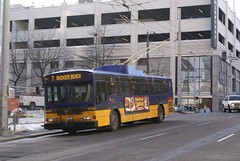
-Second, electrical components will last longer. About 5 years ago Seattle replaced their 25 year old trolley buses. However, they did not replace them with entirely new vehicles. While the bodies on the buses were worn out, the electrical components only needed refurbishing. So their ordered new bus bodies from Gillig (shown in the picture) and refurbished the electrical components thus getting new buses for substantially less than a new bus.
-Third, if a bus route has service of every 15-minutes or less trolley buses save money over diesel. Now that comes out of San Francisco with higher energy cost than Utah and back when diesel was down right cheap, so the cost savings would probably be even higher now. .
Disadvantages
-Buses are limited to routes with wires
-Need to have off-wire capability for emergencies such as road closures and other events that would cause them to have to "leave the wire".
Would Trolley Buses be more attractive to riders than standard diesel buses? They are quieter as noted so they actually could attract more riders but that cannot be quantified.
Instead of spending money on Bus Rapid Transit, putting money into Trolley buses could be an alternative worth looking at especially on the many UTA routes that now run every 15-minutes.
Friday, March 07, 2008
The 3500 South BRT line and Seattle...
OK, what does Seattle have to do with UTA's 3500 South BRT line? Well, the Seattle Transit Blog has done a question and answer session with Metro (their transit system) about what they are calling Rapid Ride.
There is several important points to be taken from this blog:
-First Metro is rightly so saying that BRT is not an alternative to rail, it is being used to provide a faster supplemental service along a busy corridor. It is not being referred to as "just like rail...just cheaper".
-BRT is not being used to replace existing service but is supplementing a busy corridor (got that UTA?)
Here is some of the requirements of the new service:
-High current transit demand and latent transit demand as evidenced by ridership growth, development and travel trends
-Significant local as well as regional trip attractors and generators with all-day, two-way demand characteristics
-While the 3500 corridor does have high current transit demand (although not by Seattle standards), the others are questionable. On the other hand, please tell me what regional trip attractors and generators are present along 3500 South except between TRAX and the West Valley Mall.
I have mentioned before the BRT is going to do little to improve the corridor and most likely just steal riders from local routes. The BRT will not add any new markets and considering UTA is going to kill the regular route 35, there is obviously no need for a supplementary service.
A BRT route from Valley Fair Mall to TRAX to the eastside to the U of U would make more sense. Even better would be a BRT route from Ogden to Salt Lake City. This would not compete against Frontrunner since it would provide much more local service but using the technology would actually made a difference in trip times. After all when you are talking saving a half hour off a two hour schedule, then you are talking some time savings.
Once again this would not be designed to replace the existing 470 but supplement it with faster service. You could actually replace the 455 with this new service and provide local service by reinstating the 471 to all day service. That way you would have faster service along the US89 portion but the 471 would provide local service were it is still needed. This would provide a route that makes sense, can use the faster speeds, create new markets, and actually improve the route network.
The picture is of Eugene's new BRT buses, and yes they do have doors on the left side.
Tuesday, January 01, 2008
Pike Place Market in Salt Lake?
Some people have mentioned that we need a Pike Place market here in Salt Lake City. We already have a farmers market at certain times but do we need something more?
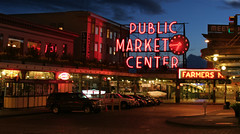
While I love Pike Place Market and a trip to Seattle is not complete without it, the is a Seattle institution and we should not in any way try to duplicate it.
However, that does not say I do not want a place modeled after Pike Place. We can create our own public market place that but with a Utah character.
Look at what makes Pike Place successful: only locally owned businesses are allowed in it and it focuses on what Seattle is know for. There is other small retailers located in the marketplace but it's big focus is on seafood.
We could create a public marketplace that focuses on products grown and made here in Utah. Not only could it focus on the foods of the area but also the arts of the area. They could give local artist that often don't have a chance to make it into the galleries a place to present their wares all year long.
In addition you could have plenty of room for restaurants that would be locally owned and other retailers.
Another thing that makes Pike Place Market a success that it is very accessible, is pedestrian friendly and close to the heart of downtown. Many people venture over to Pike Place on their lunch hours.
If we tried to duplicate Pike Place it would not work because it is unique to Seattle. However, we can create a place that focuses on Utah owned and grown and make a go of it.
Tuesday, October 23, 2007
A Taste of Sound Transit in Seattle...
While on vacation this past week, I had the opportunity to give Sound Transit's bus system a try. While there is local bus service provide by the counties such as Metro in King County and Community Transit in Snonomish County, Sound Transit was created to build light rail, commuter rail, and to provide a regional express bus system.
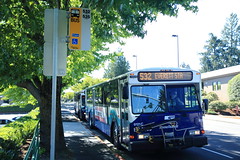
On Wednesday I arrived on Amtrak's Cascade service from Portland. My hotel was the Extended Stay in Bothell which is north of Lake Washington and Seattle. First I headed for the Seattle Bus (and now Light Rail tunnel) which recently reopened after two years of retrofitting. I got on Sound Transit route 550 which was packed even though it was 1:30pm and transferred to route 535 which took me to the Canyon Park Park N' Ride which is a freeway exit but turned out to a very short walk to my motel.
I took the same buses to get back to King Street Station the next day but this time had to walk all the way through the parking lot of the Park N' Ride lot, take an elevator up to a bridge to take me over the freeway to an on ramp with a bus stop next to it.
The 535 Route was assigned Gillig Phantom buses (UTA bought these from 1995-1997) but in a suburban configuration. The 550 on the other hand is assigned Hybrid Articulated buses (basically the same buses used on UTA's 200 Route except hybrid and in a suburban configuration). These buses were bought to be used in the bus tunnel when it reopened to replace the troublesome dual mode diesel/trolley buses that were bought to use in the bus tunnel originally.
The trip was 26 miles involving 1 transfer and took us only 54 minutes.
However, for those that complain about UTA drivers should spend the day with Sound Transit Drivers. I thought Los Angeles had some of the unfriendly drivers but Sound Transit is worse. The drivers are provided by the various county agencies but all four drivers were bad. It is clear Sound Transit needs to work on their drivers.
Otherwise I was very impressed with the system and it got to where I needed to go and it did it quickly, efficiently, and with little hassle.
Labels:
Amtrak,
Bothell,
Cascades,
Community Transit,
Extended Stay America,
King County,
Lake Washington,
Los Angeles,
Seattle,
Snonomish County,
Sound Transit,
UTA,
Utah Transit Authority
Subscribe to:
Posts (Atom)


![Reblog this post [with Zemanta]](http://img.zemanta.com/reblog_e.png?x-id=b46f6448-06ad-43ed-bf29-a5cc27dee5c8)
![Reblog this post [with Zemanta]](http://img.zemanta.com/reblog_e.png?x-id=a1381677-c270-4a6c-b94a-60106694abcf)
![Reblog this post [with Zemanta]](http://img.zemanta.com/reblog_e.png?x-id=a1feaeef-406a-4dd2-aaca-0189bafd2ab8)
![Reblog this post [with Zemanta]](http://img.zemanta.com/reblog_e.png?x-id=d5ff8441-fa7a-4d85-bf7f-1c26dcf0200f)
![Reblog this post [with Zemanta]](http://img.zemanta.com/reblog_e.png?x-id=eecf6ca1-262d-4461-a6f3-a18f1fb6f2bd)
![Reblog this post [with Zemanta]](http://img.zemanta.com/reblog_e.png?x-id=01fb9ea0-1440-4ac8-88e5-aefd832338c2)
![Reblog this post [with Zemanta]](http://img.zemanta.com/reblog_e.png?x-id=4b92329f-9b24-4e3e-ba6a-45be5bdfb814)