Showing posts with label Streetcar. Show all posts

Monday, September 24, 2012

Opening of the new Portland Streetcar Line


Had the opportunity to attend the grand opening of the new Portland CL line this past Saturday. This is the third new rail opening I have attended, the first being the opening of the original TRAX line in 1998, the second was when I was invited on the VIP run of UTA's Front Runner commuter rail service between Ogden and Salt Lake City, and finally the opening of the this new streetcar line.

My first ride on the new line occured before the actual ceremony as I rode the new CL line from 11th and Jefferson to OMSI (Oregon Museum of Science and Industry) which I happen to be a member of.

The MC of the event was the mayor of Portland Sam Adams who will be leaving office at the end of his term in a few months. He took time to blast a attack article in the Oregonian and pointed out there is already investment going on along the streetcar line.

Another speaker during the ceremony was Neil McFarlane who is general manager of TriMet. For anyone who follows transit blogs in the Portland area, they will know that he is often blasted and called some rude names in many circles including on a blog run by a disgruntled former bus driver. 

He actually rode the same streetcar that I did from the Portland State University area and will have to say that I found him to be very approachable and talk to several people on the streetcar. 


There was several other excellent speakers during the ceremony including one of the people responsible for the streetcar itself Michael Powell who happens to own a bookstore of some notoriety that is served by both of the streetcar lines now.


After the ribbon cutting the VIP's boarded the Oregon Iron Works prototype car that was making its inaugural run in revenue service. There has been some complaints about Oregon Iron Works because they are behind in production of the cars by a couple of months but one of the speakers noted that the previous cars were 8 months behind in arrived so Oregon Iron Works is actually doing pretty good. 


I rode the next streetcar to the Lloyd District and took these pictures of that streetcar returning to OMSI. The area I took this picture is pretty desolate because the area is surrounded strictly by high rise non-mixed use office buildings that are ghost towns on weekends. You may also notice in the picture above that to the right there is a Honda Accord parked in the bike line which is supposed to be the lane on the right with parking to the left of the bike lane. 


After grabbing a bite to eat I made a point to catch this streetcar on its next trip back to downtown. The car had a minor problem with its wheelchair ramp that was quickly taken care of and the we had a good trip back to 10th and Clay where I got off.

The line is currently U-shaped but in less than three years will become a true loop when the new bridge over the Willamette River is completed by TriMet and the streetcar will use it along with TriMet light rail trains.

It will be interesting to see how this line performs over the long haul. Right now frequencies are not what is needed and the area is no Pearl district however that may actually be a good thing. Do we really need lots of new high rises that bring the suburbs to the urban center, or should we see development that is more human scale? There is plenty of potential along the new line and time we tell what will be made of it.
Enhanced by Zemanta

Friday, January 20, 2012

Six months riding Trimet and Counting...

It has been about six months since I moved to Portland, about 3 months since I updated you on my travels on the Trimet System. Last time my travel was pretty straight forward: Take the 54 and 57 to work, then ride MAX, WES and 78 to PCC Sylvania and back home on the 44 or I would ride MAX, the 6, and 44 to PCC. After Christmas, my life completely changed and I am always riding the 44 to PCC and back but my work schedule has me traveling a lot more which you can see from the number of buses I have rode down below.


Here is a rundown of the rail vehicles I have traveled on:

Manufacturer Information:    # In Fleet      #Ridden       Most Ridden and Notes

1986 Bombardier                    26                 23             107 and 116 (7 Times Each)
*The three I have not ridden 106, 119, and 126 I have never seen them either so not sure if they are still in service, being repainted since many of these cars are getting new paint schemes or just missing them.
1997 Siemens SD660              52                 50              245 (4 Times)
2003 Siemens SD660              27                 All 27         303, 308, 309, 314, 325 (5 Times)
2009 Siemens S70                   22                 20              410 (3 Times)
Streetcars                               10                 All 10          7 (4 Times)
Colorado Railcar Power DMU   3                  All 3            1001 (21 Times)
Colorado Railcar Trailer            1                  1                  Once
Ex-Alaska RDC's                     2                  2                 Once Each                                          


Now for the bus fleet:

Year:    Manufacturer/Model    # in Fleet    #Ridden       Most Ridden and other notes:

1990    Gillig Phantom 40'             63?           18            1420, 1422, 1430, 1458, 1459 (Twice)
*Not sure how many of these are actually still running.
1990    Gillig Phantom 30'             43             12            1609 Twice
1992    Flxible Metro 40'              107           47             1738 (4 Times)
1994    Flxible Metro 40'              26             17             1821 (4 Times)
1992    Flxible Metro 30'              10             9               Each one only once
1997    New Flyer D40LF            22             7               2016 Twice
1997    Gillig Phantom 40'             65             50             2139 (5 Times)
*These are buses normally assigned to the 44 Monday-Friday so its no surprise that I ridden them so many times.
1998    New Flyer D40LF            118           33             2202, 2206, 2210, 2246 (Twice)
2000    New Flyer D40LF            60             16             2518, 2526, 2560 (Twice)
2002    New Flyer H40LF            2               0            
2002    New Flyer D40LF            55             38             2632 (Three Times)
2003    New Flyer D40LF            25             16              2715 and 2719 (Twice)
2005    New Flyer D40LF            39             16              2807, 2825, 2834 (Twice)
2009    New Flyer D40LFR          40             All 40        2908 (6 Times)
*Since these are the regular buses assigned to the 54 and 57 and sometimes the 78, its no wonder I was able to ride all them over a six month period.
 

Although I have a very love/hate relationship with low floor buses:: easier to get on and off, faster wheelchair loading, however they loose capacity, are not the comfortable to ride in, and are not that well put together, I will have to say that the D40LFR's from 2009 do seem to making some headway quality wise.


While Trimet may be a bus fans paradise with the large number of Flexible Metro's still around, Trimet  does have an aging fleet and with Flxible having been out of business for almost 17 years now, I imagine that some parts are now becoming difficult to get. Trimet does have 55 diesel buses on order along with 4 hybrids which are coming from Gillig.

While Trimet has many haters out there including many of its own bus drivers, as a passenger I have to say for the most part Trimet has done an excellent job. Only once has there been a bus break down that affected me and that was when I was still riding the 54 westbound and one of them broke down leaving the garage. However, Trimet while the 54 is run out of the Merlo garage on the westside, they pulled a bus out of the Central Garage on the near east side and the bus was only running a few minutes late.

The only other incident actually worked to my benefit. One of the 1992 Flxible 30' Metros was overheating and it caused the bus to run about 10 minutes late which meant I did not have to way 20 minutes for the next bus to arrive.


Drivers on the other hand are a mix bag. Trimet does have some excellent drivers. I have sent in commendations to Trimet on two of its drivers. The first one was a driver on the 54 who is now working the 67. This person has a wonderful personality, knows how to treat customers, and was always a pleasure to ride with. Sadly the replacement on the 54 has not lived up to him.

The other driver I sent in a commendation for was on the 44. This person is extremely friendly with a wise cracking personality that works perfectly for the clientele on the 44. I rode with him a few times when I needed to make trips to downtown before heading to PCC from Beaverton.

There is only one driver I have come close to filing a complaint about. This person shows a lack of personality when you board the bus and this person gives you a look like the driver would rather cut your throat than have you on the bus. This person never says a word, just gives you the dirty look. If a customer asks this person a question the customer is luck if they get a grunt.

I always try to wish the driver a good day, afternoon, etc. when I get off the bus if the bus is not extremely crowded. One time when getting of the bus I gave this driver the standard good day and I actually got a response of the driver!! The driver say "whatever." I guess its better than a something else the person could have said.

I have ridden with this person on a couple of routes so the person must be extra board. Clearly this is someone who needs to find a job where they do not have to deal with the public.


On Tuesday, I had my first encounter of adverse weather conditions on Trimet. Once again Trimet did what it was supposed to do and provided the best possible service under less than ideal conditions. Below is a picture of my 44 to PCC Sylvania on that day.

In fact the bus had to get around several cars that got stuck along Capital Hwy. and SW 49th. The driver did a great job and we arrived at our destination in good time.


In interesting note is that this was my first time every riding a transit bus with chains. The Utah Transit Authority I believe uses chains on its ski buses when conditions are bad but since I am not a skier, I never rode the buses to the ski conditions.

Another interesting note is the bus pictured above is equipped with automatic chains that engage with the flip of a toggle switch. The driver said these buses are the only ones equipped with them. I wonder if these were an add on order from another transit agency (add on orders is when a transit agency adds a bus order to another agencies order to get a better price on buses).


After six months of regularly Trimet, I can say that Trimet does what it is supposed to. Provide the best possible service to the most riders possible with the budget given them. I encounter many people in my travels that want to whine about one thing or another when it comes to Trimet, but overall service does the job it is supposed to.

Is Trimet a perfect agency? Of course not, there is issues that need to be fixed but it does its job well.


Enhanced by Zemanta

Friday, November 05, 2010

Boosting Bus Service with Streetcar

The prototype streetcar (tram) built by United...Image via Wikipedia
Whenever a new light rail system opens, we often see bus routes being modified to service the light rail stations. While some complain about the loss of a one seat ride, others complain that preferential treatment is given to light rail.

Meanwhile Portland will soon be in a different situation as its streetcar system continues to expand.

The starter Portland Streetcar which has become famous for many reasons does not duplicate any existing bus service except for the northwest section where the existing 77 travels along a portion of the streetcar line.

However, as the streetcar system expands as it is doing right now, it will soon start to duplicate existing transit lines. The new eastside loop will follow a portion of Tri-Met's existing route 6 which itself was modified from parts of old route 5 with the opening of the Yellow Line several years ago. Whatever Tri-Met decides to do with route 6 when the streetcar line opens in 2012, it would not have a dramatic effect on transit service in that area. My observations from riding the 6 line while at Railvolution is that most of the ridership tends to be from the Convention Center north (although my observations where limited so if someone from Portland wants to correct me on that...).

What will have the ability to dramatically change transit service in the region is the next set of route proposals for the street. Specifically one of the top candidates to get another streetcar line is Sandy Blvd and Burnside which currently hosts one of Tri-Mets longest if not the longest line Route 12.

Not only is the 12 route a very long bus route it is also a very busy route specially in its spine territory from Parkrose/Sumner Transit Station to Tigard. While many buses shortline in King City and Parkrose/Sumner, a bus traveling the full route from Gresham to Sherwood takes more than two hours to complete the journey.

However once the Sandy/Burnside trolley line is built there will be new opportunities to change the 12 for the better doing the opposite of what is normally done when a new light rail line opens.

If this was a light rail line opening the natural inclination would be terminate buses at the end of the line in the Hollywood section of Portland and in downtown for buses coming from the Sherwood area. The main reason for this is if you continue running the bus route that parallels the light rail line the light rail line doesn't perform up to its potential and the bus becomes a major drain on resources with little ridership.

Instead of terminating the 12 at the end points, you can instead have the 12 become a limited stop route along the portion that will duplicate the streetcar line. As I have already said the 12 is a very, very long route. While it currently takes only 20 minutes to get from 42nd street to downtown currently by making the 12 a limited you can shave off about 5 to 7 minutes by making the 12 a limited. One good place to drop the number of stops is on Burnside where there is currently multiple bus stops within a few lock area.

Also to improve the route even more Tri-Met should look at making the 12 a limited all the way through downtown and down Barbur to Beaverton-Hillsdale Road since that portion of the route is also has the 44, 54 and the 56 in the corridor. With these improvements you could shave off 10 minutes off the route.

While 10 minutes is not anything earth shattering in speed increase, you would be saving 20 minutes over a round trip which could save you bus or two on the route. Those hours could either be used to increase service on the 12 or provide additional service on other routes that could use additional service.

As the Portland Streetcar expands to new markets in the future, it will create new opportunities to make the existing bus service more efficient. This will create new marketing opportunities as streetcars provide the close to downtown urban service and buses providing faster regional service in areas that do not have light rail service.
Enhanced by Zemanta

Tuesday, July 06, 2010

Is the Streetcar the only hope for Downtown Bountiful?

The Portland Streetcar in front of Powell's Books.Image via Wikipedia


Recently I had the opportunity to take a walking tour of the downtown Bountiful area. As many of you know the Downtown Bountiful Business Association is opposing the proposal to bring the streetcar through the area. However, after looking at the current status of the downtown area, the association should be supporting this proposal as it may be the best hope of downtown bountiful surviving in the long term.

The first problem I see with downtown Bountiful is there is not much to attract people to the area. The only restaurant in the immediate area has closed so you have to walk to the extreme end of the downtown area to find a place to eat. In addition a shopping area needs a large variety of stores to keep the area vibrant. However, that is sourly lacking in the downtown Bountiful area.

Of course the city of Bountiful is not helping the downtown area. They used government money to put in a Costco obviously like many city councils lusting after the sales tax dollars. Sadly what city councils turn a blind eye to is that healthy small business bring in more sales tax dollars per square foot than a big box retailer.

While I am sure the city council sold the concept that Costco would bring in additional shoppers to the area, the truth is a Costco and stores like it do nothing for the immediate area businesses. A Costco is a destination store so that people go into the store, shop at it and then head home so they bring no money to the surrounding area.

So is the streetcar the magic that will save downtown Bountiful?

The answer to that question is no. However, what the streetcar does is bring new people into the area that would not otherwise travel to downtown Bountiful. It will create new business opportunities for those that take advantage of them.

To bring true success with the streetcar would probably take something that residents of the area would not be willing to do and that is to increase density and bring some infill development into the sea of parking lots that presently litters the area.

While downtown Bountiful has lasted longer than many downtown areas, its life its slowly being sucked away between their own city council and the Centerville city council slowly subsidizing their business away.
Enhanced by Zemanta

Tuesday, May 18, 2010

More on the Davis Transit Plan

Bike parking and streetcar coexistImage by Steven Vance via Flickr


Opposition reroutes UTA's corridor plan


While most of the media attention on this line has focused on the people up in Centerville, it looks as though there is also opposition down in Bountiful which would really benefit from this line, especially the small business owners.

Sadly the people that are forming the opposition seem to be confusing what exactly UTA is proposing here. Of course part of the problem is that there is only two modern streetcar systems in the United States so far, so many of them have not been exposed to what is being proposed.

In the article Cecilee Price-Huish calls the system light rail which is not being proposed here. I can understand her fear picturing the construction that takes place when a true light rail system is being built since that is the experience Utah has. However, while any construction is going to be disruptive for the construction period, construction for the Portland Streetcar in now way disrupted the area like its MAX light rail service.

In fact once construction has been completed, the local stores in the community would greatly benefit from the presence of a streetcar especially if marketed properly.

Having been a small business owner, and having a mother that was a retail business owner, I know the struggles that they go through. Having to compete with "government enhanced" competitors such as Wal-Mart, Costco, Cabela's, IKEA and so on, it is hard to compete. In addition like most of the United States, many small business owners carry too much debt and do not have an emergency fund to deal with construction plans.

However, having heads in the sand is not a solution to these problems. A trip to Portland to see the success that is along the streetcar system may open some eyes.

Of course this puts UTA between a rock and hard place. If they paid for people to travel to Portland to see the streetcar success they would get bashed for it, but of course none of these people will actually go check things out for themselves and if they did they would take their tunnel vision with them and not see the true success of the system.

Bountiful has an outstanding walkable downtown area, a streetcar would enhance the experience by creating the freedom of a new option to access the area.

Reblog this post [with Zemanta]

Thursday, March 04, 2010

Another Attack of the NIMBY's

Luas TramImage via Wikipedia


To no one's surprise, the NIMBY's are coming out of the wood work at the public hearings about the proposed Davis County Streetcar. They are claiming that their children will be put into danger because of the presence of the streetcar on Main Street in Centerville.

Now lets remember that these are the same people who fought so hard for the Legacy Highway but we must also remember that they Legacy Highway was not in THEIR neighborhood.

Some of their complaints remind me of some of the BS that was spouted before TRAX opened up. I remember that their was one business on State Street by the Midvale TRAX station that put up a sign saying light rail kills children. While I am big supporter of small businesses clearly this person was ignorant.

Its amazing that these are some of the same people who also tell everyone that they should take personal responsibility. Apparently personal responsibility doesn't apply to something that you are against. After all, I don't recall a TRAX train ever, ever, ever running off the tracks to run down someone in cold blood. Am I wrong? Maybe if Steven King made a movie about it but not in reality.

What is even more ironic is that the streetcar will be traveling down a major street that is also a state highway. Traffic speeds by in the neighborhood over the speed limit with many drivers not paying attention to anything but their cell phone.


Reblog this post [with Zemanta]

Friday, May 29, 2009

News On Sugar House Trolley

The Portland Streetcar at the Portland State U...Image via Wikipedia


Sugar House streetcar? It may be closer to reality than you think

Its just to bad that the center of Sugar House nothing but a big empty hole right now but maybe something will happen before the trolley is running.
Reblog this post [with Zemanta]

Sunday, January 04, 2009

Blog Postings from this week...

Phoenix Light Rail Grand Opening CelebrationImage by phxwebguy via FlickrFrom the California High Speed Rail Blog:

No Policy Change in the Stimulus?

Once again Obama seems to talk a lot about roads but never mentions transit. Maybe the change President is not going to be one.

Shake, Rattle & Roll

Talks about what will happen when a earthquake hits the high speed rail line. Also good information about the destruction to all transportation infrastructure which is something we need to keep in mind when our "big one" hits.

From The Overhead Wire:

Likely Unlikely Ally

It is nice to see the steel industry is supporting the call for new rail. While some may say that is natural because rails are made of steel, just consider the amount of steel that goes into the foundations of highways.

From the Light Rail AZ Blog:

Metro light rail - Growing pains in early days

The Phoenix light rail system seems to be doing pretty good despite the usual teething problems that you find on any new system.

From the Jacksonville Transit Blog:

THE DEVIL WENT DOWN TO FLORIDA

Apparently the mayor of Jacksonville wants to steal money appropriated by the VOTERS for transit and spend it instead on highways.

From the Intermodality Blog: .

Rapid streetcar

Rapid Streetcar is slotted between regular streetcars and full blown light rail. Instead of BRT, rapid streetcar makes much more sense as shown in the article.

From the Cap'n Transit Blog:

Don't Give Rail Infrastructure to Buses

Some common sense from the other side of the country.


Reblog this post [with Zemanta]

Sunday, August 24, 2008

Articles from the week...

This file is licensed under the Creative ...Image via Wikipedia From the Mobilizing the Region Blog out of the New York area comes this:

Highway Removal Olympics: Who Will Win the Gold?

San Francisco became famous for becoming the first area to remove a freeway after the 1989 Earthquake did serious damage to the largely completely freeway along the Embarcadero. Instead of a stub freeway they now have a beautiful pedestrian friendly boulevard with streetcar service.

Sadly, here in Utah we went the old direction with the rebuild of I-15 so we lost all the potential that could have been done with putting the freeway in a ditch and then a cap on top of it.

From Light Rail Transit Online comes:

TOD vs."TAD"

This has some good information about TOD developments. We are starting to see some developments coming on line and will see more in the future. I have noticed that more advertisements for housing stating that they are close to a TRAX line.

From the Denver Infill Blog:

The Denver Union Station Story

A great story about the history and future of Denver Union Station. While Salt Lake City let Boyer have their way with the Union Pacific Station, Denver is working to rebuild their magnificent Union Station. While it will not be a perfect situation (the light rail tracks will be about a block away from the completed station), it shows the what can be done.

That article was referred from the Denver Transit Stop Blog which has this story:

Sprawling From Grace

This talks about a video that is going to be shown at the Democratic National Convention in Denver this week. What I found interesting is the part of the video that talks about preventing gentrification and keeping character and diversity in a neighborhood.

From the Transit Sleuth comes this entry:

Last Night Wondering

Adron talks about his day doing things in Portland after work including how transit played a pivotal role in his activities. What this really points out is how Portland has become a city in which you can leave the car at home and hopefully Salt Lake will be there soon.

From Transit Miami comes:

UM: Wising Up To Transit

Apparently freshman are welcome at the University of Miami but their cars are not. The university is located on a Metrorail line and like the U Of U has their own shuttle service around the campus. When I was attending Railvolution last November I made a trip over to Coral Gables which included transferring from MetroRail to a bus to head over the Biltmore Hotel to take some pictures. In the 10 minutes I waited for the Metro Bus I counted at least six U of M shuttle vans stopping at the transit center on their trips around the campus.

From Streetsblog comes this:

The Parking Cure, Step 1: Diagnose the Problem

Previously I talked about how new school guide lines have made new schools walking unfriendly over the course of the last several years in this entry: Schools and Sprawl.

This situation in New York is very similar in that regulations have been enacted over the years that are pedestrian and transit unfriendly and need to be changed.

From the Seattle Transit Blog comes:

News Stands

Could news stands at certain TRAX stations help the newspaper and magazine businesses? They seem to work well in some of the major cities (obviously Seattle is not one of the them...yet), but what about Salt Lake City? Can't use the weather argument because cities with worse weather than us have them.

From the RT Rider comes this information from Sacramento:

RT's worst-case scenario at a glance

RT's current $2.00 fare may go up to $2.25 and severe bus cuts may be necessary. Once again Sacramento like most California systems are dependent on funding from the state and the Govenator is busing trying to transfer funds from transit to highways so they transfer that to other programs.

From Portland Transport:

Streetcar Loop Moves Forward, Your Input Needed on Future Routes

Portland is looking to extend its streetcar line across the Willamette River to the east side of Portland. Portland has been dealing with the federal governments bias toward buses over rail for in trying to get the streetcar off the ground.

From Cap' Transit Rides Again comes:

Cities are Born in Moments of Transition

Interesting perspective on why downtown areas died including highway bypasses.

Reblog this post [with Zemanta]

Sunday, August 17, 2008

Opinions from the Daily Herald...

(un)MassTransitImage by Theorris via Flickr IN OUR VIEW: Keep good news coming, UTA

Opinion from today's Daily Herald.

The Daily Herald makes a very good point. Right now Front Runner commuter rail is under construction from Salt Lake City to Provo. This will provide Utah County's first rail service and will be a big change for the area. In the past many people asked why you would need TRAX service when you have commuter rail.

Now that Front Runner is up and running people can start telling the difference between the two. Commuter rail is excellent for longer trips between longer distances. Light Rail on the other is excellent in providing service between shorter distances.

That would leave only one tier in the hierarchy of transit service missing and that is streetcar. The hierarchy being bus service--->Streetcar--->Light Rail--->Commuter Rail. Each one in the hierarchy has its place and provides a different level of service. Each provides a different level of service but when designed properly provide a regional network of effective transit solutions.


Reblog this post [with Zemanta]

Monday, June 23, 2008

BRT Scheme in Provo/Orem moves forward...

Metro system map including future extensions and expansions.Image via WikipediaHere is the latest article on the BRT project in Orem/Provo area.

Parkway may get rapid bus line

According to the article the current 830 line attracts 3000 riders per day but the BRT is supposed to carry 13,000 to 15,000 riders. I just don't see that happening.

Anyone who rides the 830 route will know that most of the riders are heading to local stops along the way especially 700 East and 1230 North, and 550 West. There is also a large amount of travel from BYU to the Mt. Timp Transit Center.

Unfortunately current policy at the Federal Transit Administration supports high ridership numbers for BRT and low ridership numbers for light rail which always makes BRT look better.

My worry is that the BRT will not meet ridership potential and that will give cause for all the anti-transit types in the Orem/Provo are to say "see, you got BRT and it failed so you don't need no light rail". If you look at the Busways in Los Angeles and Pittsburgh you will find that they are carrying below to substantially below what they were projected. The Harbor Freeway Bus way in Los Angeles is lucky to get 5,000 riders while a few miles away sits the Blue Line that carries 78,000 passengers per day.

Another problem I see with the proposal is the idea of running buses every 5 minutes. Once you get buses running that frequently you start getting problems with buses bunching together and schedule problems.

Further you have long term capacity restrictions with BRT. The much touted Orange Line in Los Angeles has hit capacity at 20,000. Metro cannot add more buses and unlike rail you cannot simply add another car to the consist.

What will help this line is Front Runner South allowing people to transfer to and from Front Runner to head for such destinations as UVSU and BYU.

Of course little progress can be expected out of the Utah Valley area so long as their planning is through MAG which is a rural based organization. The needs of Utah County are very different from the needs of the rest of the MAG area but so long as those rural interest have the say, good planning will be stymied.


Zemanta Pixie

Tuesday, May 27, 2008

Outdated Technology?

January 29 - Karl Benz patent.Image via WikipediaYou know that old tired argument that certain people who shall remain nameless because they should always use about rail transit being outdated because it is 19th Century technology?

Since there have been so many serious postings lately, I thought it was time to lighten up the mood and here is some great information to the people that use that outdated technology bogus argument.

OK, so when was the first electric rail transit line started? 1891

Your right man that is old technology lets throw it our right? Here is some more really old technology that maybe should be thrown out:

1885: The first automobile patented that used Karl Benz's Otto Gasoline Engine. That's right folks the automobiles are older technology than electric streetcars!! (Picture is of Karl Benz's auto)

1879: Karl Benz patents the two stroke engine.

1823: First internal combustion engine is patented.

1806: First automobile propelled by Hydrogen and Oxygen

Around 1769: The first horseless carriage is developed. That's right the automobile dates back all the way to the 18th Century!!

So there it is folks. The next time you hear someone throws that old tired argument that streetcars are outdated technology, you can ask them if automobiles should be thrown out too because they are OLDER technology.

Thursday, April 24, 2008

Streetcar Possiblities...


Tacoma 010
Originally uploaded by evil robot 6
Last week I went over some possible TRAX expansions to happen after the 2015 program is finished. Now here some possibilities for streetcar routes.

I have already gone over the two ideas for eastside streetcar lines starting with the Sugarhouse line as a building block. But here are some more possible routes.

Replace Route 217:

This would give Redwood Road a Streetcar plus connect two TRAX lines. Not only is this already a busy bus line but there is so many opportunities to bring good developments along the north side of the route. Plus, the streetcar can run along the TRAX line from downtown giving a full replacement to the 217.

3500 South:

Basically replacing the 35, Yeah I know that BRT scheme is going in this summer with those Lemon Van Hool buses but this would run a streetcar from the West Valley City transit center to Magna with the 33 running all the way to Valley Fair Mall. In addition you could also run a short extension to SLCC and hook up with the Redwood Road line.

Replace Route 603:

Run from the Ogden Transit Center to the Weber State University and the McKay Dee Hospital. This is already been discussed and makes sense. It would greatly benefit 25th Street in Ogden providing new opportunities along that street plus offer a great connection to FrontRunner.

Orem/Provo:

As you can probably guess already, this would run instead of the BRT line from the Oren FrontRunner Station to Towne Place Mall. Once TRAX is extended to Provo the streetcar could share the TRAX tracks in Orem with TRAX heading directly south to the Mall while the streetcar serves the Wilkinson Center and the communities south of the University.

5600 West:

Once again run a regular bus line for now instead of BRT, then run a streetcar along with route instead of a light rail line.

I hope this gets some ideas flowing as we build a truly world class transit system here in Utah.

Monday, March 17, 2008

5600 West Corridor


Rapid Bus
Originally uploaded by skew-t
Developers discovering late-blooming 5600 West area

Here is an article from today's Salt Lake Tribune about development of 5600 West. Having worked at 2100 South and 5600 West from 1998 to 2000, I can attest to the changes that have taken place along the 5600 West Corridor.

However, part of the article details UTA's plans for the corridor and once again they just do not make sense.

First they propose putting in a BRT line. Next they plan to convert the line to full Light Rail configuration within the next 25 years.

This is a case of over engineering a solution to the problem. First of all there isn't even any transit service in this corridor except for a couple of "fast buses" during the peak hours and the 47 connection between 4700 South and 4100 South.

Considering the questionable success of current BRT projects, a much better solution would be to just implement a regular bus route for now from the airport to connect up with South Jordan TRAX line once it opens. This would service a larger market than a BRT line in the corridor.

Then instead of upgrading the BRT route to a full light rail service which would be overkill in the corridor, go back to the original plan and implement a streetcar or a semi-rapid streetcar.

The line could start at Daybreak on the TRAX line, travel with the South Jordan TRAX line where it would connect up with the former Rio Grande/ Union Pacific branch line to Magna. It could travel next to the branch line all the way to 5600 West when it would enter 5600 West travel through the airport Industrial park then hook up with the Airport TRAX line to the airport terminal.

This would allow a relatively fast trip connecting two important TRAX lines. In addition it would cost less to build than a full blown TRAX line which is not needed in this corridor.

Sunday, February 24, 2008

Rapid Streetcar for Davis County?


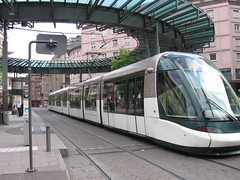
Strasbourg Tram
Originally uploaded by Jasperdo
Light rail preferred option in S. Davis

In today's Deseret News there is an article about transit options in Davis county and it looks like the preferred option is going to be a rapid streetcar which is not as expensive as light rail but faster and longer than the streetcar lines I have talked about for the Salt Lake area.

This idea makes good sense for the area. There is not a lot of room to build out a full blown TRAX line in the region, the line will already have commuter rail for longer trips so that leaves the rapid streetcar. This system will greatly increase the number of transit riders.

The picture is of a tram in Strasbourg. The line goes through the downtown area and goes through this central downtown plaza that has no auto traffic then connects a block with other streetcar lines.

Saturday, February 23, 2008

Developers propose freeway deal

Mountain View Corridor speeding up

Developers are donating land to cover the construction of the Mountainview Corridor. Notice that the land only includes the section from 9000 South to Redwood Road which is actually going to be one of the less expensive segments to purchase.

Also they mention the proposed transit line but like several of the streetcar proposals has been downgraded from rail transit to bus service.

Sunday, January 27, 2008

Article on Utah County Transit Options

Utah Valley Residents Weigh in on Transit Plans

Brandon Plewe is wrong that Utah County cannot support light rail. The area is developing rapidly and once the transit line was in place it would quickly start attracting development near it.

While Utah County is already getting a commuter rail line, a light rail line as an extension of the existing North-South line will attract different riders than the commuter rail as it has a different marketing matrix.

Plewe is right that the way University is currently designed it does not promote the use of transit. But you don't say it won't work but redesign the street to make it more pedestrian friendly. A perfect example of this would be to put in pedestrian escape zones in the center divider so people don't have to cross all the way. That is called installing effective pedestrian design. Once again our roads are designed by road builders and think about pedestrians as an after thought and this needs to change.