How do you build a better place? It takes effective transportation solutions, good Urban Design, good planning, and the political will to make it happen.
Showing posts with label Transit Systems. Show all posts
Showing posts with label Transit Systems. Show all posts
Image via Wikipedia This is a guest post by All Resort Transportation a privately run transportation company based in Utah.
Will The Utah Transit System Stand Up To a Disaster?
I began this post planning to write about the current situation with public transit in Utah, and then the earthquake struck in Japan and suddenly any of our problems in this state seemed absurdly miniscule by comparison. When the 8.9 (or 9.0, depending on your source) earthquake struck and caused the tsunami, it killed thousands and uprooted hundreds of thousands, destroying homes, roads, and anything else that was in its way.
The earthquake was felt as far away as Tokyo, which is some 150 miles or south of the epicenter. Despite the distance, the shaking was bad enough that the city shut down the transit system until they could be sure that it was structurally safe to use. Cities like Tokyo rely on their public transit systems, and when it was shut down for safety reasons, literally millions of people were stranded in the city with no way to get home or communicate with loved ones.
The Ramifications of the Shut Down
The commuter lifestyle is a little different in Japan than it is in Utah (not a big surprise there). Sometimes people will commute for hours in one direction to get to work, and some estimates say that more than 10 million people use the public transit system every day. Shutting any of these services down for even a short time would have serious ramifications, and after the earthquake millions of residents were stuck without an option.
Officials shut down the trains and subways because they needed to ensure that everything was still safe. Some lines were down for around six hours and others for much longer. Hotels were immediately flooded with people looking for a place to stay, and the government began opening schools and official buildings where people could seek shelter and sleep when it got too cold outside. We saw a lot of pictures of people curled up on the floor in the train stations and others standing in line to use a pay phone since the cell networks were immediately overloaded.
After a day, most of the transit infrastructure in Tokyo was up and running again, but it was still a little sporadic. Because of the power issues caused by the loss of the nuclear plants up north, Tokyo is planning on rolling blackouts to help conserve energy. This is leading to a slightly more erratic train schedule, but commuters seem to be dealing with it as well as could be expected.
How Would Utah Do?
Obviously, in Utah we don’t have near that many people relying on the public transit system. According to UTA, TRAX is averaging about 58,000 riders a day, though the number is increasing. Public transportation is growing all over the country, and we’ve had a big push to expand our system here. Utah transportation will probably never be as complex as it is in huge places like Tokyo, but the rising population and rising gas prices are building more and more reliance on new transit options.
Right now, Utah is developing its public transit system on a number of fronts. Currently, the FrontLines 2015 Project includes:
• Mid Jordan TRAX Line – Covering Murray, Midvale, West and South Jordan
• West Valley City TRAX Line – Running between South Salt lake and West Valley City
• Draper TRAX Line – A light rail service that runs through Draper and Sandy
• Airport TRAX Line – Get from downtown SLC to the airport
• FrontRunner Provo to Salt Lake City Line – A high speed commuter rail between these cities
On top of these projects, transit studies are currently going on in Surgarhouse, South Davis, Taylorsville, Murray, and Ogden. While it’s hard to imagine public transportation becoming as ingrained in our culture as it is in Japan, all these new developments will certainly increase the number of people who rely on everything from train lines to a Salt Lake airport shuttle. Then we have to ask: how well would we do in a disaster? Are we prepared to deal with that kind of challenge?
The tragedy in Japan is on a scale that most of us can’t really comprehend, and the impact of it was felt all over the country in many unexpected ways. The transit system may seem like a comparatively small thing, but Tokyo’s infrastructure was able to bounce back because they constructed their system to deal with natural disasters. If Utah is going to succeed with its transit initiatives, there are some definite lessons it could learn.
In my recent comments on contracting out, someone made a comment that the UTA should be split up into different agencies covering the different counties. While I have shown how that could be done in the past, we also must look at the good and the unintended consequences of this type of action.
First of all lets take a look at the good points.
By splitting up the system, the new agencies would be able to respond more quickly to changes in riding habits in their service area.
In addition, you would know that sales tax dollars generated in those counties are being used for those counties.
On the other hand there is the unintended consequences.
First of all how would the system be administered? Would UTA continue to control the money and then distribute it to the individual agencies? If UTA continues to run inter-county services and rail services how would you distribute the funds between the agencies? Will the state legislature and their self interest control the purse strings and send money to their own pet projects?
Second, the major advantage we have with having UTA is that we don't have a bunch of little agencies that protect their own turf and do a poor job and coordinating service with other agencies. The Cap'n Transit blog talked about the lack of coordination in the New York area and we could face the same problems here:
While the problems here in Utah would in now way shape or form be the same as dealing with the super agencies in the New York City region, we would still face the same problems of agencies not coordinating service for what is best for the riders and not themselves.
Los Angeles is a perfect example of the problems of having too many agencies. Almost every city in the county has a transit service of its own, few will actually coordinate service, fares, or transfers with neighboring areas.
While having some community service is fine (such as what I talked about with Salt Lake working on its own in city service), in Los Angeles the service is extremely balkanized between regional carriers making trips across the region more difficult. For example you have light and heavy rail services operated by Metro, commuter rail service operated by Metrolink, if you are traveling to the San Gabriel valley you have service operated by both Metro and Foothill, etc.
All this creates a system that is confusing for riders unfamiliar with the system and lowers the chances that choice riders will ride the system.
Another problem would be facing is bureaucracy. Not only does bureaucracy lead to the turf wars mentioned above but you also may end up having more of it than before. How much staff would each agency have and would you be duplicating functions in the different agencies causing more money to go to overhead than before.
Seattle is another example of this situation. They have the regional agency Sound Transit that runs service in the Puget Sound region. However, each county also has its own bus service who also have their own planning agencies and do their own thing.
While splitting up the UTA may be a solution to some problems with the agency, would it end up opening a can of worms that could make service worse across the region?
Here is a perfect corridor for a rapid streetcar. It would cost less than putting in full blow LRT but would also do more than BRT.
In fact it would not only be natural to run this line from the West Valley Transit Center to SLCC to the Murray Central TRAX/Front Runner station which would also serve IHC (better known as the Death Star to many) and then continue it down State to Fashion Place Mall and over to the Fort Union Area.
The Eugene BRT was impressive, and such a system for a Taylorsville-Murray line is under consideration, Chesnut said.
This comment is almost laughable. In what way was it impressive? The fact that it has higher ridership than the bus route it replaced (of course when mentioning this few say that the old bus line charged fares and the BRT is free..).
Once again we see the same BS about BRT being cheaper when it is not if you compare equal systems. Plus the fact that rail is more efficient at handling the passengers than BRT. Hopefully once the new President takes office this BS will stop being so common.
Image via WikipediaHere is some blog post that some may find of interest. First one is a post from the RT Rider about what is happening in Sacramento the capital of California. The transit agency is facing a major funding problem because the state controls the purse strings and the Govenator whats to transfer the money to road building. This is some of the options that Sacramento RT is looking at:
Next up is from the Intermodality Blog which is out of Houston. There is plans to build a new highway but what are the real reasons for it being built?
Next comes an article from Transit Miami about how a group of NIMBY's is opposing a bike trail. The author does a great job showing how misplaced fears by NIMBY's can cause heartache for a project.
According to the article the current 830 line attracts 3000 riders per day but the BRT is supposed to carry 13,000 to 15,000 riders. I just don't see that happening.
Anyone who rides the 830 route will know that most of the riders are heading to local stops along the way especially 700 East and 1230 North, and 550 West. There is also a large amount of travel from BYU to the Mt. Timp Transit Center.
Unfortunately current policy at the Federal Transit Administration supports high ridership numbers for BRT and low ridership numbers for light rail which always makes BRT look better.
My worry is that the BRT will not meet ridership potential and that will give cause for all the anti-transit types in the Orem/Provo are to say "see, you got BRT and it failed so you don't need no light rail". If you look at the Busways in Los Angeles and Pittsburgh you will find that they are carrying below to substantially below what they were projected. The Harbor Freeway Bus way in Los Angeles is lucky to get 5,000 riders while a few miles away sits the Blue Line that carries 78,000 passengers per day.
Another problem I see with the proposal is the idea of running buses every 5 minutes. Once you get buses running that frequently you start getting problems with buses bunching together and schedule problems.
Further you have long term capacity restrictions with BRT. The much touted Orange Line in Los Angeles has hit capacity at 20,000. Metro cannot add more buses and unlike rail you cannot simply add another car to the consist.
What will help this line is Front Runner South allowing people to transfer to and from Front Runner to head for such destinations as UVSU and BYU.
Of course little progress can be expected out of the Utah Valley area so long as their planning is through MAG which is a rural based organization. The needs of Utah County are very different from the needs of the rest of the MAG area but so long as those rural interest have the say, good planning will be stymied.
Apparently the bus riders union is getting desperate. Having lost its bid to stop the fuel tax surcharge, now it is attacking light rail head on posting an article by Randal O'Toole describing how Light Rail is a failure.
I have spent the last few hours deciding if I should even bother with this, but considering the bus riders union is trying to pass off this misinformation campaign I decided I should go over the facts.
O' Toole has long been a apposed to transit, especially rail transit and uses the fact that he is a foamer to qualify himself as an expert. For those who don't know the term foamer it is used to describe rabid railfans, the types you see carrying the scanners and in general wearing shirts and hats from current or dead railroads.
So lets go over what O' Toole claims and go over some facts.
1. His first point is that Light Rail Cost tax dollars to build.
Well yes, it does cost money to build but so does any infrastructure project. How many billions will go to the new Mountainview Corridor highway? However, clearly the taxpayers of the counties affected have seen the benefits of the projects and support them.
2. Light Rail does not get people out of cars.
Just look at the numbers created by TRAX. TRAX is now carrying 33% of all transit riders in the 6 counties that UTA serves. That's right folks, even though the bus network covers six counties an hundreds of miles, our 24 mile light rail system is carrying 33% of the entire transit load. Also, consider that TRAX by 2000 was carrying the same number of passengers as every major bus route including routes such as Redwood, 900 East and Highland that did not directly compete with TRAX. Also, since ridership did not dip that much on these routes it is clear that TRAX was carrying
Here is another illustration using Los Angeles, the Blue Line between Los Angeles and Long Beach is now carrying upwards of 80,000 people per day (while a nearby busway carries 5,000). If you were to replace that line with buses you would have to run articulated buses with crush loads every 60 to 120 seconds to carry the numbers that the Blue Line is carrying. The Blue line replaced an express bus (that originally replaced the red car interurbans), that ran every 20 to 30 minutes and only carried a few thousand passengers a day plus a local route that carried even less.
Light rail does attract those out of cars.
3. Light Rail can inconvenience riders.
O' Toole tries to claim that transit systems that put in light rail lines loose overall ridership. Clearly this is not true as ridership on UTA has gone up substantially. Even a better indicator is that revenue has gone up consistently since TRAX has gone into service. Yes some people have to transfer who didn't previously, but overall service is improved. Also, the problem with buses being cut isn't the cost of light rail since it cost less per passenger than buses, its that there is not enough people riding the current bus system with shows other issues besides the light rail.
4. Light Rail increases congestion.
Apparently because lights are timed for light rail trains it increases congestion. However, if you were running BRT, then you would have buses holding signals so wouldn't that increase congestion also? Also the lack of light rail would put more buses in the downtown region so that would also create more congestion. In other words we are grasping at straws here.
5. Light Rail benefits Downtown Property Owners at the expense of others elsewhere.
O' Toole uses one study to say that money is repositioned to downtown thanks to Light Rail. Could it be that people are more likely to come to downtown when they don't have to deal with traffic and parking issues. Personally, I only went downtown once or twice in the two years before TRAX started but after it started running I would go downtown much more frequently because the parking and traffic hassles were history.
6. Light Rail Does not stimulate local economic development.
More nonsense from O'Toole here. He claims that the only economic development is created by taxpayer subsidies to developers. Of course you will never here O' Toole mention the subsidies that go to big box retailers and other developments that are not transit related since they are apparently OK.
7. Light Rail Increases Energy Consumption And Greenhouse gases.
Here he attacks the TRAX directly saying because of TRAX buses are running empty causing energy consumption to go up. Then he says that bus ridership in Salt Lake went down 50% when TRAX started although the truth is bus ridership has remained relatively flat for 15 years. Of course there was areas that were loosing riders namely the Ogden area and Provo/Orem but the last time I checked TRAX did not go into those areas.
8. Light Rail diverts tax dollars that could go to more worthy transportation projects.
Here is were O'Toole and the BUS riders union shows its true colors. He states that money should be going to highways that buses could use and not rail transit. Apparently he believes the voters of Utah and other areas are stupid because they support transit. We already know that the BUS riders union will seek the support of those who want to steel the TRAX funds to support highways and this is even more proof.
Image via WikipediaA few articles of note from todays media including articles about the BRT line on 3500 South, an historical article about rail transit in Utah County and a land owner that is not happy with the offer he is getting for his land. 'Bus Rapid Transit' coming soon to 3500 South
First the article about the so-called bus rapid transit line along 3500 South. There has already been delays to the start up of the service due to problems from the manufacturer Van Hool. Van Hool buses are already being used in Oakland by AC Transit and VIVA an agency outside of Toronto. Hopefully UTA will have better luck than those agencies have had in maintaining a bus that is largely going to be an orphan of the fleet.
UTA is claiming a 15-minute savings over the regular route 35, however probably a third of more of that can be directly contributed to not making the UTA Headquarters jog that the current 35 makes.
It seems that most of the BRT propaganda includes the byline that BRT is just like light rail but only cheaper. However, it should be noted that the cost of BRT is only cheaper if you are not comparing equal systems. However, if you attempt to build a BRT line with the same carrying capacity of Light Rail, your true capital cost would be higher, and you would have to add additional operating cost since Light Rail can carry more people at a lesser cost per passenger.
Ridership numbers will be interesting to watch. Their current estimates of 1500 is about 50% more than the old 37, now 35 did going back many years. However, the best that BRT has seemed to do is attract about 13% new riders to transit and that was create new dynamics such as the case of Los Angele's route 720 that combined the Wilshire Line and the Whittier Blvd line into one market thus giving a one seat ride that didn't currently exist.
Finally there is this article from FOX 13. This is one of those situations that you can see both sides of issue and want to see a fair ending. My guess is the real answer is probably somewhere in the middle. After all most people think what they own is worth more than it actually is. How many people go into car lots to get rid of their car and think it is worth so much more than it actually is? I guess we come attached to something and it takes on more value than reality.
Sorry I haven't posted for a week by last Thursday (15th) was my wife and I's 10th Anniversary so we took a little trip through Colorado, New Mexico, and Arizona to celebrate.
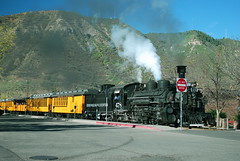
We had the opportunity to ride the famous Durango and Silverton train between those respective towns which was a contrast from Amtrak's Superliners, the Cascade Talgo, and FrontRunner.
Here is a posting from the Overhead Wire about a bill going through Congress on Transportation Funding:
Also, for anyone that still wants proof that turning UTA over to UDOT is a bad idea and could lead to transit funds being stolen for other projects, the Governor of California, you know that actor guy has proposed taking $1 Billion of voter approved moneys and moving into the general fund and then sending some of that funding over to highways. Does anyone really want to give our state legislature that opportunity?




![Reblog this post [with Zemanta]](http://img.zemanta.com/reblog_e.png?x-id=b09a6149-289f-42b8-939a-ba545aa4f224)