Showing posts with label Transportation. Show all posts

Monday, September 02, 2019

Minneapolis Red Line - What is wrong


When I think of a transit line that is referred to as the red line I think of major subway systems such as in Los Angeles or in Washington DC where the red line is a major trunk line, or one of the several light rail systems that have red lines. But in the Minneapolis-St. Paul region the Red Line is actually a bus line that runs from the Mall of America terminus of the Blue light rail line to the side of major road transit center in Apple Valley in the deep suburbs of Minneapolis – St. Paul.

The Red Line began service June 22, 2013 with 15 minute service that was designed to provide close to across the platform connections from the Blue line, however bus service has now been cut back to every 20 minutes. There are currently 5 stations on the route with two infill stations planned and a proposed extension to the city of Lakeview that will add 5 more stations and increase the route mileage from 11 to 16 miles. The service is part of the Metro network that serves the greater Minneapolis-St. Paul region. It is operated by Minnesota Valley Transit Authority which operates transit service in Dakota County that most of the route traverses through.

Monday, March 04, 2019

Autonomous Cars - Are they a magic bullet


Over the years it seems that there is always something on the horizon that is going to solve all our urban design problems. In the early 1900’s the implementation of zoning ordinances was supposed to be the magic bullet that would solve the difficulties facing cities at the time. Then there were highways, exclusionary zoning, easy to get mortgages, urban renewal, and pedestrian malls among others that were all going to solve our urban problems. Today we know from history that while each of these things had their benefits, they also came with unintended consequences and in the long run did not solve our urban problems. Today we have a new magic bullet on the horizon that many feel is going to revolutionize the world and solve all of our urban problems – the autonomous car.

Autonomous cars could have a major effect on our cities but maybe not in the way many people think they will. My first planning professor had a favorite saying, “What do we know about the future…nothing” and when it comes to autonomous cars there are those that believe that the adoption of autonomous cars will revolutionize our cities for the better. But as with all technological advances there comes a cost and what the final cost will be we will not know for some time. In addition, the changes we see will be different than envisioned and like so many of the magic bullets from the past, the unintended consequences may be more severe than we expect.

Tuesday, April 07, 2015

Mixing Active Transportation, Transit, and Freight Service

Nederlands: Luchtfoto van Nederlands hoofdkant...
Nederlands: Luchtfoto van Nederlands hoofdkantoor Bosch Rexroth (Photo credit: Wikipedia)

One of the most difficult jobs of effective transportation planning, is the compromise between creating good environments for active transportation and transit while at the same time taking into considerations the need of freight carriers such as trucks that provide an important economic tool for many communities.

A great example of the problem areas for this compromise is in industrial areas. Industrial areas see a large amount of freight traffic (hopefully both on rail along with trucks) but you also need workers in industrial areas but they can be extremely difficult to serve with transit. Many transit advocates don't see the need for industrial areas and would love them to just go away. The problem with this line of thinking is that industrial areas tend to be the best sources of jobs that can lift people out of poverty. They provide a good paying jobs that do not require a college education.

The question is how do you serve industrial areas with transit and consider the last mile problem? One of the problems with transit service in these areas is that most of the ridership occurs only during shift changes which means if the industrial area is the primary point of travel for a transit line, it will only be busy during certain times of the day and run empty the rest of the time. There is a couple of solution to this problem.

One is to ensure that the industrial area is not the primary destination of the transit route. For example TriMet route 16 in Portland travels through the Northwest  Industrial District but also serves downtown, the St. Johns area, Linnton and Sauvie Island. Two other routes the 15 and the 77 do terminate in the area but they are long routs and the industrial district makes up only a small portion of their total route mileage.

A second solution is to provide a shuttle service to the industrial area from a major transit stop. Companies such as Intel and Nike provide shuttle services from MAX light rail stations in Portland to their transit unfriendly campuses. Another example is the Burbank, CA Metrolink Commuter Rail station that sees a large number of company vans providing service from the train station to their offices although in this case they are not in industrial unfriendly industrial areas. In the cases cited the service is only provided by a specific company for their employees. A third example is in the Chicago Suburbs were employers pay the PACE transit agency to provide shuttle service from train stations to their businesses and these can be used by anyone willing to pay the fare.

Another problem presented by industrial areas is access by active transportation such as walking and bicycling. While few people will probably walk all the way to the industrial area from their homes, they may have to walk a distance from the bus stop to their place of employment and many times there is few if any sidewalks. A bigger problem is the conflict between trucks and bicyclist. Industrial areas can be congested with truck traffic that makes it dangerous for bicyclists. Trucks are large and have a hard time seeing cyclist in their mirrors. The best solution in this case is to provide dedicated infrastructure for bicyclists so they are separated from the trucks but not may not always be possible.

When bicyclists and trucks do have to share the road one of the most dangerous times is when a truck is making a turn because once the cab of the truck is at an angle it is very difficult for the driver to see what is on his right side. While there is no fail safe solution to this the problem, there is some relatively inexpensive things that can be done to increase safety. One would be to install mirrors along driveways giving truck drivers an additional way to see in their blind spots and the other would be put up more signage warning bicyclist and trucks of the dangers. A final idea would be an educational campaign that would teach both truckers and cyclists how to be safer around each other. The problem here is reaching the large number of long distance truck drivers who may come into the area only occasionally.

Industrial zones are important part of our economy but create unique transportation challenges especially when trying to serve them with transit and adding active transportation. It can be done but it takes cooperation from all parties to make a system that works.


Sunday, May 18, 2014

Looking for an Internship

English: A car of the Portland Streetcar syste...
English: A car of the Portland Streetcar system at the eastbound Portland State University stop, on Market Street at the South Park Blocks. (Photo credit: Wikipedia)
Some of you may remember when I mentioned I graduated from Portland State University with a Bachelor's Degree. Well I immediately started the Masters of Urban and Regional Planning program in September with a specialization in Transportation plus an Urban Design Certificate.

Well now I need to do 400 hours of internship hours to graduate so I am currently looking for one. You would think that I would have enough experience (especially after writing this blog for 10 years!) plus my business related background but as an older student sometimes it is difficult to find the right position.

Therefore I am checking with my readers to see if they have any leads on internships. If you have any possible leads let me know at jdornoff(at)pdx.edu.

Thank you and I will be written more in depth articles soon.
Enhanced by Zemanta

Saturday, March 29, 2014

The Barbur Transit Center - The Good, Bad, the Ugly, and the Really Ugly and how it doesn't fit into the urban form


In my first entry on how transit centers fit into the urban form and how they can they can fit better into a strong vibrant urban form I showed a worse case example with the freeway based Parkrose-Sumner Transit Center near the Portland International Airport on the MAX Red Line. 

Today's entry is an even worse example and that is the Barbur Transit Center which is stuck between Interstate 5 and its predecessor Barbur Blvd which was once US Highway 99W. The Barbur Transit Center is currently the oldest transit center in the Trimet system having opened in 1977 and as you will see it is showing its age. The transit center is actually nothing but a glorified Park N' Ride lot as the area around the transit center is very auto oriented and hostile to pedestrians and is not designed to blend into the community or the community to blend into the transit center.  

Friday, June 21, 2013

Now there is two...

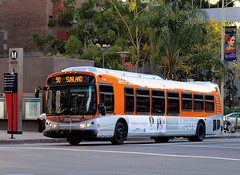
LACMTA Metro Local #8407
LACMTA Metro Local #8407 (Photo credit: L.A. Urban Soul)

Today it was announced that North American Bus Industries better known as NABI has been purchased by New Flyer Industries of Winnipeg Canada for a grand total of $80 million dollars. Although the NABI factor in Alabama will continue to produce buses at this time (currently has 1500 buses on order), it bascially leaves to companies (New Flyer and Gillig) as the major suppliers of transit buses in the United States (plus a few niche players whose orders don't amount to much).

The biggest existing customer for NABI is currently the Los Angeles METRO who purchases most of their buses from the company, having had conflicts with several manufactures in the past although most of those such as Neoplan have already stopped producing buses or the US market.


Thursday, September 13, 2012

You Can't Get There from Here...

English: Zip car carsharing service at downtow...
English: Zip car carsharing service at downtown Washington, D.C. (Photo credit: Wikipedia)
New Flyer C40LFR laying over ath the Federal W...
New Flyer C40LFR laying over ath the Federal Way Transit Center. It left a few minutes later on route 402. (Photo credit: Wikipedia)
Lincoln City, Oregon
Lincoln City, Oregon (Photo credit: Wikipedia)
English: Two buses at the Forest Grove, Oregon...
English: Two buses at the Forest Grove, Oregon terminal of TriMet, the public transit agency serving the Portland, Oregon metropolitan area. This off-street bus loop for route 57 is located at 19th Avenue and B Street in Forest Grove and is the farthest-west point in the TriMet system. Buses 2559 and 2554 are both New Flyer D40LF units built in early 2001. The small building on the right is for use by bus drivers. (Photo credit: Wikipedia)

One of the biggest challenges for those looking to do without a car is when trips need to be made beyond the normal transit area. For those that are able to drive there is the option of renting a car either through one of the car sharing companies such as Zipcar or traditional rental car companies.

However, renting a car is expensive and will most likely become even more expensive with Hertz taking over Dollar/Thrifty leaving only four major companies left to provide rental cars.

For those that cannot drive, the options are even worse as service to many areas is either non existent or very poor and not designed for inter-regional trips. For example, in the last few months I have made three trips to Tillamook from Portland. While there is limited bus service from Tillamook to Portland you cannot travel from Portland to spend the day in Tillamook. In fact even for people traveling to Portland the schedule only allows for five hours in Portland itself.

For another example let's look at Lincoln City, Oregon which is a major tourist destination. If you want to head to Lincoln City from Portland for the day forget it. There is only two transportation options. One is a casino bus that runs only a few days a week that will take you to Chinook Winds Casino on the north side of town. However, if your leaving from the Portland area it leaves the Gateway Transit Center at 5:30am. Not a very appealing time.

The only other option is the expensive Airport Caravan that travels from Yachats to the Portland Airport via Lincoln City and cost $55.00. Problem is it travels to Portland in the morning then returns in the early afternoon. Lincoln City used to have Greyhound service until a few years ago that was a little more affordable but still did not have the best times.

In Northwest Oregon/Southwest Washington we have a number of transit agencies including TriMet, Cherroits in Salem, SAM, SMART, Canby Area Transit, Woodburn Transit, C-Train, Lower Columbia, CUBS in Longview, Amtrak, Greyhound, Bolt, Sunset Transit, Tillamook County Transit, Lincoln County Transit, Pacific County Transit and several others I am probably forgetting about.

The problem is these agencies number one priority is their own service area and are often blind to travel needs beyond their districts. If we are going to create a sustainable alternatives to automobile travel, all agencies are going to need to work together to provide service that connects important points not just in their own area but regionally also.

To complicate matters even further is the fact that support for any transit service disappears once you leave the urban areas and that is why some districts such as Pierce Transit in Tacoma, WA cut back their service district recently and Intercity Transit in Olympia, WA did it several years ago. Officials made the decision that it was better to create a smaller district that would have more support but of course cuts those off who are located outside the new district.

One way to solve some of the problems would create a regional transit coordinating agency that would work with all the different agencies not only the transit providers themselves but other stakeholders to design a system that will create a more usable system. Recently Reconnecting America recently had a program that discussed issues in rural areas and how to more effectively service them. One agency in southern Maine worked with public and private companies to better coordinate transit service in the area including connecting it up with Amtrak's Downeaster service between Portland, Maine and Boston.

The difficulty in creating a regional agency is to create an organization that can walk the thin line between being able to work with all the agencies involved to coordinate activities including fares, service, and marketing while not alienating groups and not becoming another bureaucratic nightmare of an agency that exists on its own inertia.

Basically we are down to the old chicken and egg scenario. Do we worry about only providing transit service to the busiest urban areas and let the outer and rural areas deal with it until the time comes when transit service becomes more vital across the board or do we start to look at a big picture?

While I used the a section of the northwest for example, you could look to almost any area of the country and see the problems that exist we access to transit services and the lack of coordination between agencies. If transit service is to become a more important part of the transportation mix, service will need to be better coordinated to make transit service more useful to the largest number of possible riders.


Enhanced by Zemanta

Thursday, July 12, 2012

Streetcar Basics

The interior of a Portland Streetcar.
The interior of a Portland Streetcar. (Photo credit: Wikipedia)
English: A car of the Portland Streetcar syste...
English: A car of the Portland Streetcar system at the eastbound Portland State University stop, on Market Street at the South Park Blocks. (Photo credit: Wikipedia)
A few years ago the thought of streetcars returning to our streets was a fantasy. Today several cites have either installed new streetcar lines, constructing lines, or in the advance planning stages. I support streetcars as I feel that they are a great step between basic bus service and full light rail service (notice I did not include BRT - Badly Repackaged Transit). 

The question is, what should be the priorities of new streetcar lines. The most famous new streetcar line is off course the Portland Streetcar. To be honest, I rode it on Monday but overall I rarely do. Now that I spend more time downtown at Portland State I most likely will be riding more especially to head to Powell's Books

People opposed to the streetcar line say is nothing but a subsidy to developers. It is easy to call it that, after all it goes through a part of town that was about to rapidly development. On the other hand the same people who make those kind of comments turn a blind eye to all the subsidies suburban sprawl developments get every day of the week. We could quarrel all day about the that, but instead lets see what the streetcar does do. 

1. The streetcar provides service along a corridor that has never had service. While the two ends of the network (in the northwest side of town and south of PSU), the bus service was not in direct competition with 
Tri-Met buses. In fact the one line that follows the streetcar in the northwest will be rerouted in September in a budget cut move that actually eliminates duplicate service. 

2. The streetcar provides an alternative form of transportation that makes that part of the Portland much more livable. While I don't go to Powell Book's everyday, maybe once a month at the most, it is much more convenient to take the streetcar than trying to drive and find a parking spot. 

The question is, what should the priorities be for a streetcar line? The problem with making a blanket statement is that every city has different priorities so what is important for Portland, is different for Salt Lake City, Cincinnati, Atlanta or any of the other cities that have projects in progress. 

While Portland is a great example here is some things that could improve the current Portland system and any future extensions: 

1. One problem was that the system was designed only to have single cars. From my understanding this was a compromise to ensure support along the line. However, one of the benefits of rail transit is when you add additional cars to a train to make it more efficient and carry more people. Any future lines should have the capability to run multiple car trains. 

2. There is no private right of way. The streetcar gets stuck in traffic. While in an ideal world the streetcar would have its entire right of way reserved, we know in the real world this is just not possible. However, I see no reason why on 10th/11th Streets the streetcar cannot have its own reserved right of way in stretches and other areas to. 

3. The streetcar should have signal priority plus priority at the four way stops like Couch and 11th were the streetcar gets stuck for extended periods of time. 

In September Portland will open its new East side streetcar line. Until the loop is completed with the opening of the Milwaukee MAX line in 20515 I am not overly enthusiastic about how well this line will do but we shall see. 

That brings up a good question, for a city looking to extend a streetcar line or put a new one in, what should the priorities be? As I said early every city has its own most important priorities but this is some general guidelines. 

1. The first priority of a streetcar line should be to provide an essential transportation function. If the city already has a light rail or rapid transit system, the streetcar should function as a feeder between the major rail line and important business and residential sectors. Salt Lake City is a perfect example of this. The streetcar will provide service from all three light rail lines to the Sugar House district which is currently a major retail center and will have high density housing going in. 

In a way the east side streetcar in Portland will provide this function also as it will connect from the Lloyd District light rail stations to the Pearl District offering customers an alternative to the current ways to get to the Pearl. 

Once the Milwaukee MAX line is completed, the Portland streetcar will provide an excellent feeder from that line to the northwest part of town that is not currently available because of the alignment of bus service (31.32,33 and 99) and the streetcar line. 

Another good route in  Utah would be from the Ogden Transit Center to Weber State University which is being studied at this time. This would create a feeder from the Front Runner Commuter trains to busy 612 bus line on Washington Blvd and onto the University replacing route 603. 

2. Another important priority would be to supplement a overburdened bus route along a busy corridor. In its transit plan Portland is looking to supplement bus service with streetcars in such corridors as Sandy Blvd. I mentioned this at one time where it will allow the 12 route to become limited stop along this section of route speeding up Trimets longest route (which is being split up in September and won't be so long anymore). 

Another good example would be the Barbur Blvd/Capitol Highway corridor. Currently there are in the study phase on this project for Badly Repackaged Transit or Light Rail, but as I see it know there is a slim chance of a good system being built. Chances are some half baked BRT plan will get built that will end up not having a major impact. 

You could run the streetcar down Barbur and Capitol Highway to the Hilsdale area. This would allow TriMet to cut routes such as the 45 at Capital/Sunset and make routes such as the 44 and 12 faster through the area speeding up bus rides for those through travelers. 

When it comes down to it, streetcars can function both as a feeder from major rail routes to major employment and dense residential areas. It can also be a relief valve for busy bus routes along major dense corridors. What it comes down to is that streetcar routes need to be done right the first time. No matter how successful the route would be there will be naysayers, however if a route is well designed and does the job it is easier to counterbalance the CAVE (citizens against virtually everything) types. 
Enhanced by Zemanta

Monday, May 14, 2012

Its all about Selling...


Crime Train, Portland Creep, Empty Buses, 19th Century Technology, Anti-Car and so. For anyone who is an advocate of proper urban planning or effective transportation choices are well familiar with slogans like these, they are well used by opponents to paint a disparaging picture of transportation choices and planning.

The problem is these well financed campaigns are designed to one thing, to turn public point of view to their way of thinking. Some do it for the money while others do it for their ideology. The problem is that the other side is doing a heck of a good job of marketing their point of view and advocates of transportation and planning choices seem to fail.

Motivational Speaker Zig Ziglar has a saying that everything involves selling and that everyone is a salesperson whether they think that their job involves it or not. Advocates need to realize that they too need to work on their sales presentations whether it is to a city council, newspaper, blog or any other forum that they may find themselves talking to others.

Right now here in the Portland suburbs of Clackamas County their is a heated battle for county commissioners. Radio ads and billboards are being bought proclaiming that three candidates will stop "Portland Creep". They are using this term to demonize urban planning and transportation in the Portland area saying that the goal is to ruin the little perfection called Clackamas county. Now a large segment of Clackamas County is rural and the thought of additional density is to them is worse than

Smart Growth Opponants Run Against Portland's Pro-Urbanism Policies
"Portland Creep" and the Density Debate

While you can say all you want about how negative they are (yes they are) but what are they doing? They are effectively selling to certain segment of the population that sees the density of Portland as something that is very undesirable. While this group is well funded by conservative interest, they play on emotions and are good at making Portland sound bad. It will be interesting to see the elections results.

In Portland, the anti-MAX light rail forces have done an excellent job of demonizing MAX as the crime train. Now the east side MAX does have some issues but Gesham was a problem community before MAX even came along. But it has done the job, any time something happens anywhere near a MAX station the media always mention it is near a MAX station and the words "crime train" will show up in the comments within moments.

Another one you always hear no matter where you are is the argument rail is "19 century technology". The opponents have done such a good job of painting anything rail as outdated technology that "19th century technology" the first worlds out of months of many. You could go all day long on how the automobile is also 19th century and in some ways 18th century technology but it doesn't matter, rail is the outdated "19th century technology".

Another comparison is the Tea Party and Occupy. The Tea Party has done an excellent job of getting people to join their way of thinking because they are doing a better job of selling themselves. You do not have to agree with them but you have to respect the organization that has been created and instantly had a major effect on the 2010 election. Occupy meanwhile made lots of noise in October, made lots of enemies in many cities but has not become a major force. You don't have to like an organization to learn from what they do right.

Then again maybe if advocates would stop fighting among themselves, yes you are going to have disagreements after all we are all human but you must have a unified voice if you want to get your message across. Fortunately when it comes to public votes transit still wins a majority of the time, but that luck is going to run out without an organized voice that knows how to sell.

Friday, May 11, 2012

This Week at Amtrak

CP Rail Loco in Thunder Bay ON
CP Rail Loco in Thunder Bay ON (Photo credit: Wikipedia)


From the Untied Rail Passenger Alliance 
This Week at Amtrak; Vol. 9 No. 5

A very heartfelt thanks to all who contributed to this issue.

From the Editors…


So you think you know a thing or two about the railroad business. Oh really?


The “invisible hand” versus “the art of the possible”


It is no secret that railroads, as investment opportunities, have regained a stature not seen since what has been labeled as “the gilded age.” With such attention, however, comes great responsibility. Since about the most recent turn of the century, there remain seven major railroads in North America: Union Pacific, BNSF Railway, Norfolk Southern, CSX, Kansas City Southern, Canadian National and Canadian Pacific. It is also no secret that the Canadian Pacific is perceived as the weakest of the seven. Although one of the smaller roads, it still boasts a market cap of $13.2 billion and an enterprise value of $17.7 billion.


For those of us with our boots on the ground, there have long been signs of increasing trouble at CP. Now the trouble is in the top office. In late October, 2011, Pershing Square Capital Management, an activist hedge fund based in New York City, announced it had acquired a 12.2 percent stake in CP. Between then and now, the stakes have only risen to a current 14.2 percent, and the relationship between Pershing Square and the CP board has become bloody.


Contrary to your statement in the letter that we “acknowledge” that we have no plan to improve Canadian Pacific’s operating performance, we do have a plan, and we have made that plan clear both in our initial meeting and in subsequent communications with you. Our plan is to transform Canadian Pacific from the worst performing railroad in North America into one of the best by effectuating a cultural and operational transformation of Canadian Pacific which begins with a new leader. – Excerpt from January 3, 2012 letter from Pershing Square’s William Ackman to CP chairman John Cleghorn


Pershing Square is now promoting to shareholders a slate of seven alternative directors as part of its CP turnaround strategy. Two of these are significant: Stephen Tobias and E. Hunter Harrison.


For most, these names may not ring a bell; but for railroaders, these men are superstars. Both of them are past recipients of the Railway Age Railroader of the Year award: Tobias, as Norfolk Southern Chief Operating Officer and later Vice Chairman; Harrison, as President and Chief Executive Officer of CP-rival Canadian National. Tobias was a lifelong employee of NS and its predecessors, starting in 1969 as a junior engineer. He worked his way through the ranks over the next four decades until being named Vice Chairman and Chief Operating Officer in 1998. He retired from NS in 2009. Harrison’s work history is not as straightforward. He started in1964 with the St. Louis-San Francisco Railway, which later became part of the Burlington Northern. Later, he would be President of the Illinois Central which was acquired by Canadian National in 1998. He retired at the end of 2009 as CEO. It is anticipated that Harrison would reprise that role at CP if Pershing Square’s seven alternative directors are elected by the stockholders. One slight problem: That job is currently held by Fred Green.


The past six months have seen quite the flurry of activity at CP’s headquarters in Calgary, Alberta. Press releases, video streams of meetings and letters to stockholders have literally flowed unabated in preparation for the annual stockholders meeting set for May 17. A letter to the shareholders dated March 7, 2012 sets the company’s tone:


CP’s management team is aggressively and successfully executing on the Company’s Multi-Year Plan and has the full support of the Board of Directors. Your Board and management team firmly believe the CP’s string, established relationships with customers will continue to create significant value for shareholders. Strong and profitable customer relationships are essential to maintaining and expanding the volume growth that underpins CP’s Multi-Year Plan to increase earnings per share, drive down the railroad’s operating ratio and deliver greater shareholder value. The Board believes that Pershing Square’s demand that the Company replace its CEO, Fred Green, with Hunter Harrison would put at severe risk the significant forward momentum the Company is making on the Multi-Year plan.


Interestingly, CP developed and released its “Multi-Year Plan” in January; two months after Pershing Square had announced its investment.


It should be noted that none of what has transpired was at the behest of Washington or Ottawa. What we see at work has been described as “the invisible hand,” that is, when enough people believe the bottom line could be improved, something will be done.


Meanwhile, back in Washington…


Something that has been mentioned repeatedly by transportation advocates is the undying loyalty of the current presidential administration to “rail.” As evidence, they point to the administration’s mention of “High-Speed Rail” in a State of the Union speech. As we have covered here in the pages of This Week, the latest iteration of domestic “Fast Train Fever” is going the way of the previous cycles, with the last gasp — California’s HSR dreams — on life support, and the pulse slowly ebbing into silence. Rail was not mentioned in the latest State of the Union address of this past January. Perhaps the administration has given up hope on rail. If so that may explain its latest nomination:


President Obama has nominated former U.S. Rep. Yvonne Brathwaite Burke, a trailblazing fixture in Los Angeles area politics, to the AMTRAK board of directors, the White House announced Thursday.

As a young attorney in 1966, Burke made history when she became the first African American woman elected to the state Assembly. She was elected to Congress in 1972 and served until 1978. In 1979 she was appointed to a vacancy on the Board of Supervisors but lost her election bid the following year in a racially charged contest. In 1992, she won election to the board from a different district.
 – Los Angeles Times, March 29, 2012 


Before proceeding any further, let us be clear that we are not, in any way, minimizing Representative Burke’s long and distinguished record of accomplishments. She most definitely blazed trails, and when the doors would not open, she broke through them. That said, what does she know about railroads and their governance?


Currently, the seven members of the Amtrak board are: Thomas C. Carper (Chairman of the Board), Nancy A. Naples (Vice Chairman of the Board), Joseph H. Boardman (Amtrak President and CEO), Anthony R. Coscia, Bert DiClemente, Jeffrey R. Moreland, and Ray LaHood (U.S. Secretary of Transportation). Of these, only Mr. Moreland has a working history with a railroad. Starting in 1978, Mr. Moreland joined the Santa Fe Railway as Assistant General Attorney, in 1994 became Vice President for Law and General Counsel for Santa Fe’s parent company, and later retired with the same title from BNSF Railway.


It has been intimated that Amtrak has lacked a true operating foundation since 1993, when the legendary Graham Claytor retired. What did he bring to the table?


Graham Claytor had, first of all, had the stature on the Hill that we needed, but more importantly, he came out of a business environment. Even though he was a rail buff, which he was, he was a businessman, first and foremost, and that’s what we need at Amtrak. – Kathleen Gordon, Amtrak Senior Director, e-Commerce, retired, Amtrak: The First 40 Years 1971-2011, RK Publishing


Mr. Claytor never singled out one aspect of the corporation to blame for all of its faults. He knew the Northeast Corridor was a drain on finances, but accepted that fact as federal welfare to state-run operations. Under Claytor, Amtrak was a fairly well run “traditional” railroad focused on a national system. After his demise, however, the company morphed into a government agency with ferocious survival instincts. It became very NEC-centric, and continued that path by expanding its corridor service with state partners, particularly California.


Politics, “the art of the possible,” is not concerned with the bottom line, but rather short-term survivability. Politicians count on the short-term memories of their constituents to traverse the delicate tightrope walk that is their elected term in office. Railroading, on the other hand, is anything but a short term-enterprise. All railroads need long-term planning to succeed, and a core philosophy to be the thread that weaves those plans together. Since politics are by their very nature mercurial, anything beholden unto politics will be inefficient and unreliable. That pretty much explains Amtrak after 40 years.


There have been many attempts to recruit people with railroading (or at the very least, transportation) experience to the Amtrak board. Mr. Claytor was appointed Amtrak president in 1982, coming out of retirement. This was one year after Congress had altered Amtrak’s original board structure and governance, in which the four railroad common stockholders were represented on the Amtrak board and the common stock had voting rights. (The eviction of the railroad shareholders from the board and their disenfranchisement was of dubious constitutionality, but was never challenged.)


The pendulum was to swing in the other direction in 1997, when the Amtrak Reform and Accountability Act ended the monopoly voting rights of the preferred stock, held only by the Department of Transportation, restoring the original voting status of the railroads’ (now including the corporate successor of Penn Central) common stock. Nevertheless, Amtrak has continued to ignore the common shareholders, in violation of District of Columbia corporate legal requirements.


The 1997 legislation also mandated a nonpartisan expert board of directors, using language parallel to the National Transportation Safety Board statute . All directors were to possess “technical qualification, professional standing, and demonstrated expertise in the fields of transportation or corporate or financial management,” and could not be “representatives of rail labor or rail management.” Sadly, these requirements were flouted by the initial board appointments by the Clinton Administration. The following regime would attempt to follow the rule of law only to feel the blowback from the usual sources:


Bush appointees to Amtrak board foreshadow breakup and privatization

President George Bush’s proposed nomination of three new members to Amtrak’s board of directors foreshadows the administration’s support for breaking up the national passenger rail system and selling off its most profitable parts to private industry.

Among the nominees is Louis S. Thompson, who retired earlier this year from the World Bank. Thompson began his career at the Transportation Department and played a role in creating Amtrak. At the World Bank, Thompson spearheaded successful efforts to privatize railroads in Argentina, Chile, Mexico and Romania; he also played a role in similar efforts to privatize railroads in China, India and Russia.

The second nominee is Robert Crandall, who retired from the chairmanship of American Airlines parent company AMR in 1998. Since then, Crandall has served on several boards, including Halliburton, the company formerly headed by Vice President Dick Cheney. The last nominee is Floyd Hall, a long-time Republican fundraiser and former executive of companies such as Singer Sewing Machine Co., the Grand Union Co. grocery chain and KMart.
 – Brotherhood of Locomotive Engineers and Trainmen quoting the World Socialist Web Site, Published by the International Committee of the Fourth International (ICFI), 30 September 2003


Subsequently, all the actual appointees were virtually devoid of any of the listed qualifications, and consisted mainly of elected officials, lobbyists, and others of similar background.


The pendulum was to swing yet again in 2008, with the enactment of the Passenger Rail Investment and Improvement Act (PRIIA). The 1997 board statute was completely repealed, and replaced with a new, larger (nine- versus seven-member) board structure, with language openly inviting the appointment of politicians and the politically connected. The following are listed in PRIIA as alternative and independent qualifications for board membership: “general business and financial experience, experience or qualifications in transportation, freight and passenger rail transportation, travel, hospitality, cruise line, or passenger air transportation businesses, or representatives of employees or users of passenger rail transportation or a State government.” PRIIA also made the Amtrak board avowedly partisan, with a formula usually applied to multi-member federal agencies: “Not more than 5 individuals appointed…may be members of the same political party.” (“Balanced representation” of “major geographic regions served by Amtrak” is a recommended, but not required, consideration.) The ensuing appointments have been predictable.


One by one, each potential expert appointee has not passed political muster for one reason or another. Ultimately the jobs go to those who will not make anyone uncomfortable within the company, including, above all, the NEC orientation of Amtrak. Thus, it again appears that the status quo is not endangered. How will this all end? The words of Mr. Claytor from two decades ago now seem prophetic:


“Not everybody knows, and it does not always come through in the press, that the basic statute provides that Amtrak is not to be a government agency and is to be operated as a for-profit, privately owned railroad corporation. If it weren’t for that, a lot of us wouldn‘t be here, because I don’t‘ think that it is possible to run a railroad as a government agency and not have it be a disaster.” – Interview with Graham Claytor, Trains magazine, June 1991


Enhanced by Zemanta

Wednesday, May 09, 2012

Frequency Vs. Coverage

If we lived in a perfect world, a transit agency would not only be able to provide both an extensive network of core bus routes running frequently and a network of lines that is able to blanket the area with coverage.

However, few transit agencies have the resources to provide both and  with as budgets continue to be squeezed and the future of federal funding in doubt, transit agencies are having to squeeze where ever they can. The question that transit agencies and the citizens it serves has to answer do we provide the best service possible to the busiest routes or do they provide the most coverage possible?

People waiting for a bus 
Here are some pro's and con's to each service. Like previous pro and con postings, I will only point out some important pros and cons to each and if you have one that you think should also be considered be sure to throw it out in the comments.

First lets do the pros and cons of coverage:

Pro's:

The one major pro with a coverage network is that most people should be able to access a bus route both at home and to work. Until the 90's many transit systems focused on coverage to ensure that they could serve the maximum number of people possible. Even if you lived in far flung suburbs so long as you lived in the transit area you would have service.

Con's:

The biggest con is that if you are providing service to far flung areas of the system, the chances are you can only provide mediocre service. Everyone may have service but the busiest routes will not have the resources to have the amount of frequency that is demanded which will lower ridership potential.

A second con is that your bus routes will perform poorly overall. While some routes will have good ridership their ridership will be hampered by the lack of enough frequency while you run routes to areas with limited to no ridership potential.

This leads to a third con and that is the empty bus syndrome. People who already have a bent against transit will see lots of buses running around empty and will guess that they all run empty so "no body rides transit". Of course these people would say it anyway but you are just giving them some added ammunition.

Transit Center in Miami. 
Now lets look at a service network:

Pro's:

The biggest pro is that routes that have the most potential will have the best service. You focus your resources on routes that are winners. By creating a network of frequent service lines you create market synergies because a customer knows that if they miss one bus the next one will not be far away.

The second positive is that performance of the overall network will be better because you will be concentrating your resources where your ridership potential is the highest. Your resources are being concentrated where they will get the most use.

Con's:

The major con is that there is some people who will lose bus service and of course they will not be happy. Even a route that has week ridership will have people screaming up a storm if you try to cut the route. For those who want to use transit service it can limit the choices you have in housing.


Beaverton Transit Center, Beaverton, Oregon Trimet Route 57 is a frequent service line along TV-Highway from Beaverton to Forest Grove. 
When Seattle first started working on a major revamp of bus service for September the numbers were telling. 4000 riders would be affected by routes being cut. Now I am not saying that these people don't count. However, it was point out that the routes that were going to see increase service with the modifications served about 50 times that number or more.

Sadly some needed decisions in Seattle were put off in order to keep everyone happy and ironically some of the people who complained will have less service (the current service) than they would have if the changes had taken effect.

It would be wonderful if we had the best of both worlds, were we could provide extremely frequent service to the busiest areas of the network and good coverage across the service area. Hopefully the day will come when both types of services can be provided.

Tuesday, April 03, 2012

Pros and Cons of moving transportation to the state level

The western front of the United States Capitol...The western front of the United States Capitol. The Capitol serves as the seat of government for the United States Congress, the legislative branch of the U.S. federal government. It is located in Washington, D.C., on top of Capitol Hill at the east end of the National Mall. The building is marked by its central dome above a rotunda and two wings. It is an exemplar of the Neoclassical architecture style. (Photo credit: Wikipedia)When the Republican controlled House of Representatives came out with their budget proposal a few months ago many called it a doomsday budget. Among the items in the budget that had transit advocates scared was the elimination of dedicated transit spending.

So far no permanent transportation budget has been passed and considering it has been years since a plan has been passed through into law and the current state of affairs in Washington I see little happening between now and when our next president whether it is President Obama reelected or the Republican candidate is elected. 

Once the election happens we might be able to see what the future of transportation policy might be in the United States or on the other hand if we continue to have two widely different political influences in Congress, we may continue on this not so lovely state of political impasse. 

For second let me play devil's advocate with my libertarian side and say what if we not only ended dedicated transit funding on the state level, but instead completely eliminated transportation oversight by the Federal government. What would happen? 

Most people looking at this either see doomsday or happy days depending on your political perspective, however like anything there is good points and bad and let me point some of them out. This is by no means a comprehensive paper on the opportunities and unintended consequences but instead a few brief talking points designed to facilitate a discussion of the future of Transportation in America. 

Pros: 

Yes boys and girls, there would be some positive that would come out of this. The most important is that there would potentially be more money available to be used on projects (although see cons also for the funding issue part). Because an entire layer of bureaucracy that costs millions of dollars to operate would be eliminated more money could be used to fund transit projects that the states want. 

In addition unnecessary regulations could be eliminated that would also lower costs on projects. One example that has become punching bag in certain circles is the Buy American Act that raises cost of procuring equipment. While I am a supporter of American made products and want to see our local industries do well, that is an economic issue that should be dealt with separately from transportation. I am sure almost everyone could point out some  needless regulation that has been implemented on the Federal level that increase the cost to build vitally important projects. 

Third, ideally the state government would look to what are the priorities for the state and fund them by that priority list. Instead of having to worry that the Federal level would not consider their project important over something else, they could dedicated their funding to that project. 

Cons: 

If there is pros, then there has to be cons and once again let me point out I am just picking out a couple of important talking points here. You could write a book on the subject which is not the intention here. 

The biggest con is the counterpoint to number three of the pro's and that's the priorities of the state government. The question, how many state legislatures are in tuned with the needs of the people in the biggest cities in that state? I think you would be hard pressed to find a state where their priorities seemed in tuned with the needs of the cities. 

Then you add the totally wacked out state legislatures like Utah. For years anti-transit forces have been lobbying to get the Utah Transit Authority put under the control of UDOT which is strictly a highway organization. The primary goal here is to take away the voter approved funding from UTA and give it to strictly high spending. So far they have not been successful. However, if the state legislature of Utah had control of transit funding considering most members are either hostile or oblivious to transit such as my former legislator Carol Spackman who is one of the latter members. 

To see what could happen lets take a look at one law that went through the Utah Legislature this year. The city of Salt Lake City passed a no-idling ordinance to reduce pollution especially during times of inversion. The legislature decided it didn't like that so their might hand decided to change the law. 

Another con would be funding itself. With the elimination of the Federal Gasoline Tax and funding mechanisms  the responsibility for funding ALL transportation in the state would fall on the state. How hard would it be for state legislatures especially in states like Washington that has a anti-tax political machine to ramp up initiatives to shoot down any tax the state tries to levy? While the Federal government has been inept at raising the gas tax most states have not been doing anything either for fear of voter reprisals. What money was allocated would quickly be absorbed into the highways with nothing left for the alternatives. 

Finally it would also mean that the states would have to take a more active role when it comes to safety measures when it comes to transportation. This could actually make costs worse as every state enacts different regulations requiring bidders to change the specifications for every state. When it comes to transit, most orders are small enough that it could have a major detrimental effect on industry. 

Conclusion: 

There is no easy answers of this is probably only the tip of the iceberg of the pros and cons to this issue. Sadly, I see little being accomplished in Washington DC over the next few months and maybe longer depending on the outcome of this years elections. 

What is clear is we need to have an effective dialogue on the future of transportation in our country. Whether it will happen is anyone's guess. 
Enhanced by Zemanta

Friday, January 20, 2012

Six months riding Trimet and Counting...

It has been about six months since I moved to Portland, about 3 months since I updated you on my travels on the Trimet System. Last time my travel was pretty straight forward: Take the 54 and 57 to work, then ride MAX, WES and 78 to PCC Sylvania and back home on the 44 or I would ride MAX, the 6, and 44 to PCC. After Christmas, my life completely changed and I am always riding the 44 to PCC and back but my work schedule has me traveling a lot more which you can see from the number of buses I have rode down below.


Here is a rundown of the rail vehicles I have traveled on:

Manufacturer Information:    # In Fleet      #Ridden       Most Ridden and Notes

1986 Bombardier                    26                 23             107 and 116 (7 Times Each)
*The three I have not ridden 106, 119, and 126 I have never seen them either so not sure if they are still in service, being repainted since many of these cars are getting new paint schemes or just missing them.
1997 Siemens SD660              52                 50              245 (4 Times)
2003 Siemens SD660              27                 All 27         303, 308, 309, 314, 325 (5 Times)
2009 Siemens S70                   22                 20              410 (3 Times)
Streetcars                               10                 All 10          7 (4 Times)
Colorado Railcar Power DMU   3                  All 3            1001 (21 Times)
Colorado Railcar Trailer            1                  1                  Once
Ex-Alaska RDC's                     2                  2                 Once Each                                          


Now for the bus fleet:

Year:    Manufacturer/Model    # in Fleet    #Ridden       Most Ridden and other notes:

1990    Gillig Phantom 40'             63?           18            1420, 1422, 1430, 1458, 1459 (Twice)
*Not sure how many of these are actually still running.
1990    Gillig Phantom 30'             43             12            1609 Twice
1992    Flxible Metro 40'              107           47             1738 (4 Times)
1994    Flxible Metro 40'              26             17             1821 (4 Times)
1992    Flxible Metro 30'              10             9               Each one only once
1997    New Flyer D40LF            22             7               2016 Twice
1997    Gillig Phantom 40'             65             50             2139 (5 Times)
*These are buses normally assigned to the 44 Monday-Friday so its no surprise that I ridden them so many times.
1998    New Flyer D40LF            118           33             2202, 2206, 2210, 2246 (Twice)
2000    New Flyer D40LF            60             16             2518, 2526, 2560 (Twice)
2002    New Flyer H40LF            2               0            
2002    New Flyer D40LF            55             38             2632 (Three Times)
2003    New Flyer D40LF            25             16              2715 and 2719 (Twice)
2005    New Flyer D40LF            39             16              2807, 2825, 2834 (Twice)
2009    New Flyer D40LFR          40             All 40        2908 (6 Times)
*Since these are the regular buses assigned to the 54 and 57 and sometimes the 78, its no wonder I was able to ride all them over a six month period.
 

Although I have a very love/hate relationship with low floor buses:: easier to get on and off, faster wheelchair loading, however they loose capacity, are not the comfortable to ride in, and are not that well put together, I will have to say that the D40LFR's from 2009 do seem to making some headway quality wise.


While Trimet may be a bus fans paradise with the large number of Flexible Metro's still around, Trimet  does have an aging fleet and with Flxible having been out of business for almost 17 years now, I imagine that some parts are now becoming difficult to get. Trimet does have 55 diesel buses on order along with 4 hybrids which are coming from Gillig.

While Trimet has many haters out there including many of its own bus drivers, as a passenger I have to say for the most part Trimet has done an excellent job. Only once has there been a bus break down that affected me and that was when I was still riding the 54 westbound and one of them broke down leaving the garage. However, Trimet while the 54 is run out of the Merlo garage on the westside, they pulled a bus out of the Central Garage on the near east side and the bus was only running a few minutes late.

The only other incident actually worked to my benefit. One of the 1992 Flxible 30' Metros was overheating and it caused the bus to run about 10 minutes late which meant I did not have to way 20 minutes for the next bus to arrive.


Drivers on the other hand are a mix bag. Trimet does have some excellent drivers. I have sent in commendations to Trimet on two of its drivers. The first one was a driver on the 54 who is now working the 67. This person has a wonderful personality, knows how to treat customers, and was always a pleasure to ride with. Sadly the replacement on the 54 has not lived up to him.

The other driver I sent in a commendation for was on the 44. This person is extremely friendly with a wise cracking personality that works perfectly for the clientele on the 44. I rode with him a few times when I needed to make trips to downtown before heading to PCC from Beaverton.

There is only one driver I have come close to filing a complaint about. This person shows a lack of personality when you board the bus and this person gives you a look like the driver would rather cut your throat than have you on the bus. This person never says a word, just gives you the dirty look. If a customer asks this person a question the customer is luck if they get a grunt.

I always try to wish the driver a good day, afternoon, etc. when I get off the bus if the bus is not extremely crowded. One time when getting of the bus I gave this driver the standard good day and I actually got a response of the driver!! The driver say "whatever." I guess its better than a something else the person could have said.

I have ridden with this person on a couple of routes so the person must be extra board. Clearly this is someone who needs to find a job where they do not have to deal with the public.


On Tuesday, I had my first encounter of adverse weather conditions on Trimet. Once again Trimet did what it was supposed to do and provided the best possible service under less than ideal conditions. Below is a picture of my 44 to PCC Sylvania on that day.

In fact the bus had to get around several cars that got stuck along Capital Hwy. and SW 49th. The driver did a great job and we arrived at our destination in good time.


In interesting note is that this was my first time every riding a transit bus with chains. The Utah Transit Authority I believe uses chains on its ski buses when conditions are bad but since I am not a skier, I never rode the buses to the ski conditions.

Another interesting note is the bus pictured above is equipped with automatic chains that engage with the flip of a toggle switch. The driver said these buses are the only ones equipped with them. I wonder if these were an add on order from another transit agency (add on orders is when a transit agency adds a bus order to another agencies order to get a better price on buses).


After six months of regularly Trimet, I can say that Trimet does what it is supposed to. Provide the best possible service to the most riders possible with the budget given them. I encounter many people in my travels that want to whine about one thing or another when it comes to Trimet, but overall service does the job it is supposed to.

Is Trimet a perfect agency? Of course not, there is issues that need to be fixed but it does its job well.


Enhanced by Zemanta