Showing posts with label Japan. Show all posts

Thursday, January 19, 2012

Sustainability with Survive-ability

OTSUCHI, JAPAN - MARCH 19:  In this handout im...Image by Getty Images via @daylife
When we look at any development project or even a major rehabilitation, we often look at how transit oriented a project may be, or how sustainable the project should be, but how often do we look at how survivable a building will be? The thought of making a building survivable may scare some people, and developers and bean counters will start adding up the cost, but the question is, should we be taking survive-ability into account when looking at projects?

Lets take a look at the Portland, Oregon region. How many buildings in Portland are going to survive the next time the Cascadia subduction zone has a major earthquake? How many people will die because the buildings they live and work in are not designed to handle the stresses of a major earthquake?

Those of us who grew up in Southern California probably don't even bat an eye with the thought of an earthquake. However, the earthquake in Japan last year should be a wake up call. The country of Japan has prepared for years for major earthquakes and tsunami's yet still was not prepared for the devastation caused by twin disasters last year. In fact most experts thought that type of earthquake could not happen in that part of Japan but they were proven wrong.

Of course what are the chances of a major earthquake hitting the Portland area or any area for that matter. The Portland area has been hit by subduction zone earthquakes on a regular basis for thousands of years, we are talking earthquakes of 9+ of the Richter scale. The average between earthquakes is around 250 years although there has been breaks of 500 years between earthquakes but the last one was about 10,000 years ago. When did the last earthquake like this hit the area? In a few days we will pass 312 years since the last major subduction zone earthquake hit.

But lets not look at just the Portland region, any area that is a geological or meteorological hazard site needs to look at survive-ability when it comes to construction zones. Of course let us not forget that one of the worse earthquakes in recorded US history did not occur in the western U.S. but instead in the mid-west and our most recent earthquake hit the east coast.

But other areas of the country are prone to natural disasters on a regular basis and how prepared are we?

The problem is, developers are looking to make the most money (nothing wrong with that except that when it comes into conflict with how safe an area is). In Salt Lake City, or the city of Draper to be exact homes have been built on a hill of sand that is already is causing stability issues for many homes and will be extremely dangerous when an earthquake hits that area. Further developers are allowed to build subdivisions in areas with only one escape route on the side of a mountain so that if a wild fire hits with little warning people may end up trapped with no escape.

Here is a link from the Portland City Club that had a presentation on emergency preparedness. The first presenter is Chris Goldfinger who happened to be a conference when the Japan earthquake hit. The video is about an hour long but offers some interesting insights on what will happen in the Portland region:
http://www.pdxcityclub.org/content/risks-and-potential-nuclear-energy.

The second presenter Chris Higgins (Dr. Doom), makes an interesting observation about a small item that makes all homes safer in the event of an earthquake: The Northridge Valve. It is a device that will shut off natural gas to a home when an earthquake hits. He points out that they are not required in Oregon but our neighbors in California and Washington do require them. A less than $50.00 item that could save countless lives is not required in Oregon.

Few parts of the country are immune to one disaster or another. However, how often do we take survive-ability into account when looking at developments and rehabilitation's?
Enhanced by Zemanta

Monday, April 04, 2011

Guest Post

Interior of the upper level of a Bombardier bi...Image via Wikipedia
This is a guest post by All Resort Transportation a privately run transportation company based in Utah. 

Will The Utah Transit System Stand Up To a Disaster?

I began this post planning to write about the current situation with public transit in Utah, and then the earthquake struck in Japan and suddenly any of our problems in this state seemed absurdly miniscule by comparison. When the 8.9 (or 9.0, depending on your source) earthquake struck and caused the tsunami, it killed thousands and uprooted hundreds of thousands, destroying homes, roads, and anything else that was in its way.

The earthquake was felt as far away as Tokyo, which is some 150 miles or south of the epicenter. Despite the distance, the shaking was bad enough that the city shut down the transit system until they could be sure that it was structurally safe to use. Cities like Tokyo rely on their public transit systems, and when it was shut down for safety reasons, literally millions of people were stranded in the city with no way to get home or communicate with loved ones.

The Ramifications of the Shut Down
The commuter lifestyle is a little different in Japan than it is in Utah (not a big surprise there). Sometimes people will commute for hours in one direction to get to work, and some estimates say that more than 10 million people use the public transit system every day. Shutting any of these services down for even a short time would have serious ramifications, and after the earthquake millions of residents were stuck without an option.

Officials shut down the trains and subways because they needed to ensure that everything was still safe. Some lines were down for around six hours and others for much longer. Hotels were immediately flooded with people looking for a place to stay, and the government began opening schools and official buildings where people could seek shelter and sleep when it got too cold outside. We saw a lot of pictures of people curled up on the floor in the train stations and others standing in line to use a pay phone since the cell networks were immediately overloaded.

After a day, most of the transit infrastructure in Tokyo was up and running again, but it was still a little sporadic. Because of the power issues caused by the loss of the nuclear plants up north, Tokyo is planning on rolling blackouts to help conserve energy. This is leading to a slightly more erratic train schedule, but commuters seem to be dealing with it as well as could be expected.
How Would Utah Do?

Obviously, in Utah we don’t have near that many people relying on the public transit system. According to UTA, TRAX is averaging about 58,000 riders a day, though the number is increasing. Public transportation is growing all over the country, and we’ve had a big push to expand our system here. Utah transportation will probably never be as complex as it is in huge places like Tokyo, but the rising population and rising gas prices are building more and more reliance on new transit options.
Right now, Utah is developing its public transit system on a number of fronts. Currently, the FrontLines 2015 Project includes:
• Mid Jordan TRAX Line – Covering Murray, Midvale, West and South Jordan
• West Valley City TRAX Line – Running between South Salt lake and West Valley City
• Draper TRAX Line – A light rail service that runs through Draper and Sandy
• Airport TRAX Line – Get from downtown SLC to the airport
• FrontRunner Provo to Salt Lake City Line – A high speed commuter rail between these cities
On top of these projects, transit studies are currently going on in Surgarhouse, South Davis, Taylorsville, Murray, and Ogden. While it’s hard to imagine public transportation becoming as ingrained in our culture as it is in Japan, all these new developments will certainly increase the number of people who rely on everything from train lines to a Salt Lake airport shuttle. Then we have to ask: how well would we do in a disaster? Are we prepared to deal with that kind of challenge?

The tragedy in Japan is on a scale that most of us can’t really comprehend, and the impact of it was felt all over the country in many unexpected ways. The transit system may seem like a comparatively small thing, but Tokyo’s infrastructure was able to bounce back because they constructed their system to deal with natural disasters. If Utah is going to succeed with its transit initiatives, there are some definite lessons it could learn.


Enhanced by Zemanta

Tuesday, April 15, 2008

Fast Buses get more stops...

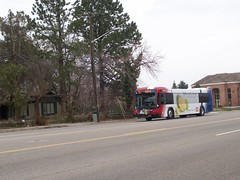
While going through the changes that will take place to bus service on April 26th, I noticed that UTA is quietly adding bus stops to many of the fast buses that were started in August.

When these bus routes first started, I pointed out that the negligibly increase in speed would not make up for the loss of potential riders due to fewer bus stops. For example my wife works at 3500 East and Bengal Blvd just around the corner from Smith’s. The old 32 bus used to provide direct service from our home to her work. The few times I took her to work I noticed that there was passenger standing at every bus stop along Bengal Blvd to catch the 32. How many of these people still took the bus when faced with a much longer walk just so the bus could be a few minutes faster?

What it comes down to is that the market potential for the slightly faster service does not equal the market penetration of the additional stops. This brings into question how well the 3500 South BRT line will do considering it is replacing the 35, not supplementing it.

UTA is not the only one to fallen into this trap. Amtrak the company that never learns from its history keeps making this mistake. On the northeast corridor between Washington DC and New York it has tried a non-stop or one stop express train several times in order to save a few minutes between the two points. However, every time they try it the train is discontinued in about a year because the time savings (most recently 10 minutes) does not justify the loss of riders from making fewer stops.

Metro in Los Angeles made the same mistake with the Gold Light Rail line. It created an express service but once again the time savings was not enough to justify not stopping. The train loadings become very uneven and this express service quietly died in the latest changes at Metro.

So how does this compare to Europe and Japan who are building a bunch of high speed rail lines or New York City that offers express subway trains?

Do you really think that France and the rest of Europe plus Japan just decide to build a high speed line for the fun of it, or because it would be cool? When they decide on which lines to build a high speed line they look at rail routes that are at capacity already. For example the first TGV route in France was between Paris and Lyon. This route was running over capacity so something had to be done so they built a new rail route. In addition, the TGV did not replace the regular trains between Paris and Lyon, it supplemented them.

In New York the situation is the same. The express subway service supplements the existing local subways that are already at capacity.

So when should fewer stop service be implemented?

Only to supplement existing service when that service is at capacity or you create a line were the time savings will create new marketing dynamics.