Today was the final day at Railvolution and the my final day in Portland.
There was two workshops today and I attended the one discussing employment centers near TOD and an introduction to complete streets. The first session had some good information from Los Angeles on the concentration of employment on the subway the sea which was followed by a presentation from a Bellevue, Washington planner discussing how that city is planning to develop two station areas beyond the downtown alignment controversy.
The session on complete streets showed what states have passed legislation mandating complete streets (which also points out how little is being done about it). The session also talked about some of the difficulties being experienced getting road engineers on the program because it isn't part of their "little black book".
Finally I went on my final mobile workshop of Railvolution which discussed some successes and difficulties of developing suburban TOD in the Portland area. We had the opportunity to check out several TOD projects and I will be discussing what was talked about on those tours and some of the things that was not talked about.
That finishes up my time at Railvolution and Portland. On Friday I head up to Seattle on Cascade Talgo operated by Amtrak. For anyone who has not had the opportunity to ride the Talgos in service in the northwest I highly recommned it.
Upon arrival in Seattle I had the opportunity to take my first ride on Link light rail but it was only through the downtown tunnel. From there I picked up a rental car since I will be heading to areas with poor transit service during the week and non-existant service on the weekends.
Showing posts with label Talgo. Show all posts
Showing posts with label Talgo. Show all posts
Sunday, October 24, 2010


Wednesday, March 10, 2010
This Week in Amtrak
 Image via Wikipedia
This Week at Amtrak; March 8, 2010
A weekly digest of events, opinions, and forecasts from
United Rail Passenger Alliance, Inc.
America’s foremost passenger rail policy institute
1526 University Boulevard, West, PMB 203 • Jacksonville, Florida
32217-2006 USA
Telephone 904-636-7739, Electronic Mail info@unitedrail.org
Volume 7, Number 8
Founded over three decades ago in 1976, URPA is a nationally known policy institute which focuses on solutions and plans for passenger rail systems in North America. Headquartered in Jacksonville, Florida, URPA has professional associates in Minnesota, California, Arizona, New Mexico, the District of Columbia, Texas, New York, and other cities. For more detailed information, along with a variety of position papers and other documents, visit the URPA web site at http://www.unitedrail.org
URPA is not a membership organization, and does not accept funding from any outside sources.
------------------------------------------------------------------------
Jack Benny, one of America's most beloved comedians and reputed tightwad extraordinaire, was perpetually 39 years old; Amtrak, this first of May, will join Mr. Benny at milepost 39. Benny's radio and television persona never sold his ancient Maxwell automobile, but Amtrak does seem to have traded in some sputtering old ideas for new ones.
First off, the news items:
* The State of Oregon reports it has purchased two new TALGO
trainsets
service between Eugene and Vancouver, British Columbia.
* Jolene Molitoris, currently Director of Ohio Department of
Transportation, and former Federal Railroad Administration chief,
this Wednesday "gave a passionate speech about ODOT" and the
nascent 3-C (Cleveland, Columbus, Dayton and Cincinnati) corridor.
According to "Linking Ohio
Molitoris emphasized "that no corridor has ever gone from zero
passenger rail options to high-speed rail in one step. She
described projects like in Maine and North Carolina that all
started with standard speed rail before upgrading to
higher-speed." Linking Ohio, which is a project of the 501(c)3
non-profit All Aboard Ohio, noted that improving current speeds --
39 mph average, 79 mph top speed -- needs to be the first phase
"of a larger passenger rail strategy."
* And then from North Carolina comes the news, according "The
not-so-fast track for high speed rail
(Stateline.org, 25 February 2010), that a "$520 million chunk [of
the Federal high speed funds]... will go toward 30 specific
improvements between Raleigh and Charlotte, and another $25
million will be used to reduce [rail] congestion between Raleigh
and Richmond, Virginia... Eugene Conti, North Carolina’s secretary
of transportation, says work on the upgrades will start within a
few months. The projects include adding more double-tracking that
would allow freight and passenger trains to pass each other and
separating rails from roads. The changes are designed to cut down
on delays for both trains and auto traffic."
* On the flip side, Buena Park, California may have to demolish a
brand-new passenger station if the planned high-speed trains whiz
past there without stopping (AP story, 8 March
and Florida's newly-awarded high-speed train is not planned to
connect with SunRail commuter trains (cable-only local news
"channel 13" story, 5 March
and commentary on The Infrastructurist
Doesn't anyone talk to anyone else anymore?
* Saturday's Amtrak Town Hall, sponsored by TRAINS magazine
(Kalmbach Publishing Co.) was the first of its kind.
Presentations, plans, and candid discussions indicate Amtrak has
some good people who are making real progress. More on this
shortly, but one remark overheard afterward was, "For the first
time I heard discussion of 'per revenue passenger mile' rather
than just 'per passenger.'"
* And a personal note: "Gentle Readers" is how Isaac Asimov -- a
modern-day Renaissance man, author of nearly 500 books, and my
chief inspiration to learn about science, arts, literature,
history and everything -- addressed his audience, and I will
occasionally use his phrase in remembrance.
Next, some feedback --
On the PIRG report, C.B. Hall writes:
I saw the document as an expression of advocacy, not an analysis of
high-speed rail's actual prospects. Chief among the obstacles - and
an obstacle I don't recall US PIRG even mentioning - is the
likelihood of political winds shifting in Washington, DC. We now
have a national administration that is exceptionally well disposed
towards passenger rail, but that administration has less than three
years to go. We're not going to get HSR, or even a major part of it,
done by the next presidential election. What we can get done is a
foretaste of HSR can ultimately do.
The investment should go to a very limited number of corridors where
visible results can be achieved on the shortest timeline. Three
years from now, we may have a national administration that returns
non-NEC HSR funding to the $25 million or whatever it was all
through the 1990s. That likelihood will decrease, however, if in the
meantime HSR in a few model corridors is far enough advanced to act
as good advertising to the rest of the country. Otherwise, the risk
of stagnation and skepticism only grows.
Yes, Mr. Hall, the report addressed "here's what we need and how we can get there" more than it asked, "what stands in our way." Being guardedly optimistic, it exemplifies elimination of once-widespread socialist dogma which stunted rail passenger advocacy for decades. Look, if you want to start an argument, propose a project that will "reduce Global Warming." If you want to get something done, propose a project that will "reduce Pollution." Same project, but which one will get built?
Eliminate the rhetoric from passenger train advocacy and let's get people moving.
To Mr. Hall's other point, a perfect example of a results-oriented approach is the San Diego Trolley, which built its first, highly successful, line at low cost, and proved its value to the community.
North Carolina is doing the right thing already: read on.
Regarding continued expansion of passenger rail, reader Stan Probstein asks:
[W]hy does Amtrak continue to be the best kept secret for rail
travel? Why isn't Amtrak advertising on cable networks like Fox News
channel, MSNBC and CNN as well as on the broadcast networks? How can
rail travel make a comeback if new rail ridership isn't informed?
True, the only market-specific advertising ever run in Phoenix by sputtering old Maxwell-style Amtrak was in 1996 to announce the closure of Union Station and the re-routing of the Sunset Limited. However, if updated thinking as was heard at this week's Chicago's Town Hall meeting is any indication, -- Stay tuned.
Now, let's look at a hypothetical 81-mile passenger train route. By the way, that happens to be the distance from Tampa to Orlando.
Key to investing our dollars wisely, is understanding the difference between Average speed and Top speed. Trains do not accelerate like sports cars; subway trains with their powerful electric motors accelerate at about 2.5 miles per hour per second, or in the parlance of race cars, "zero to 60 in half a minute or so." A conventional diesel-electric passenger train takes perhaps two minutes from a standing stop to 60 mph. Similar figures apply to slowing down. Thus, it is far more important to eliminate slow sections of track than it is to have short stretches of theoretical high speeds.
Amtrak today operates the 81-mile Orlando-Tampa route with six intermediate stops in almost exactly 2 hours - about 40 mph average speed. Eliminating most of the stops would save perhaps fifteen minutes, but at a severe impact to ridership and to the detriment of Kissimmee, Waldo, Ocala, Wildwood, Dade City, and Lakeland.
I have here a spreadsheet with rough estimations of times for a route with one station stop and a 1/4 mile section of 10mph (like a bridge or slow curve). Plugging in some sample numbers, let's look at what happens as we increase top speed.
top speed, *59* mph: *1 hour, 27 minutes*
top speed *79* mph with curve upgrade to 30mph: *1:08* (saves *19*
minutes)
*90* mph, *1:02* (saves an additional *6* minutes)
*110* mph, *53* minutes (saves an additional *9* minutes)
*168* mph, *44* minutes (saves an additional *10* minutes)
The biggest time savings comes from increasing the top speed to 79mph versus 59mph. Beyond 90mph, we save only twenty more minutes by nearly doubling that speed. Going three times as fast (180mph vs. 60) doesn't get you there three times as fast, either: only about twice as fast, because of acceleration and deceleration.
And the cost of a 168mph railroad is far beyond a 90mph railroad. Beyond 110, trains cannot share tracks with heavy freight trains, nor can there be grade crossings, so an entirely new guideway is needed.
Removing bottlenecks is the single best thing: upgrading that one curve to 30mph saves about 1 minute; to 59mph, about 2 min. Compare two minutes savings for the cost of a single curve or bridge against 20 minutes saved upgrading 80 miles of track, and you're looking at a pretty favorable cost-benefit ratio.
The practical impact is that incremental investments up to 79mph have direct, positive impact on freight and passenger trains alike; much above 90mph starts to diminish the utility of corridors for freight; and above 110mph removes passenger trains from most existing corridors, at stratospheric costs for new rights-of-way and without the benefit to industry and jobs that accrue from better freight service.
Looking again at North Carolina, Secretary Conti says that the high-speed funds there will result in noticeable "improvements in stations, on the track and with equipment in the next couple years...
Our focus is to show progress in the immediate sense..." (stateline.org)
Amtrak of late seems to be involved with sensible projects that will get built, like North Carolina's upgrades, while also talking refreshingly favorably about intercity routes at the Chicago Town Hall. Will America's modern passenger trains finally catch their stride at Amtrak's 39th birthday? Stay tuned, Gentle Readers.
\\/
William Lindley,
Scottsdale, Ariz.
------------------------------------------------------------------------
If you are reading someone else’s copy of This Week at Amtrak, you can
receive your own free copy each edition by sending your e-mail address to
freetwa@unitedrail.org
You MUST include your name, preferred e-mail address, and city and state
where you live. If you have filters or firewalls placed on your Internet
connection, set your e-mail to receive incoming mail from
twa@unitedrail.org
through any approvals processes for individuals. This mailing list is
kept strictly confidential and is not shared or used for any purposes
other than distribution of This Week at Amtrak or related URPA materials.
All other correspondence, including requests to unsubscribe should be
addressed to
wlindley@unitedrail.org
Copies of This Week at Amtrak are archived on URPA’s web site,
www.unitedrail.org
URPA leadership members are available for speaking engagements.
![Reblog this post [with Zemanta]](http://img.zemanta.com/reblog_e.png?x-id=06890325-dcb0-4df5-a41a-b6e8128e2e42)
Wednesday, September 30, 2009
This Week In Amtrak
 Image via Wikipedia
A weekly digest of events, opinions, and forecasts from
United Rail Passenger Alliance, Inc.
America’s foremost passenger rail policy institute
1526 University Boulevard, West, PMB 203 • Jacksonville, Florida 32217-2006 USA
Telephone 904-636-7739, Electronic Mail info@unitedrail.org • http://www.unitedrail.org
Volume 6, Number 38
Founded over three decades ago in 1976, URPA is a nationally known policy institute which focuses on solutions and plans for passenger rail systems in North America. Headquartered in Jacksonville, Florida, URPA has professional associates in Minnesota, California, Arizona, New Mexico, the District of Columbia, Texas, New York, and other cities. For more detailed information, along with a variety of position papers and other documents, visit the URPA web site at http://www.unitedrail.org.
URPA is not a membership organization, and does not accept funding from any outside sources.
1) The late Austin Coates, the founder of United Rail Passenger Alliance, was known to one and all as a courtly, Southern gentleman. Always quick with a friendly handshake, and at a times a poignant pause which was sincere in every way, he did have his grumpy moments in his later years. When Amtrak had been particularly naughty, he was known to say, “They ought to just pull ‘em over and park ‘em,” referring to Amtrak’s trains serving the various united states.
It’s hard to say at this moment what Mr. Coates would say about Amtrak’s naughtiness, but, in honesty, it may not be entirely fit for a family publication, such would be his many frustrations with Amtrak today.
Actually, his “pull ‘em over and park ‘em” may be just what needs to happen.
After that happened, then the parked trains should have a new paint job slapped on them (a la Amtrak Day, May 1, 1971), and a new operator should take over Amtrak’s route system; an operator which would actually be interested in running passenger trains.
Veolia? Herzog? Virgin? Where are you? We need you.
We have all been waiting months for Amtrak, with its fourth president (And, the current one only an interim president.) in less than 10 years, to come up with some – any – vision for the future. It hasn’t happened.
Reports have come (See the last issue of This Week at Amtrak.) Amtrak really isn’t interested in “slow trains,” but wants to jump into the high speed rail game, and place all of its focus there.
Ugh.
Since Amtrak can’t properly operate a conventional speed passenger rail system effectively, what proof is there Amtrak can operate a high speed rail system properly?
And, this one rather significant fact comes into play: High speed systems need conventional speed rail feeder system to make them work efficiently. Since Amtrak hasn’t accomplished that first, well, why would anyone with a rational mind entrust them with a whole new set of trains?
So, here’s the rational thought. If Amtrak management wants to go chasing after the future of high speed rail and compete with the likes of the successful European operators, we should let them. Shovel a few million bucks their way every year to keep the team together, and let them plot and plan to their collective hearts’ desire. It would be cheap by anyone’s measure to pay these folks to do something different.
While current Amtrak senior managers can work themselves silly in their new offices, real railroad managers, who not only know how to run a railroad, but WANT to run a passenger railroad, can take over Amtrak, and run and grow and expand the company the way it deserves to be run.
Veolia? Herzog? Virgin? Are you there?
All of these people like to run trains. Why not let them?
Here is what one TWA reader had to say after publication of the last TWA.
[Begin quote]
Here's a thought: why not simply invite TALGO to carefully replace train by train, line by line Amtrak's existing network, with TALGO assuming all maintenance on all Talgo equipment? The argument that TALGO can't use the NE Corridor's high level platforms is ridiculous; back in the mid-50's the New Haven Railroad's Talgo (John Quincy Adams) loaded and unloaded at the high level platforms in Grand Central Terminal on a daily basis.
A Talgo SILVER METEOR or a Talgo LAKE SHORE LIMITED are not difficult to imagine (including sleeping and dining facilities) and the Talgo tilt-feature would allow cuts in running time on EVERY route on EVERY train (imagine what a TALGO could do on the curvy route of the CARDINAL). TALGO is existing, proven technology THAT WORKS.
Washington state's Talgo CASCADES have a stellar record of reliability and passengers love them. Best of all, they're relatively INEXPENSIVE. What's not to like? As for FRA regulations, I have faith that serious Talgo engineering should be able to come up with acceptable solutions to all concerns about crashworthiness and safety.
[End quote]
Kind of makes you think, doesn’t it?
2) Who would be winners, and who would be losers in this process? What would it take to make this happen.
First, it would literally take an act of Congress. Congress created Amtrak, Congress keeps Amtrak alive, and Congress can transfer Amtrak to another management team.
Second, this is a no-brainer for Amtrak’s unions. Beyond Amtrak headquarters in Washington and the Northeast Corridor, there is literally an entire country full of Amtrak union workers who would love to have an expanded system to work on and help grow. A more aggressive passenger rail management would certainly require more workers, creating more union jobs.
Third, Amtrak’s current suppliers probably wouldn’t care who they sell to, as along as they are selling. No love lost there.
Fourth, Amtrak’s current state partners often question Amtrak’s rather high-handed approach to “partnerships,” and most likely would enjoy working with a more professional organization like Veolia, which already has contracts with over 500 cities and states around the world to run transit system.
Fifth, just to use on example, Veolia, under the leadership of Executive Vice President Ron Hartman, is filled on its front lines with some of the best ex-Amtrakers in the country (Mr. Hartman himself is a former Amtraker.).
Sixth, turning over the keys to the kingdom would be much easier today than it was on May 1, 1971; after all, a company completely in place is much easier to transition than putting together a new network made up of parts from over a dozen older networks.
We have all had enough of Amtrak’s foot dragging, whining, and inability to operate passenger trains in a professional manner. Amtrak has espoused no vision for the future, and somehow expects all of us to simply fall in line to what it says, without relevant questioning.
It’s time for that to stop.
It’s time for someone to be proactive.
It’s time for Amtrak as we know it today to come to an end, and a new operator for America’s tattered and tottering passenger rail system to come to the front and take over.
Every taxpayer in America will be better for it, and every Amtrak employee will have new, better employer with the ability to pay prevailing wages and offer better security.
All it takes is – literally – an act of Congress.
Call your congressman and senators today. You will be glad you did.
If you are reading someone else’s copy of This Week at Amtrak, you can receive your own free copy each edition by sending your e-mail address to
freetwa@unitedrail.org
You MUST include your name, preferred e-mail address, and city and state where you live. If you have filters or firewalls placed on your Internet connection, set your e-mail to receive incoming mail from twa@unitedrail.org; we are unable to go through any approvals processes for individuals. This mailing list is kept strictly confidential and is not shared or used for any purposes other than distribution of This Week at Amtrak or related URPA materials.
All other correspondence, including requests to unsubscribe should be addressed to
brucerichardson@unitedrail.org
Copies of This Week at Amtrak are archived on URPA’s web site, www.unitedrail.org and also on www.todaywithjb.blogspot.com where other rail-related writings of Bruce Richardson may also be found.
URPA leadership members are available for speaking engagements.
J. Bruce Richardson
President
United Rail Passenger Alliance, Inc.
1526 University Boulevard, West, PMB 203
Jacksonville, Florida 32217-2006 USA
Telephone 904-636-7739
brucerichardson@unitedrail.org
http://www.unitedrail.org
![Reblog this post [with Zemanta]](http://img.zemanta.com/reblog_e.png?x-id=d74bbf8f-6a44-4653-940c-ecc419c33b58)
Sunday, August 30, 2009
This Week In Amtrak
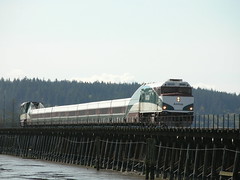 Image by Stephen Rees via Flickr
A weekly digest of events, opinions, and forecasts from
United Rail Passenger Alliance, Inc.
America’s foremost passenger rail policy institute
1526 University Boulevard, West, PMB 203 • Jacksonville, Florida 32217-2006 USA
Telephone 904-636-7739, Electronic Mail info@unitedrail.org • http://www.unitedrail.org
Volume 6, Number 33
Founded over three decades ago in 1976, URPA is a nationally known policy institute which focuses on solutions and plans for passenger rail systems in North America. Headquartered in Jacksonville, Florida, URPA has professional associates in Minnesota, California, Arizona, New Mexico, the District of Columbia, Texas, New York, and other cities. For more detailed information, along with a variety of position papers and other documents, visit the URPA web site at http://www.unitedrail.org.
URPA is not a membership organization, and does not accept funding from any outside sources.
1) Good ideas never go bad, they just sometimes are put on a shelf.
Over a full decade ago in 1998, the late Adrian Herzog, Ph.D., one of the original bright lights of United Rail Passenger Alliance, compiled a long term plan for the expansion of Amtrak.
Dr. Herzog, who by profession was a rocket scientist and university physics department chair professor, died far too young of a heart attack at his home in Northridge, California in February of 2001 at the age of 52.
Outside of the classroom, Dr. Herzog was a business partner with the late Byron Nordberg, also an original bright light of URPA. Dr. Herzog and retired United States Marine Corps Colonel Nordberg were the proprietors of NHA, Inc., a highly successful rail consulting firm based in Oceanside, California. NHA was the engine which brought the UTDC (now Bombardier) bi-level commuter passenger cars to Southern California for both Metrolink and the Coaster services. A very young Noel Braymer, now editor of the Western Rail Passenger Review and luminary in California passenger rail circles, and also an early associate of URPA, worked with Colonel Nordberg and Dr. Herzog.
The amount of work coming from Dr. Herzog was nearly unparalleled. He was one of the first, using early desktop computers, to create computer modeling for Amtrak passenger trains to measure performance and successfully predict future needs. Much of Dr. Herzog’s work has been featured on URPA’s web site, www.unitedrail.org and remains today as relevant as when it was created. Perhaps one of Dr. Herzog’s greatest accomplishments was the creation of the matrix theory, demonstrating how hubbing and end point connections are critical to the success of any passenger rail system.
2) One of the documents left by the untimely death of Dr. Herzog in this writer’s care was his plan of how a successful Amtrak would look in 2010, based on several presumptions made for 2000. Alas, those presumptions were not to be at that time, but it is fascinating to see Dr. Herzog’s vision for the future of Amtrak.
Dr. Herzog believed passenger rail was viable on three levels: as a carrier of leisure travelers, as a carrier of regional travelers moving about for any number of reasons, and as a carrier of business travelers seeking an efficient way to travel making the best use of their time in trips under five hours. Remember, in 1998 when this plan was conceived, things like Wi-Fi connections were not yet common, laptop computers were still bulky and heavy, and cellular telephones were in use by a far smaller percentage of the population.
Dr. Herzog and Colonel Nordberg also believed in two basic principles. First, every route should have at least three frequencies, and more if viable. One frequency would be as existing, a second frequency would follow six to 12 hours later so every city or town would have service at marketable times, and a third frequency mimicking the old milk run local trains, where every station had a stop. As you look at Dr. Herzog’s plan below, and see a train with a route name such as the North Coast Limited, imagine a flip schedule train such as the Mainstreeter providing the second frequency, and perhaps another named train for the local.
In some instances, the local train may better serve the route by being a series of shorter trains, such as on the Southern Crescent route between Washington, D.C. and New Orleans, where two separate day trains may provide the best level of service versus one longer train, by providing one train operating between Washington, D.C. and Atlanta, and a second day train operating between Atlanta and New Orleans. The first two trains, the Southern Crescent and the (to pick a name) Peach Queen would run the entire route, and the two day trains serve as the “local” option on two separate ends of the route.
Second, they believed passenger train routes did not always have to be in a straight line. They both favored “L” shaped routes where possible, such as taking the Lake Shore Limited from New York City to Chicago, and extending the western terminus of this train south to Memphis, Tennessee to make maximum use of equipment, and build as many city pair combinations as possible into the matrix theory.
Dr. Herzog’s plan focused primarily on a robust long distance network. Some of today’s short distance trains would be replaced by long distance trains (more efficient in many ways), but some regional services as we know them today would continue. Since this was a broad blueprint, many of the minor, regional services were not mentioned, but Dr. Herzog implied each would be retained based on productivity and cost.
3) Here is Dr. Herzog’s plan, with some updates for changes which have taken place in the last 11 years.
[Begin quote]
Strategic Routes for Amtrak
A Planning Document
October 25, 1998 • Updated 2008
Prepared by Dr. Adrian Herzog, URPA • Northridge, California
Strategic Goal: Output equal to five times the revenue passenger miles produced in FY 2000, achieved by Year 7 of the strategic plan.
This document was originally prepared by the late Adrian Herzog, Ph.D. in October 1998, and updated a decade later in 2008. The breadth of the document demonstrates the foresight of Dr. Herzog in his quest to make passenger rail in his adopted country subsidy-free.
The planning concepts for this document came from several sources, including historic successful passenger train routes and connectivity points, current travel patterns in the United States for both leisure and business travel, and travel to and from major vacation destinations. As an example, more travelers come to New Orleans from Houston, Texas than any other location.
Other factors taken into consideration are population shifts and population growth in new areas, military installations, and locations of major colleges and universities. Additional factors, such as cruise ship terminals were also considered.
Tactical Goal: Maximize network density of flow by maximizing route inter-connectivity, and multiple frequency (2 to 4) trains per route, per day.
National Corridors
• Southern Transcontinental Corridor
• Southwest Transcontinental Corridor
• Central Transcontinental Corridor
• Northern Transcontinental Corridor
• Atlantic Coast Corridor
• Pacific Coast Corridor
• Southwest Corridor
• Central California Corridor
• Pacific Northwest Corridor
• Chicago-Midwest Corridors
• Florida Corridor
• Gulf Coast Corridor
• Texas Triangle
• International links to Canada and Mexico
• Northeast Corridor low level long distance trains
Equipment Types
• Superliner Service
• California Car Service — Use of the successful daylight California Car/Superliner compatible bi-level equipment for non-overnight trains
• Talgo Service
• Viewliner Service — Conversion of existing fleet single level cars. This Includes: Viewliner, Amfleet, and Horizon
Power Types
• Genesis (Long distance trains)
• F59PH (Corridors)
• AEM-7 (NEC Long distance trains)
Crew Bases
• Seattle
• San Jose
• Los Angeles
• San Diego
• Denver
• Fort Worth
• Chicago
• New Orleans
• Tampa
• Sanford (Auto Train T&E only)
• Miami
• Charlotte
• Newport News
• Norfolk
• Philadelphia
• Boston
• Vancouver/VIA Rail Canada
Maintenance Bases and Principal Commissaries
• Vancouver, British Columbia/VIA Rail Canada
• Seattle
• Eugene, Oregon
• San Jose
• Los Angeles
• San Diego
• Denver
• Fort Worth
• Chicago
• New Orleans
• Tampa
• Sanford (Auto Train/racks only)
• Miami
• Charlotte
• Newport News
• Philadelphia
• Boston
Turn Maintenance and Commissary Support
• Vancouver, British Columbia/VIA Rail Canada
• Toronto/VIA Rail Canada
• Montreal/VIA Rail Canada
• Boston
• Washington
• Lorton
• Newport News
• Norfolk
• Cleveland
• Detroit
• Chicago
• Eugene, Oregon
• Seattle
• San Francisco
• Lancaster, California
• Redding, California
• Reno
• Santa Barbara
• Las Vegas
• Nogales
• Duluth
• Kansas City
• St. Louis
• Memphis
• Birmingham
• Charleston, South Carolina
Southern Transcontinental Corridor
Sunset Limited – Los Angeles, Tucson, El Paso, San Antonio, Houston, New Orleans, Jacksonville Orlando, Tampa
Superliner Service
Golden State – Los Angeles, Phoenix, Tucson, El Paso, Abilene, Fort Worth, Dallas, St. Louis, Chicago, Detroit, Toronto
Superliner Service
Southern Crescent – New Orleans, Atlanta, Washington, DC
Superliner Service
Gulf Breeze – New Orleans, Mobile, Montgomery, Birmingham, Atlanta, Washington, DC, Philadelphia, New York, Boston
Viewliner Service
Gulf Wind – Houston, New Orleans, Mobile, Pensacola, Tallahassee, Jacksonville, Orlando, Tampa
Superliner Service
Continental – Los Angeles, Phoenix, Tucson, El Paso, Abilene, Fort Worth, Dallas, Atlanta, Washington, DC
Superliner Service
Southwest Transcontinental Corridor
Southwest Chief/Capitol Limited – Los Angeles, Albuquerque, Kansas City, Chicago, Pittsburgh, Washington DC, Newport News
Superliner Service
San Francisco Chief – San Jose, Oakland, Bakersfield, Albuquerque, Kansas City, St. Louis, Chicago
Superliner Service
Grand Canyon Limited – Los Angeles, Albuquerque, Denver
Superliner Service
Zia – Denver, Albuquerque, Las Cruces, El Paso
Superliner Service
El Capitan – Chicago, Kansas City, Flagstaff, Phoenix, Tucson
Superliner Service
Central Transcontinental Corridor
California Zephyr – Los Angeles, San Jose, Oakland, Reno, Salt Lake City, Provo, Denver, Chicago
Superliner Service
Overland Limited – Los Angeles, Las Vegas, Provo, Salt Lake City, Ogden, Laramie, Denver, Omaha, Chicago, Cleveland, Boston
Superliner Service
Pioneer Zephyr – Vancouver BC, Seattle, Portland, Ogden, Salt Lake City, Provo, Denver, Newton, Oklahoma City, Fort Worth, Dallas, Houston, New Orleans
Superliner Service
George Washington – Kansas City, St. Louis, Louisville, Cincinnati, Charleston WV, Charlottesville, Richmond, Newport News
Superliner Service
Cavalier – Fort Worth, Dallas, Little Rock, Memphis, Chattanooga, Knoxville, Roanoke, Lynchburg, Charlottesville, Washington
Superliner Service
The Memphian – Fort Worth, Dallas, Little Rock, Memphis, Nashville, Louisville, Cincinnati, Charleston WV, Charlottesville, Richmond, Newport News
Superliner Service
Northern Transcontinental Corridor
Empire Builder – Vancouver BC, Seattle, Yakima, Spokane, Minneapolis, Chicago, Indianapolis, Cincinnati, Newport News
Superliner Service
North Coast Limited – Seattle, Spokane, Missoula, Butte, Bozeman, Billings, Bismarck, Minneapolis, Chicago
Superliner Service
Hiawatha – Eugene, Portland, Spokane, Minneapolis, Chicago
Superliner Service
Broadway Limited/Three Rivers – Duluth, Minneapolis, Chicago, Cleveland, Pittsburgh, Philadelphia, New York, Boston
Viewliner Service
Pennsylvanian – Kansas City, Chicago, Pittsburgh, Harrisburg, Philadelphia
Viewliner Service
New England States – St. Louis, Chicago, Toledo, Cleveland, Buffalo, Albany, Springfield, Boston
Viewliner Service
Pacemaker – Chicago, Toledo, Cleveland, Buffalo, Albany, New York, Philadelphia
Viewliner Service
Lake Shore Limited – Memphis, Chicago, Toledo, Cleveland, Buffalo, Albany, New York, Boston
Viewliner Service
Steeler – St. Louis, Indianapolis, Pittsburgh, Harrisburg, Philadelphia
Viewliner Service; Crew Base: Philadelphia
Columbian – Denver, Chicago, Cleveland, Pittsburgh, Washington DC, Newport News
Viewliner Service
Oriental – Vancouver BC, Edmonton, Winnipeg, Minneapolis, Chicago, Detroit, Toronto (Seasonal)
Viewliner Service
Atlantic Seaboard Corridor
Silver Meteor – Miami, Orlando, Jacksonville, Charleston, Rocky Mount, Richmond, Washington, Philadelphia, New York, St. Albans, Montreal
Viewliner Service
Silver Star – Miami, Ocala, Jacksonville, Columbia, Raleigh, Richmond, Washington, Philadelphia, New York, Boston
Viewliner Service
The Sunland – Tampa, Orlando, Jacksonville, Columbia, Raleigh, Richmond, Washington, Philadelphia, New York, Boston
Viewliner Service
Everglades – Miami, Daytona Beach, Jacksonville, Columbia, Raleigh, Richmond, Washington, Philadelphia, New York, Buffalo, Toronto
Viewliner Service
Auto Train, (Passenger section) – Tampa, Orlando, Sanford, Jacksonville, Savannah, Charleston, Rocky Mount, Richmond, Lorton, Washington, Pittsburgh, Cleveland (All station stops)
Superliner Service
Auto Train, (Car carrier section) – Sanford, Lorton
City of New Orleans – Tampa, Orlando, Jacksonville, Mobile, New Orleans, Chicago, Detroit, Toronto
Superliner Service
City of Miami – Miami, Orlando, Jacksonville, Charleston SC, Rocky Mount, Richmond, Charlottesville, Charleston WV, Cincinnati, Indianapolis, Chicago
Superliner Service
Flamingo – Tampa, Orlando, Jacksonville, Savannah, Macon, Atlanta
California Car Service
Silver Comet – Miami, West Palm Beach, Daytona Beach, Jacksonville, Savannah, Macon. Atlanta, Birmingham
Superliner Service
The Resort Special – Miami, West Palm Beach, Daytona Beach, Jacksonville, Savannah, Columbia, Raleigh, Richmond, Washington, Philadelphia, New York, Boston
Viewliner Service
Champion – Miami, West Palm Beach, Daytona Beach, Jacksonville, Savannah, Charleston, Rocky Mount, Richmond, Washington, Philadelphia, New York, Long Island
Viewliner Service
Gulf Coast Special – Tampa, Orlando, Jacksonville, Savannah, Charleston, Rocky Mount, Richmond, Washington, Philadelphia, New York, Long Island
Tidewater – Charleston, Florence, Fayetteville, Rocky Mount, Franklin, Suffolk, Norfolk
California Car Service
Piedmont – Charlotte, Raleigh, Rocky Mount, Franklin, Suffolk, Norfolk
California Car Service
Southern States – Tampa, Ocala, Jacksonville, Savannah, Columbia, Hamlet, Charlotte
California Car Service
Palmland – Miami, West Palm Beach, Orlando, Jacksonville, Savannah, Columbia, Hamlet, Charlotte, High Point, Greensboro, Danville, Charlottesville, Washington, Philadelphia, New York, Boston
Viewliner Service
Rue Orleans – New Orleans, Mobile, Montgomery, Birmingham, Nashville, Louisville, Cincinnati, Columbus, Cleveland, Buffalo, Syracuse, Montreal
Superliner Service
Southwind – Miami, Orlando, Jacksonville, Savannah, Columbia, Raleigh, Richmond, Washington, Pittsburgh, Cleveland, Toledo, Detroit
Superliner Service
Pacific Coast Corridor
Coast Starlight – Los Angeles, San Jose, Oakland, Sacramento, Eugene, Portland, Seattle
Superliner Service
Shasta Daylight – Los Angeles, Bakersfield, Fresno, Sacramento, Eugene, Portland, Seattle, Vancouver BC
Superliner Service
Columbia Starlight – Los Angeles, Las Vegas, Provo, Salt Lake, Ogden, Pocatello, Portland, Seattle
Superliner Service
Southwest Corridor
Pacific Surfliners – San Diego, Los Angeles, Santa Barbara, San Jose, San Francisco
Joint Talgo and California Car Service
High Desert – San Diego, Los Angeles, Palmdale, Lancaster
California Car Service
Las Vegans/South – San Diego, Santa Ana, Riverside, San Bernardino, Barstow, Las Vegas
Talgo Service
Las Vegans/North – Santa Barbara, Los Angeles, El Monte, San Bernardino, Las Vegas
Talgo Service
Arizonan – Los Angeles, Riverside, Palm Springs, Indio, Yuma, Phoenix, Tucson, Nogales
Talgo Service
Grand Canyon – Nogales, Tucson, Phoenix, Williams Junction, Grand Canyon
Talgo Service
Central California Corridor
San Joaquins I – San Jose, Oakland, Fresno, Bakersfield, San Bernardino, Santa Ana, San Diego
California Car Service
San Joaquins II – Bakersfield, Fresno, Sacramento, Redding
California Car Service
Capitols – San Jose, Oakland, Sacramento, Reno
Joint Talgo and California Car Service
Pacific Northwest Corridor
Cascades — Eugene, Portland, Seattle, Vancouver BC
Talgo Service
Chicago-Midwest Corridors
Train of the Saints — St. Paul (Minneapolis), La Crosse, Galesburg, Fort Madison, St. Louis
California Car Service
The Motor City — Kansas City, St. Louis, Chicago, Detroit
California Car Service
The Midwesterner — Omaha, Chicago, Cleveland
California Car Service
The Brewer — Minneapolis, Milwaukee, Chicago, Detroit
California Car Service
The City of Nashville — Chicago, Indianapolis, Louisville, Nashville
California Car Service
Florida Corridor
Seminole – Pensacola, Tallahassee, Jacksonville
California Car Service
Tampa Bay – Jacksonville, Orlando, Tampa
California Car Service
Henry Flagler – Jacksonville, Daytona Beach, West Palm Beach, Miami
California Car Service
Citrus State – Jacksonville, Ocala, West Palm Beach, Miami
California Car Service
Florida Palm – Tampa, West Palm Beach, Miami
California Car Service
Gulf Coast Corridor
Gulf Coast Limited – Houston, New Orleans, Mobile
California Car Service
Iron Mountain – New Orleans, Mobile, Montgomery, Birmingham
California Car Service
Louisiana Eagle – New Orleans, Baton Rouge, Shreveport, Dallas, Fort Worth
California Car Service
Texas Triangle
Texan – Dallas, Fort Worth, Austin, San Antonio, Houston, Dallas
California Car Service
Northeast Corridor (Extended Service Area, in addition to NEC Acela and Regional Service)
Mid Atlantic – Pittsburgh, Philadelphia, Baltimore, Washington DC, Richmond, Newport News (Viewliner Service)
Maple Leaf/Montrealer – Boston, Albany, Toronto, and New York, Albany, Montreal (Cross Platform at Albany)
Viewliner Service
Royal Blue – Newport News, Washington DC, Baltimore, Philadelphia, New York, Long Island (Viewliner Service)
Bostonian – Boston, New York, Allentown, Harrisburg
Viewliner Service
Shenandoan – Boston, New York, Philadelphia, Washington, Charlottesville, Cincinnati Viewliner Service
∙ Note: (Viewliner Service) implies any low level conventional long distance and intermediate distance trains including Amfleet, Horizon, and Viewliner
[End quote]
If you are reading someone else’s copy of This Week at Amtrak, you can receive your own free copy each edition by sending your e-mail address to
freetwa@unitedrail.org
You MUST include your name, preferred e-mail address, and city and state where you live. If you have filters or firewalls placed on your Internet connection, set your e-mail to receive incoming mail from twa@unitedrail.org; we are unable to go through any approvals processes for individuals. This mailing list is kept strictly confidential and is not shared or used for any purposes other than distribution of This Week at Amtrak or related URPA materials.
All other correspondence, including requests to unsubscribe should be addressed to
brucerichardson@unitedrail.org
Copies of This Week at Amtrak are archived on URPA’s web site, www.unitedrail.org and also on www.todaywithjb.blogspot.com where other rail-related writings of Bruce Richardson may also be found.
URPA leadership members are available for speaking engagements.
J. Bruce Richardson
President
United Rail Passenger Alliance, Inc.
1526 University Boulevard, West, PMB 203
Jacksonville, Florida 32217-2006 USA
Telephone 904-636-7739
brucerichardson@unitedrail.org
http://www.unitedrail.org
![Reblog this post [with Zemanta]](http://img.zemanta.com/reblog_e.png?x-id=116d228f-3772-4a70-95e4-eedac1c456f5)
Subscribe to:
Posts (Atom)