Thursday, April 28, 2011

This Week in Amtrak

(Amtrak 345, an EMD F40PH pulls a passenger tr...Image via Wikipedia
Volume 8, Number 7

From the Editors…

Recently, Amtrak released its updated fleet strategy plan. What a difference a year makes.

A Tale of Two Strategies

At first blush, it would appear the primary difference between Amtrak’s Fleet Strategies of February 2010 and February 2011 is a thorough going over by our very own proofreader here at This Week. (For the record, she vehemently denies this, but the investigation is on-going.) Upon closer inspection, it becomes obvious certain realities are now being accepted. Before going any further it should be known that the original document and its update are of a high quality and represent the obvious expenditure of many hours of effort.

The updated report acknowledges the orders of 130 single-level cars for Eastern long distance service and 70 electrics for the Northeast Corridor. Priorities held over from 2010 are the replacement of 250 Superliner I's and the development of “a new fuel-efficient high speed diesel locomotive.” New to the priority list are: Replacement of 145 Amfleet II's, developing a “bi-level corridor car to replace single-level cars where clearances permit, adding two cars each to the existing Acela fleet (40 new cars total), and planning the next generation of high-speed trains. Total estimated cost of this 30 year plan is $25.2 billion.

Replacement of the single-level long distance coaches, Amfleet II, has now been moved ahead of the Amfleet I replacement. Why? Despite being a few years newer, the average mileage for an Amfleet II car is 1.4 million miles over an Amfleet I. Truth be told, the Amfleet design was never meant for long-distance service, yet they have performed adequately for over 30 years; a true testament to the construction of the Budd Company. CAF USA has a very tough act to follow, constructing the 130-piece Viewliner 2 order. There are 145 Amfleet II’s in service but the Fleet Strategy does not specify how many new cars will be ordered. If CAF USA gets a chance to build a coach variant of the Viewliner 2 platform, then we could possibly see uniform trainsets in the east, something which has not happened since the introduction of the Amfleet II’s in 1980. Do you believe in miracles?

In 2010, “long distance” services were defined as “more than 600 miles,” whereas in 2011 it is “more than 750 miles.” No doubt this is a sign of inflation. Also curious is the statement that the long-distance trains “have grown around 2 percent annually,” although “Table 8: Amtrak Ridership Growth FY06-10” demonstrates that long-distance trains were the only service during those five years not to have a negative ridership growth; even during the doldrums of 2009. Average growth on the long-distance trains according to Amtrak’s data was 3.7 percent for the last five years, a fact all the more fascinating when one takes into account there has been no addition to the equipment of these trains in over a decade.

A significant difference between the two reports is the acknowledgment of Amtrak’s Office of the Inspector General (OIG). The OIG is evaluating the original report, and will issue its own report this year. “We look forward to receiving the final OIG report and we will continue to work with the OIG to ensure that its insights are incorporated in the next fleet plan update as appropriate.” Where was the OIG during the original report? Oh, right.

In both reports the Horizon fleet of regional-distance cars is panned: “These cars suffer from a variety of operational problems in cold temperatures and winter conditions.” Interestingly these cars are a variant of an original Pullman-Standard commuter car design which has gained acceptance in New Jersey, New York, Connecticut, Pennsylvania, and Massachusetts, none of which are known for their balmy winters. The solution for 2011 is a new fleet of 125 bi-level cars ostensibly patterned after the cars used in regional service in California. As these cars do not have any operating history in the extremes of the Midwest, this will be an interesting experiment. Although the “California cars” appear to be similar to Superliners, the difference is in the details. Superliners have their Head End Power (HEP) and Multiple Unit (MU) cables well above the ground and away from snow and ice buildups. California cars have their cables astride their couplers, as is standard with most other equipment. Superliners have successfully pinch hit for Horizon cars in Midwest services during wintertime. If one expects California cars to perform to the same level as the Superliners, one may be in for an unpleasant surprise.

One other curious statement as regards the potential routes for the new bi-level cars: “The only other exception would be Amtrak’s Hoosier State/Cardinal Service between Chicago and Indianapolis, which would continue to use single level equipment because of clearance constraints on the Cardinal route.” Trains between Chicago and Indianapolis have always ferried equipment to and from Beech Grove, Amtrak’s maintenance facility just outside Indianapolis. The deadheading equipment does include cars from Amtrak’s current bi-level fleet: Superliners, Superliner II’s and California cars.

The plans for Acela were wide and varied in 2010. By 2011, the choices have been narrowed: “There is a compelling case for an additional two cars for each set… [the extra cars] will deliver a positive return even if the trains were replaced in 2023.” Moreover, the desire is expressed for an additional 20 trainsets “of a new rather than the existing design and delivery would begin in 2017.” Apparently they have learned one lesson.

Unfortunately, both reports address the potential utility of self-propelled diesel cars or Diesel Multiple Units (DMUs). Not that there is anything wrong with DMUs in and of themselves; however, they are best suited to commuter operations. Amtrak is NOT a commuter railroad, and provides operating crews under contract to a handful of commuter operations around the country. If one of these commuter lines provides DMUs for its operation, so be it; but Amtrak should not be taking the lead on this.

It is recognized in the reports that: “Suppliers need a constant stream of work to ensure that there is sufficient business to support a competitive supplier base and avoid the boom and bust cycles in the past.” This work-fare program of equipment sustainability is the sort of thing a state-owned/operated polity should have pursued since its inception. Well, better late than never. The plan calls for an average of 65 single-level and 35 bi-level cars per year starting in 2012 and 2014, respectively.

Both reports speak of the need for the development of future equipment. The 2011 edition refers to the Next Generation Equipment Committee (NGEC), whose stated goal is “to promote the creation of a pool of standardized, interoperable equipment that could be used by Amtrak and the states in various state-sponsored corridors with flexibility and efficiency.” In light of Amtrak’s past history of equipment, standardization would be a vast improvement. This is, however, a double-edged sword. Such a mandate would mean ostracizing non-standard equipment such as the state-owned Talgo trainsets in Cascade and Hiawatha services. Standardization to the exclusion of innovation has a history of long-term negative consequences. Fifteen years ago, ABB Traction withdrew its product, the X2000, from contention for use in the NEC. The X2000 achieved higher speeds on conventional track through the use of radial steering trucks and active tilting. Since no other bidder could offer radial trucks, it was not included in the Federal bid request, and ABB realized it could not succeed in the face of cheaper, inferior products.

Perhaps the largest sign of change is what was not held over from the original report, the “Calculation of required added cars per set” toward the back of the report. Originally hypothesized were the train consists as they might appear for FY18 and FY23. When first released in 2010, it was these charts which caused many a confused look even from the most ardent Amtrak apologists. For 2018, 10 of the 14 long distance trains would receive one extra sleeping car. By 2023, four more trains would have added one more sleeper; yet this very same chart reports the 2008 load factors for the sleepers, and none are below 80%. Two trains are tied at 94 percent. None of Amtrak’s regional or corridor offerings even come close to matching this load factor. It is also no secret that fares for traveling by sleeping car are especially dear. Even so, sleeping cars are what the traveling public craves. Why? There could be many postulated reasons: An aging population, TSA fatigue, etc. We at This Week do not know the true reason for this trend, but it really is academic. The public has voted with its wallet, demanding sleeping car space.

Through Amtrak’s typical “framing mischief by decree,” it has made it abundantly clear that it is loathe to reinstate trains such as the Pioneer, North Coast Hiawatha, or Eastern leg of the Sunset Limited. Even so, it does acknowledge the growth in long-distance demand. “This gradual increase in demand can be satisfied through the progressive replacement of equipment and lengthening of existing train consists.” Limiting the increase, however, of already paltry long-distance trains by a mere one or two cars just does not correspond with reality. Long-term success of any business requires change, to support changing demand. In the past, the speed at which Amtrak responded to such change was glacial, at best. Amtrak has not received any new equipment since 2002. It may already be too late. After 40 years, it should be getting it right. If not, then perhaps it is really time to let someone or something else have a turn.
Enhanced by Zemanta

Friday, April 08, 2011

The 176 is saved but...

Photo of the new "poppy orange" Metr...Image via Wikipedia
I few weeks ago I went over some of the trials and tribulations of  the Los Angeles Metro Route 176 that travels from Highland Park to El Monte. For now the 176 has been saved from extinction, but will the changes going to help the 176 survive in the long run?

Originally Metro planned to replace the eastern portion of route 176 from the area of the San Gabriel Mission to El Monte with an extension of route 287 that currently travels from the Montebello Mall to El Monte creating a "U" shaped route.

Instead Metro will interline the 176 and 287 so when a 287 bus arrives at El Monte station it will change its headsign to 176 and visa versa.Service on the 287 will be reduced from every 30 minutes to every 45 minutes but the frequency of the 176 will go from a horrible every 70 minutes to a more reasonable every 45 minutes.

The question is, will this do anything to help the 176 or are we putting lipstick on a pig?

1. Will the Frequency Increase help the 176?

It might help slightly but it still is not a memory friendly timetable and in the Metro report there is not a mention of what will happen to rush hour frequency on the eastern portion of the line that is already every 35-minutes.

2. Does this address any of the destination issues with the 176?

No, there is no change in the actual route although there will now be a one seat ride for riders on the 176 to the Montebello Mall although Metro may not even put this in the timetables and for 95% of the riders of the 176 going to Montebello Mall via El Monte is substantially out of the way.

In addition this does nothing to address the issues that exist on the western portion of the route. Mainly that it serves no destinations that riders along the route want to travel to except with multiple transfers.

In other words, the changes to the 176 do not address the fundamental problems with the route. In an ideal world it would be wonderful if all the points that needed to be served by a bus (or for that matter rail) route but we do not live in an idea world. We have to look at service beyond straight corridors and look at getting bus service to the most rider generators and reworking weak lines to hit more of those generators.

Enhanced by Zemanta

Tuesday, April 05, 2011

This Week in Amtrak

Train #306 heading into Springfield from St. L...Image via Wikipedia
This Week at Amtrak Vol. 8 No. 6
Volume 8, Number 6

From the Editors…

There is a lot of talk these days of “passenger rail.” This week we attempt to separate reality from hyperbole.

The Definition of Success; The Price of the Definition

“What is the value added?” or similar questions are asked whenever any enterprise considers expansion, upgrade or reorganization. In principle it is a simple exercise; will future generations see this investment of time and resources as valuable or worthless? In the mania that has defined passenger railroading for the second decade of the 21st Century, one fact has become crystal clear, and that is that very few can accurately define what the value added is for passenger trains.

This is not to say that those promoting new trains are doing so out of shear ignorance or malfeasance. Many of these efforts are well meant. This past February, the Administration called upon Congress for a $53 billion down payment on high-speed rail for the country to enhance mobility and create work-fare. The goal was to provide access to fast trains for 80 percent of the country in 20 years. The general response was “Would you like fries with that?” More recently, two actors from a period-piece cable television drama performed, in character, a skit promoting the virtues of high-speed trains. The idea, if not the allure, of sleek, fast, sexy transportation seems positive and for good reason, because it is; however, the path from the trains of today and the trains of tomorrow is not as straight, short, or simple as one would be led to believe.

All around this great land of ours there are mixed signals as to the future of new passenger trains, let alone improvement of those extant. Passenger rail went from a Washington missive to center stage in many regional elections. As a result, planned projects in Wisconsin, Ohio, and Florida came to naught. In California, plans are moving forward to build a high-speed railroad as far out in the country as possible so as not to attract any attention. As a result of the many rejections, once-ostracized states of the Northeast are now allowed to bid for the now unwanted Federal dollars to improve Amtrak’s Northeast Corridor.

Despite these false starts, there has been meaningful progress on many fronts for the augmentation of passenger trains. In just the last month, Washington State received its grant of $590 million for improvements between Portland, Oregon, and Seattle. In North Carolina, $461 million was received for upgrades to its Raleigh-to-Charlotte route. And in Illinois, $685 million was realized to continue improvements from Chicago to St. Louis, Missouri. Some $1.736 billion of taxpayer monies have been doled out for worthwhile projects around the country.

It is still early in the decade, but a definite trend has started to take shape regarding the future of domestic passenger trains. At one end of the spectrum, the assumed silver bullet [train] which was to herald the new era of national HSR transportation was nixed in Florida. It would have run on an independent right-of-way with no direct connection to the rest of the National system. The “3C” service cancelled in Ohio was not HSR but rather an upgrade of existing freight-only trackage, most of which has not seen passenger trains for four decades. Even with the blessing of the current owners, the enhanced track was not going to be of too much benefit to freight, as Cincinnati to Cleveland via Columbus is not a natural through-freight corridor. The stalled extension of Hiawatha service from Milwaukee to Madison, Wisconsin, also not true HSR, did plan to make use of an existing passenger route as far as Watertown. From there, a nearly-abandoned freight line would have been completely rebuilt for passenger speeds. West of Watertown, the line sees minimal traffic currently handled by a short line.

The successes seen in Washington, Illinois, and North Carolina are another matter, altogether. What do they have in common?

All are pre-existing state-supported services. Washington started daily service in 1994 using trainsets made by Talgo. The Chicago-to-St. Louis service has existed in many guises since the beginning of Amtrak, and was once home to the French-made Turbo trains. (With Talgo reportedly relocating to Illinois, perhaps the Lincoln service will see yet another iteration of exotic equipment.) North Carolina’s intrastate train service started in 1995 and utilizes its own fleet of equipment.

All are on track owned (or operated) by freight railroads. The track in Washington State is a major corridor for BNSF, linking the Pacific Northwest with Canada. Even so, they have proven time and again to be willing partners with the local authority for operating the Cascade services. In Illinois, the line between St. Louis and Chicago is Union Pacific’s shortest route between the two cities. North Carolina’s Piedmont trains utilize Norfolk Southern’s main line from Greensboro to Charlotte. This track is currently undergoing capacity expansion as part of the Crescent Corridor initiative.

All currently host long-distance Amtrak trains. In Washington State the route of the Cascades is also part of the route for the Coast Starlight. The Illinois Lincoln service also hosts the daily Texas Eagle, while North Carolina’s Piedmont shares the same track with the Crescent between Greensboro and Charlotte.

In Washington, overall track capacity will increase with completion of the Point Defiance bypass. This bypass will obviate a single track tunnel and will be used by the Cascades, local commuter, as well as long-distance trains. Union Pacific plans for increased freight traffic on the Illinois line once upgrades are complete. North Carolina will add 28 miles of double track between Charlotte and Greensboro, part of the aforementioned Crescent Corridor. The planned enhancements for all three of these routes not only aid the regional and freight trains, but also increase the viability of long-distance trains; it is like getting three for the price of one. Now that is value added!

There is virtually no end to the possible public/private synergies around the country. In Virginia, passenger service will be returned to Norfolk (using State funds). The line from Norfolk to Petersburg is the Eastern end of Norfolk Southern’s recently upgraded Heartland Corridor connecting tidewater to the Midwest. Recently, the state of Missouri applied for Federal high-speed money to increase speeds between St. Louis and Kansas City. This is the route of the State-supported Missouri River Runner, and operates over the tracks of Union Pacific. Another plan under consideration is a daily train connecting Dallas to Eastern Texas. Currently, the daily Texas Eagle runs between Marshall and Dallas; westbound in the morning, eastbound in the evening. A counterpart train would run on opposite schedules with a possible extension to Shreveport, Louisiana. This would necessitate capacity expansion on the 150-mile route also owned by Union Pacific. Enhanced service between Oakland, California and Reno, Nevada is also a possibility. Currently, the route between Oakland and Auburn sees daily service as part of California’s Capitol Corridor, including the daily California Zephyr. Pushing the corridor past Auburn to Reno, 118 miles, may require capacity expansion over famed Donner Pass; predominantly re-laying much of the second track removed prior to Union Pacific’s accession of the route in 1996.

As the nation continues to adjust from the economic correction of the last few years it is evident we are a people defined as “risk averse.” Houses are not selling even though there are those who should be able to afford such. The numerous vacant automobile dealerships that now dot the landscape are further evidence of our new-found fiscal conservatism. The progress being seen in Washington, Illinois, and North Carolina demonstrate the public will to invest in the “tried and true,” where return on investment may be easily calculated and expedited.

Of all the trains run by Amtrak, it is the long-distance fleet which has garnered consistently increasing passenger loadings despite the downturn of the economy. To those inured by the high-speed-rail mentality sweeping the nation, these “slow trains” do not fit the prepackaged ideal; however, it must be understood that no high-speed train anywhere on earth was built without something predicating it. It must also be recognized that the United States has been limping along on a skeletal passenger rail network for four decades. If there is to be a true high-speed rail network, it must be preceded by a true conventional rail network.

The simple if painful truth is that a legitimate high-speed train is not a few years or even a decade away. A genuine network of meaningful passenger trains will have to be reestablished before going any further. This is a process that could conceivably take at least a generation, and no decree of imperious immediacy can change this. The latter half of the 20th Century was defined by America’s embrace of the automobile. This did not happen overnight. The return to rail-based transportation will also be a long-term transition; perhaps too long to satisfy those overly concerned about their legacy in the annals of history.
Enhanced by Zemanta

Monday, April 04, 2011

Guest Post

Interior of the upper level of a Bombardier bi...Image via Wikipedia
This is a guest post by All Resort Transportation a privately run transportation company based in Utah. 

Will The Utah Transit System Stand Up To a Disaster?

I began this post planning to write about the current situation with public transit in Utah, and then the earthquake struck in Japan and suddenly any of our problems in this state seemed absurdly miniscule by comparison. When the 8.9 (or 9.0, depending on your source) earthquake struck and caused the tsunami, it killed thousands and uprooted hundreds of thousands, destroying homes, roads, and anything else that was in its way.

The earthquake was felt as far away as Tokyo, which is some 150 miles or south of the epicenter. Despite the distance, the shaking was bad enough that the city shut down the transit system until they could be sure that it was structurally safe to use. Cities like Tokyo rely on their public transit systems, and when it was shut down for safety reasons, literally millions of people were stranded in the city with no way to get home or communicate with loved ones.

The Ramifications of the Shut Down
The commuter lifestyle is a little different in Japan than it is in Utah (not a big surprise there). Sometimes people will commute for hours in one direction to get to work, and some estimates say that more than 10 million people use the public transit system every day. Shutting any of these services down for even a short time would have serious ramifications, and after the earthquake millions of residents were stuck without an option.

Officials shut down the trains and subways because they needed to ensure that everything was still safe. Some lines were down for around six hours and others for much longer. Hotels were immediately flooded with people looking for a place to stay, and the government began opening schools and official buildings where people could seek shelter and sleep when it got too cold outside. We saw a lot of pictures of people curled up on the floor in the train stations and others standing in line to use a pay phone since the cell networks were immediately overloaded.

After a day, most of the transit infrastructure in Tokyo was up and running again, but it was still a little sporadic. Because of the power issues caused by the loss of the nuclear plants up north, Tokyo is planning on rolling blackouts to help conserve energy. This is leading to a slightly more erratic train schedule, but commuters seem to be dealing with it as well as could be expected.
How Would Utah Do?

Obviously, in Utah we don’t have near that many people relying on the public transit system. According to UTA, TRAX is averaging about 58,000 riders a day, though the number is increasing. Public transportation is growing all over the country, and we’ve had a big push to expand our system here. Utah transportation will probably never be as complex as it is in huge places like Tokyo, but the rising population and rising gas prices are building more and more reliance on new transit options.
Right now, Utah is developing its public transit system on a number of fronts. Currently, the FrontLines 2015 Project includes:
• Mid Jordan TRAX Line – Covering Murray, Midvale, West and South Jordan
• West Valley City TRAX Line – Running between South Salt lake and West Valley City
• Draper TRAX Line – A light rail service that runs through Draper and Sandy
• Airport TRAX Line – Get from downtown SLC to the airport
• FrontRunner Provo to Salt Lake City Line – A high speed commuter rail between these cities
On top of these projects, transit studies are currently going on in Surgarhouse, South Davis, Taylorsville, Murray, and Ogden. While it’s hard to imagine public transportation becoming as ingrained in our culture as it is in Japan, all these new developments will certainly increase the number of people who rely on everything from train lines to a Salt Lake airport shuttle. Then we have to ask: how well would we do in a disaster? Are we prepared to deal with that kind of challenge?

The tragedy in Japan is on a scale that most of us can’t really comprehend, and the impact of it was felt all over the country in many unexpected ways. The transit system may seem like a comparatively small thing, but Tokyo’s infrastructure was able to bounce back because they constructed their system to deal with natural disasters. If Utah is going to succeed with its transit initiatives, there are some definite lessons it could learn.


Enhanced by Zemanta

Wednesday, March 23, 2011

This Week in Amtrak

1DSC_7506-Taiwan High Speed Rail, Railroad 高速鐵...Image by 棟樑‧Harry‧黃基峰‧Taiwan via Flickr

This Week at Amtrak Vol. 8 No. 5
From the Editors…

This week a post-mortem of Florida’s latest foray into High-Speed Rail.

There was no Plan B

Oh I used to be disgusted… and now I try to be amused. - Elvis Costello

On February 16, Florida's Governor Rick Scott announced that the State of Florida would not move forward with the Federal plans to build a high-speed railway between Tampa and Orlando International Airport. Similar announcements had already been made in Wisconsin and Ohio earlier this year. So what is the big deal?

Well, if one were to believe the political rhetoric that has been fired across the bow since then, one might come to the conclusion the governor has cancelled every holiday on the calendar and shot everyone’s favorite pet. The U.S. Transportation Secretary, Ray LaHood, extended the deadline for accepting the Federal monies, $2.4 billion, so as to give the state just one more last chance. On March 1, two State senators filed suit in the Florida Supreme Court, as citizens, not on behalf of the Senate, to order the governor to take the money. Right about now, Governor Scott is probably wondering if he should have stayed in his native American Midwest. Nevertheless the answer is still “no.” So what is the big deal?

The U.S. Department of Transportation was willing to let go of projects in Ohio and Wisconsin that were not really high-speed rail, but rather state-of-the-art conventional trains running at conventional speeds on improved conventional track. The HSR label was only added to offer the illusion of progress to sell this imperious immediacy of interest. However, as they were not true HSR they were expendable. The sum total of rejected Federal monies was less than half of the ultimate total offered to Florida, and was quickly dispersed to other states. Florida, it would seem, is an entirely different story.

“You recall unpleasant memories: of hours wasted in slow moving traffic; of disquieted children in the backseat of your car; of rushing to the airport to discover your flight canceled; of missing important business appointments; and of the hassles involved in moving around this great state. Those difficult days, though, remind you how fortunate you are to live in a state where logic prevailed in the mid 1990s. Relaxing into your plush, expansive seat, you sigh contentedly when an attendant brings your drink. Just before you doze off, lulled into a peace-filled rest by the train’s near-silent motion, you briefly wonder, ‘Who made all this possible?’” - Opening statement from the Florida Overland eXpress Executive Summary, 1996.

Fifteen years ago, the vision was crystal clear; a fast train connecting three of Florida’s largest metro areas in comfort and style. The planning was solid but the money was scarce, and the whole thing seemed to come to naught in 1999. Then in 2000, an amendment to the State Constitution was approved by Florida voters, and in 2001 the State Legislature enacted the Florida High Speed Rail Authority Act; however, in 2004 Florida voters repealed the 2000 amendment, citing the expense of such a project.

To say there are a tenacious few who continue to keep the flame alive for fast trains in the Sunshine State would be an understatement. Five years after the voting public made their opinion clear, a Federal initiative sought to overrule local sentiments. With a seemingly ever- larger flow of Federal monies, a scheme was hatched to invest $2.4 billion in just the 84-mile Tampa-Orlando leg of the system under the auspices of building a national network of fast trains. There was no referendum, there was no ballot initiative; just an imperious immediacy of interest from Washington, D.C. With the nation in general and the State of Florida in particular suffering the ravages of hard economic times, any infusion of cash -- from any source -- seemed like a godsend. And with other trains on the national drawing board, Florida did not feel alone. But once again there was one rather large string attached: The potential large outlay of local funds. For this reason, the governor cancelled the project. Once again money was a big deal.

High-speed trains are not evil. However, nowhere on earth do they operate in a vacuum. In France, the national railway operates everything from urban transportation to high-speed trains. While they operate around 14,000 trains every day, only a relative handful are high speed. For a high-speed train to be successful it needs feeders to connect to places where the riding public actually wants to go. As of right, now these types of networks do not exist in Central Florida.

In what may appear as a case of bitter grapes, a ridership report was released just after the project was cancelled. Picked up by various news outlets was the figure of “3.3 million annual riders” and “would have made money from Day One.” This report was produced, for $1.3 million, by the firms of Steer Davies Gleave and Wilbur Smith Associates. In March 2010 Wilbur Smith Associates along with HNTB, in a joint partnership, were selected as program manager for passenger rail in the State of Florida. Moreover, the much-touted report was nothing more than five pages of numbers, with no justification for how those figures were compiled. The reader may read into this with impunity.

The initial route of 84 miles was chosen in large part due to the relative low cost of building, possibly $3 billion if one includes moderate overruns; however, connecting Central Florida with Central Florida now seems like an oxymoron. This fact was not lost on a recent article by Michael Cooper in the New York Times, “Tampa and Orlando are only 84 miles apart, generally considered too close for high-speed rail to make sense. The train trip, with many stops along the way, would have shaved only around a half-hour off the drive. Since there are no commercial flights between the two cities, the new line would not have lured away fliers or freed up landing slots at the busy airports.”

Ultimately the fast train in Central Florida would have been of little to no practical use for the everyday traveler. It would have missed all of the town centers on its route, thus would not have been a catalyst for urban development or renewal. A state-of-the-art conventional train on improved extant tracks would pass through the historic town centers, would be a catalyst for development, and should cost less than a third of the now-defunct fast train. But without the “HSR” label, it is not sexy enough for consideration by those who worry about their legacy.

In retrospect, perhaps the Orlando to Miami leg of the plan should have been considered first. At 240 miles, just over two and a half times the length of Tampa-Orlando, it certainly would have cost over two and a half times as much; however, connecting Central Florida with South Florida does make sense both politically as well as financially, and it certainly would be much less expensive than the postulated $42 billion price tag for the full build-out proposed in California.

With Florida now officially out of the high-speed rail business, attention turns to California and the building of America’s first true high-speed train between the metropolises of Fresno and Bakersfield. Instead of Central Florida it will be left to the Central Valley to iron out specifications, codes, analyses, and operating procedures for all American fast trains to follow. This is probably not what the administration envisioned as the next great leap in transportation for the country.

Ultimately the administration placed all its bets on Central Florida in the belief that everyone was on the same page; that everyone believed in the concept of high-speed rail. In doing so, they never contemplated what to do if everyone was not on the same page. In short, they had no plan B. If connecting Central Florida with Central Florida seemed obtuse, then what would connecting the 35th- and 58th- largest cities in the nation seem like?

For now, those passionate purveyors of fast trains in Florida must once again close their plan books and return them to their shelves. Again, they will have to wait for the day when someone whisking along at over 150 mph will ask, “Who made all this possible?” Perhaps someday, but not today.


Enhanced by Zemanta

Friday, March 18, 2011

Pedestrian Dead Zones

A TRAX train passing the Frank E. Moss Federal...Image via Wikipedia

Just because you build nice wide sidewalks and create a barrier between cars and pedestrians (such as trees) does not mean you will create an environment that conducive to pedestrian activity. To create pedestrian activity you need to have someplace to walk to but also reduce the number of barriers that exist to actually using those sidewalks to get somewhere.

Despite its very long blocks, there is some good pedestrian activity in downtown Salt Lake City from North Temple to about 350 South. If you travel any farther south than that you will see a remarkable decrease in the number of pedestrians. There is several causes of this drop off in pedestrian activity and I will cover some of the major ones in this posting.

Since Main Street is home to the TRAX light rail line I will start off at the corner of 400 South and Main. On the northwest corner of the intersection with have a court house. Court houses tend not to foster pedestrian activity because they are a single point destination, in other words people may go to the court house but that is the only reason they head there.

They are currently expanding the court house to take up most of the block from Main Street to West Temple. This will create a large barrier to pedestrian activity in the area. With court houses becoming even more fortified these days this makes court houses even more unfriendly toward pedestrian activity these days.

Here is a picture of the current court house looking north:


Here is a picture looking south diagonally from corner of 400 South and Main toward the corner of 500 South and West Temple.


Does this look like a thriving pedestrian and transit friendly downtown area or does it look like a parking lot of a suburban office park? This block of parking is made worse because of Salt Lake City's extremely long blocks. To the left of the picture is the Court House TRAX station and on the next block at State Street is another court house.

There is apparently a long story involving this parking lot barrier that covers the block between 400 South, 500 South, Main and West Temple. Despite all the opportunities that exist for development of this block with a TRAX station at the front door this lot will most likely stay as it is for the foreseeable future.

Once you walk pass the parking lot you face a new barrier for pedestrians-the 500 South and 600 South speedways to Interstate 15:


However, it is not three and four lanes of speeding cars that create a barrier to creating an effective pedestrian environment, it is the development that has occurred along the two streets. Because 500 South and 600 South are the two primary access streets to Interstate 15, the area along the two streets have become lodging row.

You would think that lodging facilities would want to foster pedestrian activity in the area but instead most lodging facilities are designed on two principles:

1. Everyone will arrive by car so there is no need to create effective pedestrian access points.
2. Especially if the lodging facility has on sight restaurants, the goal is to ensure the people staying at the facility only use their restaurants or have to get in their car and try to find parking if they want to eat somewhere else.

If you look at the picture above, you will notice that there is no pedestrian access point from the building in the picture to street level. This building is the Little America Hotel that covers all of the block with its sister property the Grand America Hotel taking up half of the block on the far side of Main Street (there is some irony that the Grand America was home to Railvolution back in 2005).

The next two pictures show the main entrance of both hotels on Main Street. While there is some pedestrian access to both hotels it is design more to foster getting guests between the two facilities than actually create any pedestrian activity on Main Street.


To be fair, the Little America does have a pedestrian entrance to its restaurant on Main Street about halfway between its main entrance and 500 South but it appears that there is few people that use it since pedestrian traffic on this section of main street is non-existent.

South of 600 South you have there is some areas of abandoned or barely used businesses and past 700 South you encounter several car dealerships including the Mark Miller Toyota Sprawl lot that completely kills most pedestrian activity in this neighborhood.

Heading back north we move one block west to West Temple and you have the only access point to the Little America from West Temple and as you can see from the picture it is not exactly pedestrian friendly:


To be fair to the Little America/Grand America hotels, they are not the only culprits as the Embassy Suites at 600 South and West Temple shows with its very small sidewalk providing the only pedestrian access to the hotel:


In fact I all of the hotels except for Motel 6, had very poor to no pedestrian access points to the hotel. This next photo is back at 500 South looking south toward 600 South with the Little America on the left. As you can see the east side of West Temple has the right elements for pedestrians, there is just too many barriers to using it.


Finally you look back toward downtown, so close yet so far away.


You can build sidewalks and put trees in to create an environment that should foster more pedestrian activity, but if development or the lack of it and street design creates barriers to pedestrians all sidewalks in the world will not encourage people to use them.


Enhanced by Zemanta

Tuesday, March 08, 2011

Do we need TOD Certification that goes beyond LEED Certification

Some people appear to be under the mistaking impression that just because a building is LEED certified, the building is not only energy efficient but also transit friendly. To dispel that theory, take a look at a recently LEED certified building in Salt Lake City: Mark Miller Toyota.


Mark Miller Toyota sits on the corner of 700 South and West Temple just south of the downtown area. While the downtown area can be fairly walkable despite the extremely long blocks, this part of downtown sees very little pedestrian activity. In a future posting I will discuss how dead zones of pedestrian activity can be created using this area as an example but lets get back to the topic at hand.

This dealership is right on the main North-South TRAX line but the only stops are a couple of blocks away. There is several dealerships in the neighborhood that make this area very pedestrian unfriendly. In fact, Mark Miller takes up three quarters of a city block and we are not talking Portland, Oregon blocks here, no we are talking Salt Lake City blocks.


Ironically if you walk to the right of this photo to the next block you will find some live/work units.


While the Mark Miller building itself may be LEED certified, overall it is nothing but a sprawl lot that creates a barrier between the hotel/motel area of downtown and neighborhoods to the South. The area to the south has suffered from a lack of a cohesive connection to the downtown area and these dealerships do not help.

While LEED gives us a good start, we need something that goes beyond LEED and truly shows us if a building supports a pedestrian, bicycle and transit environment.


Monday, February 28, 2011

What to do with Route 176

South Pasadena City HallImage via Wikipedia
In previous entries I did a short history of LA Metro's route 176 and a brief description of route. As promised today I am going to look at the 176 from a marketing prespective, look at some alternatives to make the line more successful and finally look at some alternatives for the western end of the line to keep some bus service in the section of route that has no announced replacements.

First of all, there is two things that is currently hurting route 176.

The first is the current schedule of the 176. Right now the buses run every 70 minutes.You could basically call this a bean counter schedule. The present route requires a 55-minute running time so with layovers you can run the service with only two buses. While a bean counter may like being able to run the route with only two buses, it will not attract any choice riders because of the lack of frequency.

While a 60-minute frequency still would not be enough to attract a large number of choice riders, at least the buses would be running at a schedule to remember. Having the ability to know that a bus should always come at six after the hour makes riding the bus simple compared to the bus comes at different times at every hour of the day.

Another item that hurts the 176 from a marketing perspective is the lack of major destinations along the route. As I mentioned in the route description the route does service a major industrial park but they have their own built in limitations. The bus also serves a major tourist destination in the San Gabriel Mission but very few tourist will venture onto Metro buses, especially in the suburban areas that bus service is extremely sparse.

The route does not service any major shopping centers either. Alhambra has a small 20 year old minor mall, but it has no regional draw. Except for the downtown South Pasadena area, most of the retail along the route is aging grocery store centers and strip malls which are not conducive to riding the bus.

One of the problems faced by many Metro routes is the long held philosophy of Metro's predecessor RTD and Metro itself. Their concept was to run a bus as far as it could in the same corridor creating extremely straight but long routes. The problem with the 176 is that there is not a lot of through streets in the area that do not go into NIMBY land, so the route was always one of compromise.

What the 176 is a community feeder line that the RTD turned into an extremely long route that did not work. Sadly, RTD's successor has also done a poor job of designing routes that are not major corridor routes or designing any routes at all. There has been few changes to the bus routes outside the ones that were forced on Metro by the Bus Riders Union Consent Degree.

What can be done to change the route?

While none of these proposals would be acted on, here are some ideas to create a more successful route 176.

Idea one would actually restore a portion of the route to Glassell Park but avoid the section of Division Street which caused all the NIMBY issues due to worn out 70+ year old concrete with its sub base worn down by erosion.


View Larger Map

Not only would restore service on a portion of Avenue 50 and El Paso that loss service a couple of years ago, but it would also add service along a portion of York Blvd that has never had bus service and add service to the biggest regional mall in the area.

However, the potential customers who would travel to the mall would be residents of South Pasadena who would most likely not be willing to ride a bus through Highland Park. The route would also duplicate part of one of the Glendale Beeline routes and MTA Route 183 which could be seen as a negative.

Idea two is a variation of Idea One.


View Larger Map

Back in the 1980 period, RTD proposed major changes to transit service in order to change routes so that they did not look anything like the streetcar routes that once existed. In the vain attempt to eliminate anything that resembled old streetcar routes, RTD proposed to replace service on then route 6 (now 83) on York Blvd with a reroute of Route 430 (176) along York.

The downside of this is that the frequency of the 83 along York is every 25 minutes so the present frequency of the 176 would not satisfy riders along that portion of York Blvd. However, it would also have the benefit of creating new service on the section of York Blvd north of Eagle Rock Blvd that has never had bus service before.

Here is a third idea that adds service not only to the Glendale Galleria area but also serves the Glendale Metrolink station and provide connections to Bee Line.


View Larger Map

The benefits that all these proposals have in common is to increase the number of major destinations served by the route (although they would still be on the extreme end of the line), add service to areas that do not presently have any, and provide new connection opportunities that do not presently exist with the 176.

The question is would the increased ridership justify the increased cost? The present scheduling of the route would nulify any improvements to the destinations served due to the lack of service frequency.

Since Metro is planning to save the eastern portion of the route, here is an idea to save service on the western portion of the route. Now this would have been easier if Metro still operated route 262, however that route is now Montebello Bus Lines Route 30. The route could be extended from its present terminus at Garfield/Atlantic/Huntington Drive triangle to replace the portion of Route 176 to Highland Park. This would eliminate that evil duplication that occurs in Alhambra and save service through South Pasadena to Highland Park.

The ultimate issue with the route is something that cannot be resolved and that is the economic and social divide that separates South Pasadena from the other communities the 176 travel through. The best solution which is Metro has no concept in operating, will be to work with the city of South Pasadena and set up a Call N ' Ride operation for the city providing every half hour connecting service to the Gold Line. This would provide service to those that need it in the area plus provide convenient connections to other services.

When push comes to shove, there is few people who will probably notice when the 176 disappears from the landscape. After 35 years of being ignored except to cut service to the bones, there is few riders left to really care what happens to the western portion of the route.

Thursday, February 24, 2011

A Trip on Route 176

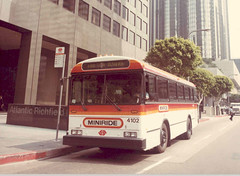
Miniride #4201 in downtownImage by Metro Transportation Library and Archive via Flickr
Last time I gave a brief history of LA Metro's Route 176. Today I will describe the route and some of the social-economic situations that exist along the line.

Map and schedule of the 176.

As I mentioned yesterday, the 176 currently starts its run near the corner of Figueroa and York in Highland Park. The actual end of the line is behind a aging 70's shopping center. At the corner of the shopping center is a fast food restaurant that used to be very good although I have not been there in several years.

Highland Park used to be a streetcar suburb but these days is sadly better know for the large amount of gang violence that takes place in the area. It is not an area you would want to be walking around after the sun goes down and sometimes even when it is up.

After leaving its layover zone the 176 turns on Avenue 64 before turning left onto York Blvd and crosses the elegant York Avenue Bridge. To the west you can see the very tall former Santa Fe bridge that the Gold Line now travels across. If the payment has worn down enough on the York bridge you can see railroad tracks in embedded in the street (unless they have been removed in the last few years). These are not former Pacific Electric tracks but are the only remains of a profitable former Union Pacific branch line that used to run all the way to Pasadena. However, when Interstate 210 was put in the tracks were forced out.

After you cross the bridge over the Arroyo Seco you have not only gone over a divide in the land, but you have also crossed a major economic divide. You have now entered the city of South Pasadena who has infamously been fighting the construction of a freeway segment for many years. Don't get the idea that there is a up-swelling of anti-car attitude in the city, they want the freeway they just in somewhere else (read between the lines: over toward the Los Angeles border in the less affluent part of town).

The first stop in the city used to generate some peak loads as there was a clothing manufacturer located here but it has been gone for many years and the riders with it. The line then makes brushes the Gold Line before heading north on Pasadena which turns into Mission Street. At the corner of Mission and Meridian is the Gold Line's stop in South Pasadena with the 176 being the only full time bus service the station sees.

The route then travels through the small South Pasadena business district which does not look all that different from the scenes shot here for the 1980's Michael J. Fox film "Teen Wolf". At the corner of Fair Oaks and Mission you have a connection with Metro Route 260 and there is also the Fair Oaks Pharmacy which features a classic soda fountain counter.

Once pass Fair Oaks the route travels through a residential area before turning onto Garfield and traveling along the San Marino/South Pasadena border. The route then crosses Huntington Drive and once again moves out into the city of Alhambra. Until the route turns onto Main Street, the 176 shares the route with Montebello Municipal Bus Route M30. Once the route turns onto Main Street it travels through the heart of the Alhambra Business District. Along Main Street the 176 shares the street with the 79 which means that along two of its primary corridors it shares the streets with other routes and we know how some transit circles see any duplication of service as something to be avoided.

Just after Main Street turns into Las Tunas the 176 turns onto Mission and passes the San Gabriel Mission. Metro plans to continue serving the rest of the 176 route by extending another route to run from El Monte to this intersection since it is the busier section of the line.The route along Mission is mostly residential with some small businesses located along the way. Most of the neighborhoods would rate as lower middle class.

The route continues down Mission, turns onto Rosemead Blvd sharing the street with the 266, then travels through the Telstar Industrial Park before making its way to the El Monte Bus Station. The Industrial Park is another generator of business but like most industrial parks generates those riders at only shift change times.

That gives you a very basic concept of the route. Next time I plan to look at the route from a marketing prospective to see what is the major failings of the route and what can be done to make the route more viable. I will also look at some alternatives to keep service along most of the route.

Enhanced by Zemanta

Wednesday, February 23, 2011

A Look at Los Angeles Metro's 176

Logo of the Los Angeles County Metro Rail and ...Image via Wikipedia
Like most transit systems across the country, Metro in Los Angeles has been facing tough economic times. However, like the rest of its brethren in California, they have also been facing a double whammy of recession and money being taken out of transportation to shore up its crumbling general fund by the former governor. Now Metro is proposing to cut even more service in June including route 176 which travels from Highland Park to the El Monte Station at the eastern end of the El Monte Busway.

The 176 is near and dear to my heart because I spent many years living along the route and riding it. Here is the map and schedule of the current 176.

The route first started as a Pacific Electric bus traveling from Mission and Fair Oaks in South Pasadena to Alhambra connecting several of the PE's major rail lines. The bus line was later extended to replace rail service and for many years was route 79 traveling from Main and Garfield in Alhambra through South Pasadena and Highland Park and ended up at Huntington Drive and Monterey Road.

In April, 1976 the RTD, Metro's predecessor, revamped routes in the San Gabriel valley and surrounding areas, and the little 79 was split up into two other lines. The first line, the 143, took the park of the 79 from Highland Park to Huntington and Monterey Rd. and continued all the way to East LA. The 143 was latter merged with route 425 and later renumbered 256 which continues today although it has also faced being axed at one time or another over the last few years.

The 430 took over the other part of the 79 from Highland Park to Alhambra plus portions of other routes to create the present 176. In early 1977, the route was extended from Highland Park to Glassell Park via Ave 50 replacing a short shuttle route. For 30+ years the 430/176 traveled back and forth between Glassell Park and El Monte with little notice until the portion between York and Figueroa in Highland Park to Glassell Park was cut in order to allow Metro to retire its remaining and aged 35 foot RTS buses.

That brings up to the present time and the very real possibility that this route will probably meet its demise in a few months. I am going to use this route as a case study on what can be done to route that has largely been ignored for 30 years to improve its performance, the socially-economic conditions that apply to the line, and some alternatives to the Metro proposal.

In the next entry I will describe the current route and some of the different neighborhoods the bus travels through and other interesting facts about the route.
Enhanced by Zemanta

Sunday, February 20, 2011

This Week in Amtrak

Penn Station (New York City)Image via Wikipedia
From the Editors…

Beware the ides of… February? This week a brief of some current events.

Just How Much is that Wild Goose?

“A billion here, a billion there, pretty soon it adds up to real money.”- Senator Everett Dirksen

Just how many names can one give to a hole in the ground? What does one name a hole that does not really exist? This particular hole, meant to connect suburban New Jersey with New York City, has had many names and titles. A decade and half ago, it was known as the “Trans-Hudson Express Tunnel” (THE Tunnel) or, deridingly, as the “tunnel to Macy’s basement.” Later known as “Access to the Region's Core,” (ARC) ground was officially broken in June of 2009. On October 27, 2010, New Jersey Governor Chris Christie (New Jersey being the only state officially participating in this project) gave it a new name: Dead. Concerned that the $8.7 billion undertaking would spiral to Big Dig proportions, the governor decided the price was too rich for New Jersey’s blood. There were meetings and more meetings between Trenton and Washington, but despite Federal demand for payback of $271 million, the project was axed once and for all… or so it seemed.

On February 6, 2011, a new player, Amtrak, rode into town along with U.S. Senate representation from New Jersey. Together, they announced a new scheme to build, and a new name: The “Gateway Tunnel.” They intend to spend $50 million for more design and engineering work, with a potential cost of $13.5 billion for completion. (It would appear Governor Christie’s concerns over costs were more than prescient.)

Two days earlier, the City of New York contracted with Parsons Brinckerhoff, Inc. to (quickly) study the feasibility of extending the No. 7 subway line west, under the Hudson River to NJ Transit’s station at Secaucus, New Jersey. Unlike the previous tunnel plans, this would allow riders transferring at Secaucus access to the West Side of Manhattan, Times Square, Grand Central Terminal, and Queens, without traversing an already-full Pennsylvania (Penn) Station.

Unlike the ARC, the Gateway Tunnel (actually two tunnels with one track each), proposed by Amtrak and friends, will not terminate north of Penn Station or Macy’s basement. Rather, it will run directly into Penn Station, adding to its already burgeoning passenger congestion. Currently, Penn Station handles a daily crush of some 600,000 persons. The existing century-old, twin single-track tubes handle a maximum of 23 trains per hour. It is expected the new Gateway Tunnel will allow for an additional 21 trains per hour. No source for this project's funding was cited.

Just two days later, on February 8, Vice President Joe Biden announced a new Administration initiative to spend $53 billion over the next six years on High-Speed Rail projects nationwide. The goal is to allow high-speed train access to 80 percent of the public within 25 years. Again, no source for the requisite funds was cited.

Not everyone is onboard with the immediacy of interest in “High-Speed Rail.” As has been reported in these pages before, many have advanced their political careers on “stop the train” platforms; therefore, it does not portend well that the two U.S. Representatives who declared this initiative “dead on arrival” are the House Transportation Committee Chairman and Railroads Subcommittee Chairman.

John Mica (R-Fla.) was his usual sanguine self in frankly appraising this development: “This is like giving Bernie Madoff another chance at handling your investment portfolio.” Mica is none too happy about the previous $10 billion pledged for HSR, or about the involvement of the Federal Railway Administration (FRA) in the HSR corridor selection process; and is especially displeased with the continued interference of the National Railroad Passenger Corporation. “Amtrak hijacked 76 of the 78 projects, most of them costly, and some already rejected by State agencies,” said Mica. “Amtrak’s Soviet-style train system is not the way to provide modern and efficient passenger rail service.”

Bill Shuster (R-Penn.) also had his take on this latest HSR missive: “The Administration continues to fail in attracting private investment, capital, and the experience to properly develop and cost-effectively operate true high-speed rail.” … “Government won’t develop American high-speed rail. Private investment and a competitive market will.”

To date, $271 million has already been spent. This includes $26.3 million for property acquisition in New Jersey for what was the ARC project; and $50 million has been proposed for more study of “ARC-lite.” Of the $10 billion pledged for “High-Speed Rail,” at least $1 billion has already been spent. To keep this all in perspective, Amtrak currently has on-order 70 new railcars for Eastern trains at approximately $2.3 million per each. The $1.321 billion already spent and proposed could have purchased over 500 of these railcars, expanding Amtrak's existing fleet by one-third. The problem with a wild goose chase is that regardless of the amount of money or resources expended, one still may not wind up with the goose.

An “E-Ticket Ride” to Fantasyland

Lathen, a small city of some 11,000+ souls (in 2009), may not ring a bell in the minds of those from outside the Emsland district in Lower Saxony, Germany. Yet, Lathen boasts what may be considered the world's fastest form of overland transportation. This is where ThyssenKrupp's Transrapid Maglev test track extends over 30 kilometers. If one is interested in buying one’s very own maglev transportation system, then Lathen is the place to visit. The test track was built to devise, test, improve and (most importantly) sell the concept of maglev; nothing more, nothing less. It does not see active scheduled service for the general public to ride.

The team members involved in writing, editing, and publishing this newsletter are all current or former residents of the State of Florida. As such, we have been watching intently the now almost-daily developments, with the latest incarnation of fast trains here being Florida High-Speed Rail. On February 16, newly-elected governor Rick Scott officially turned down $2.4 billion in Federal funds earmarked for the initial east-west, Tampa-Orlando route (roughly 80 miles). His reasoning for doing so included projected cost overruns and questionable ridership/revenue projections. This has become quite the firestorm in Tallahassee, and may rage for some time to come.

Governor Scott was not the only one questioning the validity of this project. At this year’s Southwest Rail Conference, one presenter succinctly pointed out that American HSR supporters were “attempting to have their icing without bothering to bake the cake.” Specifically he added, “Florida needs to mature its HSR plans.” Transporting tourists from theme parks to the beaches on the Gulf of Mexico is not a mature reason for building HSR.

When the go-ahead for High-Speed Rail projects came early last year, it was like popping the cork on a bottle of long-fermenting ideas. For Florida, it was a matter of dusting off the plans for the stillborn Florida Overland eXpress of 1996. When proponents for Florida HSR were questioned about the validity of this endeavor, the answer was curt and simple: The state already owns the right-of-way, and the environmental impact studies are complete. It is true that both of these prerequisites are a major hurdle for any project; still, is it not odd that public benefit was not one of the top two reasons for building?

Would Tampa-Orlando HSR be of anymore use to riders than the test track in Lathen? The simple reality is: No. It was not, nor was it ever meant to be, a serious contender for moving residents about the Sunshine State. As much as Lathen proved the workability of maglev, so too would Florida HSR be merely a vehicle to test and prove the feasibility of High-Speed trains in America. Every nation that has ventured into the HSR arena has had to develop its own system, with its own parameters to suit that nation's specific needs and conditions. The United States will be no different. Those involved with Florida HSR have been in talks with the FRA about requirements for vehicles traveling at hitherto-unseen speeds. As State Senator Paula Dockery said, “This was going to be a model for the nation.”

Numerous potential companies and consortia of companies have been eagerly awaiting the expected payout to develop all the systems for such a project. Now that it appears Florida HSR has been scrubbed, those would-be builders are scrambling. Without Florida, where else will they “beta test” their product? Without Federal money, who will pay to develop new, or adapt existing, technology for use in America?

Had the Tampa-Orlando line been built, the technology would have been built, tested, redesigned, retested, ad nauseam until everything was ready for primetime; after which, maybe the second phase of Florida HSR, a north-south, Orlando-Miami route (roughly 230 miles), would have been built. Tampa-Orlando is, however, a bit of a misnomer. In reality, the Eastern terminus is not the city of Orlando, but rather the airport (which bears its name, but is nowhere near Orlando). The western end is not the beautifully-restored downtown Union Station, but rather a parking lot off the highway. The likelihood of drawing riders was about par with drawing bees with vinegar. No matter how technically successful this may have been, would the public tolerate the spending of billions more of public monies in order to go to Miami?

Universal Truths

Every project has to start somewhere; and someone has to pay for it. Whereas private dollars may combine with public monies and actually build the line on State property between Tampa and Orlando, what about the future? When the champagne stops flowing and the confetti settles, there will still be a train to run. Will those private dollars still be there to fund its operation? When all is said and done, Florida HSR is nothing more than a novelty, a $2+ billion tourist attraction for foreign and domestic visitors to gawk at before moving on to the next attraction. Speaking as a resident this very expensive, publicly-funded tourist trap is the last thing we need here.

Enhanced by Zemanta

Friday, February 18, 2011

New Name and expanded focus...

For those arriving on this page today expecting to see Transit In Utah...surprise this blog has a new name to go along with some change in focus in the next few months and some changes in my personal life.

As I mentioned a few months ago I tried to expand the focus of the blog from covering happenings in Utah but also covering areas of interest across the United States and Canada especially in the cities I have good familiarity with such as Southern California, the San Francisco Bay Area, Utah, Las Vegas, Charlotte, Portland, Spokane and Seattle.

I might move the blog to a different platform once I study more on the different options and I have registered the follow url: http://www.urbanplanningandtransportation.com which is directing to this page at the present time and the forcible future.


The main reasons for these changes is that there is going to be a major change in my personal life over the next 4 months. While I have kept my personal life and this blog separate since its inception, this blog is actually driving some of the changes in that life.

While I do have a degree in Business Management (a two year degree) and tons of experience, the last few years have been difficult. Before I attended Railvolution in October, I was thinking of returning to school but was torn because Utah schools would not accept most of my credits so was looking at moving back to Spokane where my credits were earned. However, our first choice was to move to either Portland or Seattle and after talking to Portland Community College I found out they would take my existing credits which is great since I only need a few classes to get a transferable degree.

From there I plan to apply and attend Portland State University to get degrees in Urban Planning and Economics.

In May I will traveling up to Portland in order to find a place to live. My goal is to find a place with easy transit access to the PCC campuses and PSU. There is some other changes going to take place in March that is going to affect the type of apartment I can find. I hope you enjoy reading of my adventures of trying to find a place to live that meets these requirements.

In my years doing this blog we have seen a lot of changes both good and bad both in Utah and across the nation. I hope to make it back down to Salt Lake in August for the opening of the new TRAX lines since I have been watching progress on the these lines since they were first proposed but am not sure at this time.

To my regular readers, I hope you will continue enjoying this blog, I plan to continue providing observations on urban planning and transportation.
Enhanced by Zemanta