Showing posts with label California Cars. Show all posts

Thursday, April 28, 2011

This Week in Amtrak

(Amtrak 345, an EMD F40PH pulls a passenger tr...Image via Wikipedia
Volume 8, Number 7

From the Editors…

Recently, Amtrak released its updated fleet strategy plan. What a difference a year makes.

A Tale of Two Strategies

At first blush, it would appear the primary difference between Amtrak’s Fleet Strategies of February 2010 and February 2011 is a thorough going over by our very own proofreader here at This Week. (For the record, she vehemently denies this, but the investigation is on-going.) Upon closer inspection, it becomes obvious certain realities are now being accepted. Before going any further it should be known that the original document and its update are of a high quality and represent the obvious expenditure of many hours of effort.

The updated report acknowledges the orders of 130 single-level cars for Eastern long distance service and 70 electrics for the Northeast Corridor. Priorities held over from 2010 are the replacement of 250 Superliner I's and the development of “a new fuel-efficient high speed diesel locomotive.” New to the priority list are: Replacement of 145 Amfleet II's, developing a “bi-level corridor car to replace single-level cars where clearances permit, adding two cars each to the existing Acela fleet (40 new cars total), and planning the next generation of high-speed trains. Total estimated cost of this 30 year plan is $25.2 billion.

Replacement of the single-level long distance coaches, Amfleet II, has now been moved ahead of the Amfleet I replacement. Why? Despite being a few years newer, the average mileage for an Amfleet II car is 1.4 million miles over an Amfleet I. Truth be told, the Amfleet design was never meant for long-distance service, yet they have performed adequately for over 30 years; a true testament to the construction of the Budd Company. CAF USA has a very tough act to follow, constructing the 130-piece Viewliner 2 order. There are 145 Amfleet II’s in service but the Fleet Strategy does not specify how many new cars will be ordered. If CAF USA gets a chance to build a coach variant of the Viewliner 2 platform, then we could possibly see uniform trainsets in the east, something which has not happened since the introduction of the Amfleet II’s in 1980. Do you believe in miracles?

In 2010, “long distance” services were defined as “more than 600 miles,” whereas in 2011 it is “more than 750 miles.” No doubt this is a sign of inflation. Also curious is the statement that the long-distance trains “have grown around 2 percent annually,” although “Table 8: Amtrak Ridership Growth FY06-10” demonstrates that long-distance trains were the only service during those five years not to have a negative ridership growth; even during the doldrums of 2009. Average growth on the long-distance trains according to Amtrak’s data was 3.7 percent for the last five years, a fact all the more fascinating when one takes into account there has been no addition to the equipment of these trains in over a decade.

A significant difference between the two reports is the acknowledgment of Amtrak’s Office of the Inspector General (OIG). The OIG is evaluating the original report, and will issue its own report this year. “We look forward to receiving the final OIG report and we will continue to work with the OIG to ensure that its insights are incorporated in the next fleet plan update as appropriate.” Where was the OIG during the original report? Oh, right.

In both reports the Horizon fleet of regional-distance cars is panned: “These cars suffer from a variety of operational problems in cold temperatures and winter conditions.” Interestingly these cars are a variant of an original Pullman-Standard commuter car design which has gained acceptance in New Jersey, New York, Connecticut, Pennsylvania, and Massachusetts, none of which are known for their balmy winters. The solution for 2011 is a new fleet of 125 bi-level cars ostensibly patterned after the cars used in regional service in California. As these cars do not have any operating history in the extremes of the Midwest, this will be an interesting experiment. Although the “California cars” appear to be similar to Superliners, the difference is in the details. Superliners have their Head End Power (HEP) and Multiple Unit (MU) cables well above the ground and away from snow and ice buildups. California cars have their cables astride their couplers, as is standard with most other equipment. Superliners have successfully pinch hit for Horizon cars in Midwest services during wintertime. If one expects California cars to perform to the same level as the Superliners, one may be in for an unpleasant surprise.

One other curious statement as regards the potential routes for the new bi-level cars: “The only other exception would be Amtrak’s Hoosier State/Cardinal Service between Chicago and Indianapolis, which would continue to use single level equipment because of clearance constraints on the Cardinal route.” Trains between Chicago and Indianapolis have always ferried equipment to and from Beech Grove, Amtrak’s maintenance facility just outside Indianapolis. The deadheading equipment does include cars from Amtrak’s current bi-level fleet: Superliners, Superliner II’s and California cars.

The plans for Acela were wide and varied in 2010. By 2011, the choices have been narrowed: “There is a compelling case for an additional two cars for each set… [the extra cars] will deliver a positive return even if the trains were replaced in 2023.” Moreover, the desire is expressed for an additional 20 trainsets “of a new rather than the existing design and delivery would begin in 2017.” Apparently they have learned one lesson.

Unfortunately, both reports address the potential utility of self-propelled diesel cars or Diesel Multiple Units (DMUs). Not that there is anything wrong with DMUs in and of themselves; however, they are best suited to commuter operations. Amtrak is NOT a commuter railroad, and provides operating crews under contract to a handful of commuter operations around the country. If one of these commuter lines provides DMUs for its operation, so be it; but Amtrak should not be taking the lead on this.

It is recognized in the reports that: “Suppliers need a constant stream of work to ensure that there is sufficient business to support a competitive supplier base and avoid the boom and bust cycles in the past.” This work-fare program of equipment sustainability is the sort of thing a state-owned/operated polity should have pursued since its inception. Well, better late than never. The plan calls for an average of 65 single-level and 35 bi-level cars per year starting in 2012 and 2014, respectively.

Both reports speak of the need for the development of future equipment. The 2011 edition refers to the Next Generation Equipment Committee (NGEC), whose stated goal is “to promote the creation of a pool of standardized, interoperable equipment that could be used by Amtrak and the states in various state-sponsored corridors with flexibility and efficiency.” In light of Amtrak’s past history of equipment, standardization would be a vast improvement. This is, however, a double-edged sword. Such a mandate would mean ostracizing non-standard equipment such as the state-owned Talgo trainsets in Cascade and Hiawatha services. Standardization to the exclusion of innovation has a history of long-term negative consequences. Fifteen years ago, ABB Traction withdrew its product, the X2000, from contention for use in the NEC. The X2000 achieved higher speeds on conventional track through the use of radial steering trucks and active tilting. Since no other bidder could offer radial trucks, it was not included in the Federal bid request, and ABB realized it could not succeed in the face of cheaper, inferior products.

Perhaps the largest sign of change is what was not held over from the original report, the “Calculation of required added cars per set” toward the back of the report. Originally hypothesized were the train consists as they might appear for FY18 and FY23. When first released in 2010, it was these charts which caused many a confused look even from the most ardent Amtrak apologists. For 2018, 10 of the 14 long distance trains would receive one extra sleeping car. By 2023, four more trains would have added one more sleeper; yet this very same chart reports the 2008 load factors for the sleepers, and none are below 80%. Two trains are tied at 94 percent. None of Amtrak’s regional or corridor offerings even come close to matching this load factor. It is also no secret that fares for traveling by sleeping car are especially dear. Even so, sleeping cars are what the traveling public craves. Why? There could be many postulated reasons: An aging population, TSA fatigue, etc. We at This Week do not know the true reason for this trend, but it really is academic. The public has voted with its wallet, demanding sleeping car space.

Through Amtrak’s typical “framing mischief by decree,” it has made it abundantly clear that it is loathe to reinstate trains such as the Pioneer, North Coast Hiawatha, or Eastern leg of the Sunset Limited. Even so, it does acknowledge the growth in long-distance demand. “This gradual increase in demand can be satisfied through the progressive replacement of equipment and lengthening of existing train consists.” Limiting the increase, however, of already paltry long-distance trains by a mere one or two cars just does not correspond with reality. Long-term success of any business requires change, to support changing demand. In the past, the speed at which Amtrak responded to such change was glacial, at best. Amtrak has not received any new equipment since 2002. It may already be too late. After 40 years, it should be getting it right. If not, then perhaps it is really time to let someone or something else have a turn.
Enhanced by Zemanta

Sunday, August 30, 2009

This Week In Amtrak

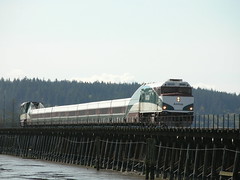
Amtrak Cascades Mud Bay Surrey BC 08-04-2005 1...Image by Stephen Rees via Flickr

This Week at Amtrak; August 28, 2009


A weekly digest of events, opinions, and forecasts from


United Rail Passenger Alliance, Inc.

America’s foremost passenger rail policy institute


1526 University Boulevard, West, PMB 203 • Jacksonville, Florida 32217-2006 USA

Telephone 904-636-7739, Electronic Mail info@unitedrail.org • http://www.unitedrail.org


Volume 6, Number 33


Founded over three decades ago in 1976, URPA is a nationally known policy institute which focuses on solutions and plans for passenger rail systems in North America. Headquartered in Jacksonville, Florida, URPA has professional associates in Minnesota, California, Arizona, New Mexico, the District of Columbia, Texas, New York, and other cities. For more detailed information, along with a variety of position papers and other documents, visit the URPA web site at http://www.unitedrail.org.


URPA is not a membership organization, and does not accept funding from any outside sources.


1) Good ideas never go bad, they just sometimes are put on a shelf.


Over a full decade ago in 1998, the late Adrian Herzog, Ph.D., one of the original bright lights of United Rail Passenger Alliance, compiled a long term plan for the expansion of Amtrak.


Dr. Herzog, who by profession was a rocket scientist and university physics department chair professor, died far too young of a heart attack at his home in Northridge, California in February of 2001 at the age of 52.


Outside of the classroom, Dr. Herzog was a business partner with the late Byron Nordberg, also an original bright light of URPA. Dr. Herzog and retired United States Marine Corps Colonel Nordberg were the proprietors of NHA, Inc., a highly successful rail consulting firm based in Oceanside, California. NHA was the engine which brought the UTDC (now Bombardier) bi-level commuter passenger cars to Southern California for both Metrolink and the Coaster services. A very young Noel Braymer, now editor of the Western Rail Passenger Review and luminary in California passenger rail circles, and also an early associate of URPA, worked with Colonel Nordberg and Dr. Herzog.


The amount of work coming from Dr. Herzog was nearly unparalleled. He was one of the first, using early desktop computers, to create computer modeling for Amtrak passenger trains to measure performance and successfully predict future needs. Much of Dr. Herzog’s work has been featured on URPA’s web site, www.unitedrail.org and remains today as relevant as when it was created. Perhaps one of Dr. Herzog’s greatest accomplishments was the creation of the matrix theory, demonstrating how hubbing and end point connections are critical to the success of any passenger rail system.


2) One of the documents left by the untimely death of Dr. Herzog in this writer’s care was his plan of how a successful Amtrak would look in 2010, based on several presumptions made for 2000. Alas, those presumptions were not to be at that time, but it is fascinating to see Dr. Herzog’s vision for the future of Amtrak.


Dr. Herzog believed passenger rail was viable on three levels: as a carrier of leisure travelers, as a carrier of regional travelers moving about for any number of reasons, and as a carrier of business travelers seeking an efficient way to travel making the best use of their time in trips under five hours. Remember, in 1998 when this plan was conceived, things like Wi-Fi connections were not yet common, laptop computers were still bulky and heavy, and cellular telephones were in use by a far smaller percentage of the population.


Dr. Herzog and Colonel Nordberg also believed in two basic principles. First, every route should have at least three frequencies, and more if viable. One frequency would be as existing, a second frequency would follow six to 12 hours later so every city or town would have service at marketable times, and a third frequency mimicking the old milk run local trains, where every station had a stop. As you look at Dr. Herzog’s plan below, and see a train with a route name such as the North Coast Limited, imagine a flip schedule train such as the Mainstreeter providing the second frequency, and perhaps another named train for the local.


In some instances, the local train may better serve the route by being a series of shorter trains, such as on the Southern Crescent route between Washington, D.C. and New Orleans, where two separate day trains may provide the best level of service versus one longer train, by providing one train operating between Washington, D.C. and Atlanta, and a second day train operating between Atlanta and New Orleans. The first two trains, the Southern Crescent and the (to pick a name) Peach Queen would run the entire route, and the two day trains serve as the “local” option on two separate ends of the route.


Second, they believed passenger train routes did not always have to be in a straight line. They both favored “L” shaped routes where possible, such as taking the Lake Shore Limited from New York City to Chicago, and extending the western terminus of this train south to Memphis, Tennessee to make maximum use of equipment, and build as many city pair combinations as possible into the matrix theory.


Dr. Herzog’s plan focused primarily on a robust long distance network. Some of today’s short distance trains would be replaced by long distance trains (more efficient in many ways), but some regional services as we know them today would continue. Since this was a broad blueprint, many of the minor, regional services were not mentioned, but Dr. Herzog implied each would be retained based on productivity and cost.


3) Here is Dr. Herzog’s plan, with some updates for changes which have taken place in the last 11 years.


[Begin quote]


Strategic Routes for Amtrak


A Planning Document


October 25, 1998 • Updated 2008


Prepared by Dr. Adrian Herzog, URPA • Northridge, California


Strategic Goal: Output equal to five times the revenue passenger miles produced in FY 2000, achieved by Year 7 of the strategic plan.


This document was originally prepared by the late Adrian Herzog, Ph.D. in October 1998, and updated a decade later in 2008. The breadth of the document demonstrates the foresight of Dr. Herzog in his quest to make passenger rail in his adopted country subsidy-free.


The planning concepts for this document came from several sources, including historic successful passenger train routes and connectivity points, current travel patterns in the United States for both leisure and business travel, and travel to and from major vacation destinations. As an example, more travelers come to New Orleans from Houston, Texas than any other location.


Other factors taken into consideration are population shifts and population growth in new areas, military installations, and locations of major colleges and universities. Additional factors, such as cruise ship terminals were also considered.


Tactical Goal: Maximize network density of flow by maximizing route inter-connectivity, and multiple frequency (2 to 4) trains per route, per day.


National Corridors

• Southern Transcontinental Corridor

• Southwest Transcontinental Corridor

• Central Transcontinental Corridor

• Northern Transcontinental Corridor

• Atlantic Coast Corridor

• Pacific Coast Corridor

• Southwest Corridor

• Central California Corridor

• Pacific Northwest Corridor

• Chicago-Midwest Corridors

• Florida Corridor

• Gulf Coast Corridor

• Texas Triangle

• International links to Canada and Mexico

• Northeast Corridor low level long distance trains


Equipment Types

• Superliner Service

• California Car Service — Use of the successful daylight California Car/Superliner compatible bi-level equipment for non-overnight trains

• Talgo Service

• Viewliner Service — Conversion of existing fleet single level cars. This Includes: Viewliner, Amfleet, and Horizon


Power Types

• Genesis (Long distance trains)

• F59PH (Corridors)

• AEM-7 (NEC Long distance trains)


Crew Bases

• Seattle

• San Jose

• Los Angeles

• San Diego

• Denver

• Fort Worth

• Chicago

• New Orleans

• Tampa

• Sanford (Auto Train T&E only)

• Miami

• Charlotte

• Newport News

• Norfolk

• Philadelphia

• Boston

• Vancouver/VIA Rail Canada


Maintenance Bases and Principal Commissaries

• Vancouver, British Columbia/VIA Rail Canada

• Seattle

• Eugene, Oregon

• San Jose

• Los Angeles

• San Diego

• Denver

• Fort Worth

• Chicago

• New Orleans

• Tampa

• Sanford (Auto Train/racks only)

• Miami

• Charlotte

• Newport News

• Philadelphia

• Boston


Turn Maintenance and Commissary Support

• Vancouver, British Columbia/VIA Rail Canada

• Toronto/VIA Rail Canada

• Montreal/VIA Rail Canada

• Boston

• Washington

• Lorton

• Newport News

• Norfolk

• Cleveland

• Detroit

• Chicago

• Eugene, Oregon

• Seattle

• San Francisco

• Lancaster, California

• Redding, California

• Reno

• Santa Barbara

• Las Vegas

• Nogales

• Duluth

• Kansas City

• St. Louis

• Memphis

• Birmingham

• Charleston, South Carolina


Southern Transcontinental Corridor


Sunset Limited – Los Angeles, Tucson, El Paso, San Antonio, Houston, New Orleans, Jacksonville Orlando, Tampa

Superliner Service


Golden State – Los Angeles, Phoenix, Tucson, El Paso, Abilene, Fort Worth, Dallas, St. Louis, Chicago, Detroit, Toronto

Superliner Service


Southern Crescent – New Orleans, Atlanta, Washington, DC

Superliner Service


Gulf Breeze – New Orleans, Mobile, Montgomery, Birmingham, Atlanta, Washington, DC, Philadelphia, New York, Boston

Viewliner Service


Gulf Wind – Houston, New Orleans, Mobile, Pensacola, Tallahassee, Jacksonville, Orlando, Tampa

Superliner Service


Continental – Los Angeles, Phoenix, Tucson, El Paso, Abilene, Fort Worth, Dallas, Atlanta, Washington, DC

Superliner Service


Southwest Transcontinental Corridor


Southwest Chief/Capitol Limited – Los Angeles, Albuquerque, Kansas City, Chicago, Pittsburgh, Washington DC, Newport News

Superliner Service


San Francisco Chief – San Jose, Oakland, Bakersfield, Albuquerque, Kansas City, St. Louis, Chicago

Superliner Service


Grand Canyon Limited – Los Angeles, Albuquerque, Denver

Superliner Service


Zia – Denver, Albuquerque, Las Cruces, El Paso

Superliner Service


El Capitan – Chicago, Kansas City, Flagstaff, Phoenix, Tucson

Superliner Service


Central Transcontinental Corridor


California Zephyr – Los Angeles, San Jose, Oakland, Reno, Salt Lake City, Provo, Denver, Chicago

Superliner Service


Overland Limited – Los Angeles, Las Vegas, Provo, Salt Lake City, Ogden, Laramie, Denver, Omaha, Chicago, Cleveland, Boston

Superliner Service

Pioneer Zephyr – Vancouver BC, Seattle, Portland, Ogden, Salt Lake City, Provo, Denver, Newton, Oklahoma City, Fort Worth, Dallas, Houston, New Orleans

Superliner Service


George Washington – Kansas City, St. Louis, Louisville, Cincinnati, Charleston WV, Charlottesville, Richmond, Newport News

Superliner Service


Cavalier – Fort Worth, Dallas, Little Rock, Memphis, Chattanooga, Knoxville, Roanoke, Lynchburg, Charlottesville, Washington

Superliner Service


The Memphian – Fort Worth, Dallas, Little Rock, Memphis, Nashville, Louisville, Cincinnati, Charleston WV, Charlottesville, Richmond, Newport News

Superliner Service


Northern Transcontinental Corridor


Empire Builder – Vancouver BC, Seattle, Yakima, Spokane, Minneapolis, Chicago, Indianapolis, Cincinnati, Newport News

Superliner Service


North Coast Limited – Seattle, Spokane, Missoula, Butte, Bozeman, Billings, Bismarck, Minneapolis, Chicago

Superliner Service


Hiawatha – Eugene, Portland, Spokane, Minneapolis, Chicago

Superliner Service


Broadway Limited/Three Rivers – Duluth, Minneapolis, Chicago, Cleveland, Pittsburgh, Philadelphia, New York, Boston

Viewliner Service


Pennsylvanian – Kansas City, Chicago, Pittsburgh, Harrisburg, Philadelphia

Viewliner Service


New England States – St. Louis, Chicago, Toledo, Cleveland, Buffalo, Albany, Springfield, Boston

Viewliner Service


Pacemaker – Chicago, Toledo, Cleveland, Buffalo, Albany, New York, Philadelphia

Viewliner Service


Lake Shore Limited – Memphis, Chicago, Toledo, Cleveland, Buffalo, Albany, New York, Boston

Viewliner Service


Steeler – St. Louis, Indianapolis, Pittsburgh, Harrisburg, Philadelphia

Viewliner Service; Crew Base: Philadelphia


Columbian – Denver, Chicago, Cleveland, Pittsburgh, Washington DC, Newport News

Viewliner Service


Oriental – Vancouver BC, Edmonton, Winnipeg, Minneapolis, Chicago, Detroit, Toronto (Seasonal)

Viewliner Service


Atlantic Seaboard Corridor


Silver Meteor – Miami, Orlando, Jacksonville, Charleston, Rocky Mount, Richmond, Washington, Philadelphia, New York, St. Albans, Montreal

Viewliner Service


Silver Star – Miami, Ocala, Jacksonville, Columbia, Raleigh, Richmond, Washington, Philadelphia, New York, Boston

Viewliner Service


The Sunland – Tampa, Orlando, Jacksonville, Columbia, Raleigh, Richmond, Washington, Philadelphia, New York, Boston

Viewliner Service


Everglades – Miami, Daytona Beach, Jacksonville, Columbia, Raleigh, Richmond, Washington, Philadelphia, New York, Buffalo, Toronto

Viewliner Service


Auto Train, (Passenger section) – Tampa, Orlando, Sanford, Jacksonville, Savannah, Charleston, Rocky Mount, Richmond, Lorton, Washington, Pittsburgh, Cleveland (All station stops)

Superliner Service


Auto Train, (Car carrier section) – Sanford, Lorton


City of New Orleans – Tampa, Orlando, Jacksonville, Mobile, New Orleans, Chicago, Detroit, Toronto

Superliner Service


City of Miami – Miami, Orlando, Jacksonville, Charleston SC, Rocky Mount, Richmond, Charlottesville, Charleston WV, Cincinnati, Indianapolis, Chicago

Superliner Service


Flamingo – Tampa, Orlando, Jacksonville, Savannah, Macon, Atlanta

California Car Service


Silver Comet – Miami, West Palm Beach, Daytona Beach, Jacksonville, Savannah, Macon. Atlanta, Birmingham

Superliner Service


The Resort Special – Miami, West Palm Beach, Daytona Beach, Jacksonville, Savannah, Columbia, Raleigh, Richmond, Washington, Philadelphia, New York, Boston

Viewliner Service


Champion – Miami, West Palm Beach, Daytona Beach, Jacksonville, Savannah, Charleston, Rocky Mount, Richmond, Washington, Philadelphia, New York, Long Island

Viewliner Service


Gulf Coast Special – Tampa, Orlando, Jacksonville, Savannah, Charleston, Rocky Mount, Richmond, Washington, Philadelphia, New York, Long Island


Tidewater – Charleston, Florence, Fayetteville, Rocky Mount, Franklin, Suffolk, Norfolk

California Car Service


Piedmont – Charlotte, Raleigh, Rocky Mount, Franklin, Suffolk, Norfolk

California Car Service


Southern States – Tampa, Ocala, Jacksonville, Savannah, Columbia, Hamlet, Charlotte

California Car Service


Palmland – Miami, West Palm Beach, Orlando, Jacksonville, Savannah, Columbia, Hamlet, Charlotte, High Point, Greensboro, Danville, Charlottesville, Washington, Philadelphia, New York, Boston

Viewliner Service


Rue Orleans – New Orleans, Mobile, Montgomery, Birmingham, Nashville, Louisville, Cincinnati, Columbus, Cleveland, Buffalo, Syracuse, Montreal

Superliner Service


Southwind – Miami, Orlando, Jacksonville, Savannah, Columbia, Raleigh, Richmond, Washington, Pittsburgh, Cleveland, Toledo, Detroit

Superliner Service


Pacific Coast Corridor


Coast Starlight – Los Angeles, San Jose, Oakland, Sacramento, Eugene, Portland, Seattle

Superliner Service


Shasta Daylight – Los Angeles, Bakersfield, Fresno, Sacramento, Eugene, Portland, Seattle, Vancouver BC

Superliner Service


Columbia Starlight – Los Angeles, Las Vegas, Provo, Salt Lake, Ogden, Pocatello, Portland, Seattle

Superliner Service


Southwest Corridor


Pacific Surfliners – San Diego, Los Angeles, Santa Barbara, San Jose, San Francisco

Joint Talgo and California Car Service


High Desert – San Diego, Los Angeles, Palmdale, Lancaster

California Car Service


Las Vegans/South – San Diego, Santa Ana, Riverside, San Bernardino, Barstow, Las Vegas

Talgo Service


Las Vegans/North – Santa Barbara, Los Angeles, El Monte, San Bernardino, Las Vegas

Talgo Service


Arizonan – Los Angeles, Riverside, Palm Springs, Indio, Yuma, Phoenix, Tucson, Nogales

Talgo Service


Grand Canyon – Nogales, Tucson, Phoenix, Williams Junction, Grand Canyon

Talgo Service


Central California Corridor


San Joaquins I – San Jose, Oakland, Fresno, Bakersfield, San Bernardino, Santa Ana, San Diego

California Car Service


San Joaquins II – Bakersfield, Fresno, Sacramento, Redding

California Car Service


Capitols – San Jose, Oakland, Sacramento, Reno

Joint Talgo and California Car Service


Pacific Northwest Corridor


Cascades — Eugene, Portland, Seattle, Vancouver BC

Talgo Service


Chicago-Midwest Corridors


Train of the Saints — St. Paul (Minneapolis), La Crosse, Galesburg, Fort Madison, St. Louis

California Car Service


The Motor City — Kansas City, St. Louis, Chicago, Detroit

California Car Service


The Midwesterner — Omaha, Chicago, Cleveland

California Car Service


The Brewer — Minneapolis, Milwaukee, Chicago, Detroit

California Car Service


The City of Nashville — Chicago, Indianapolis, Louisville, Nashville

California Car Service


Florida Corridor


Seminole – Pensacola, Tallahassee, Jacksonville

California Car Service


Tampa Bay – Jacksonville, Orlando, Tampa

California Car Service


Henry Flagler – Jacksonville, Daytona Beach, West Palm Beach, Miami

California Car Service


Citrus State – Jacksonville, Ocala, West Palm Beach, Miami

California Car Service


Florida Palm – Tampa, West Palm Beach, Miami

California Car Service


Gulf Coast Corridor


Gulf Coast Limited – Houston, New Orleans, Mobile

California Car Service


Iron Mountain – New Orleans, Mobile, Montgomery, Birmingham

California Car Service


Louisiana Eagle – New Orleans, Baton Rouge, Shreveport, Dallas, Fort Worth

California Car Service


Texas Triangle


Texan – Dallas, Fort Worth, Austin, San Antonio, Houston, Dallas

California Car Service


Northeast Corridor (Extended Service Area, in addition to NEC Acela and Regional Service)


Mid Atlantic – Pittsburgh, Philadelphia, Baltimore, Washington DC, Richmond, Newport News (Viewliner Service)


Maple Leaf/Montrealer – Boston, Albany, Toronto, and New York, Albany, Montreal (Cross Platform at Albany)

Viewliner Service


Royal Blue – Newport News, Washington DC, Baltimore, Philadelphia, New York, Long Island (Viewliner Service)


Bostonian – Boston, New York, Allentown, Harrisburg

Viewliner Service


Shenandoan – Boston, New York, Philadelphia, Washington, Charlottesville, Cincinnati Viewliner Service


∙ Note: (Viewliner Service) implies any low level conventional long distance and intermediate distance trains including Amfleet, Horizon, and Viewliner

[End quote]


If you are reading someone else’s copy of This Week at Amtrak, you can receive your own free copy each edition by sending your e-mail address to


freetwa@unitedrail.org


You MUST include your name, preferred e-mail address, and city and state where you live. If you have filters or firewalls placed on your Internet connection, set your e-mail to receive incoming mail from twa@unitedrail.org; we are unable to go through any approvals processes for individuals. This mailing list is kept strictly confidential and is not shared or used for any purposes other than distribution of This Week at Amtrak or related URPA materials.


All other correspondence, including requests to unsubscribe should be addressed to


brucerichardson@unitedrail.org


Copies of This Week at Amtrak are archived on URPA’s web site, www.unitedrail.org and also on www.todaywithjb.blogspot.com where other rail-related writings of Bruce Richardson may also be found.


URPA leadership members are available for speaking engagements.


J. Bruce Richardson

President

United Rail Passenger Alliance, Inc.

1526 University Boulevard, West, PMB 203

Jacksonville, Florida 32217-2006 USA

Telephone 904-636-7739

brucerichardson@unitedrail.org

http://www.unitedrail.org

Reblog this post [with Zemanta]