Showing posts with label Parking. Show all posts

Friday, September 28, 2012

Eliminating Parking Requirements - Easier Said Than Done

English: Bronaugh Apartments at ‎1434 Southwes...
English: Bronaugh Apartments at ‎1434 Southwest Morrison Street in Portland, Oregon. (Photo credit: Wikipedia)

Many transit advocates look to parking requirements and say that eliminating the need for so many parking spaces when new buildings are built that it would have a positive affect on transit ridership by encouraging those who live and work in those buildings to ride transit instead of driving.

The theory is that you make parking so difficult or have so few spaces that people would rather take the bus, streetcar, or light rail than have a car that they have to pay for parking or waste time finding a parking spot.

While the concept of eliminating parking sounds like a wonderful idea, sadly it is much harder to implement reduced or no parking requirements than it sounds. Currently there is several apartment buildings in the Portland, Oregon area that are either in the design stages or under construction that include no on site parking for the tenants. The hope is that the people who move into these buildings will look to using transit instead of driving a car.

The problem occurs with the neighbors surrounding these buildings as they worry that all the parking in front of their homes will be taking up parking spots on their street. One of the controversial buildings is located on the MAX Yellow Line in the area near the Overlook station.

Of course there is two ways to look at the worry's of the neighbors  You could look at it as people worried that resident of these new apartments will take up all the parking in their neighborhood and there will be no spaces left for anyone else. The other side of the argument is that we have become so accustomed to having all the parking we need for free that we cannot handle not having it handed to use on a silver platter.

One of the major obstacles faced by advocates is to get the general public to look at parking differently than they currently do. While it may not be an easy thing to do, over time a paradigm shift can occur that will open up people to the idea that parking requirements. Today parking is something that is expected and people can not comprehend that a reduction in it will be successful.

However, I can tell you from personal experience that apartments with no parking have existed for more than a hundred years, continue to exist and gasp, people actually survive. As I have mentioned previsouly I grew up in Pasadena/South Pasadena area of California. That's right in automobileville itself  the Los Angeles area before there was a Gold Line to Pasadena or an alternative to the Southern California not so Rapid Transit District.

As I mentioned before, I spent many years growing up in an apartment complex with a small grocery store around the corner. Most of my block was made up of apartment buildings except for a few large homes directly across the street from our apartment. The amazing thing was that most of the apartments did not have any on site parking. That's right folks even the buildings that where built in the 50 and 60's did not have any parking attached.

To make this situation even more shocking was that only one side of the our road had on street parking because it was so narrow. Now if you would listen to the profits of doom these new complexes in Portland will be the end of the world. However, from personal experience I can tell you that they do work and over time people will get used to the situation.

However, one thing to take into consideration is transit access. These type of complexes must be on major bus lines, in fact the priority should be to put these where at least one frequent service bus or rail line runs and preferable at the intersection of two frequent services lines to provide the maximum benefit to those that live in the complexes.

Eventually cities like Portland can get even more aggressive about elimating parking requirements. It will take and will have to be well planned as it has worked in the past, it works today in many areas, and will work even more in the future.
Enhanced by Zemanta

Friday, March 18, 2011

Pedestrian Dead Zones

A TRAX train passing the Frank E. Moss Federal...Image via Wikipedia

Just because you build nice wide sidewalks and create a barrier between cars and pedestrians (such as trees) does not mean you will create an environment that conducive to pedestrian activity. To create pedestrian activity you need to have someplace to walk to but also reduce the number of barriers that exist to actually using those sidewalks to get somewhere.

Despite its very long blocks, there is some good pedestrian activity in downtown Salt Lake City from North Temple to about 350 South. If you travel any farther south than that you will see a remarkable decrease in the number of pedestrians. There is several causes of this drop off in pedestrian activity and I will cover some of the major ones in this posting.

Since Main Street is home to the TRAX light rail line I will start off at the corner of 400 South and Main. On the northwest corner of the intersection with have a court house. Court houses tend not to foster pedestrian activity because they are a single point destination, in other words people may go to the court house but that is the only reason they head there.

They are currently expanding the court house to take up most of the block from Main Street to West Temple. This will create a large barrier to pedestrian activity in the area. With court houses becoming even more fortified these days this makes court houses even more unfriendly toward pedestrian activity these days.

Here is a picture of the current court house looking north:


Here is a picture looking south diagonally from corner of 400 South and Main toward the corner of 500 South and West Temple.


Does this look like a thriving pedestrian and transit friendly downtown area or does it look like a parking lot of a suburban office park? This block of parking is made worse because of Salt Lake City's extremely long blocks. To the left of the picture is the Court House TRAX station and on the next block at State Street is another court house.

There is apparently a long story involving this parking lot barrier that covers the block between 400 South, 500 South, Main and West Temple. Despite all the opportunities that exist for development of this block with a TRAX station at the front door this lot will most likely stay as it is for the foreseeable future.

Once you walk pass the parking lot you face a new barrier for pedestrians-the 500 South and 600 South speedways to Interstate 15:


However, it is not three and four lanes of speeding cars that create a barrier to creating an effective pedestrian environment, it is the development that has occurred along the two streets. Because 500 South and 600 South are the two primary access streets to Interstate 15, the area along the two streets have become lodging row.

You would think that lodging facilities would want to foster pedestrian activity in the area but instead most lodging facilities are designed on two principles:

1. Everyone will arrive by car so there is no need to create effective pedestrian access points.
2. Especially if the lodging facility has on sight restaurants, the goal is to ensure the people staying at the facility only use their restaurants or have to get in their car and try to find parking if they want to eat somewhere else.

If you look at the picture above, you will notice that there is no pedestrian access point from the building in the picture to street level. This building is the Little America Hotel that covers all of the block with its sister property the Grand America Hotel taking up half of the block on the far side of Main Street (there is some irony that the Grand America was home to Railvolution back in 2005).

The next two pictures show the main entrance of both hotels on Main Street. While there is some pedestrian access to both hotels it is design more to foster getting guests between the two facilities than actually create any pedestrian activity on Main Street.


To be fair, the Little America does have a pedestrian entrance to its restaurant on Main Street about halfway between its main entrance and 500 South but it appears that there is few people that use it since pedestrian traffic on this section of main street is non-existent.

South of 600 South you have there is some areas of abandoned or barely used businesses and past 700 South you encounter several car dealerships including the Mark Miller Toyota Sprawl lot that completely kills most pedestrian activity in this neighborhood.

Heading back north we move one block west to West Temple and you have the only access point to the Little America from West Temple and as you can see from the picture it is not exactly pedestrian friendly:


To be fair to the Little America/Grand America hotels, they are not the only culprits as the Embassy Suites at 600 South and West Temple shows with its very small sidewalk providing the only pedestrian access to the hotel:


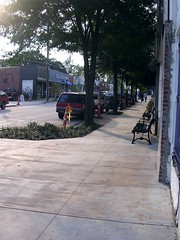
In fact I all of the hotels except for Motel 6, had very poor to no pedestrian access points to the hotel. This next photo is back at 500 South looking south toward 600 South with the Little America on the left. As you can see the east side of West Temple has the right elements for pedestrians, there is just too many barriers to using it.


Finally you look back toward downtown, so close yet so far away.


You can build sidewalks and put trees in to create an environment that should foster more pedestrian activity, but if development or the lack of it and street design creates barriers to pedestrians all sidewalks in the world will not encourage people to use them.


Enhanced by Zemanta

Wednesday, September 08, 2010

Improving Bus Service...

The "3 Cherry" bus in Seattle, Washi...Image via WikipediaThe Transit Sleuth twitted a question: " “Hmm, what would increase bus ridership in Seattle? I want to create a top 10 list. :)”

The Seattle Transit Blog responded to the twitter:

11 Steps to Bus Ridership

I thought it would be fun to look at the Seattle list and see how it would apply to the UTA. So here is the answers from the Seattle Transit Blog and my response on how they would apply to us.

1. More density. Density begets ridership.

As I have discussed we need to add smart density to both transit stations and to areas with good bus service and that will help increase ridership. By increasing ridership on the busy lines by adding new riders, the cost of those services will go down allowing funds to be used for other services that we cannot currently afford.

I have previously discussed how we need to build smart developments along the major 15-minute bus routes especially in areas where those 15-minute routes intersect.

2. Bus lanes and signal priority. Slow buses are a frequent complaint.

Well signal priority would be nice but I don't see it happening on a region wide basis. I also don't see bus lanes being addapted in many areas except maybe in the downtown area. Once again what we really need to do now that we have a majority of routes served by low floor buses (and almost exclusively by low floors in the next couple of years), is to make boarding and discharging faster. This can be done by making bus stops level with the floors on the low floor buses and also cutting out bus stops that are too close together.

3. Higher gas prices. Tackle the demand side. See 2008.

Of course higher gas prices also affect transit since they use fuel. I will not even get into a discussion of the true cost our lust for fuel has cost us as a nation. However, what we do know as China starts to lust after oil even more than we do, we are going to come to a reckoning of the true cost of gasoline and its hidden costs that we have not had to face before.

4. An end to socialized and/or regulated parking, possibly a higher commercial parking tax.

A parking tax would be one way to pay for the city of Salt Lake buses I mentioned before or could be used to provide additional UTA service in the area and improved pedestrian access to the core.

However, the cost of parking can be such a polarizing issue as people don't equate that their parking at the suburban malls are subsidized by the retailers giving them that wonderful free parking that they complain about paying anywhere else.

5. A
branded frequent-service network. RapidRide is a start.

Well we do have a dedicated 15-minute service and UTA has wrapped a couple of buses promoting it, but beyond that UTA has done little to brand the 15-minute service. We also have MAX but as I have pointed out just recently, UTA is not doing well with that one either.

6. More frequency, particularly East-West. Too many dense places in the city are too far apart by bus.

Anyone who knows the geography of Seattle can see how east-west routes are difficult to service and need special attention and while we do not have those kinds of problems in Salt Lake County, our friends to the north and south in Utah, Weber and Davis counties do have those kinds of issues.

An additional problem in these counties the lack of density making providing bus service even more difficult. The best solution for the Bountiful area would be a Call N Ride service similar to the ones in Denver that will provide guaranteed connections to Routes 455, 470 and Front Runner.

In Ogden area we have the 603 and 640 that do provide some semblance of north-south service but eventually routes need to be added to the north. The problem is the route will probably have to be a modified U-shaped route or giant S.


7. Payment reform. This is also part of speeding things up. More off-board payment would help. Popularizing ORCA through a small fare discount would speed adoption and boarding time. There are couple of ways to get rid of the pay-as-you-leave policy, but the important thing is to introduce the board in front/get off in the back and improve flow on the buses.

The ORCA card in Seattle is the Tap On or what ever they call it card here in Utah. The card seems to working pretty good here in Utah as I have only seen one bus recently that was having problems with it. The problem of course is the few number of people using it.

As many regular readers of this blog know, I do not have a problem with eliminating the fare free zone in the downtown area. We could do what Portland has done and make it apply to rail only, but it also could go away. By eliminating the zone all every bus would be pay as you enter causing less confusion for customers and eliminating the slow process of getting passengers on and off leaving on buses leaving downtown.

8. More presence by transit security.

Agreed, more presence both on TRAX, the stations and on buses would make customers feel more secure.

9. Real-time arrival where possible. GPS is being installed over the next year and will improve the accuracy of onebusaway, but RapidRide is the only part of the system that is planning message boards at stops.

10. Stop consolidation.

Metro in Seattle has been consolidating bus stops on several several routes recently. While some oppose it, I can see places where it needs to be done both there and here in Utah. There is many spots where stops are too close together and could be moved farther apart speeding up bus service along with other actions as mentioned above.

11. More standing room on crowded routes.

Anyone who rides frequently in Seattle knows that the buses can be packed. Here in Utah we usually don't have that problem although even routes such as the 213 can be packed when Cottonwood High lets out.

However we have not reached the point where standing room only is an issue for an extended period of time but will be great when it does.
Enhanced by Zemanta

Saturday, October 18, 2008

Blog Entries of Note...

East Atlanta: pedestrian friendlyImage by Amber Rhea via FlickrFrom the Mobilizing the Region Blog:

Where the Sidewalk Continues…

In September 2006, NJ Gov. Jon Corzine launched a five-year, $74 million statewide pedestrian safety initiative that included money for several NJDOT pedestrian safety programs, traffic calming infrastructure, “traffic-stat” technology, and increased inter-agency coordination. Two years in, the results are visible around the state.

This is what we need in Utah, a program to improve pedestrian safety.

From the Xing Columbus Blog:

62 New Bike Racks Installed in Past Three Months

Columbus, Ohio has installed a large number of bike racks around their city recently. One of the problems many bicyclist face is the lack of facilities to park their bikes. The next time you are out see how often you see bike racks available.

From the Overhead Wire Blog comes:

Pushy SF1

Another great entry from the Overhead Wire about so called free market and new urbanism.

From Streetsblog LA:

Metro Making Room for Bikes on Their Trains

Metro in Los Angeles actually banned bicycles during rush hour periods but is now reversing itself and doing the same thing as UTA: removing seats from trains to give more room for bicycles.

Transportation for America Launches Legislative Campaign

Campaign to improve transit and rail infrastructure.

From the Steve Munro Blog:

Diesels, Not Hybrids, At Least For Now

Back when UTA implemented the fuel surcharge people scream why doesn't UTA buy more Hybrid buses (UTA currently has three in the fleet). In Toronto, they have decided to order more diesel buses because the batteries are only lasting a quarter of the time they were supposed to.

From the Orphan Road Blog:

Parking Ruins Everything

Some interesting information about a couple of different boroughs in New York.


Reblog this post [with Zemanta]

Tuesday, December 25, 2007

Another Video from Dr. Shoup

Clarence from Streetfilms let me know that they have posted another film with Dr. Should that discuss parking.

Wednesday, December 05, 2007

Free Parking Cost...

Donald Shoup is the author of the book The High Cost of Free Parking which is available through Amazon.

Here is a nice interview of Mr. Shoup from Street Films.

Monday, October 01, 2007

Sugarhouse...

Sugar House developers, city planners surprised when expected hostile hearing is amiable

Well Gateway will soon be rising at Highland Drive and 2100 South, Oh I mean new Sugarhouse.
I have said it before, there is nothing in this development that offers anything special. You will have high priced condos, high end chain retailers, and office space. There is nothing that separates this complex from Gateway.

Here is some of the things that I see wrong with this complex:

-Parking entrance will be right on 2100 South. Parking entrances should be in the back of the building. All this creates is a situation that pedestrians will have to cross a driveway that people will barrel in and out of and make crossing it unsafe for pedestrians.

-The parking entrance will also create a barrier from Red Mountain's redoing of the former Granite Furniture Building

-While this fits in to what I already mentioned, the development will focus on Highland Drive leaving the 2100 South area left to itself.

At least this development will be more pedestrian friendly than it's neighbor across Highland Drive. I hope Mr. Mecham works with the community to build a good complex and takes into consideration the walk ability of not only Highland Drive but also 2100 South.

Sugerhouse was a unique area, but the city has slowly let the area's character be destroyed. It's time for the city to take a more active roll in building better communities.