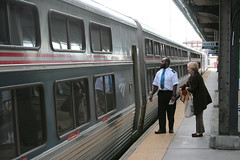
Showing posts with label Long Distance Trains. Show all posts

Thursday, June 23, 2011

This Week in Amtrak

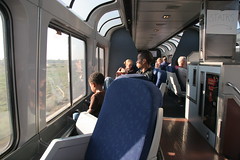
A Superliner Lounge (observation) car on Amtra...Image via Wikipedia
This Week at Amtrak Vol. 8 No. 11
Volume 8, Number 11

From the Editors…

This week we hear from Russ Jackson, Vice President of the United Rail Passenger Alliance. Russ is a retired California college instructor, former RailPAC officer and editor, and is now living near Dallas, Texas.

AMTRAK Long-Distance trains at 40

And, what they still need is more cars!


Comments by Russ Jackson

That was then: Forty years is a long time. In this report let us first take a look at where the Western long distance trains started for Amtrak, and then look at today. Charting will be for two trains that were in the Amtrak official timetable #1 for May 1, 1971, which was quickly replaced with a new one on July 12 (to view this timetable see: http://www.timetables.org/browse/?group=19710712r&st=0001); then, the May, 1991 national timetable which was in effect when this writer became editor of RailPAC’s Western Rail Passenger Review; and then we do a comparison of those past schedules with the 40th anniversary 2011 national system timetable which is available now at all Amtrak-staffed stations.

Trains 1 and 2, the Sunset Limited

We all know what the problem with this train has been and continues to be: Tri-weekly (also said as tri-weakly) service from day one, thanks to the inherited schedule from the Southern Pacific, and it continues to run today with nearly full loads despite the very bad schedule.

1971 Dp NOrl 1:00 PM; Dp Phx 10:50 PM; Ar LA 7:30 AM Su,W,F 44.5 hrs
1991 Dp NOrl 2:15 PM; Dp Phx 10:31 PM; Ar LA 7:00 AM M,W,F 42.75 hrs
2011 Dp NOrl 11:55 AM; Dp Mar 11:57 PM; Ar LA 8:30 AM Su,W,F 44.5 hrs *

1971 Dp LA 10:00 PM; Dp Phx 8:10 AM; Ar NOrl 8:00 PM Su,Tu,Th 44 hrs
1991 Dp LA 10:50 PM; Dp Phx 7:20 AM; Ar NOrl 7:50 PM Su,Tu,Th 43 hrs
2011 Dp LA 3:00 PM; Dp Mar 10:38 PM; Ar NOrl 2:55 PM Su,Tu,F 48 hrs *

*NOTE: In 2011 the trains do not go through Phoenix, a major city now without train service, and there are generous amounts of built-in recovery times throughout the route. In 1971, the schedule called for Yuma to Tucson via Phoenix to be 6 hours; in 1991, 6-1/2 hours; in 2011, 4-3/4 hours via Maricopa. If Phoenix were still on the schedule, an hour and a half would have to be added to the 2011 schedule.

Trains 3 and 4, the Southwest Chief

In 1971 timetable #1, this train had numbers 17 and 18 and was named “Super Chief-El Capitan,” continuing its inherited Santa Fe tradition.

1971 Dp Chi 6:30 PM; Ar LA 9:00 AM; daily 40.5 hrs *
1991 Dp Chi 5:00 PM; Ar LA 8:10 AM; daily 41.25 hrs
2011 Dp Chi 3:00 PM; Ar LA 8:15 AM; daily 43 hrs

1971 Dp LA 7:30 PM; Ar Chi 1:30 PM; daily 42 hrs *
1991 Dp LA 8:30 PM; Ar Chi 3:50 PM; daily 42.25 hrs
2011 Dp LA 6:15 PM; Ar Chi 3:15 PM; daily 45 hrs

* NOTE: In 1971, the train did not go via Topeka, KS, which adds one hour to the schedule.

While running times and scheduled departures have remained fairly consistent for these trains, for others they has been all over the map. Several interesting changes from 1971: Then, the Coast Starlight was the first west coast train to travel from Seattle to, first, San Diego. It ran tri-weekly north of Oakland and from Los Angeles to San Diego, but daily from Oakland to Los Angeles. In 1971 there were only two daily round-trip San Diegans between Los Angeles and San Diego; no San Joaquins, and no Capitols. Originally, the California Zephyr was scheduled to travel its current route, but when the D&RGW railroad decided to opt out of Amtrak, it ran via Wyoming, and operated daily from Chicago to Denver but tri-weekly between Denver and Oakland. The Empire Builder did not have a Portland section, and crossed the Cascades in Washington going via Yakima instead of Wenatchee. All this was accomplished using low-level cars and locomotives that were 20 years old and operating crews inherited from the freight railroads.

This is now: In the July, 2011 issue of Trains magazine, writer Bob Johnston has written a review of Amtrak’s past, dividing its history into five sections and comparing “then” to “now.” For example, section one, “Wake-up call,” says “Then: equipment had to be ordered and funded.” Sadly, “Now: equipment has to be ordered and funded.” While that is important for all parts of the system, including the Northeast Corridor, Amtrak has neglected its long distance trains badly. In his presentation to the RailPAC-NARP meeting in March, 2011, Minnesota’s Andrew C. Selden said, “Amtrak has made no significant investment in its long distance services in 20 years, and now plans only to replace its Superliner I cars, not to grow its long distance fleet or network.” Mr. Selden’s comments and data explaining all this were published in the May-June issue of the RailPAC newsletter.

On May 17, 2011, Amtrak CEO Joseph Boardman told the U.S. Senate Appropriations Committee, “You are not going to cut costs far enough on the long-distance trains to make (them) profitable.” This statement came after Amtrak’s West Coast Superintendent, William Duggan, spoke to the RailPAC meeting, revealing (with a Power Point visual) that “Sleeping car ticket revenue makes a positive contribution to Amtrak’s bottom line.” That is what RailPAC, URPA, and most objective long distance train advocates have been saying for too many years; but Amtrak has not been willing to fund additional cars that will contribute positively to that bottom line, instead choosing to invest only in corridor trains that are paid for by the states (except in the NEC). Mr. Selden says, “Amtrak is turning away boatloads of money for want of new capacity.” As RailPAC President Paul Dyson, says, “More cars on the (existing) trains means more revenue and smaller deficits. The true deficit is in management, not dollars.”

So we can all agree that adding additional high-revenue cars to existing trains, those that will run every day (including the daily Sunset Limited, eventually), is where Amtrak should be concentrating its efforts, right? RailPAC’s Noel Braymer suggests, “How about private financing (safe-harbor leasing) with a business plan to pay for them with increased revenues? With California about to order new bi-level cars how about Amtrak getting an ‘add-on’ to that order for new hulls at least.”

We must add a caution written by Mr. Selden to us, that it “will take hundreds of new cars–effectively deployed in high revenue services–to get to break-even. But, local wisdom in St. Paul is that there never will be a fourth sleeper on the Builder because the diner is swamped as it is and they couldn’t feed another carload of passengers. Personal observation is that they’re right. The diner in mid-summer (i.e., for the four peak months) is dreadful in terms of regimentation and rushed service, and stress on an understaffed crew.” After a trip on the Empire Builder, where he is a National Park Service volunteer in the Rails-Trails program, narrating the trip between Minneapolis and Wisconsin Dells, Mr. Selden wrote that “All three sleepers were all but sold out on both trains and would be sold out west of Minneapolis. Coaches were about 2/3 occupied so statistically sold-out due to down-line sales.” And this on a train that has had many on-time problems this winter and spring.

RailPAC Vice President-South James Smith returned from a round trip on the Southwest Chief from Los Angeles to Chicago and reported the same sold-out condition in May, before the official travel season begins. People want to ride… Something must be done for these western trains, besides just replacing cars one-for-one, if Amtrak really wants to grow financially and calm the criticism thrown at it. Or does it?
Enhanced by Zemanta

Tuesday, June 07, 2011

This Week in Amtrak

Railway tracks. (NOTE: Uploader says, in uploa...Image via Wikipedia
This Week at Amtrak Vol. 8 No. 10
Volume 8, Number 10

From the Editors…

With the same assurance as the sun setting in the West, once again all of Amtrak’s perpetual financial woes are blamed on its long-distance trains.

Oh, really?

“Ducking this issue calls for real leadership.” - Springfield Mayor “Diamond” Joe Quimby, The Simpsons

Passenger rail ridership is up, of this there may be no doubt. Using the rudimentary yet flawed number of “riders,” Amtrak carried 28.7 million people in fiscal year 2010. This year should be even higher. Of course, now-a-days Amtrak never discusses “passenger miles” or “revenue per passenger mile” but this was not always the case.

Even so, when questioned by Congress as to why increasing “ridership” did not correlate to a drop in losses, the standard chestnut was brought out one more time, “It’s the long-distance trains,” said Amtrak President Joe Boardman. “They’re all unprofitable.” Oh, really? We have all heard this before, but how long will this broken record continue to play?

For many, the long-distance trains are the perceived final connection to an earlier era. Many a parent has packed up his family for an overnight trip with the proud exclamation, “We’re going to ‘Travel in Pullman Safety and Comfort’ like our grandparents did.” Obviously, there are no more open sections or drawing rooms. If there is an observation car it is privately owned. Oh, and when was the last time someone shined your shoes for you whilst you slept? Today’s long-distance train is a mere shadow of the former glory that once was the grand conveyance. Whereas average citizens could not afford fine linens, china, and silver service, these were commonplace for all who frequented the dining car; it was their chance to live like royalty, if only for a few hundred miles. Do today’s trains even come close to emulating such an emotion? Alas, such only exists for those who remember when, or who have studied the subject.

Things behind the scenes have changed, as well. Even into the early Amtrak days, long-distance reservations still used the old tried-and-true drum system. Dozens of agents sat around a rotating metal carousel with compartments containing train accommodation diagrams, while talking to customers or agents by phone. Today all of this is computerized. The ragtag collection of locomotives and rolling stock has been replaced by standard designs. Locomotive fuel economy has never been higher. Steam heating has been replaced by electric. Operating crew districts are no longer 100 miles. Bases for maintenance have been consolidated and centralized. Yet with all of these changes, which should have led to better economies, the long-distance trains still “lose money.” How can this be?

The Vision from 20 Years Ago

For Amtrak’s 20th anniversary, then-Amtrak-president Graham Claytor boasted of its cost control:

“Amtrak is determined to continue to improve bottom line through better service and controlled cost until 100 percent of operating costs are covered by earned revenues. At close to 80 percent in 1991, we are nearing that goal.” - All Aboard Amtrak 1971-1991, Railpace Publications

At no time in any of the historical records has it been found where Mr. Claytor blamed any of Amtrak’s financial woes on just the long-distance trains. Mr. Claytor was a railroad executive starting with a career at Southern Railway in 1963. He knew the numbers and, more importantly, knew what they meant:

“A year before Amtrak, railroads carried intercity passengers 4.9 billion passenger-miles and lost the 1991 equivalent of $1.5 billion doing it. In Fiscal Year 1990, Amtrak carried its 22.2 million intercity passengers 6.1 billion passenger miles and pared operating losses to about $330 million.” - All Aboard Amtrak 1971-1991, Railpace Publications

Mr. Claytor understood that the true measure of output is “passenger-miles” and revenue per passenger-mile, not the mere number of tickets sold. Tickets sold is the measure of the number of transactions, but ten $1 tickets are not as valuable as one $20 ticket. To this end, it must be noted that during the last five years the long-distance trains have averaged a growth rate of 3.7 percent, with no years of negative growth; something not even the regional or corridor trains can claim. Even more surprising is that the LD trains showed any growth at all, since they were statistically almost sold-out to begin with, and over the last 15 years (post-Claytor), their aggregate capacity (measured in “available seat miles” or even just “car miles”) has declined. This is growth in a product line defined as distance of 750 miles or greater on trains that have not seen any additional equipment in over a decade. Even so, this growth in patronage should correlate to higher revenue. What went wrong?

Since the passing of Mr. Claytor, there has not been a seasoned railroad executive at the helm of Amtrak. As a result Amtrak, a ward of the state, has reverted to a function of government; a workfare/basic transportation/federal entity charged with placating the public while twisting in the political winds. As a result it finds itself stuck between the dichotomous mandates of affordable transit and covering debts. The July/August 1974 edition of the Official Railway Guide lists the one-way coach fare between Chicago and Los Angeles at $113.50; corrected to 2011 dollars, this would be $514.47. Today's fare is one-half to one-third the inflation-corrected fare. After checking coach fares between numerous city pairs, today’s fare is one-half or less than that of 35 years ago (when corrected for inflation). Remarkably, sleeper fares are on par to then, when correlated. The result of this has, in effect, reduced Amtrak’s trains (long distance in particular) to Greyhound buses on rails. Was this always the plan? Not according to Mr. Claytor:

“They [fares] are going to increase just as fast as competitive factors permit… Because our service has been improving, and more and more people have been willing to ride, and as long as more and more people are willing to ride, and pay higher fares, the fares are going up. This is not new. This is the policy that we have been following for at least 10 years.” - Interview with Graham Claytor, Trains magazine, June 1991

Today there appear to be “more and more people willing to ride,” yet in the last 20 years Amtrak ticket sales have gone from 22.2 million to 28.7 million. Just 6.5 million more riders per year in 20 years? This is hardly anything to crow about. During the same period, as aggregate intercity travel has increased (and air traffic has quadrupled), Amtrak’s aggregate national market share has declined. How, after all this time, could ridership remain so paltry? Perhaps no one at Amtrak knows how to grow ridership and increase output. Mr. Claytor knew how to do both. When asked about service expansion and the goal of full cost recovery:

“That is one of the ways we hope to reach it and to get additional equipment in order to increase our revenues faster than our costs. That spread is what counts. With the new order for locomotives already in [to General Electric], and with the orders for new Superliner cars we hope to make this year, these would give us the additional capacity to increase our revenues. We are up against the stops on many ways, because many times of the year we can’t carry more people. We have more people wanting to go than we can carry, because we do not have the capacity. The first priority is to get more capacity on the routes we serve. The second priority will be to start new routes that we think have a good possibility of working.” - Interview with Graham Claytor, Trains magazine, June 1991

Mr. Claytor’s “first priority” fell by the wayside after his passing. Instead, focus shifted and intensified on the corporation-owned Northeast Corridor (NEC). This would culminate in the extension of electrification from New Haven, Connecticut to Boston and the notorious Acela trainsets. While these are demonstrative improvements in infrastructure and passenger amenities, it is still a short corridor, and as such offers limited potential for passenger-mile revenue growth. While total NEC ridership has grown, Amtrak’s overall market share has declined sharply, and is less than 1.5%; all of this is hardly enough to offset the costs of infrastructure maintenance, and the high maintenance and power consumption of the Acela trainsets.

Ultimately, passenger railroading in America has been held hostage by misconceptions. In the 1950s, hucksters such as Robert Young convinced people that the only future for passenger rail was the short-haul train; conveniently, short-haul trainsets were what he was attempting to sell. The outcome of a 1958 Interstate Commerce Commission investigation has been dubbed the “Hosmer Report,” after ICC examiner Howard Hosmer, wherein:

“This examiner’s proposed report included an oft-quoted speculative conclusion that railway passenger coaches would likely soon become museum pieces along with stagecoaches, sidewheelers, and steam locomotives. Such language was not adopted in the subsequent formal ICC decision.” - Amtrak’s Long-Distance Service, Can it be Made Viable?, Gordon Gill

Today’s weary chant of “the long-distance passenger trains are a money drain” is nothing more than a continuation of the "junk science" formulated over 50 years ago by those lobbying for their own agendas. The public at large blithely accepted that junk science as fact, since passenger trains, for the most part, were not germane to everyday life. As growth in passenger rail with long-distance trains, in particular, has shown, junk science no longer cuts the mustard for today's savvy travelers. Amtrak had better find a new mantra.

Past is Prologue

Recently, someone was nice enough to publicly post a picture of a train gate at Chicago Union Station from 1964, showing the makeup of that day’s South Wind: http://www.rrpicturearchives.net/showPicture.aspx?id=2487104 Even at this late date, seven years before Amtrak, notice there are eight sleeping cars assigned to this train along with five coaches. On today’s trains, if the number of sleepers is equal to the coaches, it is a miracle; in the East, the sleepers are outnumbered by coaches. Moreover, Amtrak does not have an adequate supply of spare equipment to increase train length to match fluctuating demand. If Amtrak had kept the proper ratio, at least the income from the First Class section of the train would still be the same as 35 years ago.

Is it rational to expect Amtrak to provide “First Class” amenities? Does Amtrak really provide a First Class Service? Is the provision of a mattress enough to be classified as “First Class?” If so, try to remember that, the next time Motel 6 leaves the light on for you.

Even though Graham Claytor believed it was possible, perhaps Amtrak is not capable of providing the equipment, let alone the proper business acumen/model for overnight service. It should be remembered that for most of the history of American passenger railroading, overnight rolling stock, sleepers, and diners were provided by a third party: The Pullman Company. Pullman was a private enterprise employed by the private railroads to provide a service. For most of its life, Pullman made money. Relieving Amtrak of this chore should allow it to concentrate on its core business; the equivalent of buses on rails.
Enhanced by Zemanta

Monday, May 02, 2011

This Week in Amtrak - Amtrak's 40th Anniversary Edition

Acela Express power car 2000 at BWI Rail StationImage via Wikipedia
Volume 8, Number 8

From the Editors…

For those who have not noticed, Amtrak is now a four-decade-old reality. Is this the best we could hope for?

Fix Amtrak First

May 1, 2011 marks a major anniversary in American railroading. For some it is a celebration. For others it is a bittersweet regret. For a few, it means keeping their vocation. Then there are those who find political opportunity.

To be sure, the world which led to the creation of Amtrak is now a distant memory. In 1970, despite ever growing ton-miles, America’s railroads were in trouble. In the Northeast over a half-dozen carriers were mere decrepit shells of their former glory, and one by one would follow Penn Central into bankruptcy. The Milwaukee Road and Rock Island of the Midwest teetered on the brink of insolvency, seeking relief by shrinking their physical plants or by mergers. Out West, the Southern Pacific, once the third largest industrial corporation in the country, sought relief through merger and passenger train-offs. Otherwise healthy roads in the Southeast and West knew only too well that their future fortunes were inextricably tied to continued interconnectivity in the nation as a whole. Over six decades of burdensome Federal overregulation was threatening to wipe railroading from the American landscape.

Meanwhile, the rest of the country was aiming ever higher. Man landed on the moon. Commercial supersonic flight was becoming a reality. The basic interstate highway system framework was complete with no impediment, financial or physical, to its construction. Nevertheless, America could not survive without its railroads, and the powers-that-be knew this.

The simple reality is that Amtrak was created, not to save the passenger train, but rather to save the freight rail network. In a stopgap move created to relieve the railroads of their financial malaise, the government established the National Railroad Passenger Corporation, first known as Railpax, and today known as Amtrak. All eligible (non-commuter) railroads were invited to participate. All but seven joined. This was merely a Band-Aid for the industry. A much larger bandage would be the Federal takeover of the Northeast railroads in 1976, in the form of Consolidated Rail Corporation, or ConRail. The ultimate corrective surgery would be passage of the Staggers Act of 1980 and deregulation of much of the industry. ConRail would be privatized in 1987 and ultimately broken up in 1999. Through it all, the Band-Aid that is Amtrak remains.

Now with nationalized intercity passenger service a reality for four decades, the world is a much different place. We are no longer a nation capable of visiting the moon. Commercial supersonic flight ended almost a decade ago. The cost to return the interstate highway system to a state of good repair is estimated in the “hundreds of billions of dollars,” money the nation simply does not have. Now more than ever the nation is in need of a comprehensive and coherent passenger rail system, not a Band-Aid. In order to achieve this there is one unavoidable step: Fix Amtrak first.

True, there have been past attempts at fixing Amtrak’s woes. The most recent was the Amtrak Reform Council of the last decade. It was during this period that many Amtrak apologists obfuscated, and demanded from any who questioned Amtrak’s worthiness to “define reform.” Well, in just the last 18-24 months Amtrak has fired its Inspector General for ostensibly doing his job; after losing the contract to operate Virginia’s commuter trains, Amtrak began systematically harassing the winning bidder, Keolis, in what may or may not have been an attempt to get the contract back. In Florida, Amtrak demanded unnecessary concessions from a not-yet-running commuter railroad, SunRail, for reasons that are still nebulous. Suffice it to say there is plenty of room for improvement at Amtrak; actions such as the above at any private corporation would have warranted legal and/or disciplinary action.

Amtrak’s foibles have not been lost on the current administration. The cry for High-Speed Rail was followed by requests of interest; not from Amtrak, but rather from the states, directly. With this end-run around Amtrak, it was hoped the rebuilding of passenger railroading could be achieved sans the bureaucratic black hole of business as usual. The results were spectacular failures in Ohio, Wisconsin, and Florida. If there is to be a renaissance of passenger trains, Amtrak is no longer a can to kick down the road.

Although there is no quick fix, there are steps which could aid in the recovery of national passenger rail service. The best place to start would be at the top: The Amtrak board of directors. Since 2008, the Amtrak Board should have had nine members; currently there are eight. Of these, seven are life-long bureaucrats with only one from a professional railroading background. As Amtrak is a ward of the State, this is to be expected, but it was not the original intent:

"Once the corporation was set up, it was placed under the responsibility of management working under a 15-man board of directors. Eight of the directors were to be appointed by the President, and one of the eight always was to be the Secretary of Transportation. None of these eight directors nor any officer of the corporation was allowed to have any connections with the railroads. Three additional directors were to be elected by common stockholders and four by preferred stockholders. Initially, common stock was to be issued only to railroads and preferred stock only to persons other than railroads. In short, the corporation mainly was to be owned by the railroads, but all the decisions were to be made by a board composed largely of Presidential appointees." - Don Phillips, Railpax Rescue, Journey to Amtrak, 1972.

Obviously, the original plan for the Board did not pan out. All of Amtrak’s preferred stock is held by the government and much of the common stock is still held by the railroads. As these shares are deemed worthless, they are not much of a basis upon which to run a corporation; however, there is a very significant difference between then and now. In 1971, there were over five dozen Class One railroads. Today there are only seven, six of which handle daily Amtrak trains.

Adding seven seats to the existing nine-member Board would come close to the original plan of 15 members. Of these seven new seats on the Amtrak Board of Directors, six seats would be from those Class Ones, and one would be a representative from the American Short Line and Regional Railroad Association (ASLRRA). Why? This ensures there are at least seven people on the Amtrak Board who understand business and understand railroading. By design, Amtrak is meant to be a quasi-public corporation. The addition of seven members from the private sector will ensure a professional atmosphere in accordance with generally accepted business practices. These seven new members would balance with the existing nine board members, selected and confirmed from the public sector, guaranteeing the public’s input to “America’s Railroad.” If leadership from the private sector were allowed to re-allocate available Federal capital to applications that would yield the highest return per dollar invested (as opposed to political goals), then Amtrak’s financial outlook might not be so dismal. Also, as seen with commuter passenger services provided under contract by some freight railroads such as BNSF in Chicago, they still know a thing or two about passenger operations.

Every aspiring manager is warned of a common human tendency of subordinates: The ever-present gravitation toward those projects that are favorites, to the neglect of other projects which may be priority. To that end, it becomes necessary to remove the Northeast Corridor from Amtrak. This is not to imply a lack of importance for the NEC. A large number of people live in the Northeast, but the majority of Americans do not. Even before Amtrak, the U.S. Department of Transportation singled out fast trains as reflected in the High Speed Ground Transportation Act of 1966, which led to the DOT's sponsorship of the Metroliners on Penn Central. Ever since the NEC was ceded to Amtrak in the fire sale that was the end of the Penn Central, Amtrak’s myopic attention has continuously returned to those 450 miles of track between Boston and Washington, D.C., consuming a half billion dollars or more a year in Federal support. What about the other 20,000 miles? Due to the unique nature of the NEC, it should be grounded in its own reality; a separate board of governance, and its own budget separate from the national network. Congress has mandated that all corridor services be operated in a uniform manner (read, state subsidy) by 2015. Now would be an opportune time to place the NEC where it belongs.

Obviously there are other issues plaguing American passenger railroading: Deteriorating equipment, eyesore stations, growing tonnage on the rationalized freight railroads, outdated labor practices, etc. These will all have to be addressed in time. For now, it is time to take that “first step,” the initial change in direction departing from the status quo, intent on a new destination. Up until now, Amtrak has been deemed too small to register with the body politic, but too large to simply dispense with entirely; now, however, is a different time. Passenger rail is no longer a luxury subsidized out of the national largesse. Passenger trains are the ever-present and ever-growing lynch pin of transportation. Future growth will be predicated on the present amelioration of the business-as-usual Amtrak. Is this not what we, the people, should deserve and should expect?


Enhanced by Zemanta

Thursday, April 28, 2011

This Week in Amtrak

(Amtrak 345, an EMD F40PH pulls a passenger tr...Image via Wikipedia
Volume 8, Number 7

From the Editors…

Recently, Amtrak released its updated fleet strategy plan. What a difference a year makes.

A Tale of Two Strategies

At first blush, it would appear the primary difference between Amtrak’s Fleet Strategies of February 2010 and February 2011 is a thorough going over by our very own proofreader here at This Week. (For the record, she vehemently denies this, but the investigation is on-going.) Upon closer inspection, it becomes obvious certain realities are now being accepted. Before going any further it should be known that the original document and its update are of a high quality and represent the obvious expenditure of many hours of effort.

The updated report acknowledges the orders of 130 single-level cars for Eastern long distance service and 70 electrics for the Northeast Corridor. Priorities held over from 2010 are the replacement of 250 Superliner I's and the development of “a new fuel-efficient high speed diesel locomotive.” New to the priority list are: Replacement of 145 Amfleet II's, developing a “bi-level corridor car to replace single-level cars where clearances permit, adding two cars each to the existing Acela fleet (40 new cars total), and planning the next generation of high-speed trains. Total estimated cost of this 30 year plan is $25.2 billion.

Replacement of the single-level long distance coaches, Amfleet II, has now been moved ahead of the Amfleet I replacement. Why? Despite being a few years newer, the average mileage for an Amfleet II car is 1.4 million miles over an Amfleet I. Truth be told, the Amfleet design was never meant for long-distance service, yet they have performed adequately for over 30 years; a true testament to the construction of the Budd Company. CAF USA has a very tough act to follow, constructing the 130-piece Viewliner 2 order. There are 145 Amfleet II’s in service but the Fleet Strategy does not specify how many new cars will be ordered. If CAF USA gets a chance to build a coach variant of the Viewliner 2 platform, then we could possibly see uniform trainsets in the east, something which has not happened since the introduction of the Amfleet II’s in 1980. Do you believe in miracles?

In 2010, “long distance” services were defined as “more than 600 miles,” whereas in 2011 it is “more than 750 miles.” No doubt this is a sign of inflation. Also curious is the statement that the long-distance trains “have grown around 2 percent annually,” although “Table 8: Amtrak Ridership Growth FY06-10” demonstrates that long-distance trains were the only service during those five years not to have a negative ridership growth; even during the doldrums of 2009. Average growth on the long-distance trains according to Amtrak’s data was 3.7 percent for the last five years, a fact all the more fascinating when one takes into account there has been no addition to the equipment of these trains in over a decade.

A significant difference between the two reports is the acknowledgment of Amtrak’s Office of the Inspector General (OIG). The OIG is evaluating the original report, and will issue its own report this year. “We look forward to receiving the final OIG report and we will continue to work with the OIG to ensure that its insights are incorporated in the next fleet plan update as appropriate.” Where was the OIG during the original report? Oh, right.

In both reports the Horizon fleet of regional-distance cars is panned: “These cars suffer from a variety of operational problems in cold temperatures and winter conditions.” Interestingly these cars are a variant of an original Pullman-Standard commuter car design which has gained acceptance in New Jersey, New York, Connecticut, Pennsylvania, and Massachusetts, none of which are known for their balmy winters. The solution for 2011 is a new fleet of 125 bi-level cars ostensibly patterned after the cars used in regional service in California. As these cars do not have any operating history in the extremes of the Midwest, this will be an interesting experiment. Although the “California cars” appear to be similar to Superliners, the difference is in the details. Superliners have their Head End Power (HEP) and Multiple Unit (MU) cables well above the ground and away from snow and ice buildups. California cars have their cables astride their couplers, as is standard with most other equipment. Superliners have successfully pinch hit for Horizon cars in Midwest services during wintertime. If one expects California cars to perform to the same level as the Superliners, one may be in for an unpleasant surprise.

One other curious statement as regards the potential routes for the new bi-level cars: “The only other exception would be Amtrak’s Hoosier State/Cardinal Service between Chicago and Indianapolis, which would continue to use single level equipment because of clearance constraints on the Cardinal route.” Trains between Chicago and Indianapolis have always ferried equipment to and from Beech Grove, Amtrak’s maintenance facility just outside Indianapolis. The deadheading equipment does include cars from Amtrak’s current bi-level fleet: Superliners, Superliner II’s and California cars.

The plans for Acela were wide and varied in 2010. By 2011, the choices have been narrowed: “There is a compelling case for an additional two cars for each set… [the extra cars] will deliver a positive return even if the trains were replaced in 2023.” Moreover, the desire is expressed for an additional 20 trainsets “of a new rather than the existing design and delivery would begin in 2017.” Apparently they have learned one lesson.

Unfortunately, both reports address the potential utility of self-propelled diesel cars or Diesel Multiple Units (DMUs). Not that there is anything wrong with DMUs in and of themselves; however, they are best suited to commuter operations. Amtrak is NOT a commuter railroad, and provides operating crews under contract to a handful of commuter operations around the country. If one of these commuter lines provides DMUs for its operation, so be it; but Amtrak should not be taking the lead on this.

It is recognized in the reports that: “Suppliers need a constant stream of work to ensure that there is sufficient business to support a competitive supplier base and avoid the boom and bust cycles in the past.” This work-fare program of equipment sustainability is the sort of thing a state-owned/operated polity should have pursued since its inception. Well, better late than never. The plan calls for an average of 65 single-level and 35 bi-level cars per year starting in 2012 and 2014, respectively.

Both reports speak of the need for the development of future equipment. The 2011 edition refers to the Next Generation Equipment Committee (NGEC), whose stated goal is “to promote the creation of a pool of standardized, interoperable equipment that could be used by Amtrak and the states in various state-sponsored corridors with flexibility and efficiency.” In light of Amtrak’s past history of equipment, standardization would be a vast improvement. This is, however, a double-edged sword. Such a mandate would mean ostracizing non-standard equipment such as the state-owned Talgo trainsets in Cascade and Hiawatha services. Standardization to the exclusion of innovation has a history of long-term negative consequences. Fifteen years ago, ABB Traction withdrew its product, the X2000, from contention for use in the NEC. The X2000 achieved higher speeds on conventional track through the use of radial steering trucks and active tilting. Since no other bidder could offer radial trucks, it was not included in the Federal bid request, and ABB realized it could not succeed in the face of cheaper, inferior products.

Perhaps the largest sign of change is what was not held over from the original report, the “Calculation of required added cars per set” toward the back of the report. Originally hypothesized were the train consists as they might appear for FY18 and FY23. When first released in 2010, it was these charts which caused many a confused look even from the most ardent Amtrak apologists. For 2018, 10 of the 14 long distance trains would receive one extra sleeping car. By 2023, four more trains would have added one more sleeper; yet this very same chart reports the 2008 load factors for the sleepers, and none are below 80%. Two trains are tied at 94 percent. None of Amtrak’s regional or corridor offerings even come close to matching this load factor. It is also no secret that fares for traveling by sleeping car are especially dear. Even so, sleeping cars are what the traveling public craves. Why? There could be many postulated reasons: An aging population, TSA fatigue, etc. We at This Week do not know the true reason for this trend, but it really is academic. The public has voted with its wallet, demanding sleeping car space.

Through Amtrak’s typical “framing mischief by decree,” it has made it abundantly clear that it is loathe to reinstate trains such as the Pioneer, North Coast Hiawatha, or Eastern leg of the Sunset Limited. Even so, it does acknowledge the growth in long-distance demand. “This gradual increase in demand can be satisfied through the progressive replacement of equipment and lengthening of existing train consists.” Limiting the increase, however, of already paltry long-distance trains by a mere one or two cars just does not correspond with reality. Long-term success of any business requires change, to support changing demand. In the past, the speed at which Amtrak responded to such change was glacial, at best. Amtrak has not received any new equipment since 2002. It may already be too late. After 40 years, it should be getting it right. If not, then perhaps it is really time to let someone or something else have a turn.
Enhanced by Zemanta

Tuesday, January 18, 2011

This Week in Amtrak

ViewlinerImage by Madbuster75 via Flickr
From the Editors…
And now a (highly) condensed look at the year past through the eyes of This Week at Amtrak.

2010, A.D. [Amtrak Defined]
As we enter our eighth year of publication, we find the world of passenger railroading in a greater-than-usual state of flux. Obviously, the biggest curveball thrown may be summed up in three little words: High- Speed Rail. After the “Vision for High-Speed Rail” and High-Speed Rail guidelines of 2009, we waited in expectation for January 28, when $8 billion worth of specific American Recovery and Reinvestment Act rail projects would be announced. It took months for the euphoria to subside. Then came reality; mid-term election candidates began to run on platforms advocating stoppage of HSR projects in their respective states. Freight railroads found the punitive federal guidelines “surprising” and “frightening.”

Then things got interesting.

On January 5, after an initial one-year term as President, Joseph H. Boardman was granted (by the Amtrak Board) a permanent position. On January 11, an Amtrak press release announced, “AMTRAK READY WITH BIG PLANS FOR 2010 -- New Year brings major projects and new initiatives.” This was hardly the first announcement heralding “big plans.” As with so many other forward-looking statements of years past, this was generally received with a sigh. As events would later prove, however, some rather big things did actually happen.

March 6 saw the first Town Hall meeting co-sponsored by Amtrak and Trains Magazine. Well-attended and featuring the presence of Amtrak Chairman Tom Carper, as well as Joe Boardman, there were those inside the corporation who decried this “foamers’ forum.” Even so, there was positive dialogue about photography and updates on equipment rebuilding at the Beech Grove Repair Facility, using stimulus money. A train of three cars and a locomotive were on display for all in attendance to tour (and photograph).

March 31 was the end of an era at Amtrak. Cliff Black, long-time (and long-suffering) Chief of Communications and employee since 1981, retired. For years, it had been his quotes, his voice which represented Amtrak to the general public. Through each change of leadership at Amtrak, and there were several, the one constant had been Black's deft handling of the news media. Any of us seeking good honest information knew Cliff Black was the man to see. While keeping on-message for his employer, he never led the news media astray; an amazing feat in today's world of journalism. Suffice it to say, this is a retirement well earned and richly deserved.

July 23 brought what was perhaps the biggest, most jaw-dropping initiative undertaken by Amtrak all year, and possibly all decade: The order for 130 new Viewliner 2 single level cars with an option for 70 more to replace the remaining Heritage baggage cars and diners. Was this shocking turn due to a previously-unrealized corporate need? No. As far back as 15 years ago, Amtrak's then-president Thomas Downs described the remaining Heritage cars in service as “junk.” Was this, then, as a result of a sudden jump in demand for sleeping car space on eastern trains? No. Sleeper space has been at a premium, especially in the East, since the retirement of the last Heritage sleepers in 2006. Ever since the 50-unit fleet of Viewliner sleeping cars entered service in 1995-96, we have been waiting for the rest of the Viewliner fleet to supplant the last of the Heritage fleet. We have waited… and waited… and waited. When Amtrak announced, on January 11, “a comprehensive and detailed plan to replace and expand its fleet of locomotives and passenger railcars” they could have warned us that this time they really meant it.

The Washington Times of September 12 reported on a Congressional probe of the sudden ouster of Amtrak Inspector General Fred Weiderhold, the previous year. Quoting from draft copy, “Because of his expertise, the [Amtrak] Board viewed Weiderhold as a threat.” Also found were “excessive fees” paid to outside law firms by Amtrak’s Law Department and, due to the circumstances surrounding Mr. Weiderhold’s departure, “It was not a truly voluntary resignation as Amtrak management had suggested in public statements.” There was some attention given in the Halls of Congress which, thus far, has amounted to nothing beyond lip service. But as Chicago Cubs fans are used to saying, “maybe next year.”

On October 16, a Norfolk Southern freight train departing Enola Yard across the river from Harrisburg, Pennsylvania, en route to Hagerstown, Maryland and points South, derailed in downtown Harrisburg. The rear of the train was still west of the Amtrak station, precluding the eastbound Pennsylvanian from entering. Many will use such an incident to demonize the freight railroads and to call for building separate tracks. Ironically, that is exactly what NS has been attempting to accomplish in the area for a number of years. Currently, when freight trains to or from the south enter or depart Enola Yard, they are required to cross the Susquehanna River twice (and pass the Amtrak station), a process which adds hours to transit times. NS has been working with the State to rebuild a former connection on the south side of Enola Yard at Lemoyne. The process has been held up for the usual political reasons (concerning which a boxcar could not care less). Until this has resolution, efficiency will suffer. Passenger rail will suffer. Egos will continue to be stroked. A similar incident occurred July 2, and for what? For less than 1,300 feet of track. Sometimes the answer really is that simple.

Also in October came an admission of the obvious. One year earlier, the contract to run the Virginia Railway Express commuter service, held by Amtrak for 18 years, was awarded to the French company Keolis. Amtrak did not like this intrusion into its turf. As documented by veteran reporter Don Phillips, “The battle then turned bitter, and Amtrak and its unions turned nasty. Union officials made it clear to employees that if they signed with Keolis, they would be fired immediately by Amtrak and permanently blacklisted. Crews who agreed to stay with Amtrak not only received a $5,000 bonus but were guaranteed a job. Amtrak, meanwhile, even tried to hire crews laid off from New Jersey Transit who had been approached by Keolis. The idea was to prevent Keolis from hiring enough crews to run the system by takeover day, June 28.” Yet, in spite of all the chicanery and dirty tricks Keolis did begin service (albeit delayed) and continues to operate. By October of 2010, Amtrak President Joe Boardman finally admitted, “We know we did not provide the right answers,” and “I see a lot more competition coming forward.” Amtrak considers itself to be the sole keeper of American passenger railroading. Considering its isolationist history, this is understandable; however, the word is getting around that there are others willing to ante up to the table. Amtrak has promised to behave. Will it?

Finally, on December 20, Norfolk Southern and the Commonwealth of Virginia entered an agreement to reintroduce passenger service to Norfolk. This is funded by “an $87 million Rail Enhancement Fund grant” which, when translated into English, means these are state monies, not Federal or ARRA grant. Yes Virginia, there really are states who take the initiative in their passenger rail programs.

2010 promised to be the year of “High-Speed Rail.” Ultimately, it came in like a lion and went out like a lamb. HSR was touted as the savior of our economy; an engine for creating jobs in much the same way as the Interstate Highway System of two generations ago. Rhetoric was thick. Substance was lacking. The proposed fast trains look sleek and sexy, but where is the business case to justify them? No one is against creating jobs, but with at least $8 billion in the offing, the question is begged: Is this a good, sustainable transportation policy?

Perhaps the biggest story in passenger rail is the one that did not happen.

Amtrak’s manifesto of January 11 predicted, in part, “the purchase of several hundred single-level and bi-level long distance passenger railcars and more than a hundred locomotives.” New Viewliners were ordered in July, followed by a contract for new electrics in October. Unlike many of the HSR initiatives, these orders have had no political opposition. Yet as 2010 wrapped up, there were no “bi-level long distance passenger railcars” on the horizon. As pointed out by Andrew Selden, URPA Vice President, “This is the one application of capital available to Amtrak that promises a quick and positive return on incremental invested capital. No other investment opportunity, honestly accounted for using GAAP measures, offers anything even close to this. Yet Amtrak refuses to pursue it.”

As the year has drawn to a close, the same basic route map remains in place. Apologists are grateful the map has not shrunk any further. Advocates wonder why, in an era of so much talk of rail, the map is not growing. The Sunset Limited still does not venture any further East than New Orleans, and is carried on Amtrak’s daily status as "Hurricane`Katrina' Aftermath & Service Adjustments - Sunset Limited: Normal service resumed 03Nov05, with the exception of Trains 1 and 2 between Orlando and New Orleans."

True, there was much more talk about passenger rail this past year than in recent memory. The small order for equipment was positive, yet after so many years of benign neglect, this can hardly be counted as a fresh start. “What is needed most in 2011, following what happened in 2010, is a better, more rigid plan for creating new trains which have a higher guarantee of success and financial reward, instead of becoming yet another burden on the overburdened taxpayers,” said Bruce Richardson, URPA President.

As the afterglow of the latest surge in HSR interest fades into memory, it is clear that sleek, fast trains do not exist in a vacuum. Around the real high-speed world, fast trains succeed as part of a vast integrated network; the trains, by themselves, would be nothing more than pricey tourist attractions. Amtrak would appear to have figured this out, as evidenced by its current equipment orders, and wish list from last January. Unless projects of this type are embraced, to build upon the few successes of this past year, then the whole enterprise is for naught; hopefully, it will not be too little, too late.

Enhanced by Zemanta

Sunday, January 10, 2010

This Week in Amtrak

Empire BuilderImage by Patrick Rasenberg via Flickr


This Week at Amtrak; January 11, 2010


A weekly digest of events, opinions, and forecasts from


United Rail Passenger Alliance, Inc.

America’s foremost passenger rail policy institute


1526 University Boulevard, West, PMB 203 • Jacksonville, Florida 32217-2006 USA

Telephone 904-636-7739, Electronic Mail info@unitedrail.org • http://www.unitedrail.org


Volume 7, Number 2


Founded over three decades ago in 1976, URPA is a nationally known policy institute which focuses on solutions and plans for passenger rail systems in North America. Headquartered in Jacksonville, Florida, URPA has professional associates in Minnesota, California, Arizona, New Mexico, the District of Columbia, Texas, New York, and other cities. For more detailed information, along with a variety of position papers and other documents, visit the URPA web site at http://www.unitedrail.org.


URPA is not a membership organization, and does not accept funding from any outside sources.


1) VIA Rail Canada is superb at doing it. The freight railroads do it like it’s an everyday occurrence. Amtrak, on the other hand, can never seem to get it right.


We’re referring, of course at this time of year, to operating trains in severe winter weather. While things have mostly been humming on the Northeast Corridor, it’s been a far different story out in flyover country where the Empire Builder operates between Chicago and Seattle, Washington/Portland, Oregon.


It’s been a while since Amtrak consistently got a train over the road anywhere near to keeping a schedule, and even running two trains in a row.


The problem has mostly been blamed on malfunctioning air systems from the locomotives. Without a working air system, there are no brakes on a train. (The air system we’re referring to has nothing to do with the hotel power from the locomotives to the rest of the train which provides heat for the train.)


Some Empire Builders have arrived nearly a day late, some not at all, some have only traveled a part of the route before being annulled. Word is, even Amtrak’s host railroad for the Empire Builder, the Burlington Northern Santa Fe Railroad, has banned the Builder from its infrastructure until Amtrak can prove it can get a train from Point A to Point B without having a locomotive failure and fouling the main line which has heavy freight traffic.


All of this begs the question, “why?” since Amtrak has had nearly 40 winters to figure things like this out.


Some folks have speculated it’s because Amtrak tries to have an all-weather locomotive fleet, which operates in desert heat in the Southwest as well as it does in blizzard conditions in North Dakota. As with anything else which tries to be all things to all people, the inevitable failure occurs.


Some folks have speculated Amtrak’s mechanical department just isn’t up to the job, and does what it can with the budget it has to work with each year.


Some folks have speculated Amtrak just doesn’t care; if it doesn’t have anything directly to do with the NEC, then it’s not important.


But, looking at VIA Rail Canada, which generally operates under some of the most severe winter weather conditions in the world, VIA rarely has Amtrak’s winter weather problems. And, VIA is a smaller company, has fewer resources, and often makes do with older equipment.


The freight railroads in the same severe winter weather always manager to get trains with dozens and dozens of heavily loaded freight cars down the track, also using air brake systems, and they don’t have these problems. BNSF, like Amtrak, operates from the extreme northern tier of the country to the extreme southern tier, and needs locomotives, too, which can work in extremes of heat and cold.


If VIA can do it, and BNSF can do it, and Union Pacific can do it, and CSX and Norfolk Southern and Kansas City Southern can all do it, along with Canadian National and Canadian Pacific, why can’t Amtrak?


As said in this space before, we know there are some dedicated transportation people at Amtrak who want the railroad to run right, no matter what the weather forecast. Why aren’t these people given the budget and resources they need to get the job done? Amtrak begs for money every year from Congress and the federal treasury, laying out priorities. Why isn’t locomotive reliability outside of the Northeast Corridor in the winter a priority?


These are the times which try mens’ souls, when the harsh realities of Mother Nature go up against the needs of mortal man. These are the times when the professional railroaders, who go to sleep thinking about railroading and then wake up the next morning thinking about the same thing, need the resources to do their jobs. If Amtrak wants to continue to promote itself as the custodian of the next generation of passenger trains and thinks it’s going to be the first choice as the operator of the new high speed rail systems, rational people making those decisions are going to wonder why Amtrak, which is operating conventional rail on a system which has been in place for over 150 years, can’t figure out how to make that system work. If Amtrak can’t get conventional rail right, how will it ever get high speed rail right?


2) Where are you on the Amtrak spectrum? Are you a True Believer, willing to accept anything Amtrak and the National Association of Railroad Passengers says, at face value? Are you always willing to give Amtrak more and more money, without accountability, just because it’s Amtrak?


Are you more of a pragmatist, and believe in the business of passenger rail, knowing at one time it was a sane, profitable business, and there is no reason why in the future it can’t return to that status?


Are you convinced the days of passenger rail are gone, and everyone should enjoy driving their private vehicle down crowded highways or the only other option for public transportation is airplanes?


Which one are you? Do you fit into any of those categories, or, perhaps are you something of a blend of two or more of those categories?


How do you see the future of passenger rail? Are we on the cusp of renaissance, or near the end of the line? Is that light at the end of the tunnel an oncoming passenger train you welcome, or the halogen headlights of an overpriced SUV getting five gallons of gas to the mile of transportation?


It’s time to start choosing sides. More and more passenger rail publications are openly questioning the actions/lack of actions of Amtrak. Columnists who were once reliable Amtrak Apologists are now apologizing to their readers for taking so long to see the truth about Amtrak, and its lack of motivation.


So, are you going to sit on the sidelines and kibbitz about what the final colors of pre-merger Seaboard Air Line Railroad passenger locomotives were, or are you going to figure out how to take some action and demand better passenger rail transportation in this country, whether or not it’s from Amtrak?


Politics in Washington are in a turmoil, and there is likely to be a huge sea change in Congress at the end of this year. No matter who is charge in Washington, it’s time to express your displeasure with how things are with passenger rail, and demand better oversight, and, most importantly, demand someone, somewhere, develop a coherent national surface transportation plan.


As long as everyone just sits around and waits for something to happen, nothing is likely to happen. Amtrak seems content to consume its annual free federal and state monies without any demonstration of progress to create more or better passenger trains. Amtrak needs some major prodding, and it needs prodding from someone who can force change and inspire vision at Amtrak.


What are you going to do about it?


If you are reading someone else’s copy of This Week at Amtrak, you can receive your own free copy each edition by sending your e-mail address to


freetwa@unitedrail.org


You MUST include your name, preferred e-mail address, and city and state where you live. If you have filters or firewalls placed on your Internet connection, set your e-mail to receive incoming mail from twa@unitedrail.org; we are unable to go through any approvals processes for individuals. This mailing list is kept strictly confidential and is not shared or used for any purposes other than distribution of This Week at Amtrak or related URPA materials.


All other correspondence, including requests to unsubscribe should be addressed to


brucerichardson@unitedrail.org


Copies of This Week at Amtrak are archived on URPA’s web site, www.unitedrail.org and also on www.todaywithjb.blogspot.com where other rail-related writings of Bruce Richardson may also be found.


URPA leadership members are available for speaking engagements.


J. Bruce Richardson

President

United Rail Passenger Alliance, Inc.

1526 University Boulevard, West, PMB 203

Jacksonville, Florida 32217-2006 USA

Telephone 904-636-7739

brucerichardson@unitedrail.org

http://www.unitedrail.org


Reblog this post [with Zemanta]

Thursday, December 10, 2009

This Week in Amtrak

Track approaching Medway Viaducts. {{location ...Image via Wikipedia

This Week at Amtrak; November 24, 2009


A weekly digest of events, opinions, and forecasts from


United Rail Passenger Alliance, Inc.

America’s foremost passenger rail policy institute


1526 University Boulevard, West, PMB 203 • Jacksonville, Florida 32217-2006 USA

Telephone 904-636-7739, Electronic Mail info@unitedrail.org • http://www.unitedrail.org


Volume 6, Number 47


Founded over three decades ago in 1976, URPA is a nationally known policy institute which focuses on solutions and plans for passenger rail systems in North America. Headquartered in Jacksonville, Florida, URPA has professional associates in Minnesota, California, Arizona, New Mexico, the District of Columbia, Texas, New York, and other cities. For more detailed information, along with a variety of position papers and other documents, visit the URPA web site at http://www.unitedrail.org.


URPA is not a membership organization, and does not accept funding from any outside sources.


1) Today is the Tuesday before the Wednesday before Thanksgiving, and Wednesday is considered by everyone to be just about the busiest travel day of the year, even in times of recession.


Once again, Amtrak is making its usual Herculean effort on the Northeast Corridor to shuttle holiday travelers between Washington, New York City, and Boston.


This year, there are also some additional services on the West Coast in California, and some extra goodies elsewhere.


However, once again, there is a notable lack of beefing up of long distance trains throughout the nation; Amtrak apparently feels only people on the Left Coast and Right Coast, north of Virginia, celebrate Thanksgiving, and the rest of the country – as usual – are left to fend for themselves for holiday travel.


Part of the problem is Amtrak’s lack of equipment, due to its deliberate plan to keep as much long distance equipment as possible out of service to save on maintenance costs. Never mind the revenue lost or new passengers to be served; Amtrak managers only receive recognition and bonuses on money saved, not money spent to improve the company’s core financial position.


2) All of that aside, it is important to pay respect to all of the Amtrak employees who will be working long and hard on Wednesday and Thursday, and throughout the holiday weekend taking care of their passengers. Amtrak is still a 365 day a year operation, and no matter that it’s Thanksgiving, Christmas Day, or any other holiday, dedicated Amtrak employees are out on the road, manning ticket windows in stations, cleaning cars in coach yards, and refueling locomotives all over the country, and we thank them for taking care of our needs while they are away from home and their families.


3) You may want to glance again at the date of this missive; one month from today is Christmas Eve. Finished your shopping, yet?


4) Thanksgiving also marks another milestone: Amtrak Interim President and CEO Joseph Boardman marks the completion of his single year contract this week as Amtrak’s chief steward. Since no announcements have been made to the contrary, everyone can only assume his one year contract has been extended ...


William Lindley of Scottsdale, Arizona has some thoughts on the subject.


[Begin quote]


By William Lindley


Those of you who held General Motors shares and now hold the converted "Motors Liquidation Company" will be pleased (sarcasm alert) to know that according to their website (https://www.motorsliquidation.com/?evar10=InvestorInfo_MotorsLiquidation), at the end of the bankruptcy proceedings, it is the Company's expectation your remaining interest in "common stock will have no value."


We could argue who was to blame for GM's failure – the unions? the management? the corporate culture? too much government regulation? not enough government assistance? – but the crux of the matter is, the board of directors – and particularly the president – are ultimately responsible for a corporation's performance. It was the board's, and the president's, responsibility to either guide the company to stability, or advise the stockholders far in advance of an impending failure. The board, and particularly the president, failed to do so.


No-one should be much interested in placing blame now, though; words have little value, results have much.


By the same token, we expect interim Amtrak president Joseph Boardman to be clear about his company's future. Many of us have heard him speak, with positive impressions. Yet the results that matter – reports stuffed with lackluster, unimaginative excuses instead of positive plans for restoring furloughed routes or opening new ones – ultimately rest under his watch. The failure to order equipment sufficient even to maintain current routes, ultimately rests under his watch.


Look out your window. Do you see a tree or a shrub? It is doing one of two things – growing or dying. There is no middle ground, there is never stagnation. A business is the same way. Grow, or die.


Is it Amtrak's intention simply to go gentle into the good night? If not, where is the bold plan, where is the vision for growth? Eagerly, we await.


[End quote]


If you are reading someone else’s copy of This Week at Amtrak, you can receive your own free copy each edition by sending your e-mail address to


freetwa@unitedrail.org


You MUST include your name, preferred e-mail address, and city and state where you live. If you have filters or firewalls placed on your Internet connection, set your e-mail to receive incoming mail from twa@unitedrail.org; we are unable to go through any approvals processes for individuals. This mailing list is kept strictly confidential and is not shared or used for any purposes other than distribution of This Week at Amtrak or related URPA materials.


All other correspondence, including requests to unsubscribe should be addressed to


brucerichardson@unitedrail.org


Copies of This Week at Amtrak are archived on URPA’s web site, www.unitedrail.org and also on www.todaywithjb.blogspot.com where other rail-related writings of Bruce Richardson may also be found.


URPA leadership members are available for speaking engagements.


J. Bruce Richardson

President

United Rail Passenger Alliance, Inc.

1526 University Boulevard, West, PMB 203

Jacksonville, Florida 32217-2006 USA

Telephone 904-636-7739

brucerichardson@unitedrail.org

http://www.unitedrail.org


Reblog this post [with Zemanta]

Friday, October 23, 2009

This Week In Amtrak

Northern Pacific train No. 25, the North Coast...Image via Wikipedia


This Week at Amtrak; October 22, 2009


A weekly digest of events, opinions, and forecasts from


United Rail Passenger Alliance, Inc.

America’s foremost passenger rail policy institute


1526 University Boulevard, West, PMB 203 • Jacksonville, Florida 32217-2006 USA

Telephone 904-636-7739, Electronic Mail info@unitedrail.org • http://www.unitedrail.org


Volume 6, Number 44


Founded over three decades ago in 1976, URPA is a nationally known policy institute which focuses on solutions and plans for passenger rail systems in North America. Headquartered in Jacksonville, Florida, URPA has professional associates in Minnesota, California, Arizona, New Mexico, the District of Columbia, Texas, New York, and other cities. For more detailed information, along with a variety of position papers and other documents, visit the URPA web site at http://www.unitedrail.org.


URPA is not a membership organization, and does not accept funding from any outside sources.


1) Well. A lot has been happening in the two weeks since the last This Week at Amtrak was published. Before we get into some specifics, we first need to hear what Minnesota Association of Rail Passengers and United Rail Passenger Alliance Vice President of Law and Policy Andrew Selden has to say on the current state of Amtrak.


[Begin quote]


By Andrew C. Selden


Amtrak blinds itself, in its endless posturing to fool its bankers in Congress, by measuring its performance by numbers that do not really matter, while ignoring or burying numbers that do matter. As a result, it makes decisions, including strategically important allocations of precious investment capital, on the basis of fundamentally misleading data.


The most glaring example is Amtrak's endless blathering about "ridership." Ridership is only a measure of a sale transaction. It does not differentiate among the size of the sales. One "rider" from New Haven to Boston is, by this yardstick, exactly equal to one rider from Washington, D.C. to Boston, or even Los Angeles to Boston. Amtrak makes this worse by blurring useful sales data (ticket prices) into averages by which they measure (actually, it's just arithmetic, not really "measuring" anything) "yield," which is the average revenue per passenger mile on a train or route. This tends to reinforce the false belief any one passenger is pretty much the same as any other.

In an urban transit system where every passenger pays the same fare, that might be okay.


But on Amtrak, where a typical "corridor" customer might pay $10 to $30, but a family in a sleeper to the west coast could be paying $1,000 or more, these "riders" are decidedly unequal. Fifty of the former are less than two of the latter. But Amtrak is obsessively focused on "ridership."


A yardstick Amtrak tries to hide, and apparently never uses to make important resource allocation decisions, is load factor. Load factor is the percentage of your inventory you are able to sell. Airlines live and breathe load factor.


Load factor is available seat miles (total inventory) divided by revenue passenger miles (seat-miles sold to paying passengers).


Load factor ("LF") matters greatly. Among other things it is a perfect measure of capital efficiency, and where a business is over-invested vs. under-invested. It is an indirect measure of opportunity cost. A trend analysis of LF is a tell-tale for a growing or a dying business.


It indicates whether an operation has achieved an efficiency of scale, or needs to ramp up, or down, its application of capital assets to achieve an efficiency of scale. The NEC's low load factors show Amtrak is already over-invested there: it offers much more inventory than it can sell for $30, or even give away. Long distance trains, with high load factors, show where Amtrak is under-invested, turning away potential $1,000 customers by the hundreds.


Simple "ridership," without consideration of load factor, is classic "Amtrak accounting" that disregards the cost and utilization of capital. If you have a rich uncle who doesn't care, or a politically-oriented appropriations committee that has other objectives, or a gullible state agency that doesn't seem to get it (a la Oklahoma and the Heartland Flyer), then one can disregard capital costs, load factor, and utilization. Ready access to "free" capital (but always with a heavy political and opportunity cost) obscures that.


Suppose a train or route has a LF of 40% (NEC average is about 40%). Suppose the LF is static, or even growing slowly. Is that a good thing? Or does that suggest the capital – represented here by the rolling stock, the overheads and even the relationship and rent costs with the host railroad – might be better applied elsewhere?


In other words: Can those trainsets produce, or earn, even more someplace else?


Real world, actual example: take a standard KFC restaurant with 72 seats grossing a million a year, and is often "full" (i.e., has a very high LF). It is a cash cow. The owner is happy. His banker is happy. But an investment banker focused on returns on capital (i.e., making money by maximizing output) will say, "Bulldoze this obsolete, underperforming asset. Get rid of it. It is a parasite. It is an obstacle to growth and profit. In its place, build a new, larger KFC with 150 seats and a bigger kitchen and a drive-through, that is physically capable of growing into a TWO or even three million a year store." And if the KFC instead were a lightly-used 40-seater that was doing $500,000 a year and showing no real growth, even if it were steadily profitable at that level, any rational analysis would conclude the store should be closed outright, and maybe re-located across town by the Wal-Mart, or out by the interstate. LF as well as cash flow, market share, and earnings are all part of the constant analysis that should be done of any commercial activity.


Amtrak NEVER does that. Amtrak instead fools itself and fools its bankers in Congress and its client state governments with phony-baloney data about transaction volumes ("ridership") and other irrelevancies.


ITEM: Amtrak's net loss last year was UP from the year before, for the umpteenth year in a row, even after all the subsidy and the deferred maintenance and the shrunken fleet and all the other voodoo accounting. That is why Amtrak is still a sinking ship, and why Interim President and CEO Joe Boardman, just like his several predecessors, is no different from Captain Edward Smith of the White Star Line. And trains like the Harrisburg – Philadelphia locals, or Acela, or the Heartland Flyer, with their low load factor, whatever the ridership, are just like that tiny scrape in the hull that eventually worked its disproportionate magic on the fortunes of the RMS Titanic.


[End quote]


2) Amtrak issued another route renewal report, and issued a final report on a second route.


The Pioneer route report, which was commented on previously in this space, was issued in a final form with no real changes in how Amtrak perceives to put this train between Denver and Seattle back into service at extremely high costs and a too long lead time, despite questioning from two United States Senators along the route, Senator Crapo of Idaho, and Senator Wyden of Oregon.


The new report issued was for restoration of the North Coast Hiawatha (Originally, the North Coast Limited, pre-Amtrak.) over the original Northern Pacific Railroad tracks. This route will parallel the Empire Builder route, but make a more southerly trip. Pre-Amtrak, the Empire Builder and the North Coast Limited were strong rivals between Chicago and Seattle, and both routes have breath-taking mountain scenery. The North Coast Hiawatha was one of the trains massacred by the route cuts of the Carter Administration.


Amtrak wants – yes, we’re not kidding – over one billion dollars to restore this route, with the bulk of the money going to track upgrades. After the Burlington, Northern Pacific, and Great Northern railroads were all folded into one company (which eventually became BNSF when the Santa Fe was added to the mix), the Northern Pacific route was considered redundant to the Great Northern (Empire Builder) route, and was downgraded. Part of the route in Montana was sold to a short line operator, too.


All of that aside, Amtrak has come out with ridiculously high figures for route restoration, including an amazing $330,000,000 just for six trainset of new equipment, including locomotives. This works out to an astounding $4,500,000 per piece of equipment, which is not only impossible to justify, but incredible anyone could present this figure with a straight face. Additionally, Amtrak demands millions and millions of dollars for crew training, as it has done in previous reports.


This analysis of the North Coast Hiawatha landed in the This Week at Amtrak mailbox.


[Begin quote]


Amtrak North Coast Hiawatha Report Reflects Apathy and Atrophy; Fails to Answer Many Questions


By Joseph D. Henchman

October 17, 2009


Introduction


On October 16, 2009, Amtrak published the North Coast Hiawatha Passenger Rail Study as required by the Passenger Rail Investment and Improvement Act of 2008 (PRIIA). That law required Amtrak to produce a report within one year of October 16, 2008 examining the feasibility of restoring passenger rail service between Chicago and Seattle via the former Northern Pacific mainline in Southern Montana.


Confronted with a political environment favorable to the expansion of its services, the report suggests an institution whose marketing and innovative instincts have atrophied. The report’s tone reflects a determination to drag out the timeline and extract as many subsidies as possible rather than seriously consider how a successful passenger rail service in the study area can be implemented.


Below are specific areas the report is insufficient or raises serious concerns.


Amtrak penalizes the study train for diverted passengers from other trains, but does not credit it for passengers fed to other trains.


Amtrak’s report penalizes the ticket revenue of the North Coast Hiawatha by $8 million because Amtrak estimates the train will divert passengers from the Empire Builder, a heavily-patronized Amtrak train (693 passengers each train in FY 2009 through July) that also operates daily between Seattle and Chicago. Amtrak goes so far as to say that the diverted revenue will “increase Amtrak’s direct operating loss.”


This analysis is incomplete for two reasons. First, the Empire Builder is often sold out for being over capacity, so an additional train may have the net impact of freeing up space on that train to be sold to others, wiping out any revenue loss. Second, and more importantly, Amtrak does not estimate additional revenue for other trains from the addition of the North Coast Hiawatha (or if they do, they don’t report it). Few Amtrak long-distance passengers ride end-to-end, with many taking shorter trips often involving transfers to other trains. On the west end is the Seattle-Portland Cascade train as well as the long-distance Coast Starlight to California. On the east end are services to St. Louis, New Orleans, Washington, Boston, New York, and Michigan. Added service into and out of Seattle and Chicago will result in additional revenues for all of these trains. If Amtrak “penalizes” the North Coast Hiawatha for “diverting” passenger revenue from trains, it should also “credit” the North Coast Hiawatha for “feeding” passenger revenue to other trains.


One approach Amtrak did not take would be to estimate system-wide revenues and expenses from the addition of the North Coast Hiawatha. This would give a true picture of the actual incremental cost of service expansion. Amtrak is also studying the expansion of services in several other routes, and is producing piecemeal reports on financial impacts, one-by-one. As Amtrak adds trains and frequencies, the additional options stimulate demand beyond that of one-train-on-one-corridor. A comprehensive approach of these proposals would be necessary for informed decision-making.


Amtrak Inexplicably Buries Its Conclusion that the Train Will Cost Its Operating Costs


There are two types of costs associated with running trains. One are relatively fixed costs that do not vary with the number of trains (system reservations and website, management costs, station costs), and the other are costs that vary with the number of trains (crew costs, fuel, payments to host railroads, and to some extent equipment maintenance). Amtrak’s estimate of North Coast Hiawatha operations, put in these terms, is as follows:


Passenger Related Revenue (not including $8 million revenue penalty for diversions from Empire Builder) – $51,000,000


Variable Expense: Fuel – $7,400,000


Variable Expense: Train Crew Labor – $13,000,000


Variable Expense: On-Board Services Labor – $14,700,000


Variable Expense: Mechanical – $11,900,000


Total Variable Expenses – $47,000,000


Net, Variable Expenses – +$3,000,000


Non-Variable: Station & System Expenses – $27,100,000


Total, All Expenses – $74,100,000


Total Net, All Expenses – ($24,100,000)


Farebox Recovery, Variable Expenses Only – 108.5%


Farebox Recovery, All Expenses (Amtrak reduces the farebox recovery by 10 percentage points by excluding the diverted revenue to the Empire Builder) – 68.8%


Amtrak’s long-distance service requires subsidies to cover its operating shortfalls [Based on Amtrak accounting methods]. Few if any recover 68.8% of their costs for all expenses, or actually break even on variable expenses, as Amtrak estimates here. Why Amtrak buries this information is inexplicable. One possibility would be that acknowledging Amtrak will run a train with a rather positive financial performance undermines its argument that massive subsidies are required to operate it.


Note: Amtrak does not clarify whether its estimate of system and route costs are the amounts that will be assigned to the North Coast Hiawatha or whether they are incremental costs of adding the train. For example, assume (using made-up numbers) Amtrak spends $100,000 a year operating the existing station at Fargo, North Dakota (which the North Coast Hiawatha would stop at), and $5 million a year running its existing national reservation system. Assume also Amtrak’s cost estimates in the report include line-items of $50,000 for the Fargo station and $200,000 for system reservations (they don’t; those items are not broken out). Does that mean Amtrak is spending an additional $250,000 when the North Coast Hiawatha is launched, or rather the North Coast Hiawatha will be assigned $250,000 of existing costs?


If the latter, it is relevant information, but its inclusion warps the decision-making process. Among Amtrak’s costs of operating the North Coast Hiawatha would be costs Amtrak is already incurring, and will incur whether the route is launched or not. To use economics terms, a decision-maker would be erroneously looking at average cost instead of marginal cost.


If it is the former, Amtrak needs to justify the $27 million in route and system expenses beyond merely saying they are “other direct expenses.” The amount reflects a third of the expenses associated with running the train, and while not suspect on its face, it does raise questions. Why does Amtrak’s report not include a technical appendix itemizing the costs it has estimated?


Amtrak Provides Just One Option: A Single, Slow, Short Train over the Entire Route


Unlike here, Amtrak’s past studies have often included a series of operating options. The recent Pioneer Service Study looked at several different alignments, the Sunset Limited Service Study looked at different service options, and the Ohio Service Study looked at different frequency options. Here, however, Amtrak provides no option other than one single, slow, short train. Given Amtrak’s own ridership and cost estimates, this is indefensible. It also allows Amtrak to demand higher subsidies than would be required to operate the North Coast Hiawatha.


The report recommends the establishment of one round trip a day along the 2,300 mile route on a 49 hour schedule, for an average speed of 47 M.P.H. (The North Coast Limited in 1956 managed 46.5 hours, so Amtrak proposes a train slower than one run 50 years ago.). The train would consist of locomotives, a baggage car, a crew car, two sleeping cars, three coaches, a dining car, and a lounge. Since each sleeping car has a maximum capacity of 49 and each coach has a maximum capacity of 74, that would mean a total train capacity of 320.


On page 28, Amtrak estimates even this slow, single train will result in 359,800 passengers a year, or 492 per train. On the face of it, this suggests the train will fill 153% of its capacity. Of course, few passengers will ride end-to-end, resulting in turnover en route. It would be useful to know Amtrak’s estimate of passenger-miles or load factor, but the report does not provide those numbers. Even if each seat turns over once per trip, the load factor would still be 76% (which would make airlines envious).


Amtrak’s report handicaps itself by limiting the train’s capacity. Many of a train’s expenses are fixed (engineer and conductor costs, for instance) or grow only minimally (fuel and service attendant costs, for instance) with additional cars. In the past, American passenger trains have operated with 16 to 22 cars (Today, in Canada, the Canadian transcontinental often operates with 22 cars in high season). The only serious limiting factor on train lengths are station platform lengths and locomotive power (itself limited based on the route’s curves and grades) and the ability to transmit hotel power from the locomotive to the rest of the train; usually 18 cars in the United States is the maximum train length because of this. Amtrak provides no information on why it limits the North Coast Hiawatha to nine cars (with only five being revenue cars) other than it lacks the imagination to try for more.


Since Amtrak’s proposed train already has locomotives, a baggage car, a crew car, dining car, and lounge, any additional cars would be revenue cars generating sleeping or coach ticket revenue. A 14-car train, for instance, would double the North Coast Hiawatha’s capacity, potentially doubling its revenue and most certainly not doubling its costs. Given Amtrak’s ridership estimates, such a capacity expansion would be justifiable. Amtrak does not investigate this option.


Amtrak also does not investigate the option of greater frequencies or runs over segments of the route (aside from noting that Washington State would not object to running trains to Minneapolis instead of all the way to Chicago). As Amtrak has discovered with service in California and Illinois, additional trains each day can reduce subsidies because (1) added frequencies can mean equipment spends less time idle at each end and (2) added frequencies can increase revenue from additional riders taking advantage of more options. A second frequency 12-hours off of the proposed schedule would be a natural consideration, as would additional day-train frequencies between segments of the route. It is unfortunate Amtrak looks at additional frequencies not as expanding passengers options and thus revenue, but rather as something to be penalized for “cannibalizing” passengers and revenue from existing trains.


Most transportation providers offer travelers options. One of Amtrak’s largest weaknesses is many of its trains run only once per day, resulting in equipment sitting idle for 6-18 hours at each end and passengers giving up if they cannot work with Amtrak’s one timetable option. Twice the trains can in many cases result in more than twice as many passengers. Fixed route costs, such as station operating costs (here estimated to be $27.1 million), can also be spread over more trains. As noted above, Amtrak estimates that the train’s operation itself, exclusive of system and route costs, will break even.


Amtrak Does Not Investigate Marketing Options


Amtrak’s report also provides no discussion of service options or marketing opportunities. The report mentions the North Coast Hiawatha’s Livingstone station is not far from Yellowstone National Park, but does not enlighten the reader as to whether Amtrak will capitalize on that beyond leaving passengers at Livingstone. (In the past, the Northern Pacific Railroad ran shuttle trains and later shuttle buses to the park.) The private Grand Canyon Railway in Arizona offers four different accommodation options, including a basic coach seat option. The higher-priced options include snacks, entertainment, and Grand Canyon National Park admission. In Europe, the CityNightLine overnight train service offers several different accommodation options, with higher-priced options including welcome wine or beer, an array of magazines, and breakfast on arrival. Other Amtrak trains have included parlor lounges, observation cars, children’s playrooms, quiet cars, wine tastings, and enroute tour guides. Other ideas could include on-board treadmills or weight equipment, video arcades, taverns or bars, or gift shops. Amtrak’s report shows no creative thinking with regard to providing services to passengers, an important aspect of its operation.


This is particularly indefensible in that Amtrak requires the purchase of brand-new railcars to launch the service, and estimates it will take 4-5 years to begin operations after funding becomes available. If Amtrak needs five years and new trainsets to provide exactly what it has provided for years on other routes, it is not thinking sufficiently creatively.


Amtrak’s report also provides no discussion of joint marketing opportunities for other popular attractions along the route, including the Mall of America in Minneapolis; historic tourist attractions in Butte, Montana (a larger town which Amtrak inexplicably writes off without bothering to estimate the costs of serving it despite rails existing and being on the train’s route, even though it reports that public and Montana Department of Transportation comments strongly favored studying operating service via Butte) and Bozeman, Montana; airports; and small-town communities currently without rail service in Washington State.


Conclusion


Throughout the report and its actions in recent history, Amtrak views its role as merely common-carrier transportation handling passengers when they show up. Instead, Amtrak should push itself to figure out how it can develop a market, providing a travel experience. Doing so will improve the bottom line for the company and for taxpayers, but requires shaking Amtrak out of its apathy and atrophy.


Questions Unanswered by Amtrak In Its Report


1. What is Amtrak’s estimate of the load factor for the North Coast Hiawatha, and how many passenger-miles will it generate?


2. What are the system-wide and marginal revenues and costs associated with launching the North Coast Hiawatha, including additional revenues to other trains from its operation?


3. How many of the cost items within Amtrak’s estimated $74.1 million in estimated North Coast Hiawatha operating expenses will be incurred whether or not the train route is launched?


4. What are the revenue and costs associated with other operating options, such as a longer train of 14-22 cars, or additional frequencies?


5. What additional level of capital investment would be required to raise average operating speed to 55 M.P.H. (42 hour schedule), 65 M.P.H. (36 hour schedule), or 75 M.P.H. (31 hour schedule)?


6. Given that Amtrak will be purchasing new equipment for these trains, what innovative ideas will Amtrak explore for the equipment?


7. What marketing opportunities will Amtrak explore for the operation of the trains, to maximize passenger travel experience and develop the market?


8. What are the costs associated with operating via Butte, Montana?


9. How would a system-wide expansion of train lengths and frequencies for long-distance trains change the operating performance of this route?


10. Why does Amtrak estimate so many people will ride the North Coast Hiawatha, relative to other long-distance trains?


About the Author


Joseph Henchman lives in Arlington, Virginia, and is interested in transportation economics and rail planning. He works as an attorney and policy analyst with a non-profit think tank in Washington, D.C., but this report is not associated with that organization. His email address is jdhenchman [at] yahoo.com.


[End quote]


3) Amtrak has now issued four reports since the end of the summer. First, the Sunset Limited – East of New Orleans/Gulf Coast report (Amtrak doesn’t want to run the service); the Ohio 3-C report for restored service between Cleveland, Columbus, and Cincinnati (Amtrak doesn’t want to run the service), the Pioneer report for restored service between Denver and Seattle (Amtrak doesn’t want to run the service), and, finally, the North Coast Hiawatha restored service report (Amtrak doesn’t want to run that service, either).


When you add up Amtrak’s estimates to restart these four routes, it’s over $2,000,000,000 (that’s two billion dollars, if you don’t want to count zeros).


In reality, if Amtrak really wanted to do any of these projects, the estimates are probably high by at least 40%, if not a full 50%. But, when you’re a planner for a quasi-governmental agency and you’re accustomed to spending someone else’s money (That would be money which belongs to you, the taxpayer.), costs don’t really matter. What matters is convenience and lots of bells and whistles (No pun intended.). Amtrak’s dream world dictates all new equipment, extravagant stations where smaller ones will do, crew training costs which are incomprehensible to any railroad professional, and a gold-plating of railroad infrastructure “just in case” the railroads want their entire right-of-way wish lists fulfilled at someone else’s expense.


All of this leads to the inescapable, sad conclusion that until Amtrak has a new management team which has any inkling of a vision for the future which includes new passenger car orders, a business plan based on reality instead of only raiding government treasuries, or without fantasies of ignoring the conventional passenger rail business because of the glamour of an incorrect assumption Amtrak will be the exclusive high speed rail operator (there’s a thought to give you nightmares for a week), restored long routes such as the North Coast Hiawatha may not be the best plan.


As presented, Amtrak’s four route restoration plans are a prescription for disaster.


The Gulf Coast report laments Amtrak went to all of the trouble of studying multiple scenarios, and settled on four, all of which Amtrak has priced too high. The reality of the Gulf Coast report is if Amtrak simply extends the City of New Orleans from New Orleans to Orlando, Amtrak will instantly reestablish a Chicago-Florida train, restore service on the Gulf Coast, and have a powerhouse operation for the cost of one extra trainset for the City of New Orleans (due to current too long equipment layovers in New Orleans) and the cost of Positive Train Control installation on the CSX line between New Orleans and Jacksonville.


The Pioneer report wants to set up a separate operation for the Pioneer between Denver and Seattle, with through-cars on the back of the California Zephyr between Chicago and Denver. Amtrak never considered the huge benefit of running a second frequency in the form of the Pioneer between Chicago and Denver, apparently because it would be too much trouble, no matter how much of a financial gain would be found.


The Ohio report wants to set up a pretty good service, but with a lousy end point in Cincinnati so the service will not connect withe the Cardinal; Amtrak continues its reckless policy of not often enough offering connecting trains just in case some passengers may want to travel on more than one route to reach a final destination.


None of the reports take into account the matrix effect of connectivity, more travel choices, or more stations served. Amtrak can only see costs, instead of benefits.


Little of Amtrak’s work reflects it was created by anyone with real concepts of passenger service, what’s overall best for passengers, or what posture best serves Amtrak – and, our country – financially.


For right now, until some of this changes, Amtrak may best serve itself and all of us by making some logical, small steps which will strengthen the company financially. Things like Kansas City-Omaha, Oklahoma City-Kansas City, Peoria-St. Louis, Savannah-Jacksonville, or Barstow-Bakersfield (/San Jose). Maybe think about Harrisburg-Newark via the Lehigh Valley.


Even easier would be to add truly new Superliner capacity to the existing long distance trains, to start to capture many of those $1,000 tickets Amtrak is losing now because the sleepers are full at various peak load points.


For those hoping for restoration of routes which never should have went away, this fall is truly a season of discontent. Amtrak seems to have gone out of its way to make things as difficult as possible for any returning trains, yet its chairman of the board and some senior executives are making presentations around the country about how Amtrak is the perfect organization to be the exclusive high speed rail operator for new services in America.


Until Amtrak gets its house in order and demonstrates it has some – any! – vision, no one (even government bureaucrats) are going to be foolish enough to anoint Amtrak as the high speed rail operator.


4) Last Saturday, October 17, 2009, a determined band of people met together here in Jacksonville, Florida. The group named itself the Sunset Marketing and Revitalization Team, and has been meeting for over a year now at various locations along the former transcontinental route of the Sunset, prior to its unceremonious loss of the east end of the route beyond New Orleans due to Hurricane Katrina in 2005.


John Sita, Jr. of New Orleans is chairman of the SMART group, and Jerry Sullivan of Jacksonville was the gracious host of the meeting.


The meeting lasted three hours, and the SMART members represented a number of states along the route, both east and west of New Orleans. One SMART member from Louisiana made an all-rail trip from his home to the meeting. To cover the roughly 600 miles from New Orleans to Jacksonville without the Sunset, he rode first to Washington via Birmingham, Atlanta, and Charlotte on the Crescent for a full day and a night, and then took the Silver Star from Washington for the afternoon and overnight trip to Jacksonville. Whew! Talk about dedication ...


Without getting into the various discussions and deliberations the group had, what is notable is the very need for the existence of this group. This group has no formal sponsorship, and is completely self-funded. These people banded together because they feel their quasi-governmental national passenger rail carrier has failed in its duty and obligations to restart the Sunset Limited east of New Orleans, and has constantly failed during the entire existence of Amtrak to make the Sunset Limited a daily train between Los Angeles and New Orleans (And Orlando when the train ran its full route.).


In the real, non-Amtrak world, this group should never have been necessary. If Amtrak had the compunction to live up to its mandate as a national rail carrier, there would be no discussion about the gaping hole in Amtrak’s route map between New Orleans and Jacksonville. An entire region of the country is disenfranchised for passenger rail service because Amtrak isn’t clever enough to figure out how to make the Sunset a success.


So, a group whose membership is more than 50 souls is working together to take the place of a taxpayer funded organization’s planning department to figure out how to make the Sunset Limited viable. Amtrak should be terribly embarrassed.


If you are reading someone else’s copy of This Week at Amtrak, you can receive your own free copy each edition by sending your e-mail address to


freetwa@unitedrail.org


You MUST include your name, preferred e-mail address, and city and state where you live. If you have filters or firewalls placed on your Internet connection, set your e-mail to receive incoming mail from twa@unitedrail.org; we are unable to go through any approvals processes for individuals. This mailing list is kept strictly confidential and is not shared or used for any purposes other than distribution of This Week at Amtrak or related URPA materials.


All other correspondence, including requests to unsubscribe should be addressed to


brucerichardson@unitedrail.org


Copies of This Week at Amtrak are archived on URPA’s web site, www.unitedrail.org and also on www.todaywithjb.blogspot.com where other rail-related writings of Bruce Richardson may also be found.


URPA leadership members are available for speaking engagements.


J. Bruce Richardson

President

United Rail Passenger Alliance, Inc.

1526 University Boulevard, West, PMB 203

Jacksonville, Florida 32217-2006 USA

Telephone 904-636-7739

brucerichardson@unitedrail.org

http://www.unitedrail.org


Reblog this post [with Zemanta]