Showing posts with label Pedestrian. Show all posts

Monday, January 28, 2013

"I Know Engineers...They Love to Change Things"

English: A diagram of a diverging diamond inte...
English: A diagram of a diverging diamond interchange, showing how the traffic flows. Apparently, the Dept. of Transportation in the state of Missouri had too much money this year and hired some kids to do the drawings. If people would simply pay attention to their driving, instead of treating their vehicle like a phone booth/restaurant, ridiculous designs like this wouldn't be part of today's roads Svenska: En bild på en divergernade diamantkorsning som visar hur tafiken rör sig. (Photo credit: Wikipedia)
For those too young to remember the quote from the title of this entry, it is from Star Trek: The Motion Picture and from Dr. McCoy and I thought it was perfect for this entry.

I came across the video below on the Portland Transport site and thought it was something that had to be shared. The Utah Department of Transportation installed one of these intersections at 2100 South Expressway and Bangerter Highway in West Valley.

The diagram on the right gives you the basics of what these types of intersections are supposed to do. I have to say the first time I approached the one on Bangerter Highway it was really confusing especially since it was dark and snowing at the time.

There was also several drivers almost taken out at the intersection by a semi that seemed to be even more confused that the average driver over how to drive this thing.

While the one in the video has "token" pedestrian and cycling access the Utah one does not but then again Bangerter and the 2100 South Expressway is not designed for pedestrians.


Besides this diverging diamond intersection, UDOT has also been busy turning traffic lanes on 5400 South into reversible lanes. In addition they also did a continuous flow intersection treatment at Redwood and 5400 South that I will discuss in the future.
Enhanced by Zemanta

Friday, March 18, 2011

Pedestrian Dead Zones

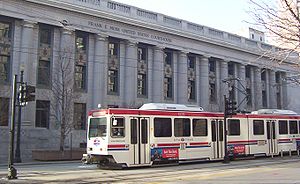
A TRAX train passing the Frank E. Moss Federal...Image via Wikipedia

Just because you build nice wide sidewalks and create a barrier between cars and pedestrians (such as trees) does not mean you will create an environment that conducive to pedestrian activity. To create pedestrian activity you need to have someplace to walk to but also reduce the number of barriers that exist to actually using those sidewalks to get somewhere.

Despite its very long blocks, there is some good pedestrian activity in downtown Salt Lake City from North Temple to about 350 South. If you travel any farther south than that you will see a remarkable decrease in the number of pedestrians. There is several causes of this drop off in pedestrian activity and I will cover some of the major ones in this posting.

Since Main Street is home to the TRAX light rail line I will start off at the corner of 400 South and Main. On the northwest corner of the intersection with have a court house. Court houses tend not to foster pedestrian activity because they are a single point destination, in other words people may go to the court house but that is the only reason they head there.

They are currently expanding the court house to take up most of the block from Main Street to West Temple. This will create a large barrier to pedestrian activity in the area. With court houses becoming even more fortified these days this makes court houses even more unfriendly toward pedestrian activity these days.

Here is a picture of the current court house looking north:


Here is a picture looking south diagonally from corner of 400 South and Main toward the corner of 500 South and West Temple.


Does this look like a thriving pedestrian and transit friendly downtown area or does it look like a parking lot of a suburban office park? This block of parking is made worse because of Salt Lake City's extremely long blocks. To the left of the picture is the Court House TRAX station and on the next block at State Street is another court house.

There is apparently a long story involving this parking lot barrier that covers the block between 400 South, 500 South, Main and West Temple. Despite all the opportunities that exist for development of this block with a TRAX station at the front door this lot will most likely stay as it is for the foreseeable future.

Once you walk pass the parking lot you face a new barrier for pedestrians-the 500 South and 600 South speedways to Interstate 15:


However, it is not three and four lanes of speeding cars that create a barrier to creating an effective pedestrian environment, it is the development that has occurred along the two streets. Because 500 South and 600 South are the two primary access streets to Interstate 15, the area along the two streets have become lodging row.

You would think that lodging facilities would want to foster pedestrian activity in the area but instead most lodging facilities are designed on two principles:

1. Everyone will arrive by car so there is no need to create effective pedestrian access points.
2. Especially if the lodging facility has on sight restaurants, the goal is to ensure the people staying at the facility only use their restaurants or have to get in their car and try to find parking if they want to eat somewhere else.

If you look at the picture above, you will notice that there is no pedestrian access point from the building in the picture to street level. This building is the Little America Hotel that covers all of the block with its sister property the Grand America Hotel taking up half of the block on the far side of Main Street (there is some irony that the Grand America was home to Railvolution back in 2005).

The next two pictures show the main entrance of both hotels on Main Street. While there is some pedestrian access to both hotels it is design more to foster getting guests between the two facilities than actually create any pedestrian activity on Main Street.


To be fair, the Little America does have a pedestrian entrance to its restaurant on Main Street about halfway between its main entrance and 500 South but it appears that there is few people that use it since pedestrian traffic on this section of main street is non-existent.

South of 600 South you have there is some areas of abandoned or barely used businesses and past 700 South you encounter several car dealerships including the Mark Miller Toyota Sprawl lot that completely kills most pedestrian activity in this neighborhood.

Heading back north we move one block west to West Temple and you have the only access point to the Little America from West Temple and as you can see from the picture it is not exactly pedestrian friendly:


To be fair to the Little America/Grand America hotels, they are not the only culprits as the Embassy Suites at 600 South and West Temple shows with its very small sidewalk providing the only pedestrian access to the hotel:


In fact I all of the hotels except for Motel 6, had very poor to no pedestrian access points to the hotel. This next photo is back at 500 South looking south toward 600 South with the Little America on the left. As you can see the east side of West Temple has the right elements for pedestrians, there is just too many barriers to using it.


Finally you look back toward downtown, so close yet so far away.


You can build sidewalks and put trees in to create an environment that should foster more pedestrian activity, but if development or the lack of it and street design creates barriers to pedestrians all sidewalks in the world will not encourage people to use them.


Enhanced by Zemanta

Saturday, November 27, 2010

Stardards and Livable Communities

Brickell Avenue is home to the largest concent...Image via Wikipedia
In my last posting I referred to this article:

Confessions of a recovering engineer

One of the things you get out of the article is the problem with standards. Now standards are needed but there is many times that so called standards get in the way of providing livable, pedestrian and bicycle friendly communities.

A example of an organization sticking to its 'standards' and not paying attention to the big picture is down in Miami with FloridaDot and Brickell Avenue.

FDOT Continues to Play Pedestrian Russian Roulette on Brickell Avenue

Pedestrian Hit Near Brickell Avenue, Mayor Regalado and Commisioner Gimenez Support Ped-Friendly Streets; FDOT Still Says No

Brickell in the area in question is home to several high rises both office and residential but FDOT standards dictate that the street is designed to speed cars through the area thus putting pedestrians in danger by high speed automobiles in the area. A bus stop with a shelter has been taken out by speeding drivers on more than one occasion.

Brickell Avenue Bus Stop Gets Taken Out Again

It was pointed out a couple of times while I a was at Railvolution that the "black book" for traffic engineers goes against making streets more pedestrian and bicycle friendly.

We saw one example of that in the Portland suburb of Hillsboro. The Transit Oriented Development of Orenco is bisected by Cornell Road. While the road is essential at the present time to make the retail component of the complex successful, there was much controversy surrounding the road.

The traffic engineers wanted to make the road three lanes which of course equates to a very pedestrian hostile environment. After all, there is a direct correlation to the number lanes and the speeds along that stretch of road. After going back and forth the traffic engineers finally accepted two lanes in each direction with a center turn lane.

However, the speed limit is still 35mph (which few drivers observe), making it hostile for residents to get from the apartment, condo and MAX station across Cornell to the main retail component of the complex. In fact Cornell has become a barrier just like a freeway between to the two sides of the development.

The standards of traffic engineers are not the only ones that become a barrier to more effective transit development. While not written in law, the 'standards' fire departments become a hindrance to effective livable communities. There standards say that they should be able to turn around one of their fire trucks in the street.

At one time most fired departments had a variety of vehicles but due to escalating cost and limited tax income, fire departments have the most part standardized on one size of fire truck (although fire departments often times still have some specialized equipment). Standardization has lead to the standard truck being the largest size necessary so they have a large turn radius. This results in fire departments fighting more pedestrian friendly streets in order to have plenty of room to turn their large fire trucks.

There are more examples such as school districts and other government agencies that have policies that keep us from building more livable cities. We need to start changing these standards if we are going to have a chance at more livable communities.

Enhanced by Zemanta

Thursday, November 11, 2010

Perils for Pedestrians Video

Since I was in Portland last month for Railvolution, I thought this Perils for Pedestrian video was appropriate since it covers the Portland area.

Friday, August 13, 2010

Perils for Pedestrian Video

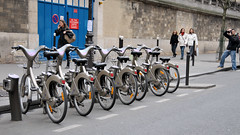
Paris Bicycle for rentImage by Serge Melki via Flickr
I has been a few months since I posted one of these videos so I decided to was time.

This episode is from Paris, France. It is interesting to see the city of Paris which we think as a more pedestrian and transit friendly city still has its own problems that create problems for pedestrians.

Also some great information on the bicycle sharing program that has been going on in Paris. Like anything it has its troubles but overall the program has been working well. There is also some good comments on the usually comments you get when you attempt to take away parking.

The video also shows you how simple the bicycle sharing program is.

Perils For Pedestrians Paris

Enhanced by Zemanta

Tuesday, May 18, 2010

Cul-de-sac hell

U.S. 2004 edition of standard traffic signs  U.S.Image via Wikipedia

Here is some good ready from Jarrett at Human Transit.

In the article Jarrett discusses cul-de-sacs and pedestrian access. Not only do cul-de-sacs cause an increase in traffic congestion by forcing vehicles on select roads, but they are also a nightmare for pedestrians.

In cul-de-sac hell and the radius of demand Jarrett discuses issues of accessing transit from this type of development.


Reblog this post [with Zemanta]

Monday, November 03, 2008

Perils for Pedestrian Video

Here is another perils for Pedestrian Video.

This video covers the complete streets legislation that has been blogged about over the last few months. The video also features the city of Davis, California which was the first to reach platinum level with the League of America Bicyclists.


Monday, August 18, 2008

Perils for Pedestrian Video

Here is another one of the Perils for Pedestrian Videos.

This was the 12th episode of the series (there is more hundreds).

The third segment talks about problems with people in crosswalks and with cars stopping for them. The person mentions that sometimes one car will stop and others will go around them. A family we know in Spokane the mother and her children were crossing in crosswalk on a two lane road. The cars stopped in both directions. A driver went around the stopped cars and hit them. Because the driver was elderly she was not prosecuted despite making an illegal passing maneuver.

Every time one of these incidents happen in Spokane there is some Paramedic that always writes a letter to the editor statement that the solution would be to eliminate pedestrian rights. Then he mentions cities such as Jacksonville, Florida as shining examples of cities were pedestrians don't have right of way. Jacksonville, Florida is not exactly a city I would hope up as an example of a livable city. Besides the issue automobiles not obeying the laws.

The fourth section of the video talks about about the abuse of handicap parking permits.

The fifth section is another one I really like. It talks about how little things like painting lines in the proper places can make a big difference for pedestrians.


Reblog this post [with Zemanta]