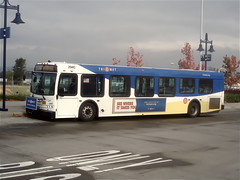
UTA will be holding a special celebration August 3rd for the opening of the Mid Jordan and West Valley TRAX lines. Trains will be operating on their new schedules offering public rides from approximately 9:00AM to 11:00pm. Fare will be free but are encouraged to bring food items to donate for the Utah Food Bank.
This will be an excellent opportunity to check out the newest light rail lines in the country and ride the new S70 low floor light rail vehicles.
I will not have the opportunity to ride the new lines until sometime in the future probably next June or so. I look forward to checking them out.
How do you build a better place? It takes effective transportation solutions, good Urban Design, good planning, and the political will to make it happen.
Wednesday, July 27, 2011
Sunday, July 10, 2011
This Week at Amtrak
From the United Rail Passenger Alliance
This Week at Amtrak, Vol. 8 No. 12
Volume 8, Number 12
From the Editors…
Recently a prominent state rail advocacy group signed on accepting the ultimatum of a major railroad. What does this portend for the rest of the country?
Cannot Predict HSR Speed? How About a Happy Medium…
“A thousand miles seems pretty far, But they've got planes and trains and cars, I'd walk to you if I had no other way…” Hey There Delilah - Plain White T’s
Back in January of 2008, not long before the most recent resurgence and subsequent retreat of American High-Speed Rail, Rick Harnish of the Midwest High Speed Rail Association was one of the highlighted speakers at the Carmichael Conference held in St. Louis, Missouri. An interesting anecdote during his lecture told of the public’s reaction to plans for high-speed trains: “How do we get the trains we already have to run on time,” and “How do we keep the bathrooms clean.” This may lead one to wonder: Are the public’s expectations low or just realistic?
It should be noted, all hyperbole aside, that there are currently no high-speed trains in operation anywhere on the North American continent. The true definition of HSR by those who actually operate it is 250 kph (155 mph), so Amtrak’s Acela does not quite make it. But that’s okay here in the USA where our motto is, “If you don’t like what you see, lower your expectations.” Therefore, the American definition of HSR is anything faster than a bicycle going downhill. As a result there are projects ongoing to raise certain corridors up to top speeds of 90 mph or greater. The freight railroads which own the track in those corridors have their own ideas pertaining to “high speed.”
As has already been covered by This Week, Norfolk Southern’s CEO, Wick Moorman, made it clear that for his railroad “passenger train” means 79 mph, maybe 90 mph in certain circumstances. Ergo, the extension of regional trains in the Commonwealth of Virginia to Norfolk will top out at 90 mph. CSX has the same vision for passenger trains. In upstate New York, CSX has stipulated that 90 mph be the top speed for the current service running from Albany-Rensselaer to Buffalo. The government of New York State sees things quite differently, pushing to raise those train speeds to 110 mph. This is where perception meets reality; the former New York Central main line, the storied Water Level Route, is the property of Jacksonville, Florida-based CSX.
In a move to help settle this impasse, the Empire State Passenger Association agreed with CSX:
“The Empire State Passengers Association (ESPA) has endorsed 90 miles per hour as the near-term maximum speed for Amtrak’s Empire Corridor passenger trains operating on CSX’s busy freight mainline across upstate New York from west of the Capital District to the Buffalo region.”
To be sure, the ultimate goal of ESPA is to realize 110 mph trains in New York State. Still, they have wisely determined that half a loaf, paid for by someone else, is better than none. They must also be keenly aware that time is of the essence. As per the Passenger Rail Investment and Improvement Act of 2008, specifically Section 209, it is expected that individual states will be held responsible for the operating losses for such trains. If everything had gone as per the language in the PRIIA, then in October, 2013 New York State would have to buy the cow because the milk will no longer be free.
Asleep at the Switch
Speaking of the Passenger Rail Investment and Improvement Act of 2008, formally known as Public Law 110-432/Division B, it may well be described as a train wreck in no motion. By law enacted October 16, 2008, Amtrak was required per Section 209 to “develop and implement a single, nationwide standardized methodology for establishing and allocating the operating and capitol costs among the States and Amtrak” for routes under 750 miles by October 16, 2010. Now some nine months later, no such “methodology” has been brought forward by Amtrak, although negotiations with the states are ongoing. Even so, the law is clear as to what was supposed to happen following the deadline and no agreement:
“If Amtrak and the States (including the District of Columbia) in which Amtrak operates such routes do not voluntarily adopt and implement the methodology developed under subsection (a) in allocating costs and determining compensation for the provision of service in accordance with the date established therein, the Surface Transportation Board shall determine the appropriate methodology required under subsection (a) for such services in accordance with the procedures and procedural schedule applicable to a proceeding under section 24904(c) of title 49, United States Code, and require the full implementation of this methodology with regards to the provision of such service within 1 year after the Board’s determination of the appropriate methodology.”
In other words, with no negotiated agreement in place by October 2010 there should have been accelerated implementation deadline for the Surface Transportation Board-issued standards. Instead of five years from enactment if the schedule had been followed, with the STB involved, it was supposed to be two years (the missed deadline) + 120 days (the STB decision) + one year = three years and four months vice five years. The STB was required to issue standards by mid-February 2011, to become effective and binding one year later.
To be certain, the Surface Transportation Board has more than enough on its plate these days, what with every utility in the land seemingly attempting to re-regulate the railroad industry. As such, they are more than content to sit back and watch the negotiations from afar, and will only intervene if a dispute arises between the states and Amtrak.
This is nothing we have not seen before, here at This Week. We fully expect Amtrak to come into the STB waving a tardy “agreement,” and then the STB to take the path of least resistance by adopting it. The inherent danger of such after-the-bell acceptance would be the serious legal questions about the validity of any cost standards thus generated. Any other operator seeking to bid on any route negotiated with this agreement will be free to challenge said standards simply on the basis of missing the October 2010 deadline, and the STB’s subsequent failure to promulgate standards unilaterally as specified in the PRIIA when that happened.
The Future of American Passenger Rail Corridors?
No matter how you slice it, the costs of transportation, all transportation, are going to be reallocated such that the states will have a more direct financial responsibility. The Passenger Rail Investment and Improvement Act of 2008, specifically Section 209, has a goal of establishing a uniform strategy for determining those costs of train routes 750 miles and under and then passing the bill along to the states. Translation: The federal government is getting out of the corridor business. Eventually we will see the same scenario with the Northeast Corridor.
Learning from the British experiment, the physical in-place plant should belong to a public entity; in the case of the NEC, perhaps a compact of those states. The legal foundation for such a compact already exists:
“Consent to Compacts.--Congress grants consent to States with an interest in a specific form, route, or corridor of intercity passenger rail service (including high speed rail service) to enter into interstate compacts to promote the provision of the service…” - The Amtrak Reform and Accountability Act of 1997, Section 410
Connecticut and Massachusetts already own all or a substantial portion of their intrastate section of the route. The states already have the bureaucratic machinery in place for their commuter services. The maintenance needs of the NEC are roughly $500 million per year, which comes out roughly to $1 million per mile. New Jersey would have the largest stake, at 58 miles. But they also have the largest NEC demand: NJ Transit. Is it any wonder that New Jersey politicians are fighting tooth and nail to keep the status quo?
The next logical step would be to bid out the premium services. If, say, an entity such as Sir Richard Branson’s Virgin Trains wins the bid, they purchase and maintain their own equipment; they pay an access fee, and the public gets to ride in the same manner as it would if it had flown. The private entity now has room to innovate within the bounds of its own equipment and on its own dime, far from the scrutiny of the budget hawks. In the real world of HSR, this is becoming a reality. In 2013 German Rail (DB) will commence HSR Intercity Express (ICE) service from Frankfurt and Amsterdam to London. The existing HSR services on the lines will continue to run. Although DB is a public entity it is improvising like a private company. This also demonstrates that HSR can be done over someone else's infrastructure, and that competing HSR services can coexist. That is about the practical extent of “privatization” in the corridor world.
Thursday, June 23, 2011
This Week in Amtrak
This Week at Amtrak Vol. 8 No. 11
Volume 8, Number 11
From the Editors…
This week we hear from Russ Jackson, Vice President of the United Rail Passenger Alliance. Russ is a retired California college instructor, former RailPAC officer and editor, and is now living near Dallas, Texas.
AMTRAK Long-Distance trains at 40
And, what they still need is more cars!
Comments by Russ Jackson
That was then: Forty years is a long time. In this report let us first take a look at where the Western long distance trains started for Amtrak, and then look at today. Charting will be for two trains that were in the Amtrak official timetable #1 for May 1, 1971, which was quickly replaced with a new one on July 12 (to view this timetable see: http://www.timetables.org/browse/?group=19710712r&st=0001); then, the May, 1991 national timetable which was in effect when this writer became editor of RailPAC’s Western Rail Passenger Review; and then we do a comparison of those past schedules with the 40th anniversary 2011 national system timetable which is available now at all Amtrak-staffed stations.
Trains 1 and 2, the Sunset Limited
We all know what the problem with this train has been and continues to be: Tri-weekly (also said as tri-weakly) service from day one, thanks to the inherited schedule from the Southern Pacific, and it continues to run today with nearly full loads despite the very bad schedule.
1971 Dp NOrl 1:00 PM; Dp Phx 10:50 PM; Ar LA 7:30 AM Su,W,F 44.5 hrs
1991 Dp NOrl 2:15 PM; Dp Phx 10:31 PM; Ar LA 7:00 AM M,W,F 42.75 hrs
2011 Dp NOrl 11:55 AM; Dp Mar 11:57 PM; Ar LA 8:30 AM Su,W,F 44.5 hrs *
1971 Dp LA 10:00 PM; Dp Phx 8:10 AM; Ar NOrl 8:00 PM Su,Tu,Th 44 hrs
1991 Dp LA 10:50 PM; Dp Phx 7:20 AM; Ar NOrl 7:50 PM Su,Tu,Th 43 hrs
2011 Dp LA 3:00 PM; Dp Mar 10:38 PM; Ar NOrl 2:55 PM Su,Tu,F 48 hrs *
*NOTE: In 2011 the trains do not go through Phoenix, a major city now without train service, and there are generous amounts of built-in recovery times throughout the route. In 1971, the schedule called for Yuma to Tucson via Phoenix to be 6 hours; in 1991, 6-1/2 hours; in 2011, 4-3/4 hours via Maricopa. If Phoenix were still on the schedule, an hour and a half would have to be added to the 2011 schedule.
Trains 3 and 4, the Southwest Chief
In 1971 timetable #1, this train had numbers 17 and 18 and was named “Super Chief-El Capitan,” continuing its inherited Santa Fe tradition.
1971 Dp Chi 6:30 PM; Ar LA 9:00 AM; daily 40.5 hrs *
1991 Dp Chi 5:00 PM; Ar LA 8:10 AM; daily 41.25 hrs
2011 Dp Chi 3:00 PM; Ar LA 8:15 AM; daily 43 hrs
1971 Dp LA 7:30 PM; Ar Chi 1:30 PM; daily 42 hrs *
1991 Dp LA 8:30 PM; Ar Chi 3:50 PM; daily 42.25 hrs
2011 Dp LA 6:15 PM; Ar Chi 3:15 PM; daily 45 hrs
* NOTE: In 1971, the train did not go via Topeka, KS, which adds one hour to the schedule.
While running times and scheduled departures have remained fairly consistent for these trains, for others they has been all over the map. Several interesting changes from 1971: Then, the Coast Starlight was the first west coast train to travel from Seattle to, first, San Diego. It ran tri-weekly north of Oakland and from Los Angeles to San Diego, but daily from Oakland to Los Angeles. In 1971 there were only two daily round-trip San Diegans between Los Angeles and San Diego; no San Joaquins, and no Capitols. Originally, the California Zephyr was scheduled to travel its current route, but when the D&RGW railroad decided to opt out of Amtrak, it ran via Wyoming, and operated daily from Chicago to Denver but tri-weekly between Denver and Oakland. The Empire Builder did not have a Portland section, and crossed the Cascades in Washington going via Yakima instead of Wenatchee. All this was accomplished using low-level cars and locomotives that were 20 years old and operating crews inherited from the freight railroads.
This is now: In the July, 2011 issue of Trains magazine, writer Bob Johnston has written a review of Amtrak’s past, dividing its history into five sections and comparing “then” to “now.” For example, section one, “Wake-up call,” says “Then: equipment had to be ordered and funded.” Sadly, “Now: equipment has to be ordered and funded.” While that is important for all parts of the system, including the Northeast Corridor, Amtrak has neglected its long distance trains badly. In his presentation to the RailPAC-NARP meeting in March, 2011, Minnesota’s Andrew C. Selden said, “Amtrak has made no significant investment in its long distance services in 20 years, and now plans only to replace its Superliner I cars, not to grow its long distance fleet or network.” Mr. Selden’s comments and data explaining all this were published in the May-June issue of the RailPAC newsletter.
On May 17, 2011, Amtrak CEO Joseph Boardman told the U.S. Senate Appropriations Committee, “You are not going to cut costs far enough on the long-distance trains to make (them) profitable.” This statement came after Amtrak’s West Coast Superintendent, William Duggan, spoke to the RailPAC meeting, revealing (with a Power Point visual) that “Sleeping car ticket revenue makes a positive contribution to Amtrak’s bottom line.” That is what RailPAC, URPA, and most objective long distance train advocates have been saying for too many years; but Amtrak has not been willing to fund additional cars that will contribute positively to that bottom line, instead choosing to invest only in corridor trains that are paid for by the states (except in the NEC). Mr. Selden says, “Amtrak is turning away boatloads of money for want of new capacity.” As RailPAC President Paul Dyson, says, “More cars on the (existing) trains means more revenue and smaller deficits. The true deficit is in management, not dollars.”
So we can all agree that adding additional high-revenue cars to existing trains, those that will run every day (including the daily Sunset Limited, eventually), is where Amtrak should be concentrating its efforts, right? RailPAC’s Noel Braymer suggests, “How about private financing (safe-harbor leasing) with a business plan to pay for them with increased revenues? With California about to order new bi-level cars how about Amtrak getting an ‘add-on’ to that order for new hulls at least.”
We must add a caution written by Mr. Selden to us, that it “will take hundreds of new cars–effectively deployed in high revenue services–to get to break-even. But, local wisdom in St. Paul is that there never will be a fourth sleeper on the Builder because the diner is swamped as it is and they couldn’t feed another carload of passengers. Personal observation is that they’re right. The diner in mid-summer (i.e., for the four peak months) is dreadful in terms of regimentation and rushed service, and stress on an understaffed crew.” After a trip on the Empire Builder, where he is a National Park Service volunteer in the Rails-Trails program, narrating the trip between Minneapolis and Wisconsin Dells, Mr. Selden wrote that “All three sleepers were all but sold out on both trains and would be sold out west of Minneapolis. Coaches were about 2/3 occupied so statistically sold-out due to down-line sales.” And this on a train that has had many on-time problems this winter and spring.
RailPAC Vice President-South James Smith returned from a round trip on the Southwest Chief from Los Angeles to Chicago and reported the same sold-out condition in May, before the official travel season begins. People want to ride… Something must be done for these western trains, besides just replacing cars one-for-one, if Amtrak really wants to grow financially and calm the criticism thrown at it. Or does it?
From the Editors…
This week we hear from Russ Jackson, Vice President of the United Rail Passenger Alliance. Russ is a retired California college instructor, former RailPAC officer and editor, and is now living near Dallas, Texas.
AMTRAK Long-Distance trains at 40
And, what they still need is more cars!
Comments by Russ Jackson
That was then: Forty years is a long time. In this report let us first take a look at where the Western long distance trains started for Amtrak, and then look at today. Charting will be for two trains that were in the Amtrak official timetable #1 for May 1, 1971, which was quickly replaced with a new one on July 12 (to view this timetable see: http://www.timetables.org/browse/?group=19710712r&st=0001); then, the May, 1991 national timetable which was in effect when this writer became editor of RailPAC’s Western Rail Passenger Review; and then we do a comparison of those past schedules with the 40th anniversary 2011 national system timetable which is available now at all Amtrak-staffed stations.
Trains 1 and 2, the Sunset Limited
We all know what the problem with this train has been and continues to be: Tri-weekly (also said as tri-weakly) service from day one, thanks to the inherited schedule from the Southern Pacific, and it continues to run today with nearly full loads despite the very bad schedule.
1971 Dp NOrl 1:00 PM; Dp Phx 10:50 PM; Ar LA 7:30 AM Su,W,F 44.5 hrs
1991 Dp NOrl 2:15 PM; Dp Phx 10:31 PM; Ar LA 7:00 AM M,W,F 42.75 hrs
2011 Dp NOrl 11:55 AM; Dp Mar 11:57 PM; Ar LA 8:30 AM Su,W,F 44.5 hrs *
1971 Dp LA 10:00 PM; Dp Phx 8:10 AM; Ar NOrl 8:00 PM Su,Tu,Th 44 hrs
1991 Dp LA 10:50 PM; Dp Phx 7:20 AM; Ar NOrl 7:50 PM Su,Tu,Th 43 hrs
2011 Dp LA 3:00 PM; Dp Mar 10:38 PM; Ar NOrl 2:55 PM Su,Tu,F 48 hrs *
*NOTE: In 2011 the trains do not go through Phoenix, a major city now without train service, and there are generous amounts of built-in recovery times throughout the route. In 1971, the schedule called for Yuma to Tucson via Phoenix to be 6 hours; in 1991, 6-1/2 hours; in 2011, 4-3/4 hours via Maricopa. If Phoenix were still on the schedule, an hour and a half would have to be added to the 2011 schedule.
Trains 3 and 4, the Southwest Chief
In 1971 timetable #1, this train had numbers 17 and 18 and was named “Super Chief-El Capitan,” continuing its inherited Santa Fe tradition.
1971 Dp Chi 6:30 PM; Ar LA 9:00 AM; daily 40.5 hrs *
1991 Dp Chi 5:00 PM; Ar LA 8:10 AM; daily 41.25 hrs
2011 Dp Chi 3:00 PM; Ar LA 8:15 AM; daily 43 hrs
1971 Dp LA 7:30 PM; Ar Chi 1:30 PM; daily 42 hrs *
1991 Dp LA 8:30 PM; Ar Chi 3:50 PM; daily 42.25 hrs
2011 Dp LA 6:15 PM; Ar Chi 3:15 PM; daily 45 hrs
* NOTE: In 1971, the train did not go via Topeka, KS, which adds one hour to the schedule.
While running times and scheduled departures have remained fairly consistent for these trains, for others they has been all over the map. Several interesting changes from 1971: Then, the Coast Starlight was the first west coast train to travel from Seattle to, first, San Diego. It ran tri-weekly north of Oakland and from Los Angeles to San Diego, but daily from Oakland to Los Angeles. In 1971 there were only two daily round-trip San Diegans between Los Angeles and San Diego; no San Joaquins, and no Capitols. Originally, the California Zephyr was scheduled to travel its current route, but when the D&RGW railroad decided to opt out of Amtrak, it ran via Wyoming, and operated daily from Chicago to Denver but tri-weekly between Denver and Oakland. The Empire Builder did not have a Portland section, and crossed the Cascades in Washington going via Yakima instead of Wenatchee. All this was accomplished using low-level cars and locomotives that were 20 years old and operating crews inherited from the freight railroads.
This is now: In the July, 2011 issue of Trains magazine, writer Bob Johnston has written a review of Amtrak’s past, dividing its history into five sections and comparing “then” to “now.” For example, section one, “Wake-up call,” says “Then: equipment had to be ordered and funded.” Sadly, “Now: equipment has to be ordered and funded.” While that is important for all parts of the system, including the Northeast Corridor, Amtrak has neglected its long distance trains badly. In his presentation to the RailPAC-NARP meeting in March, 2011, Minnesota’s Andrew C. Selden said, “Amtrak has made no significant investment in its long distance services in 20 years, and now plans only to replace its Superliner I cars, not to grow its long distance fleet or network.” Mr. Selden’s comments and data explaining all this were published in the May-June issue of the RailPAC newsletter.
On May 17, 2011, Amtrak CEO Joseph Boardman told the U.S. Senate Appropriations Committee, “You are not going to cut costs far enough on the long-distance trains to make (them) profitable.” This statement came after Amtrak’s West Coast Superintendent, William Duggan, spoke to the RailPAC meeting, revealing (with a Power Point visual) that “Sleeping car ticket revenue makes a positive contribution to Amtrak’s bottom line.” That is what RailPAC, URPA, and most objective long distance train advocates have been saying for too many years; but Amtrak has not been willing to fund additional cars that will contribute positively to that bottom line, instead choosing to invest only in corridor trains that are paid for by the states (except in the NEC). Mr. Selden says, “Amtrak is turning away boatloads of money for want of new capacity.” As RailPAC President Paul Dyson, says, “More cars on the (existing) trains means more revenue and smaller deficits. The true deficit is in management, not dollars.”
So we can all agree that adding additional high-revenue cars to existing trains, those that will run every day (including the daily Sunset Limited, eventually), is where Amtrak should be concentrating its efforts, right? RailPAC’s Noel Braymer suggests, “How about private financing (safe-harbor leasing) with a business plan to pay for them with increased revenues? With California about to order new bi-level cars how about Amtrak getting an ‘add-on’ to that order for new hulls at least.”
We must add a caution written by Mr. Selden to us, that it “will take hundreds of new cars–effectively deployed in high revenue services–to get to break-even. But, local wisdom in St. Paul is that there never will be a fourth sleeper on the Builder because the diner is swamped as it is and they couldn’t feed another carload of passengers. Personal observation is that they’re right. The diner in mid-summer (i.e., for the four peak months) is dreadful in terms of regimentation and rushed service, and stress on an understaffed crew.” After a trip on the Empire Builder, where he is a National Park Service volunteer in the Rails-Trails program, narrating the trip between Minneapolis and Wisconsin Dells, Mr. Selden wrote that “All three sleepers were all but sold out on both trains and would be sold out west of Minneapolis. Coaches were about 2/3 occupied so statistically sold-out due to down-line sales.” And this on a train that has had many on-time problems this winter and spring.
RailPAC Vice President-South James Smith returned from a round trip on the Southwest Chief from Los Angeles to Chicago and reported the same sold-out condition in May, before the official travel season begins. People want to ride… Something must be done for these western trains, besides just replacing cars one-for-one, if Amtrak really wants to grow financially and calm the criticism thrown at it. Or does it?
Saturday, June 18, 2011
Emergency Funds
The last few years have been pretty tough for transit agencies around the nation. Because of the extended recession many transit agencies have had to cut service and raise fares.
This can be especially hard for the transit dependent and low income folks, but the fact of the matter is, any organization has a budget it has to work with. You can complain all you want about salaries, where capital is being spent, or whatever other whipping post people like to complain about.
IF we lived in a perfect world, transit systems would be able to use their emergency funds to cover operations during a recessionary period. Some of you may be asking what exactly is an emergency fund: it is exactly what it sounds like, a fund to protect against emergencies. Smart financial planners tell not only individuals but also businesses to have three to preferably six months of expenses set aside for emergencies such as recessions, lay offs, etc.
Of course only a small percentage of the population actually keeps an emergency fund. Maybe that's what so many are bitterly opposed to government agencies of any kind to have emergency funds. In Oregon, instead of saving money for slow periods, the money goes back to the taxpayers. Some lawmakers this year tried to promote the idea of keeping some of that money for emergencies but most would not go for it probably considering it political suicide in today's environment.
A perfect example of a agency that was attacked severely for building up an emergency fund was the Spokane Transit Authority. Because of efficient operations the agency started to build up a nest egg but came under fierce attack.
It should be pointed out that some transit agencies did not help their own cause but being overly optimistic when it came to financial projections. One agency required 6% annual economic growth to maintain their existing services. Depending on overly optimistic economic projects was a one way trip to disaster.
Hopefully we will learn a couple of things from this recession. First, revenue projects need to be realistic and a agency cannot depend on continually economic growth to keep existing services running as is. Second, that emergency funds is something that not only individuals need but it also makes since for businesses and government agencies to be prepared for raining days.
Tuesday, June 07, 2011
This Week in Amtrak
This Week at Amtrak Vol. 8 No. 10
Volume 8, Number 10
From the Editors…
With the same assurance as the sun setting in the West, once again all of Amtrak’s perpetual financial woes are blamed on its long-distance trains.
Oh, really?
“Ducking this issue calls for real leadership.” - Springfield Mayor “Diamond” Joe Quimby, The Simpsons
Passenger rail ridership is up, of this there may be no doubt. Using the rudimentary yet flawed number of “riders,” Amtrak carried 28.7 million people in fiscal year 2010. This year should be even higher. Of course, now-a-days Amtrak never discusses “passenger miles” or “revenue per passenger mile” but this was not always the case.
Even so, when questioned by Congress as to why increasing “ridership” did not correlate to a drop in losses, the standard chestnut was brought out one more time, “It’s the long-distance trains,” said Amtrak President Joe Boardman. “They’re all unprofitable.” Oh, really? We have all heard this before, but how long will this broken record continue to play?
For many, the long-distance trains are the perceived final connection to an earlier era. Many a parent has packed up his family for an overnight trip with the proud exclamation, “We’re going to ‘Travel in Pullman Safety and Comfort’ like our grandparents did.” Obviously, there are no more open sections or drawing rooms. If there is an observation car it is privately owned. Oh, and when was the last time someone shined your shoes for you whilst you slept? Today’s long-distance train is a mere shadow of the former glory that once was the grand conveyance. Whereas average citizens could not afford fine linens, china, and silver service, these were commonplace for all who frequented the dining car; it was their chance to live like royalty, if only for a few hundred miles. Do today’s trains even come close to emulating such an emotion? Alas, such only exists for those who remember when, or who have studied the subject.
Things behind the scenes have changed, as well. Even into the early Amtrak days, long-distance reservations still used the old tried-and-true drum system. Dozens of agents sat around a rotating metal carousel with compartments containing train accommodation diagrams, while talking to customers or agents by phone. Today all of this is computerized. The ragtag collection of locomotives and rolling stock has been replaced by standard designs. Locomotive fuel economy has never been higher. Steam heating has been replaced by electric. Operating crew districts are no longer 100 miles. Bases for maintenance have been consolidated and centralized. Yet with all of these changes, which should have led to better economies, the long-distance trains still “lose money.” How can this be?
The Vision from 20 Years Ago
For Amtrak’s 20th anniversary, then-Amtrak-president Graham Claytor boasted of its cost control:
“Amtrak is determined to continue to improve bottom line through better service and controlled cost until 100 percent of operating costs are covered by earned revenues. At close to 80 percent in 1991, we are nearing that goal.” - All Aboard Amtrak 1971-1991, Railpace Publications
At no time in any of the historical records has it been found where Mr. Claytor blamed any of Amtrak’s financial woes on just the long-distance trains. Mr. Claytor was a railroad executive starting with a career at Southern Railway in 1963. He knew the numbers and, more importantly, knew what they meant:
“A year before Amtrak, railroads carried intercity passengers 4.9 billion passenger-miles and lost the 1991 equivalent of $1.5 billion doing it. In Fiscal Year 1990, Amtrak carried its 22.2 million intercity passengers 6.1 billion passenger miles and pared operating losses to about $330 million.” - All Aboard Amtrak 1971-1991, Railpace Publications
Mr. Claytor understood that the true measure of output is “passenger-miles” and revenue per passenger-mile, not the mere number of tickets sold. Tickets sold is the measure of the number of transactions, but ten $1 tickets are not as valuable as one $20 ticket. To this end, it must be noted that during the last five years the long-distance trains have averaged a growth rate of 3.7 percent, with no years of negative growth; something not even the regional or corridor trains can claim. Even more surprising is that the LD trains showed any growth at all, since they were statistically almost sold-out to begin with, and over the last 15 years (post-Claytor), their aggregate capacity (measured in “available seat miles” or even just “car miles”) has declined. This is growth in a product line defined as distance of 750 miles or greater on trains that have not seen any additional equipment in over a decade. Even so, this growth in patronage should correlate to higher revenue. What went wrong?
Since the passing of Mr. Claytor, there has not been a seasoned railroad executive at the helm of Amtrak. As a result Amtrak, a ward of the state, has reverted to a function of government; a workfare/basic transportation/federal entity charged with placating the public while twisting in the political winds. As a result it finds itself stuck between the dichotomous mandates of affordable transit and covering debts. The July/August 1974 edition of the Official Railway Guide lists the one-way coach fare between Chicago and Los Angeles at $113.50; corrected to 2011 dollars, this would be $514.47. Today's fare is one-half to one-third the inflation-corrected fare. After checking coach fares between numerous city pairs, today’s fare is one-half or less than that of 35 years ago (when corrected for inflation). Remarkably, sleeper fares are on par to then, when correlated. The result of this has, in effect, reduced Amtrak’s trains (long distance in particular) to Greyhound buses on rails. Was this always the plan? Not according to Mr. Claytor:
“They [fares] are going to increase just as fast as competitive factors permit… Because our service has been improving, and more and more people have been willing to ride, and as long as more and more people are willing to ride, and pay higher fares, the fares are going up. This is not new. This is the policy that we have been following for at least 10 years.” - Interview with Graham Claytor, Trains magazine, June 1991
Today there appear to be “more and more people willing to ride,” yet in the last 20 years Amtrak ticket sales have gone from 22.2 million to 28.7 million. Just 6.5 million more riders per year in 20 years? This is hardly anything to crow about. During the same period, as aggregate intercity travel has increased (and air traffic has quadrupled), Amtrak’s aggregate national market share has declined. How, after all this time, could ridership remain so paltry? Perhaps no one at Amtrak knows how to grow ridership and increase output. Mr. Claytor knew how to do both. When asked about service expansion and the goal of full cost recovery:
“That is one of the ways we hope to reach it and to get additional equipment in order to increase our revenues faster than our costs. That spread is what counts. With the new order for locomotives already in [to General Electric], and with the orders for new Superliner cars we hope to make this year, these would give us the additional capacity to increase our revenues. We are up against the stops on many ways, because many times of the year we can’t carry more people. We have more people wanting to go than we can carry, because we do not have the capacity. The first priority is to get more capacity on the routes we serve. The second priority will be to start new routes that we think have a good possibility of working.” - Interview with Graham Claytor, Trains magazine, June 1991
Mr. Claytor’s “first priority” fell by the wayside after his passing. Instead, focus shifted and intensified on the corporation-owned Northeast Corridor (NEC). This would culminate in the extension of electrification from New Haven, Connecticut to Boston and the notorious Acela trainsets. While these are demonstrative improvements in infrastructure and passenger amenities, it is still a short corridor, and as such offers limited potential for passenger-mile revenue growth. While total NEC ridership has grown, Amtrak’s overall market share has declined sharply, and is less than 1.5%; all of this is hardly enough to offset the costs of infrastructure maintenance, and the high maintenance and power consumption of the Acela trainsets.
Ultimately, passenger railroading in America has been held hostage by misconceptions. In the 1950s, hucksters such as Robert Young convinced people that the only future for passenger rail was the short-haul train; conveniently, short-haul trainsets were what he was attempting to sell. The outcome of a 1958 Interstate Commerce Commission investigation has been dubbed the “Hosmer Report,” after ICC examiner Howard Hosmer, wherein:
“This examiner’s proposed report included an oft-quoted speculative conclusion that railway passenger coaches would likely soon become museum pieces along with stagecoaches, sidewheelers, and steam locomotives. Such language was not adopted in the subsequent formal ICC decision.” - Amtrak’s Long-Distance Service, Can it be Made Viable?, Gordon Gill
Today’s weary chant of “the long-distance passenger trains are a money drain” is nothing more than a continuation of the "junk science" formulated over 50 years ago by those lobbying for their own agendas. The public at large blithely accepted that junk science as fact, since passenger trains, for the most part, were not germane to everyday life. As growth in passenger rail with long-distance trains, in particular, has shown, junk science no longer cuts the mustard for today's savvy travelers. Amtrak had better find a new mantra.
Past is Prologue
Recently, someone was nice enough to publicly post a picture of a train gate at Chicago Union Station from 1964, showing the makeup of that day’s South Wind: http://www.rrpicturearchives.net/showPicture.aspx?id=2487104 Even at this late date, seven years before Amtrak, notice there are eight sleeping cars assigned to this train along with five coaches. On today’s trains, if the number of sleepers is equal to the coaches, it is a miracle; in the East, the sleepers are outnumbered by coaches. Moreover, Amtrak does not have an adequate supply of spare equipment to increase train length to match fluctuating demand. If Amtrak had kept the proper ratio, at least the income from the First Class section of the train would still be the same as 35 years ago.
Is it rational to expect Amtrak to provide “First Class” amenities? Does Amtrak really provide a First Class Service? Is the provision of a mattress enough to be classified as “First Class?” If so, try to remember that, the next time Motel 6 leaves the light on for you.
Even though Graham Claytor believed it was possible, perhaps Amtrak is not capable of providing the equipment, let alone the proper business acumen/model for overnight service. It should be remembered that for most of the history of American passenger railroading, overnight rolling stock, sleepers, and diners were provided by a third party: The Pullman Company. Pullman was a private enterprise employed by the private railroads to provide a service. For most of its life, Pullman made money. Relieving Amtrak of this chore should allow it to concentrate on its core business; the equivalent of buses on rails.
Saturday, June 04, 2011
Some news and links...
Image by paulkimo90 via FlickrSix weeks from today I will be moving to Portland, Oregon so the next few weeks are going to be very crazy for me. I have several posts in the pipeline and will finish as time allows. Meanwhile here is some links that I hope you find interesting and will try to get some more in depth articles out soon.
From the Denver Urbanism Blog:
Transitways can be landscaped
From the Grist Blog:
Want more cash in your pocket? Live in a neighborhood with good transportation options
From the Bike Portland Blog:
The parking/biking trade-off: Q & A with PDC Director Patrick Quinton
PBOT unveils new "Beacon Buddies" animated video
From the Metro Jacksonville Blog:
Jacksonville Terminal As The Job Maker
An Obituary for Florida Growth Management
Can a Streetcar cost less than a Faux Trolley?
From the Urbanphile:
This Is Why We’re Broke
The Wars Between the States by Richard C. Longworth
Where Is the Good Government We Need?
The New Provincials by Jason Tinkey
From the Transport Politic:
Paris Region Moves Ahead with 125 Miles of New Metro Lines
The Silly Argument Over BRT and Rail
Sinking Dreams of a Privately-Funded Subway in Toronto
From Stephen Rees's Blog:
Study: Building Roads to Cure Congestion Is an Exercise in Futility
On Broadway
From Streetsblog LA:
Highwayman Inhofe Still Wants to Rob Bike/Ped Funding From Transpo Bill
Video: LaHood Answers Questions About Bike Lanes, Fuel Economy, and HSR
On Broadway
From Streetsblog LA:
Highwayman Inhofe Still Wants to Rob Bike/Ped Funding From Transpo Bill
Video: LaHood Answers Questions About Bike Lanes, Fuel Economy, and HSR
From the Seattle Transit Blog:
Monday, May 23, 2011
Finding an Apartment
For those of you that have ever looked for an apartment, especially for those of us that want to use transit, you come to find most of the resources available online for finding an apartment mostly useless. While some apartments may show that they are close to transit or close to shopping, most of the websites fail to give you a good idea exactly how easy it is to access those services.
A week ago Saturday I flew to Portland in order to find a new place to live when we move. I think of myself as pretty web savy so I have done lots of research over the last six months since we made the decision to go back to school to try to find the right place for us.
For someone not familiar with a city this could be a daunting task. I have an advantage that I am actually familiar with the Portland area and know where to look and not look for a place to live. However, I still do not know the ins and outs of many of the neighborhoods themselves.
I do have to give a kudos to For Rent which is now including a walkscore map of the neighborhood the apartment to give you a better idea how far you have to walk to find necessary services.While that does help apartment searchers it still does not offer all the information that someone may need to find an apartment.
When I was doing research I would often have four or five windows up trying to find all the information necessary. I would have the apartment rental sights on one page, Tri-Met's website on a second, Google Maps on a third, apartment ratings on a fourth, and a fifth for other information.
Fortunately I was able to find a good apartment with excellent transit access at a good price.
However, this points out the lack of resources available through most transit system websites. Most sites are destinations with few links to get information you need beyond riding the system. Transit systems need to look at their websites not only to provide transit information but also a portal for those looking to not only ride the system but also be less car dependent.
Labels:
Apartment,
Google Maps,
Oregon,
Portland,
Rent
This Week in Amtrak
This Week at Amtrak Vol. 8 No. 9
Volume 8, Number 9
From the Editors…
For something completely different, This Week goes to the movies, plus some observations by URPA Vice President of Corporate Communications Russ Jackson.
The Little Movie that Just Might: Atlas Shrugged, Part One
To be clear, Atlas Shrugged may not win any Academy awards. But that is not the point. The tale behind bringing Ayn Rand’s 1957 novel to the big screen is almost as long as the book itself. Loathed or loved, public sentiment is anything but neutral for Atlas Shrugged.
In this first of possibly three installments, the year is 2016 and the national economy continues to spiral downward. As a result, commercial aviation is a recent memory and all traffic, freight and passenger, must move by rail. (It is ironic that in this alternate reality all rail traffic is still in the hands of private operators.) In typical Luddite fashion, elected officials attempt to garner support for themselves while exacting a heavy burden from industry. The result? Numerous prominent businessmen vanish, following a shadow named John Galt.
From a literary standpoint, the movie succeeds. All the main points are visited: Hard work, and the virtue of the reward for such hard work, lead to progress; rewarding those who do not contribute will ultimately lead to ruin; the inequity of expecting industry to respond to critics whose sole job it is to criticize. That is not, however, the reason one goes to the movie theater.
This production was constrained by a small budget, and the results have the appearance of made-for-television instead of the big screen. The principal railroad scenes are stock footage of modern day trains and a real Union Pacific track maintenance/concrete tie crew in Indiana. The climax of the film is the completion of the rebuilding of a rail line, and the first train to ply it. Ironically, that first train is a computer-generated image which is heavily based on Amtrak’s Acela, the very epitome of government interference in railroad operations.
As a point of comparison, a rather silly movie from last year, Unstoppable, did succeed in bringing the railroad to the big screen. Although its plot was an unrealistic contrivance of unstoppable exaggerations, the moviegoer did get a first-hand look at the grit, grime and gravity of railroad life.
In Atlas Shrugged, the plot centers around three industries: The railroad, steel, and petroleum. Malevolent special interest government intrusion is hampering their efforts, but they resolve to move ahead despite this interference. The film makers concentrate on the characters and portrayal of the squeaky-clean world they inhabit. After all, why show the gritty side of industry? Interestingly, the plot of this film is not fantasy, but was once reality. Our film’s heroine, Dagny Taggart, presides over a railroad where locomotive parts are hard to come by, and some lines have track that is over a century old. Imagine Penn Central circa 1972. Imagine parked trains derailing. Now imagine direct government involvement. Hardly fantasy, these things actually happened. It was this world which led to creation of the National Railroad Passenger Corporation.
Should the film makers have paid more attention to railroad details? At a screening/Q&A session arraigned by the Reason Foundation, the first two questions asked by the audience were about the railroad scenes. Not too many people have seen the inside of a steel foundry or an oil refinery, but railroads are a universal tie which binds us all, either as onetime passengers or perhaps via family connections. This preexisting subconscious familiarity with railroading is just the sort of connection needed to attract an audience.
In spite of it all, the film does work. It is rather dense, and as such will sail clear over the heads of the average moviegoer. It is a thinking movie for a thinking audience. Is the free market the answer to all our problems? Of course not; but neither is the free market so infinitely large as to subsidize everything else. Some may see this as a political statement, others as social commentary. In the words of Alfred Hitchcock, “It’s only a movie.”
Winter and the Amtrak long distance trains
Report and Comments by Russ Jackson
The western long distance trains had a rough winter in the northern two-thirds of the country. Some trains were canceled altogether for several days. Here is a rundown of some of the activity, by train, in the past few weeks. Not everything is included, but here are some highlights, using Amtrak's data. When April is figured in, things will look much worse.
California Zephyr. 45.2% on time in March, 52.5% for the last 12 months. For several days, Donner Pass was closed not only to road traffic on I-80, but also the Union Pacific main line was snowed in as drifts of over five feet of blowing snow blocked access. While there was diligence by the UP crews, there were several derailments. For the first time in many years, the rotary plows stationed at Roseville were called into service. The old heads who remember how it was up there when snows like that were more common are mostly retired, and the youngsters have never seen snow like this before. The weather is still bad, but the route is open again so that Trains #5/6 can run their regular route. Train 5, which left Chicago on April 16 on time, arrived in Emeryville 3 days later and 58 minutes early. Delays to the trains now are in southern Iowa, where flooding has occurred. For some days the trains originated-terminated at Reno, with passengers bused from California when I-80 finally opened. To see a great video of the rotary plows in operation, look at http://www.kcra.com/r-video/27364908/detail.html.
Empire Builder. 33.6% on time in March, 33.8% for the last 12 months. The Builder was the hardest hit of all the western trains. It did not run at all for many days, including the week before April 15, when it had not operated due to flooding on the BNSF in North Dakota. Before that it was winter storms, but once the snow starts to melt up in that state, Amtrak's line from Fargo to Grand Forks and west is subject to water problems. An anticipated BNSF detour line direct from Fargo to Minot had many slow orders due to high water, and was declared unusable. Amtrak has discussed permanently moving #7/8 to this alternate line, but it will bypass Grand Forks, Devils Lake, and Rugby, towns that rely on the train for service. Amtrak has said it will cost $100 million in upgrades to bridges and track in the Devils Lake area if that service is to continue. The BNSF does not use that route for freight service. It would take two "construction seasons" to rebuild, after Congress had appropriated the money. How likely is that to happen now?
Southwest Chief. 83.9% on time in March, 77.8% for the last 12 months. Not much to say here, as Trains #3/4 continued to depart on time, and arrived early at both ends more than they were late.
Sunset Limited. 88.9% on time in March, 83.1% for the last 12 months; however, problems arose when wildfires damaged a Union Pacific bridge near Marfa, Texas, on April 9, stalling the train for 18 hours; thus weather at the other extreme affected the Sunset route.
Coast Starlight. 45.2% on time in March, 65% for the last 12 months. Winter weather did have an effect on the operation of Trains #11/14, but most of the problems have come due to track work being done by the Union Pacific south of San Jose and San Luis Obispo, which has required the trains to be detoured, and has provided railfans with several chances to ride the detour route through the San Joaquin Valley. The detour began south of Emeryville at Fremont, where the trains crossed the Altamont Pass to Stockton, then traveled on the Union Pacific line south to Bakersfield, up the Tehachapis, across the famous Loop, through Mojave, Lancaster, Palmdale, and into Los Angeles. For a full description of one of the #11 detours that departed Oakland Jack London Square 30 minutes late and arrived at Los Angeles Union Station at 9:57 PM, see Chris Guenzler's picture story on http://www.Trainweb.org. Passengers going south to the Starlight's regular Central Coast stations rode buses from Oakland.
Whether Amtrak and its host railroads were "prepared" for this winter is ripe for speculation, but when a winter like this one happens it's nail biting time all along the routes. We congratulate Amtrak, the BNSF, and the UP for their diligence in restoring service in a timely manner. Lessons were learned, and it will be interesting to see how prepared they all are next winter.
Related articles
- Amtrak Losses to Widen (online.wsj.com)
- All aboard! Amtrak sees surge in ridership (msnbc.msn.com)
Monday, May 02, 2011
This Week in Amtrak - Amtrak's 40th Anniversary Edition
Volume 8, Number 8
From the Editors…
For those who have not noticed, Amtrak is now a four-decade-old reality. Is this the best we could hope for?
Fix Amtrak First
May 1, 2011 marks a major anniversary in American railroading. For some it is a celebration. For others it is a bittersweet regret. For a few, it means keeping their vocation. Then there are those who find political opportunity.
To be sure, the world which led to the creation of Amtrak is now a distant memory. In 1970, despite ever growing ton-miles, America’s railroads were in trouble. In the Northeast over a half-dozen carriers were mere decrepit shells of their former glory, and one by one would follow Penn Central into bankruptcy. The Milwaukee Road and Rock Island of the Midwest teetered on the brink of insolvency, seeking relief by shrinking their physical plants or by mergers. Out West, the Southern Pacific, once the third largest industrial corporation in the country, sought relief through merger and passenger train-offs. Otherwise healthy roads in the Southeast and West knew only too well that their future fortunes were inextricably tied to continued interconnectivity in the nation as a whole. Over six decades of burdensome Federal overregulation was threatening to wipe railroading from the American landscape.
Meanwhile, the rest of the country was aiming ever higher. Man landed on the moon. Commercial supersonic flight was becoming a reality. The basic interstate highway system framework was complete with no impediment, financial or physical, to its construction. Nevertheless, America could not survive without its railroads, and the powers-that-be knew this.
The simple reality is that Amtrak was created, not to save the passenger train, but rather to save the freight rail network. In a stopgap move created to relieve the railroads of their financial malaise, the government established the National Railroad Passenger Corporation, first known as Railpax, and today known as Amtrak. All eligible (non-commuter) railroads were invited to participate. All but seven joined. This was merely a Band-Aid for the industry. A much larger bandage would be the Federal takeover of the Northeast railroads in 1976, in the form of Consolidated Rail Corporation, or ConRail. The ultimate corrective surgery would be passage of the Staggers Act of 1980 and deregulation of much of the industry. ConRail would be privatized in 1987 and ultimately broken up in 1999. Through it all, the Band-Aid that is Amtrak remains.
Now with nationalized intercity passenger service a reality for four decades, the world is a much different place. We are no longer a nation capable of visiting the moon. Commercial supersonic flight ended almost a decade ago. The cost to return the interstate highway system to a state of good repair is estimated in the “hundreds of billions of dollars,” money the nation simply does not have. Now more than ever the nation is in need of a comprehensive and coherent passenger rail system, not a Band-Aid. In order to achieve this there is one unavoidable step: Fix Amtrak first.
True, there have been past attempts at fixing Amtrak’s woes. The most recent was the Amtrak Reform Council of the last decade. It was during this period that many Amtrak apologists obfuscated, and demanded from any who questioned Amtrak’s worthiness to “define reform.” Well, in just the last 18-24 months Amtrak has fired its Inspector General for ostensibly doing his job; after losing the contract to operate Virginia’s commuter trains, Amtrak began systematically harassing the winning bidder, Keolis, in what may or may not have been an attempt to get the contract back. In Florida, Amtrak demanded unnecessary concessions from a not-yet-running commuter railroad, SunRail, for reasons that are still nebulous. Suffice it to say there is plenty of room for improvement at Amtrak; actions such as the above at any private corporation would have warranted legal and/or disciplinary action.
Amtrak’s foibles have not been lost on the current administration. The cry for High-Speed Rail was followed by requests of interest; not from Amtrak, but rather from the states, directly. With this end-run around Amtrak, it was hoped the rebuilding of passenger railroading could be achieved sans the bureaucratic black hole of business as usual. The results were spectacular failures in Ohio, Wisconsin, and Florida. If there is to be a renaissance of passenger trains, Amtrak is no longer a can to kick down the road.
Although there is no quick fix, there are steps which could aid in the recovery of national passenger rail service. The best place to start would be at the top: The Amtrak board of directors. Since 2008, the Amtrak Board should have had nine members; currently there are eight. Of these, seven are life-long bureaucrats with only one from a professional railroading background. As Amtrak is a ward of the State, this is to be expected, but it was not the original intent:
"Once the corporation was set up, it was placed under the responsibility of management working under a 15-man board of directors. Eight of the directors were to be appointed by the President, and one of the eight always was to be the Secretary of Transportation. None of these eight directors nor any officer of the corporation was allowed to have any connections with the railroads. Three additional directors were to be elected by common stockholders and four by preferred stockholders. Initially, common stock was to be issued only to railroads and preferred stock only to persons other than railroads. In short, the corporation mainly was to be owned by the railroads, but all the decisions were to be made by a board composed largely of Presidential appointees." - Don Phillips, Railpax Rescue, Journey to Amtrak, 1972.
Obviously, the original plan for the Board did not pan out. All of Amtrak’s preferred stock is held by the government and much of the common stock is still held by the railroads. As these shares are deemed worthless, they are not much of a basis upon which to run a corporation; however, there is a very significant difference between then and now. In 1971, there were over five dozen Class One railroads. Today there are only seven, six of which handle daily Amtrak trains.
Adding seven seats to the existing nine-member Board would come close to the original plan of 15 members. Of these seven new seats on the Amtrak Board of Directors, six seats would be from those Class Ones, and one would be a representative from the American Short Line and Regional Railroad Association (ASLRRA). Why? This ensures there are at least seven people on the Amtrak Board who understand business and understand railroading. By design, Amtrak is meant to be a quasi-public corporation. The addition of seven members from the private sector will ensure a professional atmosphere in accordance with generally accepted business practices. These seven new members would balance with the existing nine board members, selected and confirmed from the public sector, guaranteeing the public’s input to “America’s Railroad.” If leadership from the private sector were allowed to re-allocate available Federal capital to applications that would yield the highest return per dollar invested (as opposed to political goals), then Amtrak’s financial outlook might not be so dismal. Also, as seen with commuter passenger services provided under contract by some freight railroads such as BNSF in Chicago, they still know a thing or two about passenger operations.
Every aspiring manager is warned of a common human tendency of subordinates: The ever-present gravitation toward those projects that are favorites, to the neglect of other projects which may be priority. To that end, it becomes necessary to remove the Northeast Corridor from Amtrak. This is not to imply a lack of importance for the NEC. A large number of people live in the Northeast, but the majority of Americans do not. Even before Amtrak, the U.S. Department of Transportation singled out fast trains as reflected in the High Speed Ground Transportation Act of 1966, which led to the DOT's sponsorship of the Metroliners on Penn Central. Ever since the NEC was ceded to Amtrak in the fire sale that was the end of the Penn Central, Amtrak’s myopic attention has continuously returned to those 450 miles of track between Boston and Washington, D.C., consuming a half billion dollars or more a year in Federal support. What about the other 20,000 miles? Due to the unique nature of the NEC, it should be grounded in its own reality; a separate board of governance, and its own budget separate from the national network. Congress has mandated that all corridor services be operated in a uniform manner (read, state subsidy) by 2015. Now would be an opportune time to place the NEC where it belongs.
Obviously there are other issues plaguing American passenger railroading: Deteriorating equipment, eyesore stations, growing tonnage on the rationalized freight railroads, outdated labor practices, etc. These will all have to be addressed in time. For now, it is time to take that “first step,” the initial change in direction departing from the status quo, intent on a new destination. Up until now, Amtrak has been deemed too small to register with the body politic, but too large to simply dispense with entirely; now, however, is a different time. Passenger rail is no longer a luxury subsidized out of the national largesse. Passenger trains are the ever-present and ever-growing lynch pin of transportation. Future growth will be predicated on the present amelioration of the business-as-usual Amtrak. Is this not what we, the people, should deserve and should expect?
Thursday, April 28, 2011
This Week in Amtrak
Volume 8, Number 7
From the Editors…
Recently, Amtrak released its updated fleet strategy plan. What a difference a year makes.
A Tale of Two Strategies
At first blush, it would appear the primary difference between Amtrak’s Fleet Strategies of February 2010 and February 2011 is a thorough going over by our very own proofreader here at This Week. (For the record, she vehemently denies this, but the investigation is on-going.) Upon closer inspection, it becomes obvious certain realities are now being accepted. Before going any further it should be known that the original document and its update are of a high quality and represent the obvious expenditure of many hours of effort.
The updated report acknowledges the orders of 130 single-level cars for Eastern long distance service and 70 electrics for the Northeast Corridor. Priorities held over from 2010 are the replacement of 250 Superliner I's and the development of “a new fuel-efficient high speed diesel locomotive.” New to the priority list are: Replacement of 145 Amfleet II's, developing a “bi-level corridor car to replace single-level cars where clearances permit, adding two cars each to the existing Acela fleet (40 new cars total), and planning the next generation of high-speed trains. Total estimated cost of this 30 year plan is $25.2 billion.
Replacement of the single-level long distance coaches, Amfleet II, has now been moved ahead of the Amfleet I replacement. Why? Despite being a few years newer, the average mileage for an Amfleet II car is 1.4 million miles over an Amfleet I. Truth be told, the Amfleet design was never meant for long-distance service, yet they have performed adequately for over 30 years; a true testament to the construction of the Budd Company. CAF USA has a very tough act to follow, constructing the 130-piece Viewliner 2 order. There are 145 Amfleet II’s in service but the Fleet Strategy does not specify how many new cars will be ordered. If CAF USA gets a chance to build a coach variant of the Viewliner 2 platform, then we could possibly see uniform trainsets in the east, something which has not happened since the introduction of the Amfleet II’s in 1980. Do you believe in miracles?
In 2010, “long distance” services were defined as “more than 600 miles,” whereas in 2011 it is “more than 750 miles.” No doubt this is a sign of inflation. Also curious is the statement that the long-distance trains “have grown around 2 percent annually,” although “Table 8: Amtrak Ridership Growth FY06-10” demonstrates that long-distance trains were the only service during those five years not to have a negative ridership growth; even during the doldrums of 2009. Average growth on the long-distance trains according to Amtrak’s data was 3.7 percent for the last five years, a fact all the more fascinating when one takes into account there has been no addition to the equipment of these trains in over a decade.
A significant difference between the two reports is the acknowledgment of Amtrak’s Office of the Inspector General (OIG). The OIG is evaluating the original report, and will issue its own report this year. “We look forward to receiving the final OIG report and we will continue to work with the OIG to ensure that its insights are incorporated in the next fleet plan update as appropriate.” Where was the OIG during the original report? Oh, right.
In both reports the Horizon fleet of regional-distance cars is panned: “These cars suffer from a variety of operational problems in cold temperatures and winter conditions.” Interestingly these cars are a variant of an original Pullman-Standard commuter car design which has gained acceptance in New Jersey, New York, Connecticut, Pennsylvania, and Massachusetts, none of which are known for their balmy winters. The solution for 2011 is a new fleet of 125 bi-level cars ostensibly patterned after the cars used in regional service in California. As these cars do not have any operating history in the extremes of the Midwest, this will be an interesting experiment. Although the “California cars” appear to be similar to Superliners, the difference is in the details. Superliners have their Head End Power (HEP) and Multiple Unit (MU) cables well above the ground and away from snow and ice buildups. California cars have their cables astride their couplers, as is standard with most other equipment. Superliners have successfully pinch hit for Horizon cars in Midwest services during wintertime. If one expects California cars to perform to the same level as the Superliners, one may be in for an unpleasant surprise.
One other curious statement as regards the potential routes for the new bi-level cars: “The only other exception would be Amtrak’s Hoosier State/Cardinal Service between Chicago and Indianapolis, which would continue to use single level equipment because of clearance constraints on the Cardinal route.” Trains between Chicago and Indianapolis have always ferried equipment to and from Beech Grove, Amtrak’s maintenance facility just outside Indianapolis. The deadheading equipment does include cars from Amtrak’s current bi-level fleet: Superliners, Superliner II’s and California cars.
The plans for Acela were wide and varied in 2010. By 2011, the choices have been narrowed: “There is a compelling case for an additional two cars for each set… [the extra cars] will deliver a positive return even if the trains were replaced in 2023.” Moreover, the desire is expressed for an additional 20 trainsets “of a new rather than the existing design and delivery would begin in 2017.” Apparently they have learned one lesson.
Unfortunately, both reports address the potential utility of self-propelled diesel cars or Diesel Multiple Units (DMUs). Not that there is anything wrong with DMUs in and of themselves; however, they are best suited to commuter operations. Amtrak is NOT a commuter railroad, and provides operating crews under contract to a handful of commuter operations around the country. If one of these commuter lines provides DMUs for its operation, so be it; but Amtrak should not be taking the lead on this.
It is recognized in the reports that: “Suppliers need a constant stream of work to ensure that there is sufficient business to support a competitive supplier base and avoid the boom and bust cycles in the past.” This work-fare program of equipment sustainability is the sort of thing a state-owned/operated polity should have pursued since its inception. Well, better late than never. The plan calls for an average of 65 single-level and 35 bi-level cars per year starting in 2012 and 2014, respectively.
Both reports speak of the need for the development of future equipment. The 2011 edition refers to the Next Generation Equipment Committee (NGEC), whose stated goal is “to promote the creation of a pool of standardized, interoperable equipment that could be used by Amtrak and the states in various state-sponsored corridors with flexibility and efficiency.” In light of Amtrak’s past history of equipment, standardization would be a vast improvement. This is, however, a double-edged sword. Such a mandate would mean ostracizing non-standard equipment such as the state-owned Talgo trainsets in Cascade and Hiawatha services. Standardization to the exclusion of innovation has a history of long-term negative consequences. Fifteen years ago, ABB Traction withdrew its product, the X2000, from contention for use in the NEC. The X2000 achieved higher speeds on conventional track through the use of radial steering trucks and active tilting. Since no other bidder could offer radial trucks, it was not included in the Federal bid request, and ABB realized it could not succeed in the face of cheaper, inferior products.
Perhaps the largest sign of change is what was not held over from the original report, the “Calculation of required added cars per set” toward the back of the report. Originally hypothesized were the train consists as they might appear for FY18 and FY23. When first released in 2010, it was these charts which caused many a confused look even from the most ardent Amtrak apologists. For 2018, 10 of the 14 long distance trains would receive one extra sleeping car. By 2023, four more trains would have added one more sleeper; yet this very same chart reports the 2008 load factors for the sleepers, and none are below 80%. Two trains are tied at 94 percent. None of Amtrak’s regional or corridor offerings even come close to matching this load factor. It is also no secret that fares for traveling by sleeping car are especially dear. Even so, sleeping cars are what the traveling public craves. Why? There could be many postulated reasons: An aging population, TSA fatigue, etc. We at This Week do not know the true reason for this trend, but it really is academic. The public has voted with its wallet, demanding sleeping car space.
Through Amtrak’s typical “framing mischief by decree,” it has made it abundantly clear that it is loathe to reinstate trains such as the Pioneer, North Coast Hiawatha, or Eastern leg of the Sunset Limited. Even so, it does acknowledge the growth in long-distance demand. “This gradual increase in demand can be satisfied through the progressive replacement of equipment and lengthening of existing train consists.” Limiting the increase, however, of already paltry long-distance trains by a mere one or two cars just does not correspond with reality. Long-term success of any business requires change, to support changing demand. In the past, the speed at which Amtrak responded to such change was glacial, at best. Amtrak has not received any new equipment since 2002. It may already be too late. After 40 years, it should be getting it right. If not, then perhaps it is really time to let someone or something else have a turn.
Friday, April 08, 2011
The 176 is saved but...
I few weeks ago I went over some of the trials and tribulations of the Los Angeles Metro Route 176 that travels from Highland Park to El Monte. For now the 176 has been saved from extinction, but will the changes going to help the 176 survive in the long run?
Originally Metro planned to replace the eastern portion of route 176 from the area of the San Gabriel Mission to El Monte with an extension of route 287 that currently travels from the Montebello Mall to El Monte creating a "U" shaped route.
Instead Metro will interline the 176 and 287 so when a 287 bus arrives at El Monte station it will change its headsign to 176 and visa versa.Service on the 287 will be reduced from every 30 minutes to every 45 minutes but the frequency of the 176 will go from a horrible every 70 minutes to a more reasonable every 45 minutes.
The question is, will this do anything to help the 176 or are we putting lipstick on a pig?
1. Will the Frequency Increase help the 176?
It might help slightly but it still is not a memory friendly timetable and in the Metro report there is not a mention of what will happen to rush hour frequency on the eastern portion of the line that is already every 35-minutes.
2. Does this address any of the destination issues with the 176?
No, there is no change in the actual route although there will now be a one seat ride for riders on the 176 to the Montebello Mall although Metro may not even put this in the timetables and for 95% of the riders of the 176 going to Montebello Mall via El Monte is substantially out of the way.
In addition this does nothing to address the issues that exist on the western portion of the route. Mainly that it serves no destinations that riders along the route want to travel to except with multiple transfers.
In other words, the changes to the 176 do not address the fundamental problems with the route. In an ideal world it would be wonderful if all the points that needed to be served by a bus (or for that matter rail) route but we do not live in an idea world. We have to look at service beyond straight corridors and look at getting bus service to the most rider generators and reworking weak lines to hit more of those generators.
Related articles
- A Look at Los Angeles Metro's 176 (transitinutah.blogspot.com)
- A Trip on Route 176 (transitinutah.blogspot.com)
- What to do with Route 176 (transitinutah.blogspot.com)
Tuesday, April 05, 2011
This Week in Amtrak
This Week at Amtrak Vol. 8 No. 6
Volume 8, Number 6
From the Editors…
There is a lot of talk these days of “passenger rail.” This week we attempt to separate reality from hyperbole.
The Definition of Success; The Price of the Definition
“What is the value added?” or similar questions are asked whenever any enterprise considers expansion, upgrade or reorganization. In principle it is a simple exercise; will future generations see this investment of time and resources as valuable or worthless? In the mania that has defined passenger railroading for the second decade of the 21st Century, one fact has become crystal clear, and that is that very few can accurately define what the value added is for passenger trains.
This is not to say that those promoting new trains are doing so out of shear ignorance or malfeasance. Many of these efforts are well meant. This past February, the Administration called upon Congress for a $53 billion down payment on high-speed rail for the country to enhance mobility and create work-fare. The goal was to provide access to fast trains for 80 percent of the country in 20 years. The general response was “Would you like fries with that?” More recently, two actors from a period-piece cable television drama performed, in character, a skit promoting the virtues of high-speed trains. The idea, if not the allure, of sleek, fast, sexy transportation seems positive and for good reason, because it is; however, the path from the trains of today and the trains of tomorrow is not as straight, short, or simple as one would be led to believe.
All around this great land of ours there are mixed signals as to the future of new passenger trains, let alone improvement of those extant. Passenger rail went from a Washington missive to center stage in many regional elections. As a result, planned projects in Wisconsin, Ohio, and Florida came to naught. In California, plans are moving forward to build a high-speed railroad as far out in the country as possible so as not to attract any attention. As a result of the many rejections, once-ostracized states of the Northeast are now allowed to bid for the now unwanted Federal dollars to improve Amtrak’s Northeast Corridor.
Despite these false starts, there has been meaningful progress on many fronts for the augmentation of passenger trains. In just the last month, Washington State received its grant of $590 million for improvements between Portland, Oregon, and Seattle. In North Carolina, $461 million was received for upgrades to its Raleigh-to-Charlotte route. And in Illinois, $685 million was realized to continue improvements from Chicago to St. Louis, Missouri. Some $1.736 billion of taxpayer monies have been doled out for worthwhile projects around the country.
It is still early in the decade, but a definite trend has started to take shape regarding the future of domestic passenger trains. At one end of the spectrum, the assumed silver bullet [train] which was to herald the new era of national HSR transportation was nixed in Florida. It would have run on an independent right-of-way with no direct connection to the rest of the National system. The “3C” service cancelled in Ohio was not HSR but rather an upgrade of existing freight-only trackage, most of which has not seen passenger trains for four decades. Even with the blessing of the current owners, the enhanced track was not going to be of too much benefit to freight, as Cincinnati to Cleveland via Columbus is not a natural through-freight corridor. The stalled extension of Hiawatha service from Milwaukee to Madison, Wisconsin, also not true HSR, did plan to make use of an existing passenger route as far as Watertown. From there, a nearly-abandoned freight line would have been completely rebuilt for passenger speeds. West of Watertown, the line sees minimal traffic currently handled by a short line.
The successes seen in Washington, Illinois, and North Carolina are another matter, altogether. What do they have in common?
All are pre-existing state-supported services. Washington started daily service in 1994 using trainsets made by Talgo. The Chicago-to-St. Louis service has existed in many guises since the beginning of Amtrak, and was once home to the French-made Turbo trains. (With Talgo reportedly relocating to Illinois, perhaps the Lincoln service will see yet another iteration of exotic equipment.) North Carolina’s intrastate train service started in 1995 and utilizes its own fleet of equipment.
All are on track owned (or operated) by freight railroads. The track in Washington State is a major corridor for BNSF, linking the Pacific Northwest with Canada. Even so, they have proven time and again to be willing partners with the local authority for operating the Cascade services. In Illinois, the line between St. Louis and Chicago is Union Pacific’s shortest route between the two cities. North Carolina’s Piedmont trains utilize Norfolk Southern’s main line from Greensboro to Charlotte. This track is currently undergoing capacity expansion as part of the Crescent Corridor initiative.
All currently host long-distance Amtrak trains. In Washington State the route of the Cascades is also part of the route for the Coast Starlight. The Illinois Lincoln service also hosts the daily Texas Eagle, while North Carolina’s Piedmont shares the same track with the Crescent between Greensboro and Charlotte.
In Washington, overall track capacity will increase with completion of the Point Defiance bypass. This bypass will obviate a single track tunnel and will be used by the Cascades, local commuter, as well as long-distance trains. Union Pacific plans for increased freight traffic on the Illinois line once upgrades are complete. North Carolina will add 28 miles of double track between Charlotte and Greensboro, part of the aforementioned Crescent Corridor. The planned enhancements for all three of these routes not only aid the regional and freight trains, but also increase the viability of long-distance trains; it is like getting three for the price of one. Now that is value added!
There is virtually no end to the possible public/private synergies around the country. In Virginia, passenger service will be returned to Norfolk (using State funds). The line from Norfolk to Petersburg is the Eastern end of Norfolk Southern’s recently upgraded Heartland Corridor connecting tidewater to the Midwest. Recently, the state of Missouri applied for Federal high-speed money to increase speeds between St. Louis and Kansas City. This is the route of the State-supported Missouri River Runner, and operates over the tracks of Union Pacific. Another plan under consideration is a daily train connecting Dallas to Eastern Texas. Currently, the daily Texas Eagle runs between Marshall and Dallas; westbound in the morning, eastbound in the evening. A counterpart train would run on opposite schedules with a possible extension to Shreveport, Louisiana. This would necessitate capacity expansion on the 150-mile route also owned by Union Pacific. Enhanced service between Oakland, California and Reno, Nevada is also a possibility. Currently, the route between Oakland and Auburn sees daily service as part of California’s Capitol Corridor, including the daily California Zephyr. Pushing the corridor past Auburn to Reno, 118 miles, may require capacity expansion over famed Donner Pass; predominantly re-laying much of the second track removed prior to Union Pacific’s accession of the route in 1996.
As the nation continues to adjust from the economic correction of the last few years it is evident we are a people defined as “risk averse.” Houses are not selling even though there are those who should be able to afford such. The numerous vacant automobile dealerships that now dot the landscape are further evidence of our new-found fiscal conservatism. The progress being seen in Washington, Illinois, and North Carolina demonstrate the public will to invest in the “tried and true,” where return on investment may be easily calculated and expedited.
Of all the trains run by Amtrak, it is the long-distance fleet which has garnered consistently increasing passenger loadings despite the downturn of the economy. To those inured by the high-speed-rail mentality sweeping the nation, these “slow trains” do not fit the prepackaged ideal; however, it must be understood that no high-speed train anywhere on earth was built without something predicating it. It must also be recognized that the United States has been limping along on a skeletal passenger rail network for four decades. If there is to be a true high-speed rail network, it must be preceded by a true conventional rail network.
The simple if painful truth is that a legitimate high-speed train is not a few years or even a decade away. A genuine network of meaningful passenger trains will have to be reestablished before going any further. This is a process that could conceivably take at least a generation, and no decree of imperious immediacy can change this. The latter half of the 20th Century was defined by America’s embrace of the automobile. This did not happen overnight. The return to rail-based transportation will also be a long-term transition; perhaps too long to satisfy those overly concerned about their legacy in the annals of history.
Monday, April 04, 2011
Guest Post
This is a guest post by All Resort Transportation a privately run transportation company based in Utah.
Will The Utah Transit System Stand Up To a Disaster?
I began this post planning to write about the current situation with public transit in Utah, and then the earthquake struck in Japan and suddenly any of our problems in this state seemed absurdly miniscule by comparison. When the 8.9 (or 9.0, depending on your source) earthquake struck and caused the tsunami, it killed thousands and uprooted hundreds of thousands, destroying homes, roads, and anything else that was in its way.
The earthquake was felt as far away as Tokyo, which is some 150 miles or south of the epicenter. Despite the distance, the shaking was bad enough that the city shut down the transit system until they could be sure that it was structurally safe to use. Cities like Tokyo rely on their public transit systems, and when it was shut down for safety reasons, literally millions of people were stranded in the city with no way to get home or communicate with loved ones.
The Ramifications of the Shut Down
The commuter lifestyle is a little different in Japan than it is in Utah (not a big surprise there). Sometimes people will commute for hours in one direction to get to work, and some estimates say that more than 10 million people use the public transit system every day. Shutting any of these services down for even a short time would have serious ramifications, and after the earthquake millions of residents were stuck without an option.
Officials shut down the trains and subways because they needed to ensure that everything was still safe. Some lines were down for around six hours and others for much longer. Hotels were immediately flooded with people looking for a place to stay, and the government began opening schools and official buildings where people could seek shelter and sleep when it got too cold outside. We saw a lot of pictures of people curled up on the floor in the train stations and others standing in line to use a pay phone since the cell networks were immediately overloaded.
After a day, most of the transit infrastructure in Tokyo was up and running again, but it was still a little sporadic. Because of the power issues caused by the loss of the nuclear plants up north, Tokyo is planning on rolling blackouts to help conserve energy. This is leading to a slightly more erratic train schedule, but commuters seem to be dealing with it as well as could be expected.
How Would Utah Do?
Obviously, in Utah we don’t have near that many people relying on the public transit system. According to UTA, TRAX is averaging about 58,000 riders a day, though the number is increasing. Public transportation is growing all over the country, and we’ve had a big push to expand our system here. Utah transportation will probably never be as complex as it is in huge places like Tokyo, but the rising population and rising gas prices are building more and more reliance on new transit options.
Right now, Utah is developing its public transit system on a number of fronts. Currently, the FrontLines 2015 Project includes:
• Mid Jordan TRAX Line – Covering Murray, Midvale, West and South Jordan
• West Valley City TRAX Line – Running between South Salt lake and West Valley City
• Draper TRAX Line – A light rail service that runs through Draper and Sandy
• Airport TRAX Line – Get from downtown SLC to the airport
• FrontRunner Provo to Salt Lake City Line – A high speed commuter rail between these cities
On top of these projects, transit studies are currently going on in Surgarhouse, South Davis, Taylorsville, Murray, and Ogden. While it’s hard to imagine public transportation becoming as ingrained in our culture as it is in Japan, all these new developments will certainly increase the number of people who rely on everything from train lines to a Salt Lake airport shuttle. Then we have to ask: how well would we do in a disaster? Are we prepared to deal with that kind of challenge?
The tragedy in Japan is on a scale that most of us can’t really comprehend, and the impact of it was felt all over the country in many unexpected ways. The transit system may seem like a comparatively small thing, but Tokyo’s infrastructure was able to bounce back because they constructed their system to deal with natural disasters. If Utah is going to succeed with its transit initiatives, there are some definite lessons it could learn.
Subscribe to:
Posts (Atom)