Showing posts with label Empire Builder. Show all posts

Thursday, June 23, 2011

This Week in Amtrak

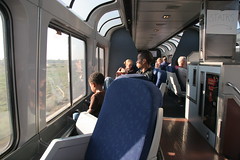
A Superliner Lounge (observation) car on Amtra...Image via Wikipedia
This Week at Amtrak Vol. 8 No. 11
Volume 8, Number 11

From the Editors…

This week we hear from Russ Jackson, Vice President of the United Rail Passenger Alliance. Russ is a retired California college instructor, former RailPAC officer and editor, and is now living near Dallas, Texas.

AMTRAK Long-Distance trains at 40

And, what they still need is more cars!


Comments by Russ Jackson

That was then: Forty years is a long time. In this report let us first take a look at where the Western long distance trains started for Amtrak, and then look at today. Charting will be for two trains that were in the Amtrak official timetable #1 for May 1, 1971, which was quickly replaced with a new one on July 12 (to view this timetable see: http://www.timetables.org/browse/?group=19710712r&st=0001); then, the May, 1991 national timetable which was in effect when this writer became editor of RailPAC’s Western Rail Passenger Review; and then we do a comparison of those past schedules with the 40th anniversary 2011 national system timetable which is available now at all Amtrak-staffed stations.

Trains 1 and 2, the Sunset Limited

We all know what the problem with this train has been and continues to be: Tri-weekly (also said as tri-weakly) service from day one, thanks to the inherited schedule from the Southern Pacific, and it continues to run today with nearly full loads despite the very bad schedule.

1971 Dp NOrl 1:00 PM; Dp Phx 10:50 PM; Ar LA 7:30 AM Su,W,F 44.5 hrs
1991 Dp NOrl 2:15 PM; Dp Phx 10:31 PM; Ar LA 7:00 AM M,W,F 42.75 hrs
2011 Dp NOrl 11:55 AM; Dp Mar 11:57 PM; Ar LA 8:30 AM Su,W,F 44.5 hrs *

1971 Dp LA 10:00 PM; Dp Phx 8:10 AM; Ar NOrl 8:00 PM Su,Tu,Th 44 hrs
1991 Dp LA 10:50 PM; Dp Phx 7:20 AM; Ar NOrl 7:50 PM Su,Tu,Th 43 hrs
2011 Dp LA 3:00 PM; Dp Mar 10:38 PM; Ar NOrl 2:55 PM Su,Tu,F 48 hrs *

*NOTE: In 2011 the trains do not go through Phoenix, a major city now without train service, and there are generous amounts of built-in recovery times throughout the route. In 1971, the schedule called for Yuma to Tucson via Phoenix to be 6 hours; in 1991, 6-1/2 hours; in 2011, 4-3/4 hours via Maricopa. If Phoenix were still on the schedule, an hour and a half would have to be added to the 2011 schedule.

Trains 3 and 4, the Southwest Chief

In 1971 timetable #1, this train had numbers 17 and 18 and was named “Super Chief-El Capitan,” continuing its inherited Santa Fe tradition.

1971 Dp Chi 6:30 PM; Ar LA 9:00 AM; daily 40.5 hrs *
1991 Dp Chi 5:00 PM; Ar LA 8:10 AM; daily 41.25 hrs
2011 Dp Chi 3:00 PM; Ar LA 8:15 AM; daily 43 hrs

1971 Dp LA 7:30 PM; Ar Chi 1:30 PM; daily 42 hrs *
1991 Dp LA 8:30 PM; Ar Chi 3:50 PM; daily 42.25 hrs
2011 Dp LA 6:15 PM; Ar Chi 3:15 PM; daily 45 hrs

* NOTE: In 1971, the train did not go via Topeka, KS, which adds one hour to the schedule.

While running times and scheduled departures have remained fairly consistent for these trains, for others they has been all over the map. Several interesting changes from 1971: Then, the Coast Starlight was the first west coast train to travel from Seattle to, first, San Diego. It ran tri-weekly north of Oakland and from Los Angeles to San Diego, but daily from Oakland to Los Angeles. In 1971 there were only two daily round-trip San Diegans between Los Angeles and San Diego; no San Joaquins, and no Capitols. Originally, the California Zephyr was scheduled to travel its current route, but when the D&RGW railroad decided to opt out of Amtrak, it ran via Wyoming, and operated daily from Chicago to Denver but tri-weekly between Denver and Oakland. The Empire Builder did not have a Portland section, and crossed the Cascades in Washington going via Yakima instead of Wenatchee. All this was accomplished using low-level cars and locomotives that were 20 years old and operating crews inherited from the freight railroads.

This is now: In the July, 2011 issue of Trains magazine, writer Bob Johnston has written a review of Amtrak’s past, dividing its history into five sections and comparing “then” to “now.” For example, section one, “Wake-up call,” says “Then: equipment had to be ordered and funded.” Sadly, “Now: equipment has to be ordered and funded.” While that is important for all parts of the system, including the Northeast Corridor, Amtrak has neglected its long distance trains badly. In his presentation to the RailPAC-NARP meeting in March, 2011, Minnesota’s Andrew C. Selden said, “Amtrak has made no significant investment in its long distance services in 20 years, and now plans only to replace its Superliner I cars, not to grow its long distance fleet or network.” Mr. Selden’s comments and data explaining all this were published in the May-June issue of the RailPAC newsletter.

On May 17, 2011, Amtrak CEO Joseph Boardman told the U.S. Senate Appropriations Committee, “You are not going to cut costs far enough on the long-distance trains to make (them) profitable.” This statement came after Amtrak’s West Coast Superintendent, William Duggan, spoke to the RailPAC meeting, revealing (with a Power Point visual) that “Sleeping car ticket revenue makes a positive contribution to Amtrak’s bottom line.” That is what RailPAC, URPA, and most objective long distance train advocates have been saying for too many years; but Amtrak has not been willing to fund additional cars that will contribute positively to that bottom line, instead choosing to invest only in corridor trains that are paid for by the states (except in the NEC). Mr. Selden says, “Amtrak is turning away boatloads of money for want of new capacity.” As RailPAC President Paul Dyson, says, “More cars on the (existing) trains means more revenue and smaller deficits. The true deficit is in management, not dollars.”

So we can all agree that adding additional high-revenue cars to existing trains, those that will run every day (including the daily Sunset Limited, eventually), is where Amtrak should be concentrating its efforts, right? RailPAC’s Noel Braymer suggests, “How about private financing (safe-harbor leasing) with a business plan to pay for them with increased revenues? With California about to order new bi-level cars how about Amtrak getting an ‘add-on’ to that order for new hulls at least.”

We must add a caution written by Mr. Selden to us, that it “will take hundreds of new cars–effectively deployed in high revenue services–to get to break-even. But, local wisdom in St. Paul is that there never will be a fourth sleeper on the Builder because the diner is swamped as it is and they couldn’t feed another carload of passengers. Personal observation is that they’re right. The diner in mid-summer (i.e., for the four peak months) is dreadful in terms of regimentation and rushed service, and stress on an understaffed crew.” After a trip on the Empire Builder, where he is a National Park Service volunteer in the Rails-Trails program, narrating the trip between Minneapolis and Wisconsin Dells, Mr. Selden wrote that “All three sleepers were all but sold out on both trains and would be sold out west of Minneapolis. Coaches were about 2/3 occupied so statistically sold-out due to down-line sales.” And this on a train that has had many on-time problems this winter and spring.

RailPAC Vice President-South James Smith returned from a round trip on the Southwest Chief from Los Angeles to Chicago and reported the same sold-out condition in May, before the official travel season begins. People want to ride… Something must be done for these western trains, besides just replacing cars one-for-one, if Amtrak really wants to grow financially and calm the criticism thrown at it. Or does it?
Enhanced by Zemanta

Tuesday, March 23, 2010

This Week in Amtrak

Sunset Limited in Houston.Image via Wikipedia


This Week at Amtrak; March 23, 2010


A weekly digest of events, opinions, and forecasts from


United Rail Passenger Alliance, Inc.

America’s foremost passenger rail policy institute


1526 University Boulevard, West, PMB 203 • Jacksonville, Florida 32217-2006 USA

Telephone 904-636-7739, Electronic Mail info@unitedrail.org • http://www.unitedrail.org


Volume 7, Number 10


Founded over three decades ago in 1976, URPA is a nationally known policy institute which focuses on solutions and plans for passenger rail systems in North America. Headquartered in Jacksonville, Florida, URPA has professional associates in Minnesota, California, Arizona, New Mexico, the District of Columbia, Texas, New York, and other cities. For more detailed information, along with a variety of position papers and other documents, visit the URPA web site at http://www.unitedrail.org.


URPA is not a membership organization, and does not accept funding from any outside sources.


--------------------------------------------------------------------------------

Volume 7, Number 10
Before we begin this week, a note from Bruce Richardson:

Amtrak will lose one of its most important human assets at the end of this month. Cliff Black, long the public face of Amtrak and its long serving spokesman is retiring after decades of service. He will be greatly missed by all of us who have known him professionally, and by those who have worked directly with him.


During his tenure at Amtrak there have been too many presidents of the company who have come and gone to keep count of, but, through each change of leadership at Amtrak the one constant has been Mr. Black’s deft handling of the news media and corporate communications. Any of us seeking true, honest information knew Cliff Black was the man to talk to; while keeping on message for his employer, he never led anyone in the news media astray, an amazing feat in today’s world of journalism.

A phone call to or from Cliff Black is always a few moments of pleasant diversion. A written message from him is always an honest missive, whether it contains good or bad news.

So, Mr. Black heads into the next part of his life, leaving the corporate world behind. All of us thank him profusely for his service to Amtrak and good journalism, and wish him well for the future. If his successor is just half as good at what Mr. Black does, then his successor will be a great success.

# # #

An ocean liner does not turn on a dime, and neither does a large corporation. Some parts of Amtrak are definitely changing course while others have not yet caught up.

Starting with the positive, we hear a few weeks ago that real china, linens, and glassware are returning to the Coast Starlight. This is certainly a good bit of news, and part of a refocusing on passenger needs. One wonders, however, how many surveys are required to determine that folks shelling out the equivalent of a fairly posh hotel room in most American cities, for their “first class” railway accommodations, expect a table setting in the diner to more closely approximate something saying “Lenox” than “Dixie Cup Company.” We do extend a note of approval to Mr. Brian Rosenwald, Chief of Product Development, and all those involved in the recent changes on the Starlight.

Then we hear from Amtrak spokesman Mark Magliari that Amtrak is also evaluating the Capitol Limited in a not dissimilar manner, looking also at the schedule. An article in the Cleveland Plain Dealer invites residents of that city to request Amtrak consider changing the wee-hour stops to something more amenable to civilized travel. We further commend the company for such recent emphasis on listening to advocates, railfans, and (gasp!) even their own potential customers, and fervently hope to see more “doing more with what we have.”

The key to Amtrak solving its financial and public-relations challenges will be getting more people on its trains — not just “doing more,” but adding capacity. Again we see positive developments in the rehabilitation of wrecked Superliners and an order for Viewliners… the beginning of what needs to be a long road.

Speaking of alternatives to wee-hour schedules, and doing more with existing routes and stations, we can now thank www.timetables.org — a new web site which has scanned all Amtrak’s historic timetables — for providing proof that, once upon a time, Amtrak operated at least one of its Western long distance trains on a twice-daily basis. Page 52 of the June 11, 1972 timetable shows both the Chief and the Super Chief operating Chicago-Los Angeles, on schedules several hours apart. Any railfan younger than 50 years old probably never knew this; certainly the popular railfan magazines never mentioned the fact in all the years I read them. One could well imagine all long-distance routes past the Eastern seaboard with two daily trains, spaced by eight or ten hours, providing convenient times in most every origin-destination pair… doubling revenue with little increase in station or system costs.

David Carleton writes,

At the very beginning of Amtrak, the railroads were still the operating agents running trains “for” the National Railroad Passenger Corporation. The Santa Fe and the SCL did at first add trains to the schedule during periods when they knew there would be heavier traffic…

In 1971, the El Capitan / Super Chief ran with six Hi-Level coaches containing 424 seats, and six sleeping cars containing eighty rooms with a total of 132 berths.

The Chief which ran in 1972 carried three Hi-Level coaches containing 208 seats and two sleeping cars of various configurations.

By 1975 the same operation (but renamed the Southwest Limited when a disgusted Santa Fe withdrew the rights to the traditional names) was down to three Hi-Level coaches containing 208 seats and three sleeping cars containing fifty-nine rooms with a total of 88 berths.

Remember, the year 1973 saw the Arab Oil Embargo, rationed gasoline, and folks looking for any alternative to driving. Little Japanese cars like the Honda CVCC (later the Civic) were all the rage, as Detroit rushed the Vega and the Pinto to market. Where were 1972’s second frequencies on 1973’s Amtrak? Mr. Carleton writes, “We can confirm based on our own direct observations that none of those trains ran empty!” Have we yet truly overcome obstacles to expanding our country’s passenger trains?

Judging by the past week’s Kansas rail study — no. The Lawrence (Kansas) Journal-World reports — http://www2.ljworld.com/news/2010/mar/11/amtrak-study-shows-routes-through-kansas/ — that “Ridership numbers have good potential, but [the] effort” to carry passengers between Kansas City and Fort Worth “will take years, officials say.” The study considered four options with start-up costs ranging from about $150 to $500 million (exclusive of stations), projecting 65,000 to 174,000 annual riders.

John Mills of Topeka noted in a forum elsewhere on the Internet that the study includes the addition of a second main track to 40 miles of the BNSF railway, at four million dollars a mile, rather than a more sensible six mile stretch of double-track and one new passing siding. Much more than that, he argues, is more a pure benefit to freight movement than a mitigation of the relative few minutes of delay introduced by a couple daily passenger trains, and thus should be partly paid for by BNSF itself. Bluntly, just as with last year’s flawed system expansion reports (the Sunset Limited east of New Orleans, the Pioneer and the North Coast Hiawatha) the Kansas study overstates the obstacles and understates the potential to get something moving quickly while seriously working with the railroads to improve even further. There’s much more to say about this, next time.

On the High Speed Rail front, Scott McCartney’s “blog” on the Wall Street Journal website ( http://blogs.wsj.com/middleseat/2010/03/09/lahood-to-airlines-get-onboard-the-high-speed-train/ ) noted that Transportation Sec. Ray LaHood, addressing the Federal Aviation Administration’s annual forecasting conference in Washington, D.C., said that within a few decades, American cities will be connected by high-speed rail – “whether airlines like it or not. ‘People want alternatives,’ he [LaHood] said pointedly. ‘People are still going to fly, but we need alternatives. So get with the program.’”

On the heels of Mr. LaHood’s comments comes an employee advisory from Mr. Boardman at Amtrak on Friday 19 March, regarding a new High-Speed Rail department at Amtrak to “be led by a vice president reporting directly to me.” The press release continues,

Specifically, this department will work on the planning and development activities that will allow us to significantly increase operating speeds above 150 mph (240 kph) on the Northeast Corridor. It will also pursue partnerships with states and others in the passenger rail industry to develop federally-designated high-speed rail corridors such as the new projects moving forward in California and Florida.

Amtrak’s leadership in this area is reaffirmed in the Passenger Rail Investment and Improvement Act of 2008 and we must make every effort to remain in that position.

That last paragraph sounds curiously aware of potential competition from the private high-speed railway operators of Europe and other shores. Who says competition is a bad thing?

Finally, and on this subject, we hear from Mr. Daniel Carleton. Until next week, gentle readers.

– \\/
William Lindley, Scottsdale, Ariz.

A Tale of Two (High-Speed) Rails; a lesson of pragmatism vs. phantasm
by Daniel Carleton
The awarding of the American Recovery and Reinvestment Act grants (ARRA) for High-Speed Rail projects has ended many months of speculation how the funds would be allocated. In all, $8 billion has been sown toward expanded and improved passenger rail service in America. The big winner is California with $2.3 billion going toward various projects, including a very small down-payment for their $45 billion HSR system. In comparison, Illinois, considered an early crony favorite, only picked up $1.1 billion; strange considering Chicago is the railroad hub of America.

However, there are two states which are poles apart in their passenger rail ambitions and ARRA grant requests: Wisconsin and Florida. Wisconsin is on tap to receive $822 million; the vast majority of this to reinstate service between Milwaukee and Madison, 80 miles. Florida sees things somewhat differently. The Sunshine State is bequeathed $1.25 billion for preliminary engineering on a high-speed railway between Tampa and Orlando, 84 miles. Why does four miles add $428 million to the tab? Moreover, the total estimated cost of the Tampa – Orlando route is $3.5 billion. Can both these plans be realistic?

In Wisconsin the idea is rather straightforward: reinstate passenger traffic between the state capitol, Madison, and the state’s largest city, Milwaukee. The right-of-way historically is former Milwaukee Road; part of the route, Milwaukee to Watertown, sees Amtrak’s daily Empire Builder. West of Watertown, the line is now governed by the Wisconsin & Southern Railroad, a local regional road. The Badger State has already committed $47 million dollars of state funds for two new fourteen-car TALGO trainsets to support their existing Chicago – Milwaukee service. Ostensibly, two more trainsets will be ordered to support this further expansion in service, and the concurrent increase in speeds to 110 mph, all of which is expected to be running by 2013.

Florida, in contrast, has opted to reinvent the flanged wheel by building an entirely separate railroad between Orlando and Tampa, as part of a larger goal of extending the system to Miami. The initial phase would see a new right-of-way established between or near the lanes of Interstate Highway 4. New stations would be built even though numerous ones already exist. A new station is planned for Walt Disney World even though Disney’s involvement has been the kiss of death for all previous HSR incarnations in Florida. Preliminary engineering is expected to be finished by 2011 and service by 2014.

The desire to utilize existing highway rights-of-way is manifold. On top of this list is the low-to-nonexistent cost of land acquisition. Yet, a brief look at the historical economic impact of highways should be reviewed before proceeding. When a new highway was built there was a positive financial influence; land at or near interchanges and exits became more valuable and businesses were built. However, over time traffic increased and transit times increased to the point of highway expansion. What was the economic impact of new lanes to an existing highway? Practically nil. The land at the interchanges and exits didn’t move and any extra business practiced comes no where near to paying for the lane addition. Does anyone realistically expect building a railroad adjacent to a highway, high-speed or otherwise, to have any different an effect? If built as planned, Florida’s HSR stations will be built at or near existing development. Whereas heavy construction will gain a short-term production there will be no long-term development. Is this worth $3.5 billion?

There is an existing railroad between Tampa and Orlando with a daily scheduled Amtrak train. The right-of-way is owned by CSX and is predominantly a secondary route to Tampa. (A small section between Lakeland and Auburndale will increase in importance once a new yard in Winter Haven is completed.) This former Atlantic Coast Line trackage rolls through the heart of numerous well established central Florida towns such as Plant City, Lakeland, and Kissimmee; Lakeland having built a brand new station in 1998. Anchoring the west end of this corridor is Tampa Union Station, which was completely renovated and dedicated also in 1998. Orlando does not currently have the best station for the riding public. This situation which will change with the coming of SunRail commuter train service and a new intermodal station built downtown; Lynx Central Station. As of right now none of this existing infrastructure is slated to be utilized for Florida’s HSR ambitions. Is this really an act of recovery or reinvestment?

What if Florida were to, instead of reinventing the flanged wheel, rebuild the existing corridor? The existing highway and its associated development will not go away; the fast food restaurants, big box stores and movie multiplexes are not likely to blow away with the wind. Rebuilding the existing railroad would mean an opportunity for growth to the towns and cities who owe their origins to the railroad. Downtown Tampa, where Union Station is already situated, could once again be made vibrant. Similar could be said of the smaller towns which atrophied or shrank in the highway age. What this means is jobs. Already development is seen, either on the ground or on the drawing board, around the area to be served by SunRail. There is no reason this cannot be expanded west. What does it say about governance when glitzy ambitions are placed ahead of the people’s needs?


--------------------------------------------------------------------------------


If you are reading someone else’s copy of This Week at Amtrak, you can receive your own free copy each edition by sending your e-mail address to


freetwa@unitedrail.org


You MUST include your name, preferred e-mail address, and city and state where you live. If you have filters or firewalls placed on your Internet connection, set your e-mail to receive incoming mail from twa@unitedrail.org; we are unable to go through any approvals processes for individuals. This mailing list is kept strictly confidential and is not shared or used for any purposes other than distribution of This Week at Amtrak or related URPA materials.


All other correspondence, including requests to unsubscribe should be addressed to


wlindley@unitedrail.org


Copies of This Week at Amtrak are archived on URPA’s web site, www.unitedrail.org


URPA leadership members are available for speaking engagements.


Reblog this post [with Zemanta]

Sunday, January 10, 2010

This Week in Amtrak

Empire BuilderImage by Patrick Rasenberg via Flickr


This Week at Amtrak; January 11, 2010


A weekly digest of events, opinions, and forecasts from


United Rail Passenger Alliance, Inc.

America’s foremost passenger rail policy institute


1526 University Boulevard, West, PMB 203 • Jacksonville, Florida 32217-2006 USA

Telephone 904-636-7739, Electronic Mail info@unitedrail.org • http://www.unitedrail.org


Volume 7, Number 2


Founded over three decades ago in 1976, URPA is a nationally known policy institute which focuses on solutions and plans for passenger rail systems in North America. Headquartered in Jacksonville, Florida, URPA has professional associates in Minnesota, California, Arizona, New Mexico, the District of Columbia, Texas, New York, and other cities. For more detailed information, along with a variety of position papers and other documents, visit the URPA web site at http://www.unitedrail.org.


URPA is not a membership organization, and does not accept funding from any outside sources.


1) VIA Rail Canada is superb at doing it. The freight railroads do it like it’s an everyday occurrence. Amtrak, on the other hand, can never seem to get it right.


We’re referring, of course at this time of year, to operating trains in severe winter weather. While things have mostly been humming on the Northeast Corridor, it’s been a far different story out in flyover country where the Empire Builder operates between Chicago and Seattle, Washington/Portland, Oregon.


It’s been a while since Amtrak consistently got a train over the road anywhere near to keeping a schedule, and even running two trains in a row.


The problem has mostly been blamed on malfunctioning air systems from the locomotives. Without a working air system, there are no brakes on a train. (The air system we’re referring to has nothing to do with the hotel power from the locomotives to the rest of the train which provides heat for the train.)


Some Empire Builders have arrived nearly a day late, some not at all, some have only traveled a part of the route before being annulled. Word is, even Amtrak’s host railroad for the Empire Builder, the Burlington Northern Santa Fe Railroad, has banned the Builder from its infrastructure until Amtrak can prove it can get a train from Point A to Point B without having a locomotive failure and fouling the main line which has heavy freight traffic.


All of this begs the question, “why?” since Amtrak has had nearly 40 winters to figure things like this out.


Some folks have speculated it’s because Amtrak tries to have an all-weather locomotive fleet, which operates in desert heat in the Southwest as well as it does in blizzard conditions in North Dakota. As with anything else which tries to be all things to all people, the inevitable failure occurs.


Some folks have speculated Amtrak’s mechanical department just isn’t up to the job, and does what it can with the budget it has to work with each year.


Some folks have speculated Amtrak just doesn’t care; if it doesn’t have anything directly to do with the NEC, then it’s not important.


But, looking at VIA Rail Canada, which generally operates under some of the most severe winter weather conditions in the world, VIA rarely has Amtrak’s winter weather problems. And, VIA is a smaller company, has fewer resources, and often makes do with older equipment.


The freight railroads in the same severe winter weather always manager to get trains with dozens and dozens of heavily loaded freight cars down the track, also using air brake systems, and they don’t have these problems. BNSF, like Amtrak, operates from the extreme northern tier of the country to the extreme southern tier, and needs locomotives, too, which can work in extremes of heat and cold.


If VIA can do it, and BNSF can do it, and Union Pacific can do it, and CSX and Norfolk Southern and Kansas City Southern can all do it, along with Canadian National and Canadian Pacific, why can’t Amtrak?


As said in this space before, we know there are some dedicated transportation people at Amtrak who want the railroad to run right, no matter what the weather forecast. Why aren’t these people given the budget and resources they need to get the job done? Amtrak begs for money every year from Congress and the federal treasury, laying out priorities. Why isn’t locomotive reliability outside of the Northeast Corridor in the winter a priority?


These are the times which try mens’ souls, when the harsh realities of Mother Nature go up against the needs of mortal man. These are the times when the professional railroaders, who go to sleep thinking about railroading and then wake up the next morning thinking about the same thing, need the resources to do their jobs. If Amtrak wants to continue to promote itself as the custodian of the next generation of passenger trains and thinks it’s going to be the first choice as the operator of the new high speed rail systems, rational people making those decisions are going to wonder why Amtrak, which is operating conventional rail on a system which has been in place for over 150 years, can’t figure out how to make that system work. If Amtrak can’t get conventional rail right, how will it ever get high speed rail right?


2) Where are you on the Amtrak spectrum? Are you a True Believer, willing to accept anything Amtrak and the National Association of Railroad Passengers says, at face value? Are you always willing to give Amtrak more and more money, without accountability, just because it’s Amtrak?


Are you more of a pragmatist, and believe in the business of passenger rail, knowing at one time it was a sane, profitable business, and there is no reason why in the future it can’t return to that status?


Are you convinced the days of passenger rail are gone, and everyone should enjoy driving their private vehicle down crowded highways or the only other option for public transportation is airplanes?


Which one are you? Do you fit into any of those categories, or, perhaps are you something of a blend of two or more of those categories?


How do you see the future of passenger rail? Are we on the cusp of renaissance, or near the end of the line? Is that light at the end of the tunnel an oncoming passenger train you welcome, or the halogen headlights of an overpriced SUV getting five gallons of gas to the mile of transportation?


It’s time to start choosing sides. More and more passenger rail publications are openly questioning the actions/lack of actions of Amtrak. Columnists who were once reliable Amtrak Apologists are now apologizing to their readers for taking so long to see the truth about Amtrak, and its lack of motivation.


So, are you going to sit on the sidelines and kibbitz about what the final colors of pre-merger Seaboard Air Line Railroad passenger locomotives were, or are you going to figure out how to take some action and demand better passenger rail transportation in this country, whether or not it’s from Amtrak?


Politics in Washington are in a turmoil, and there is likely to be a huge sea change in Congress at the end of this year. No matter who is charge in Washington, it’s time to express your displeasure with how things are with passenger rail, and demand better oversight, and, most importantly, demand someone, somewhere, develop a coherent national surface transportation plan.


As long as everyone just sits around and waits for something to happen, nothing is likely to happen. Amtrak seems content to consume its annual free federal and state monies without any demonstration of progress to create more or better passenger trains. Amtrak needs some major prodding, and it needs prodding from someone who can force change and inspire vision at Amtrak.


What are you going to do about it?


If you are reading someone else’s copy of This Week at Amtrak, you can receive your own free copy each edition by sending your e-mail address to


freetwa@unitedrail.org


You MUST include your name, preferred e-mail address, and city and state where you live. If you have filters or firewalls placed on your Internet connection, set your e-mail to receive incoming mail from twa@unitedrail.org; we are unable to go through any approvals processes for individuals. This mailing list is kept strictly confidential and is not shared or used for any purposes other than distribution of This Week at Amtrak or related URPA materials.


All other correspondence, including requests to unsubscribe should be addressed to


brucerichardson@unitedrail.org


Copies of This Week at Amtrak are archived on URPA’s web site, www.unitedrail.org and also on www.todaywithjb.blogspot.com where other rail-related writings of Bruce Richardson may also be found.


URPA leadership members are available for speaking engagements.


J. Bruce Richardson

President

United Rail Passenger Alliance, Inc.

1526 University Boulevard, West, PMB 203

Jacksonville, Florida 32217-2006 USA

Telephone 904-636-7739

brucerichardson@unitedrail.org

http://www.unitedrail.org


Reblog this post [with Zemanta]

Friday, October 23, 2009

This Week In Amtrak

Northern Pacific train No. 25, the North Coast...Image via Wikipedia


This Week at Amtrak; October 22, 2009


A weekly digest of events, opinions, and forecasts from


United Rail Passenger Alliance, Inc.

America’s foremost passenger rail policy institute


1526 University Boulevard, West, PMB 203 • Jacksonville, Florida 32217-2006 USA

Telephone 904-636-7739, Electronic Mail info@unitedrail.org • http://www.unitedrail.org


Volume 6, Number 44


Founded over three decades ago in 1976, URPA is a nationally known policy institute which focuses on solutions and plans for passenger rail systems in North America. Headquartered in Jacksonville, Florida, URPA has professional associates in Minnesota, California, Arizona, New Mexico, the District of Columbia, Texas, New York, and other cities. For more detailed information, along with a variety of position papers and other documents, visit the URPA web site at http://www.unitedrail.org.


URPA is not a membership organization, and does not accept funding from any outside sources.


1) Well. A lot has been happening in the two weeks since the last This Week at Amtrak was published. Before we get into some specifics, we first need to hear what Minnesota Association of Rail Passengers and United Rail Passenger Alliance Vice President of Law and Policy Andrew Selden has to say on the current state of Amtrak.


[Begin quote]


By Andrew C. Selden


Amtrak blinds itself, in its endless posturing to fool its bankers in Congress, by measuring its performance by numbers that do not really matter, while ignoring or burying numbers that do matter. As a result, it makes decisions, including strategically important allocations of precious investment capital, on the basis of fundamentally misleading data.


The most glaring example is Amtrak's endless blathering about "ridership." Ridership is only a measure of a sale transaction. It does not differentiate among the size of the sales. One "rider" from New Haven to Boston is, by this yardstick, exactly equal to one rider from Washington, D.C. to Boston, or even Los Angeles to Boston. Amtrak makes this worse by blurring useful sales data (ticket prices) into averages by which they measure (actually, it's just arithmetic, not really "measuring" anything) "yield," which is the average revenue per passenger mile on a train or route. This tends to reinforce the false belief any one passenger is pretty much the same as any other.

In an urban transit system where every passenger pays the same fare, that might be okay.


But on Amtrak, where a typical "corridor" customer might pay $10 to $30, but a family in a sleeper to the west coast could be paying $1,000 or more, these "riders" are decidedly unequal. Fifty of the former are less than two of the latter. But Amtrak is obsessively focused on "ridership."


A yardstick Amtrak tries to hide, and apparently never uses to make important resource allocation decisions, is load factor. Load factor is the percentage of your inventory you are able to sell. Airlines live and breathe load factor.


Load factor is available seat miles (total inventory) divided by revenue passenger miles (seat-miles sold to paying passengers).


Load factor ("LF") matters greatly. Among other things it is a perfect measure of capital efficiency, and where a business is over-invested vs. under-invested. It is an indirect measure of opportunity cost. A trend analysis of LF is a tell-tale for a growing or a dying business.


It indicates whether an operation has achieved an efficiency of scale, or needs to ramp up, or down, its application of capital assets to achieve an efficiency of scale. The NEC's low load factors show Amtrak is already over-invested there: it offers much more inventory than it can sell for $30, or even give away. Long distance trains, with high load factors, show where Amtrak is under-invested, turning away potential $1,000 customers by the hundreds.


Simple "ridership," without consideration of load factor, is classic "Amtrak accounting" that disregards the cost and utilization of capital. If you have a rich uncle who doesn't care, or a politically-oriented appropriations committee that has other objectives, or a gullible state agency that doesn't seem to get it (a la Oklahoma and the Heartland Flyer), then one can disregard capital costs, load factor, and utilization. Ready access to "free" capital (but always with a heavy political and opportunity cost) obscures that.


Suppose a train or route has a LF of 40% (NEC average is about 40%). Suppose the LF is static, or even growing slowly. Is that a good thing? Or does that suggest the capital – represented here by the rolling stock, the overheads and even the relationship and rent costs with the host railroad – might be better applied elsewhere?


In other words: Can those trainsets produce, or earn, even more someplace else?


Real world, actual example: take a standard KFC restaurant with 72 seats grossing a million a year, and is often "full" (i.e., has a very high LF). It is a cash cow. The owner is happy. His banker is happy. But an investment banker focused on returns on capital (i.e., making money by maximizing output) will say, "Bulldoze this obsolete, underperforming asset. Get rid of it. It is a parasite. It is an obstacle to growth and profit. In its place, build a new, larger KFC with 150 seats and a bigger kitchen and a drive-through, that is physically capable of growing into a TWO or even three million a year store." And if the KFC instead were a lightly-used 40-seater that was doing $500,000 a year and showing no real growth, even if it were steadily profitable at that level, any rational analysis would conclude the store should be closed outright, and maybe re-located across town by the Wal-Mart, or out by the interstate. LF as well as cash flow, market share, and earnings are all part of the constant analysis that should be done of any commercial activity.


Amtrak NEVER does that. Amtrak instead fools itself and fools its bankers in Congress and its client state governments with phony-baloney data about transaction volumes ("ridership") and other irrelevancies.


ITEM: Amtrak's net loss last year was UP from the year before, for the umpteenth year in a row, even after all the subsidy and the deferred maintenance and the shrunken fleet and all the other voodoo accounting. That is why Amtrak is still a sinking ship, and why Interim President and CEO Joe Boardman, just like his several predecessors, is no different from Captain Edward Smith of the White Star Line. And trains like the Harrisburg – Philadelphia locals, or Acela, or the Heartland Flyer, with their low load factor, whatever the ridership, are just like that tiny scrape in the hull that eventually worked its disproportionate magic on the fortunes of the RMS Titanic.


[End quote]


2) Amtrak issued another route renewal report, and issued a final report on a second route.


The Pioneer route report, which was commented on previously in this space, was issued in a final form with no real changes in how Amtrak perceives to put this train between Denver and Seattle back into service at extremely high costs and a too long lead time, despite questioning from two United States Senators along the route, Senator Crapo of Idaho, and Senator Wyden of Oregon.


The new report issued was for restoration of the North Coast Hiawatha (Originally, the North Coast Limited, pre-Amtrak.) over the original Northern Pacific Railroad tracks. This route will parallel the Empire Builder route, but make a more southerly trip. Pre-Amtrak, the Empire Builder and the North Coast Limited were strong rivals between Chicago and Seattle, and both routes have breath-taking mountain scenery. The North Coast Hiawatha was one of the trains massacred by the route cuts of the Carter Administration.


Amtrak wants – yes, we’re not kidding – over one billion dollars to restore this route, with the bulk of the money going to track upgrades. After the Burlington, Northern Pacific, and Great Northern railroads were all folded into one company (which eventually became BNSF when the Santa Fe was added to the mix), the Northern Pacific route was considered redundant to the Great Northern (Empire Builder) route, and was downgraded. Part of the route in Montana was sold to a short line operator, too.


All of that aside, Amtrak has come out with ridiculously high figures for route restoration, including an amazing $330,000,000 just for six trainset of new equipment, including locomotives. This works out to an astounding $4,500,000 per piece of equipment, which is not only impossible to justify, but incredible anyone could present this figure with a straight face. Additionally, Amtrak demands millions and millions of dollars for crew training, as it has done in previous reports.


This analysis of the North Coast Hiawatha landed in the This Week at Amtrak mailbox.


[Begin quote]


Amtrak North Coast Hiawatha Report Reflects Apathy and Atrophy; Fails to Answer Many Questions


By Joseph D. Henchman

October 17, 2009


Introduction


On October 16, 2009, Amtrak published the North Coast Hiawatha Passenger Rail Study as required by the Passenger Rail Investment and Improvement Act of 2008 (PRIIA). That law required Amtrak to produce a report within one year of October 16, 2008 examining the feasibility of restoring passenger rail service between Chicago and Seattle via the former Northern Pacific mainline in Southern Montana.


Confronted with a political environment favorable to the expansion of its services, the report suggests an institution whose marketing and innovative instincts have atrophied. The report’s tone reflects a determination to drag out the timeline and extract as many subsidies as possible rather than seriously consider how a successful passenger rail service in the study area can be implemented.


Below are specific areas the report is insufficient or raises serious concerns.


Amtrak penalizes the study train for diverted passengers from other trains, but does not credit it for passengers fed to other trains.


Amtrak’s report penalizes the ticket revenue of the North Coast Hiawatha by $8 million because Amtrak estimates the train will divert passengers from the Empire Builder, a heavily-patronized Amtrak train (693 passengers each train in FY 2009 through July) that also operates daily between Seattle and Chicago. Amtrak goes so far as to say that the diverted revenue will “increase Amtrak’s direct operating loss.”


This analysis is incomplete for two reasons. First, the Empire Builder is often sold out for being over capacity, so an additional train may have the net impact of freeing up space on that train to be sold to others, wiping out any revenue loss. Second, and more importantly, Amtrak does not estimate additional revenue for other trains from the addition of the North Coast Hiawatha (or if they do, they don’t report it). Few Amtrak long-distance passengers ride end-to-end, with many taking shorter trips often involving transfers to other trains. On the west end is the Seattle-Portland Cascade train as well as the long-distance Coast Starlight to California. On the east end are services to St. Louis, New Orleans, Washington, Boston, New York, and Michigan. Added service into and out of Seattle and Chicago will result in additional revenues for all of these trains. If Amtrak “penalizes” the North Coast Hiawatha for “diverting” passenger revenue from trains, it should also “credit” the North Coast Hiawatha for “feeding” passenger revenue to other trains.


One approach Amtrak did not take would be to estimate system-wide revenues and expenses from the addition of the North Coast Hiawatha. This would give a true picture of the actual incremental cost of service expansion. Amtrak is also studying the expansion of services in several other routes, and is producing piecemeal reports on financial impacts, one-by-one. As Amtrak adds trains and frequencies, the additional options stimulate demand beyond that of one-train-on-one-corridor. A comprehensive approach of these proposals would be necessary for informed decision-making.


Amtrak Inexplicably Buries Its Conclusion that the Train Will Cost Its Operating Costs


There are two types of costs associated with running trains. One are relatively fixed costs that do not vary with the number of trains (system reservations and website, management costs, station costs), and the other are costs that vary with the number of trains (crew costs, fuel, payments to host railroads, and to some extent equipment maintenance). Amtrak’s estimate of North Coast Hiawatha operations, put in these terms, is as follows:


Passenger Related Revenue (not including $8 million revenue penalty for diversions from Empire Builder) – $51,000,000


Variable Expense: Fuel – $7,400,000


Variable Expense: Train Crew Labor – $13,000,000


Variable Expense: On-Board Services Labor – $14,700,000


Variable Expense: Mechanical – $11,900,000


Total Variable Expenses – $47,000,000


Net, Variable Expenses – +$3,000,000


Non-Variable: Station & System Expenses – $27,100,000


Total, All Expenses – $74,100,000


Total Net, All Expenses – ($24,100,000)


Farebox Recovery, Variable Expenses Only – 108.5%


Farebox Recovery, All Expenses (Amtrak reduces the farebox recovery by 10 percentage points by excluding the diverted revenue to the Empire Builder) – 68.8%


Amtrak’s long-distance service requires subsidies to cover its operating shortfalls [Based on Amtrak accounting methods]. Few if any recover 68.8% of their costs for all expenses, or actually break even on variable expenses, as Amtrak estimates here. Why Amtrak buries this information is inexplicable. One possibility would be that acknowledging Amtrak will run a train with a rather positive financial performance undermines its argument that massive subsidies are required to operate it.


Note: Amtrak does not clarify whether its estimate of system and route costs are the amounts that will be assigned to the North Coast Hiawatha or whether they are incremental costs of adding the train. For example, assume (using made-up numbers) Amtrak spends $100,000 a year operating the existing station at Fargo, North Dakota (which the North Coast Hiawatha would stop at), and $5 million a year running its existing national reservation system. Assume also Amtrak’s cost estimates in the report include line-items of $50,000 for the Fargo station and $200,000 for system reservations (they don’t; those items are not broken out). Does that mean Amtrak is spending an additional $250,000 when the North Coast Hiawatha is launched, or rather the North Coast Hiawatha will be assigned $250,000 of existing costs?


If the latter, it is relevant information, but its inclusion warps the decision-making process. Among Amtrak’s costs of operating the North Coast Hiawatha would be costs Amtrak is already incurring, and will incur whether the route is launched or not. To use economics terms, a decision-maker would be erroneously looking at average cost instead of marginal cost.


If it is the former, Amtrak needs to justify the $27 million in route and system expenses beyond merely saying they are “other direct expenses.” The amount reflects a third of the expenses associated with running the train, and while not suspect on its face, it does raise questions. Why does Amtrak’s report not include a technical appendix itemizing the costs it has estimated?


Amtrak Provides Just One Option: A Single, Slow, Short Train over the Entire Route


Unlike here, Amtrak’s past studies have often included a series of operating options. The recent Pioneer Service Study looked at several different alignments, the Sunset Limited Service Study looked at different service options, and the Ohio Service Study looked at different frequency options. Here, however, Amtrak provides no option other than one single, slow, short train. Given Amtrak’s own ridership and cost estimates, this is indefensible. It also allows Amtrak to demand higher subsidies than would be required to operate the North Coast Hiawatha.


The report recommends the establishment of one round trip a day along the 2,300 mile route on a 49 hour schedule, for an average speed of 47 M.P.H. (The North Coast Limited in 1956 managed 46.5 hours, so Amtrak proposes a train slower than one run 50 years ago.). The train would consist of locomotives, a baggage car, a crew car, two sleeping cars, three coaches, a dining car, and a lounge. Since each sleeping car has a maximum capacity of 49 and each coach has a maximum capacity of 74, that would mean a total train capacity of 320.


On page 28, Amtrak estimates even this slow, single train will result in 359,800 passengers a year, or 492 per train. On the face of it, this suggests the train will fill 153% of its capacity. Of course, few passengers will ride end-to-end, resulting in turnover en route. It would be useful to know Amtrak’s estimate of passenger-miles or load factor, but the report does not provide those numbers. Even if each seat turns over once per trip, the load factor would still be 76% (which would make airlines envious).


Amtrak’s report handicaps itself by limiting the train’s capacity. Many of a train’s expenses are fixed (engineer and conductor costs, for instance) or grow only minimally (fuel and service attendant costs, for instance) with additional cars. In the past, American passenger trains have operated with 16 to 22 cars (Today, in Canada, the Canadian transcontinental often operates with 22 cars in high season). The only serious limiting factor on train lengths are station platform lengths and locomotive power (itself limited based on the route’s curves and grades) and the ability to transmit hotel power from the locomotive to the rest of the train; usually 18 cars in the United States is the maximum train length because of this. Amtrak provides no information on why it limits the North Coast Hiawatha to nine cars (with only five being revenue cars) other than it lacks the imagination to try for more.


Since Amtrak’s proposed train already has locomotives, a baggage car, a crew car, dining car, and lounge, any additional cars would be revenue cars generating sleeping or coach ticket revenue. A 14-car train, for instance, would double the North Coast Hiawatha’s capacity, potentially doubling its revenue and most certainly not doubling its costs. Given Amtrak’s ridership estimates, such a capacity expansion would be justifiable. Amtrak does not investigate this option.


Amtrak also does not investigate the option of greater frequencies or runs over segments of the route (aside from noting that Washington State would not object to running trains to Minneapolis instead of all the way to Chicago). As Amtrak has discovered with service in California and Illinois, additional trains each day can reduce subsidies because (1) added frequencies can mean equipment spends less time idle at each end and (2) added frequencies can increase revenue from additional riders taking advantage of more options. A second frequency 12-hours off of the proposed schedule would be a natural consideration, as would additional day-train frequencies between segments of the route. It is unfortunate Amtrak looks at additional frequencies not as expanding passengers options and thus revenue, but rather as something to be penalized for “cannibalizing” passengers and revenue from existing trains.


Most transportation providers offer travelers options. One of Amtrak’s largest weaknesses is many of its trains run only once per day, resulting in equipment sitting idle for 6-18 hours at each end and passengers giving up if they cannot work with Amtrak’s one timetable option. Twice the trains can in many cases result in more than twice as many passengers. Fixed route costs, such as station operating costs (here estimated to be $27.1 million), can also be spread over more trains. As noted above, Amtrak estimates that the train’s operation itself, exclusive of system and route costs, will break even.


Amtrak Does Not Investigate Marketing Options


Amtrak’s report also provides no discussion of service options or marketing opportunities. The report mentions the North Coast Hiawatha’s Livingstone station is not far from Yellowstone National Park, but does not enlighten the reader as to whether Amtrak will capitalize on that beyond leaving passengers at Livingstone. (In the past, the Northern Pacific Railroad ran shuttle trains and later shuttle buses to the park.) The private Grand Canyon Railway in Arizona offers four different accommodation options, including a basic coach seat option. The higher-priced options include snacks, entertainment, and Grand Canyon National Park admission. In Europe, the CityNightLine overnight train service offers several different accommodation options, with higher-priced options including welcome wine or beer, an array of magazines, and breakfast on arrival. Other Amtrak trains have included parlor lounges, observation cars, children’s playrooms, quiet cars, wine tastings, and enroute tour guides. Other ideas could include on-board treadmills or weight equipment, video arcades, taverns or bars, or gift shops. Amtrak’s report shows no creative thinking with regard to providing services to passengers, an important aspect of its operation.


This is particularly indefensible in that Amtrak requires the purchase of brand-new railcars to launch the service, and estimates it will take 4-5 years to begin operations after funding becomes available. If Amtrak needs five years and new trainsets to provide exactly what it has provided for years on other routes, it is not thinking sufficiently creatively.


Amtrak’s report also provides no discussion of joint marketing opportunities for other popular attractions along the route, including the Mall of America in Minneapolis; historic tourist attractions in Butte, Montana (a larger town which Amtrak inexplicably writes off without bothering to estimate the costs of serving it despite rails existing and being on the train’s route, even though it reports that public and Montana Department of Transportation comments strongly favored studying operating service via Butte) and Bozeman, Montana; airports; and small-town communities currently without rail service in Washington State.


Conclusion


Throughout the report and its actions in recent history, Amtrak views its role as merely common-carrier transportation handling passengers when they show up. Instead, Amtrak should push itself to figure out how it can develop a market, providing a travel experience. Doing so will improve the bottom line for the company and for taxpayers, but requires shaking Amtrak out of its apathy and atrophy.


Questions Unanswered by Amtrak In Its Report


1. What is Amtrak’s estimate of the load factor for the North Coast Hiawatha, and how many passenger-miles will it generate?


2. What are the system-wide and marginal revenues and costs associated with launching the North Coast Hiawatha, including additional revenues to other trains from its operation?


3. How many of the cost items within Amtrak’s estimated $74.1 million in estimated North Coast Hiawatha operating expenses will be incurred whether or not the train route is launched?


4. What are the revenue and costs associated with other operating options, such as a longer train of 14-22 cars, or additional frequencies?


5. What additional level of capital investment would be required to raise average operating speed to 55 M.P.H. (42 hour schedule), 65 M.P.H. (36 hour schedule), or 75 M.P.H. (31 hour schedule)?


6. Given that Amtrak will be purchasing new equipment for these trains, what innovative ideas will Amtrak explore for the equipment?


7. What marketing opportunities will Amtrak explore for the operation of the trains, to maximize passenger travel experience and develop the market?


8. What are the costs associated with operating via Butte, Montana?


9. How would a system-wide expansion of train lengths and frequencies for long-distance trains change the operating performance of this route?


10. Why does Amtrak estimate so many people will ride the North Coast Hiawatha, relative to other long-distance trains?


About the Author


Joseph Henchman lives in Arlington, Virginia, and is interested in transportation economics and rail planning. He works as an attorney and policy analyst with a non-profit think tank in Washington, D.C., but this report is not associated with that organization. His email address is jdhenchman [at] yahoo.com.


[End quote]


3) Amtrak has now issued four reports since the end of the summer. First, the Sunset Limited – East of New Orleans/Gulf Coast report (Amtrak doesn’t want to run the service); the Ohio 3-C report for restored service between Cleveland, Columbus, and Cincinnati (Amtrak doesn’t want to run the service), the Pioneer report for restored service between Denver and Seattle (Amtrak doesn’t want to run the service), and, finally, the North Coast Hiawatha restored service report (Amtrak doesn’t want to run that service, either).


When you add up Amtrak’s estimates to restart these four routes, it’s over $2,000,000,000 (that’s two billion dollars, if you don’t want to count zeros).


In reality, if Amtrak really wanted to do any of these projects, the estimates are probably high by at least 40%, if not a full 50%. But, when you’re a planner for a quasi-governmental agency and you’re accustomed to spending someone else’s money (That would be money which belongs to you, the taxpayer.), costs don’t really matter. What matters is convenience and lots of bells and whistles (No pun intended.). Amtrak’s dream world dictates all new equipment, extravagant stations where smaller ones will do, crew training costs which are incomprehensible to any railroad professional, and a gold-plating of railroad infrastructure “just in case” the railroads want their entire right-of-way wish lists fulfilled at someone else’s expense.


All of this leads to the inescapable, sad conclusion that until Amtrak has a new management team which has any inkling of a vision for the future which includes new passenger car orders, a business plan based on reality instead of only raiding government treasuries, or without fantasies of ignoring the conventional passenger rail business because of the glamour of an incorrect assumption Amtrak will be the exclusive high speed rail operator (there’s a thought to give you nightmares for a week), restored long routes such as the North Coast Hiawatha may not be the best plan.


As presented, Amtrak’s four route restoration plans are a prescription for disaster.


The Gulf Coast report laments Amtrak went to all of the trouble of studying multiple scenarios, and settled on four, all of which Amtrak has priced too high. The reality of the Gulf Coast report is if Amtrak simply extends the City of New Orleans from New Orleans to Orlando, Amtrak will instantly reestablish a Chicago-Florida train, restore service on the Gulf Coast, and have a powerhouse operation for the cost of one extra trainset for the City of New Orleans (due to current too long equipment layovers in New Orleans) and the cost of Positive Train Control installation on the CSX line between New Orleans and Jacksonville.


The Pioneer report wants to set up a separate operation for the Pioneer between Denver and Seattle, with through-cars on the back of the California Zephyr between Chicago and Denver. Amtrak never considered the huge benefit of running a second frequency in the form of the Pioneer between Chicago and Denver, apparently because it would be too much trouble, no matter how much of a financial gain would be found.


The Ohio report wants to set up a pretty good service, but with a lousy end point in Cincinnati so the service will not connect withe the Cardinal; Amtrak continues its reckless policy of not often enough offering connecting trains just in case some passengers may want to travel on more than one route to reach a final destination.


None of the reports take into account the matrix effect of connectivity, more travel choices, or more stations served. Amtrak can only see costs, instead of benefits.


Little of Amtrak’s work reflects it was created by anyone with real concepts of passenger service, what’s overall best for passengers, or what posture best serves Amtrak – and, our country – financially.


For right now, until some of this changes, Amtrak may best serve itself and all of us by making some logical, small steps which will strengthen the company financially. Things like Kansas City-Omaha, Oklahoma City-Kansas City, Peoria-St. Louis, Savannah-Jacksonville, or Barstow-Bakersfield (/San Jose). Maybe think about Harrisburg-Newark via the Lehigh Valley.


Even easier would be to add truly new Superliner capacity to the existing long distance trains, to start to capture many of those $1,000 tickets Amtrak is losing now because the sleepers are full at various peak load points.


For those hoping for restoration of routes which never should have went away, this fall is truly a season of discontent. Amtrak seems to have gone out of its way to make things as difficult as possible for any returning trains, yet its chairman of the board and some senior executives are making presentations around the country about how Amtrak is the perfect organization to be the exclusive high speed rail operator for new services in America.


Until Amtrak gets its house in order and demonstrates it has some – any! – vision, no one (even government bureaucrats) are going to be foolish enough to anoint Amtrak as the high speed rail operator.


4) Last Saturday, October 17, 2009, a determined band of people met together here in Jacksonville, Florida. The group named itself the Sunset Marketing and Revitalization Team, and has been meeting for over a year now at various locations along the former transcontinental route of the Sunset, prior to its unceremonious loss of the east end of the route beyond New Orleans due to Hurricane Katrina in 2005.


John Sita, Jr. of New Orleans is chairman of the SMART group, and Jerry Sullivan of Jacksonville was the gracious host of the meeting.


The meeting lasted three hours, and the SMART members represented a number of states along the route, both east and west of New Orleans. One SMART member from Louisiana made an all-rail trip from his home to the meeting. To cover the roughly 600 miles from New Orleans to Jacksonville without the Sunset, he rode first to Washington via Birmingham, Atlanta, and Charlotte on the Crescent for a full day and a night, and then took the Silver Star from Washington for the afternoon and overnight trip to Jacksonville. Whew! Talk about dedication ...


Without getting into the various discussions and deliberations the group had, what is notable is the very need for the existence of this group. This group has no formal sponsorship, and is completely self-funded. These people banded together because they feel their quasi-governmental national passenger rail carrier has failed in its duty and obligations to restart the Sunset Limited east of New Orleans, and has constantly failed during the entire existence of Amtrak to make the Sunset Limited a daily train between Los Angeles and New Orleans (And Orlando when the train ran its full route.).


In the real, non-Amtrak world, this group should never have been necessary. If Amtrak had the compunction to live up to its mandate as a national rail carrier, there would be no discussion about the gaping hole in Amtrak’s route map between New Orleans and Jacksonville. An entire region of the country is disenfranchised for passenger rail service because Amtrak isn’t clever enough to figure out how to make the Sunset a success.


So, a group whose membership is more than 50 souls is working together to take the place of a taxpayer funded organization’s planning department to figure out how to make the Sunset Limited viable. Amtrak should be terribly embarrassed.


If you are reading someone else’s copy of This Week at Amtrak, you can receive your own free copy each edition by sending your e-mail address to


freetwa@unitedrail.org


You MUST include your name, preferred e-mail address, and city and state where you live. If you have filters or firewalls placed on your Internet connection, set your e-mail to receive incoming mail from twa@unitedrail.org; we are unable to go through any approvals processes for individuals. This mailing list is kept strictly confidential and is not shared or used for any purposes other than distribution of This Week at Amtrak or related URPA materials.


All other correspondence, including requests to unsubscribe should be addressed to


brucerichardson@unitedrail.org


Copies of This Week at Amtrak are archived on URPA’s web site, www.unitedrail.org and also on www.todaywithjb.blogspot.com where other rail-related writings of Bruce Richardson may also be found.


URPA leadership members are available for speaking engagements.


J. Bruce Richardson

President

United Rail Passenger Alliance, Inc.

1526 University Boulevard, West, PMB 203

Jacksonville, Florida 32217-2006 USA

Telephone 904-636-7739

brucerichardson@unitedrail.org

http://www.unitedrail.org


Reblog this post [with Zemanta]

Wednesday, September 30, 2009

This Week in Amtrak

CHICAGO - MARCH 13:  Amtrak cars sit in a rail...Image by Getty Images via Daylife

This Week at Amtrak; September 22, 2009


A weekly digest of events, opinions, and forecasts from


United Rail Passenger Alliance, Inc.

America’s foremost passenger rail policy institute


1526 University Boulevard, West, PMB 203 • Jacksonville, Florida 32217-2006 USA

Telephone 904-636-7739, Electronic Mail info@unitedrail.org • http://www.unitedrail.org


Volume 6, Number 40


Founded over three decades ago in 1976, URPA is a nationally known policy institute which focuses on solutions and plans for passenger rail systems in North America. Headquartered in Jacksonville, Florida, URPA has professional associates in Minnesota, California, Arizona, New Mexico, the District of Columbia, Texas, New York, and other cities. For more detailed information, along with a variety of position papers and other documents, visit the URPA web site at http://www.unitedrail.org.


URPA is not a membership organization, and does not accept funding from any outside sources.


1) Now, there is no doubt. Amtrak doesn’t want to be in the passenger railroad business. Last week Amtrak released a requested study on Ohio’s “3 C” corridor, which runs from Cleveland to Cincinnati via Columbus and Dayton. And, Amtrak released a preliminary draft for discussion for the much-awaited Pioneer route restoration between (Chicago), Denver, and the Pacific Northwest. The part of the route from Chicago to Denver would travel over the existing California Zephyr route, but from Denver westward it would be a restored route.


We will examine each proposal, with the Ohio examination coming in the next issue of This Week at Amtrak, but it’s clear Amtrak is pricing the costs of these routes so high it’s trying to discourage backers and political entities along the route it really doesn’t want to create or restore either of these routes, much in the vein it did with the previous Gulf Coast report earlier this summer.


Yes, of course, any good businessman makes a presentation which is conservative on sales projections, and high on costs. That way, when things work out like they are supposed to beyond the projections, there are no nasty little surprises. But, Amtrak has gone to such extremes in both of these instances, one can only begin to guess at the metrics Amtrak used to create these studies. Good business sense certainly never came into play when putting these studies together.


One consistent component of these two studies and the previous Gulf Coast study is Amtrak expects individual states to pony up money for these trains, and doesn’t seem to assume any responsibility for being a national passenger train operator, which transcends state boundaries.


2) To read the Pioneer preliminary report asking for comment before final submission to Congress on October 15th is to truly understand corporate shallowness.


For years, Amtrak has gotten away with running the Empire Builder with a Portland, Oregon section separate from the Seattle section by splitting and joining the train in Spokane, Washington. Just as Amtrak does also with the Boston section of the Lake Shore Limited separate from the New York City section, nearly a complete train is operated, minus a dining car. Both of these operations miss a huge revenue producing opportunity for a full, second frequency to operate over the majority of the route.


Time and again, we know a second frequency on any route not only boosts ridership, revenues, and revenue passenger miles significantly, but it also spreads the infrastructure costs such as stations over two trains instead of one.


The Silver Meteor and Silver Star on the Right Coast travel nearly identical routes between New York City and Miami, with the Star diverting from the Meteor’s route to traverse the old Seaboard Air Line Railroad route via Raleigh, North Carolina and Columbia, South Carolina, and also call at Tampa, Florida. Less than four hours is added to the running time of the Star versus the Meteor, and the payback for that is reflected in two million additional revenue passenger miles generated for the Star over the Meteor’s performance.


The Silver Meteor generated in Fiscal Year 2008 $30,538,800 in revenue, 194,454,000 revenue passenger miles, and carried 319,800 souls an average length of trip of 608 miles. The Silver Star generated $28,111,900 in revenue, 196,924,000 revenue passenger miles, and carried 367,100 passengers an average length of trip of 536 miles.


The Empire Builder generated $59,389,600 in revenue, 409,480,000 revenue passenger miles, and carried 554,300 passengers an average length of trip of 739 miles. The Lake Shore Limited generated $24,212,000 in revenue, 152,329,000 revenue passenger miles, and carried 345,600 passengers an average length of trip of 441 miles.


You can easily see the strength of both the Silver Meteor and Silver Star, and it’s also easy to imagine if the Portland section of the Empire Builder became the Western Star as its own, second frequency all the way to Chicago how much fiscal strength and transportation output it would generate, as would a second frequency of the Lake Shore Limited into Boston serving the same purpose.


So, Amtrak’s plan for the possibility of a restored Pioneer to is add three cars to the California Zephyr between Chicago and Denver, consisting of a coach, coach/baggage, and sleeper. In Denver, a dedicated diner/lounge and separate locomotive would be added to the minuscule consist and form the Pioneer to the Pacific Northwest, terminating in either Portland or Seattle (Seattle being the better option of the two.).


Amtrak projected ridership and revenue for the Pioneer is too small, too. As said above, while being conservative in projections is the best method, Amtrak projections tend more to fatalism than objectivity.


Amtrak has produced four options for restored Pioneer service, Option 1 being a Salt Lake City-Seattle choice, with 102,000 passengers and $11.6 million in revenue projected.


Option 2 is a Denver-Seattle choice, with 111,000 passengers and $13.1 million in revenue projected.


Option 3 is a Salt Lake City-Portland choice, with 82,000 passengers and $7.6 million in revenue, and Option 4 is a Denver-Portland option with 95,000 passengers and $9.2 million in revenue projected.


Option 2 is consistently the best choice, even though through Amtrak’s projections it also has the greatest cost. Option 2 restores service over Union Pacific’s fabled Overland Route through Wyoming, which would bring service to another state currently without passenger rail benefits.


Much of Amtrak’s projections are based on ridership and revenues from the former Pioneer, which ceased operations in 1997. In FY 1992, Pioneer ridership peaked at 156,000 passengers a year. Amtrak states in its preliminary report it expects lower ridership because of stiffer airline competition in the region. Amtrak likes to sell itself short with silly statements like this; it never seems to understand the uniqueness of its own product and the desirability of its product among all classes of travelers.


Amtrak is projecting per mile passenger revenue of 12.2 cents, which would place it only above the Sunset Limited, with revenue of 12.1 cents per passenger mile. It’s a mystery why Amtrak would use this number, since the California Zephyr generates 14.5 cents per passenger mile, the Southwest Chief 13.3 cents per passenger mile, and the Empire Builder 14.5 cents. Why there is any presumption of such a low passenger mile figure can only be explained that Amtrak doesn’t want this train to come back.


The 111,000 figure for ridership is easily low by 25,000 passengers, but, if a second frequency all the way from Chicago to Denver and then a single frequency to Seattle was used because it is a better choice, then a ridership figure of 250,000 to 300,000 is more likely. Yes, this would require more equipment, but, that’s the cost of having the burden of meeting consumer demand.


When you couple realistic passenger mile revenue of 14.5 cents per passenger mile as is found on the California Zephyr with the ridership of a second frequency, suddenly the Pioneer is not only a good idea, but a great idea. Perhaps Amtrak doesn’t want to do this because it is afraid of a new service being successful? After all, it’s very difficult for Amtrak today to hide the outright success of its long distance trains, so adding another train would just add to Amtrak’s problems of explaining why long distance trains always work better than state supported corridor trains with greater transportation output and greater efficiencies in every area.


Training and personnel preparation is another area where Amtrak’s proposal seems to be from outer space. Amtrak wants to budget $6.6 million for crew training for Option 2. Why? Perhaps, Amtrak is considering taking kindergarten students and paying for their entire education (including advanced university graduate studies degrees) and, a lifetime later, making them train and engine crew members. The Pioneer is proposed to operate over a route that is already a freight railroad route; there is no blazing of trails going on here. Between Portland and Seattle, the route is an existing Amtrak route, so it’s just a matter of adding more crew to the crew base, not creating an whole new cadre of employees. As far as the portion of the route between Denver and Portland, it is not rocket science to recruit and train railroad employees. Amtrak has obviously based its numbers of taking raw employees off the street and turning them into railroaders, and then doubling that cost for a final project figure. In the real world, that is not only unrealistic, but just silly.


On the subject of equipment, Amtrak says it doesn’t have enough equipment on the wreck line it could fix, or other cars in storage to get this service moving. It wants (like in the Gulf Coast report) up to four years to develop and build new equipment, at a cost of $123 million for an expected need (for the too short consist) of 27 cars and locomotives, total. That breaks down to over $4,500,000 for each piece of equipment. Perhaps they are projecting all of this equipment will be made of gold and platinum? This figure is way too high, plus, a few pieces of equipment could come from Amtrak’s wreck line at a much lower price for rehabilitation instead of new build. Amtrak says it needs to buy four new locomotives in this equipment group, but it has seven wrecked P42s in its inactive fleet, plus 30 stored P40s, and nine stored F40s. There are other bits and pieces of Superliner equipment Amtrak has that could easily supplement this equipment request without having to buy everything new.


The report goes on and on in this vain vein. Probably, the numbers Union Pacific Railroad have submitted for track upgrades are a good starting point for a wish list, and it would help all parties concerned for some infrastructure improvement on the line.


As far as station costs are concerned, Amtrak worries greatly about taking some existing buildings and having to upgrade them for Americans With Disabilities Act compliance. While this has great merit, it always seems to be Amtrak’s default position on any new project; it doesn’t have the money to spend for ADA compliance. After over a decade without service, many of the route stations have either been removed or converted to other purposes. There will be a great need for new station facilities. However, this is a reasonable expense for cities and towns that wish to have passenger rail service to share the expenses. If they want passenger rail service, provide the portal for that, just like for airlines.


Amtrak says it will need $469,800,000 to restart Pioneer service, with Denver as the jumping off point. The majority of that is $324,100,000 for track and signals, including the coming need for Positive Train Control.


An educated guess says this cost is $150,000,000 too high, including unrealistic training, equipment, and new station costs. By the time a realistic number is agreed upon between Amtrak and the Union Pacific Railroad, that $469 million should be closer to $320,000,000.


Ridership, revenue, and revenue passenger mile projections are tremendously under-represented, and operating expenses are tremendously over-represented. When the true figures meet in the middle, farebox recovery should be in the 50% or higher range (As opposed to Amtrak’s guess of 28%).


So, at this point, if you’re an elected official of any of the states hoping for a restored Pioneer, what do you do? Amtrak wants $469 million in start-up costs, and then it expects ongoing subsidies to run a train that is positioned in the most expensive way it can be to drain government treasuries.


Here’s an idea. Let Amtrak submit its grossly flawed report, with all of the figures as gospel. Then, spend some more money and some more time (After all, Amtrak wants four years or more to restore this service, so to them time is not a factor.), and find a credible passenger rail consulting firm to create a real route analysis, using real world numbers, and then take that report and beat Amtrak over the head with it until it comes to its senses and becomes realistic on what it will take to restore the Pioneer as part of its long distance system.


3) Here is the most compelling part of the Amtrak Pioneer report.


[Begin quote]


These projections reflect the fact that all or virtually all of the equipment required for Pioneer restoration would have to be purchased new. Despite growing ridership, Amtrak’s long distance equipment fleet is smaller now than it was when the Pioneer operated. Due to funding constraints, Amtrak has not ordered any new long distance equipment since the early 1990s, and most of the “Heritage” cars built for other railroads that Amtrak acquired at its formation have been retired due to age. Amtrak’s existing fleet of bi-level Superliner cars is insufficient to meet equipment requirements on the nine long distance trains that currently use Superliner equipment, and Amtrak has only a small number of repairable “wreck status” Superliner cars. In addition, if Amtrak is to continue to provide existing services on long distance routes, it must in the very near future replace nearly 100 remaining “Heritage” cars that are now more than half a century old.


Amtrak has recently issued a request for proposals for the acquisition of 130 single-level long distance cars, primarily to replace the remaining Heritage cars (although funding for this purchase has not yet been identified). Purchasing additional single-level cars to equip a restored Pioneer would not be an optimal solution. Single level cars would accommodate fewer passengers, and operation of single-level Pioneer cars to/from Chicago on the bi-level California Zephyr would trigger a need for additional Superliner “transition” cars (which are in particularly short supply) equipped with a high-level door one end and a single-level door on the other.

A purchase of new bi-level equipment for the Pioneer, which would take approximately four years for design, procurement and construction, would have to be part of a larger equipment order. The high upfront design and tooling costs associated with building passenger rail cars make it uneconomic to construct them in small quantities. Amtrak is preparing a comprehensive equipment fleet strategy that will, among other things, address the existing shortage of bi-level Superliner cars that limits capacity on Western long distance trains. An order for new bi-level equipment, which would be subject to funding availability, could provide the means to acquire additional equipment for new services such as a restored Pioneer.


[End quote]


What is Amtrak saying, here? Has Amtrak actually said – in writing, in an official document, no less – it has demand for long distance trains that is not being met? (Gasp!) Could this be true? Amtrak has unmet demand on trains which are not corridor trains? Could this be a whole line of revenue Amtrak is ignoring? What about taking more cars out of the wreck line and storage yard and putting them into service? Would that imperil Amtrak’s ongoing business plan which is to mainly request government subsidies instead of generating revenue inhouse?


And, take a look at the line, “Amtrak is preparing a comprehensive equipment fleet strategy that will, among other things, address the existing shortage of bi-level Superliner cars that limits capacity on Western long distance trains. An order for new bi-level equipment, which would be subject to funding availability, could provide the means to acquire additional equipment for new services as a restored Pioneer.”


(Gasp! again) NEW SERVICES? Our Amtrak? Is someone actually preparing a vision for the future for Amtrak? Inquiring minds want to know.


3) While you’re trying to wrap your mind around that concept just above, here’s an editorial which is appearing in the October 2009 issue of RAILPACE Newsmagazine, which is appearing on news stands today. This commentary is by Tom Nemeth, Editor-in-Chief of RAILPACE, and is used with his permission.


[Begin quote]


EDITORIAL


By Tom Nemeth


Amtrak: Getting the Lead Out


Now that Amtrak has adequate funding for operations and growth, while enjoying unprecedented public and political support, it is time for a management makeover. Amtrak service today, with a few exceptions on some western long-hauls and the Acelas, is beginning to look like the final days of Penn Central. While top management obsesses about photographers, on-time performance continues to lag, trains are dirty, shopworn, and overcrowded. What is the meaning of a “reserved train” when passengers are required to stand between Wilmington and Washington, as a friend did on Train 94 on a recent Friday. This editor endured a Business Class coach from Trenton to Newport News on Train 99 on March 28 with reeking toilets. A round trip on the Texas Eagle on June 15 and June 23 last year, in addition to being 8 hours late each way, revealed shopworn Superliners badly in need of a facelift. Another colleague, writing Amtrak in protest of a rather rude trainman, was advised that Amtrak management is not responsible for the behavior of its crews. Granted that working a crowded train is not easy, but there must be recognition that the company (and Federal funding) exists for the benefit of Amtrak’s customers, the riding public. In short, it appears that top management just doesn’t care.


There are other Amtrak customers too. The commuter railroads whose spine is the Northeast Corridor, are not treated any better by Amtrak’s insular management.The faulty design of the ARC rail tunnel now being built under the Hudson River, which will not connect to Penn Station in Manhattan, is partly the fault of Amtrak, which did not want a seat at the table when the project was in initial design, a fatal flaw that will haunt regional rail advocates for generations. Amtrak management just didn’t care about “NJ Transit’s tunnel.” New York’s MTA continues to struggle with Amtrak’s inability to execute its responsibility for the Long Island Rail Road East Side Access project. This represents a lack of accountability by Amtrak management, who are in a unique position to influence the outcome of these multi-billion dollar investments. Amtrak’s own engineering department continues to lack competent leadership, allowing substandard quality concrete ties onto the Northeast Corridor (now being replaced at great expense), and serious structural cracks in a bridge in Elizabeth, NJ, to go unnoticed by inadequately trained maintenance workers.


But where IS management? Corporate culture on Norfolk Southern and other successful railroads dictates that Division Superintendents and Engineering Department officers are not to be found sitting in their offices; rather they get out and ride the trains regularly and observe the property firsthand. On Amtrak, they sequester themselves behind desks and await their long-sought retirement day.


Then there’s the issue of Amtrak operations. Shrinking consists in an era of growing ridership hardly makes sense. Amtrak’s “One Size Fits All” policy for its long-distance trainsets is also bizarre. One would expect that Western train consists would swell in the summer months, while Florida bound consists would lengthen significantly in the winter season.


Amtrak’s culture is one of meetings and seminars, and hiring consultants to produce “studies” for a laissez-faire management that doesn’t want to work to resolve the issues themselves.


Meanwhile, Amtrak’s lethargic bureaucracy continues to balloon. The agency continues to be a dumping ground for failed bureaucrats and retirees from other government agencies eagerly awaiting retirement. In fact, many already seem to be there.


This is not a Democratic or Republican partisan issue, rather, it concerns the willingness of elected officials to finally purge Amtrak’s management ranks of Bush-era minions and install new, energetic top leaders who are committed to growth and expansion; whose actions speak louder than words (and their consultants’ reports.)

Nearly a year after the U.S. election, Amtrak still does not have a corporate Strategic Plan for growth. As of this writing, management still does not have a Fleet Plan in place, nor new equipment on order. Management has become so moribund that Joe Szabo, the recently-appointed Administrator of the Federal Railroad Administration, recently had to direct Amtrak Acting President Joe Boardman to come up with a Fleet Plan. Hello.


Amtrak’s Bush-era management team has become more insular and combative, and dismissive of its long term supporters and customers; witness Amtrak’s illegal Photography Ban, perhaps the Boardman Administration’s only “accomplishment” this year. Boardman, a career bureaucrat, disdains individual discussions with media editors and freelance photojournalists concerning Amtrak’s strategic plans and initiatives, and has refused to acknowledge communications from citizens and customers regarding Amtrak’s Photo Ban.


Change must start from the top, and there are a number of great rail executives who stand ready to lead Amtrak out of its chaos this fall, when Acting President Joseph Boardman’s term is finished. These luminaries include Gene Skoropowski, managing director for California’s Capitol Corridor Joint Powers Authority, the agency responsible for intercity passenger rail service linking Sacramento with the Bay Area. Skoropowski has spearheaded growth and development of intercity and corridor passenger rail in California, including implementation of CalTrain’s “Baby Bullet” trains. Peter Cannito, former Executive Vice President of Engineering at Amtrak, and retired president of Metro North Railroad, brings a wealth of engineering expertise. Dennis F. Sullivan, former Amtrak Executive Vice President, is a seasoned Operations railroader who will bring customer focus to Amtrak. These three individuals form the backbone of a team that will inspire performance among Amtrak employees and get the company moving forward.


While politics is a necessary aspect of Amtrak’s presidency, it cannot be the only aspect. It is essential now to rebuild Amtrak’s management team, to run the company as a railroad and as a business, to achieve a vibrant and growing national system.


The U.S. had an extensive passenger rail system until the 1960s, when financial losses caused for-profit railroads to jettison their passenger services. Now that Federal and State governments have begun to accept responsibility for funding a national passenger rail system, there is growing support for breaking the 38-year old Amtrak monopoly on intercity passenger service, and allowing freight railroads and/or private operators to take over Amtrak routes, or even launch new services. This may be the Amtrak Board’s last chance to install competent, growth– and customer– oriented management, or the current groundswell of public and political support for passenger rail— and Amtrak’s monopoly of it— may soon come to an end.


[End quote]


Okay, Amtrak, more and more people in the non-Amworld are wondering what you’re up to; the “business as usual” status quo is no longer acceptable. Do something. The days of laying around and whining about the world being so terribly unfair are over. You’re expected to perform, just like everyone else.


If you are reading someone else’s copy of This Week at Amtrak, you can receive your own free copy each edition by sending your e-mail address to


freetwa@unitedrail.org


You MUST include your name, preferred e-mail address, and city and state where you live. If you have filters or firewalls placed on your Internet connection, set your e-mail to receive incoming mail from twa@unitedrail.org; we are unable to go through any approvals processes for individuals. This mailing list is kept strictly confidential and is not shared or used for any purposes other than distribution of This Week at Amtrak or related URPA materials.


All other correspondence, including requests to unsubscribe should be addressed to


brucerichardson@unitedrail.org


Copies of This Week at Amtrak are archived on URPA’s web site, www.unitedrail.org and also on www.todaywithjb.blogspot.com where other rail-related writings of Bruce Richardson may also be found.


URPA leadership members are available for speaking engagements.


J. Bruce Richardson

President

United Rail Passenger Alliance, Inc.

1526 University Boulevard, West, PMB 203

Jacksonville, Florida 32217-2006 USA

Telephone 904-636-7739

brucerichardson@unitedrail.org

http://www.unitedrail.org

Reblog this post [with Zemanta]