Showing posts with label Sunset Limited. Show all posts

Thursday, June 23, 2011

This Week in Amtrak

A Superliner Lounge (observation) car on Amtra...Image via Wikipedia
This Week at Amtrak Vol. 8 No. 11
Volume 8, Number 11

From the Editors…

This week we hear from Russ Jackson, Vice President of the United Rail Passenger Alliance. Russ is a retired California college instructor, former RailPAC officer and editor, and is now living near Dallas, Texas.

AMTRAK Long-Distance trains at 40

And, what they still need is more cars!


Comments by Russ Jackson

That was then: Forty years is a long time. In this report let us first take a look at where the Western long distance trains started for Amtrak, and then look at today. Charting will be for two trains that were in the Amtrak official timetable #1 for May 1, 1971, which was quickly replaced with a new one on July 12 (to view this timetable see: http://www.timetables.org/browse/?group=19710712r&st=0001); then, the May, 1991 national timetable which was in effect when this writer became editor of RailPAC’s Western Rail Passenger Review; and then we do a comparison of those past schedules with the 40th anniversary 2011 national system timetable which is available now at all Amtrak-staffed stations.

Trains 1 and 2, the Sunset Limited

We all know what the problem with this train has been and continues to be: Tri-weekly (also said as tri-weakly) service from day one, thanks to the inherited schedule from the Southern Pacific, and it continues to run today with nearly full loads despite the very bad schedule.

1971 Dp NOrl 1:00 PM; Dp Phx 10:50 PM; Ar LA 7:30 AM Su,W,F 44.5 hrs
1991 Dp NOrl 2:15 PM; Dp Phx 10:31 PM; Ar LA 7:00 AM M,W,F 42.75 hrs
2011 Dp NOrl 11:55 AM; Dp Mar 11:57 PM; Ar LA 8:30 AM Su,W,F 44.5 hrs *

1971 Dp LA 10:00 PM; Dp Phx 8:10 AM; Ar NOrl 8:00 PM Su,Tu,Th 44 hrs
1991 Dp LA 10:50 PM; Dp Phx 7:20 AM; Ar NOrl 7:50 PM Su,Tu,Th 43 hrs
2011 Dp LA 3:00 PM; Dp Mar 10:38 PM; Ar NOrl 2:55 PM Su,Tu,F 48 hrs *

*NOTE: In 2011 the trains do not go through Phoenix, a major city now without train service, and there are generous amounts of built-in recovery times throughout the route. In 1971, the schedule called for Yuma to Tucson via Phoenix to be 6 hours; in 1991, 6-1/2 hours; in 2011, 4-3/4 hours via Maricopa. If Phoenix were still on the schedule, an hour and a half would have to be added to the 2011 schedule.

Trains 3 and 4, the Southwest Chief

In 1971 timetable #1, this train had numbers 17 and 18 and was named “Super Chief-El Capitan,” continuing its inherited Santa Fe tradition.

1971 Dp Chi 6:30 PM; Ar LA 9:00 AM; daily 40.5 hrs *
1991 Dp Chi 5:00 PM; Ar LA 8:10 AM; daily 41.25 hrs
2011 Dp Chi 3:00 PM; Ar LA 8:15 AM; daily 43 hrs

1971 Dp LA 7:30 PM; Ar Chi 1:30 PM; daily 42 hrs *
1991 Dp LA 8:30 PM; Ar Chi 3:50 PM; daily 42.25 hrs
2011 Dp LA 6:15 PM; Ar Chi 3:15 PM; daily 45 hrs

* NOTE: In 1971, the train did not go via Topeka, KS, which adds one hour to the schedule.

While running times and scheduled departures have remained fairly consistent for these trains, for others they has been all over the map. Several interesting changes from 1971: Then, the Coast Starlight was the first west coast train to travel from Seattle to, first, San Diego. It ran tri-weekly north of Oakland and from Los Angeles to San Diego, but daily from Oakland to Los Angeles. In 1971 there were only two daily round-trip San Diegans between Los Angeles and San Diego; no San Joaquins, and no Capitols. Originally, the California Zephyr was scheduled to travel its current route, but when the D&RGW railroad decided to opt out of Amtrak, it ran via Wyoming, and operated daily from Chicago to Denver but tri-weekly between Denver and Oakland. The Empire Builder did not have a Portland section, and crossed the Cascades in Washington going via Yakima instead of Wenatchee. All this was accomplished using low-level cars and locomotives that were 20 years old and operating crews inherited from the freight railroads.

This is now: In the July, 2011 issue of Trains magazine, writer Bob Johnston has written a review of Amtrak’s past, dividing its history into five sections and comparing “then” to “now.” For example, section one, “Wake-up call,” says “Then: equipment had to be ordered and funded.” Sadly, “Now: equipment has to be ordered and funded.” While that is important for all parts of the system, including the Northeast Corridor, Amtrak has neglected its long distance trains badly. In his presentation to the RailPAC-NARP meeting in March, 2011, Minnesota’s Andrew C. Selden said, “Amtrak has made no significant investment in its long distance services in 20 years, and now plans only to replace its Superliner I cars, not to grow its long distance fleet or network.” Mr. Selden’s comments and data explaining all this were published in the May-June issue of the RailPAC newsletter.

On May 17, 2011, Amtrak CEO Joseph Boardman told the U.S. Senate Appropriations Committee, “You are not going to cut costs far enough on the long-distance trains to make (them) profitable.” This statement came after Amtrak’s West Coast Superintendent, William Duggan, spoke to the RailPAC meeting, revealing (with a Power Point visual) that “Sleeping car ticket revenue makes a positive contribution to Amtrak’s bottom line.” That is what RailPAC, URPA, and most objective long distance train advocates have been saying for too many years; but Amtrak has not been willing to fund additional cars that will contribute positively to that bottom line, instead choosing to invest only in corridor trains that are paid for by the states (except in the NEC). Mr. Selden says, “Amtrak is turning away boatloads of money for want of new capacity.” As RailPAC President Paul Dyson, says, “More cars on the (existing) trains means more revenue and smaller deficits. The true deficit is in management, not dollars.”

So we can all agree that adding additional high-revenue cars to existing trains, those that will run every day (including the daily Sunset Limited, eventually), is where Amtrak should be concentrating its efforts, right? RailPAC’s Noel Braymer suggests, “How about private financing (safe-harbor leasing) with a business plan to pay for them with increased revenues? With California about to order new bi-level cars how about Amtrak getting an ‘add-on’ to that order for new hulls at least.”

We must add a caution written by Mr. Selden to us, that it “will take hundreds of new cars–effectively deployed in high revenue services–to get to break-even. But, local wisdom in St. Paul is that there never will be a fourth sleeper on the Builder because the diner is swamped as it is and they couldn’t feed another carload of passengers. Personal observation is that they’re right. The diner in mid-summer (i.e., for the four peak months) is dreadful in terms of regimentation and rushed service, and stress on an understaffed crew.” After a trip on the Empire Builder, where he is a National Park Service volunteer in the Rails-Trails program, narrating the trip between Minneapolis and Wisconsin Dells, Mr. Selden wrote that “All three sleepers were all but sold out on both trains and would be sold out west of Minneapolis. Coaches were about 2/3 occupied so statistically sold-out due to down-line sales.” And this on a train that has had many on-time problems this winter and spring.

RailPAC Vice President-South James Smith returned from a round trip on the Southwest Chief from Los Angeles to Chicago and reported the same sold-out condition in May, before the official travel season begins. People want to ride… Something must be done for these western trains, besides just replacing cars one-for-one, if Amtrak really wants to grow financially and calm the criticism thrown at it. Or does it?
Enhanced by Zemanta

Tuesday, September 14, 2010

This Week in Amtrak

Morning on Amtrak's Capitol LimitedImage by Madbuster75 via Flickr
After a slow August in the world of passenger rail, we return to a busy soon-to-be autumn.

According to Fred Frailey in TRAINS magazine,

Union Pacific has told Amtrak that changing the Sunset Limited‘s frequency from tri-weekly to daily will cost the government-supported company about $750 million in capital improvements.

That’s almost as much as Phoenix spent building an entirely new 20-mile “light rail” system — including two large bridges and a complete modern maintenance facility and fifty computer-controlled trolley cars. We eagerly await U.P.’s wish-list. One wonders, once you spend some millions to restore a missing connection at San Antonio to eliminate back-up moves, add a couple formerly removed station tracks at places like Tucson, add a bridge here and some signals there … how do you come up with three-quarters of a billion dollars to run one train once a day?

Meanwhile, Berkshire’s BNSF issued a two-part $750 million bond, $250 million for a 10-year period at 3.616% and a 30-year $500 million part at 5.074%, both paying a premium over Treasury bonds.

In his annual letter to shareholders, Berkshire chief Warren Buffett wrote: “Overall, we expect this regulated sector to deliver significantly increased earnings over time, albeit at the cost of our investing many tens — yes, tens — of billions of dollars of incremental equity capital…” So the same dollar figure that U.P. wants for one passenger train, it seems, is the same as BNSF’s first installment in sprucing up its entire system. Does one of those numbers seem a bit off?

Next, to Ohio, where Republican gubernatorial candidate John Kasich has “vowed to kill the 3C plan if elected.” This train, which would connect Cincinnati, Dayton, Columbus and Cleveland, is in line for a $25 million for a preliminary study. Kasich and his advisors apparently are fretting over the $400 million starting price tag, and continuing state outlays. One does wonder, where is one penny of income from Ohio’s libraries? From Ohio’s fire departments? From Ohio’s superhighways? Oh, you say they result in increased education, decreased property losses, and increased economic and social activity, right? So why do we not frame trains in the same way? What is the cost of a trip not taken…

Yet we rail advocates find ourselves in a nasty predicament. Every time good work gets done, as in Ohio, toward a new train… or in Boise… or anywhere across the country where cities and states who want better transportation, and the social and economic benefits that stem from trains… Every time new Amtrak service is proposed, the price is so high and the service to be so slim that nothing ever happens. A year ago we looked at Amtrak’s Ohio report, one of three wrong-think reports issued around that time. We saw how “Amtrak really doesn’t want to be in the passenger railroad business” and, although there were some hopeful signs in subsequent months, we seem still stuck in the same doldrums as for the past 40 years.

One correspondent writes,

Amtrak’s complaints are so ingrained in politicians’ and voters’ minds that when some good public relations is needed, the cupboard is not only bare, but snarling back at those seeking relief.

Another writes that Amtrak,

has spent most of the last forty years not only saying, but proving, that passenger rail is a fiscal sinkhole. Needless to say the green eye-shade brigade in state capitals that must produce a balanced state budget every year takes on massive new obligations only with trepidation.

Add to this carriers like Union Pacific pulling massive numbers, some might think out of a hat, but perhaps out of reasonable expectations based on past dismal performance of a government-run passenger railroad, and here we sit, stalled again.

Perhaps the most excellent description of the conundrum is Steve Forbes’ recent commentary on high-speed rail. Forbes, logically unconvinced by what trains might be able to do, looks at projects like the Acela so-called high speed train which have failed to deliver on practically any of their promises, and at the cost of billions including a hidden billion-dollar loan from Canada… and rightly asks, Where is the benefit? Forbes doesn’t see any. And without benefit, what is the point of pouring billions more dollars into it? At some point, there have to be results. Call it return on investment.

To succeed in business, to succeed in the real world, you have to become indispensable. Apple has done that. Google has done that. Some might say Amtrak seems to have concentrated on becoming irrelevant.

Perhaps the renaissance of passenger trains will have to occur from the bottom up. USA Today reports that Denver has broken ground for its commuter train to the International Airport that replaced Stapleton Field. This is to be the long-anticipated first of four commuter lines radiating from Union Station which will complement Denver’s light-rail system. The article continues,

Denver joins a growing list of U.S. airports that are trying to promote public rail transportation. Others that will be connected directly via rail in the coming years include Dallas Love Field, Salt Lake City, Phoenix, Miami, Dallas/Fort Worth, Oakland, Washington Dulles and Los Angeles.

An AP newswire story tells how even Arizona is planning on a commuter and regional train system:

“It will not be possible to accommodate growth and avoid traffic congestion by improving roadways alone, so passenger rail should become a key component of the Sun Corridor transportation system,” the draft plan stated, referring to a planning area that stretches from Prescott on the north to Nogales on the south and includes both Phoenix and Tucson.

Phoenix is seeing results with its Metro trains, with monthly averages up to 44,000 daily riders, far above the projected 26,500, and continuing year-over-year increases. With few exceptions, every city that has built a rail system in the past decades has met or exceeded expectations, and brought new development and a renewed sense of place and community pride. The cost has shown its benefit. Why should there be any different standard for intercity trains?

Finally, as promised, this on first-class accomodations.
AMTRAK SLEEPING CARS ARE THE BEST VALUE AMTRAK OWNS

Commentary by Andrew C. Selden and Randy Schlotthauer, URPA

Note: This item was on (Congressman) Eric Cantor’s list of budget cuts he wants people to vote on. Only 48% of respondents to the poll favored the idea, but on Thursday, July 22, Mr. Cantor and some of his followers appeared on the floor of the U.S. House to extol the desirability of this cut. An amendment to a pending bill was introduced to implement the idea, but was rejected 234-179. We asked Mr. Selden and Mr. Schlotthauer to comment on the reasons this idea was not a good one. – Russ Jackson

Eric Cantor: “Prohibit ‘First-Class’ Subsidies on Amtrak; Potential savings of $1.2 billion over ten years. While only 16 percent of Amtrak long-distance passengers opt for “sleeper class” travel, as opposed to coach class, federal taxpayers provide substantial extra subsidies for this first class travel. Passengers in long-distance first class travel are provided a sleeping room, many with a private toilet and shower, turn-down service, and complimentary entertainment and pre-paid food. Yet, Amtrak loses more than twice as much per passenger (an average of $396) for first class service as compared to coach class service. These losses are made up by taxpayers. This proposal would eliminate subsidies for first-class service and require Amtrak to provide any first class service at cost.”

Andrew C. Selden: The issue is the corrupt Amtrak RPS-based internal MIS/cost accounting system. Large subsidies to western sleepers are an artifact, if not an intentional distortion, caused by the system, not the business activity. We can show (and have often done so) that these sleepers are substantial net contributors of free cash flow to Amtrak, failing only to cover arbitrarily allocated shares of other system, not operating, costs, only some of which are even indirectly related to the operation of these services.

The Superliner sleeping car, measured by business economic factors like return on capital investment, load factor, revenue per dollar invested, etc., is the best thing Amtrak owns. These members of Congress should look closely at actual sleeping car fares out west, where many passengers are paying thousands of dollars for a single trip. There is NO POSSIBILITY that these fares are losing money on a direct cost basis. The catch is always to audit deeply what costs Amtrak is charging against the sleeping car revenues to determine that a loss exists in the first place. That is where the members of Congress were being conned.

The collateral issue is the subsidy that these sleepers provide to the dining cars. FIRST, diners are indispensable to all travelers on LD trains, where the AVERAGE trip runs 15-20 hours in duration (varying by route). These people therefore (including every coach passenger) are on board over two to four meal periods (and of course some for even more). Lose the diner, and you’ll lose ALL the passengers, not just the “fat cat” families and retirees in the sleepers. The sleeper fare transfer to the diner is what keeps the diner on at all—by including meals in the sleeper fare, Amtrak guarantees a predictable base of revenue to the diner. Take away the sleepers and that fare transfer, and with the loss of sleeping car passengers (most of whom wouldn’t be caught dead making a two or three day trip in coach) and their fare transfers to the diner, the diner would have to charge obscene prices that would drive out the remaining coach passengers, and without meals over two to three day trips, no one will ride and the trains would be empty.

If Congress wants to look for subsidies to first class riders, have them divide the Acela first class revenue by its proportionate share of the annual two-thirds of a billion dollars of subsidy “invested” each year into the NEC. Those numbers are real and staggering, even though Amtrak never reports them as such.

Randy Schlotthauer: Were it not for the frightening lack of concern by our government about the concerns of citizens, not to mention their misplacing of the Constitution (I have several copies of my own that I would be happy to donate to them), this entire debate over “first class” subsidies would be so tiresome that I would not be drawn to the laptop to respond to it. Those of us that have been involved with Amtrak since THE BEGINNING (that would be before many supporters and opponents were born) have seen this windmill tilted at every year. I remember when we were desperately phoning and writing politicians, interest groups, and anybody else that would listen over a $246M TOTAL SUBSIDY that promised that the pin would be pulled on October 1, (fill in the year). This was in the good old days when there were just two types of cars: Amfleet and everything else, which wasn’t much. Though few of us at the time would have granted it, Amtrak President Graham Claytor managed to “modernize” the fleet with new equipment which in retrospect probably saved the LD trains, which we were convinced he was conspiring with THEM to eliminate.

Though designed with the promise and physical capability to deliver a high quality LD experience, through active sabotage by some crew members and a benign neglect (read: stupidity) on the part of management. None of the LD trains ever made full use of the features designed into the cars, and did not repair equipment that was damaged or stolen by passengers, crew, and the denizens of 16th St, 8th Street, and other “maintenance facilities”. As a result, even the best attempts by individual route managers to ended up flowering and then all too soon downgraded due to budget cuts that often were the disguised jealousies of other route managers. Despite the efforts of the original RailPAC-URPA group to introduce market economic laws and theories to Amtrak and it’s 485 owners, every year it was a battle for survival, with Amtrak management’s RPS accounting system proving that they could be profitable if not for those nasty LD trains.

Never was enough capacity provided to even approach break even, which was all any serious advocate discussed. If every seat in every car on every train on every day were filled at the highest tariff fare, there would still be a loss. Even Herb Kelleher (Southwest Airlines) couldn’t do anything with one triweekly plane to its largest potential markets. He recognized that planes (and trains too!) make money only if they are moving and filled with people. In fact Herb was one of Amtrak’s greatest opponents, because he knew what a well run passenger railroad could do.

So today we are discussing the proposed elimination of the First Class Subsidy, in order to “save” the railroad. First of all, the last trip I took in a Deluxe Bedroom on #3 and #4 could not be called luxury by any stretch of the imagination. Indeed, Denny’s offers superior food, service, and even entertainment (if you are at the right one at the right time of night). When you kill the sleepers you kill the diner and lounge. When you kill those, you are the Southern Pacific in the 1960′s, although this time there are not enough people that buy the line that America NEEDS Amtrak. I can build you a great case for a quality passenger rail service, including multiple classes of service. I can even build you a case of how you make it break even in 10 years. RailPAC-URPA’s Dr. Adrian Herzog did the math a long time ago, and it still works. What I cannot do is build a case to justify an Amtrak First Class Subsidy for LD trains. There is corporate culture at Amtrak that would fight any attempts to a really make things work.
Enhanced by Zemanta

Thursday, April 08, 2010

This Week in Amtrak

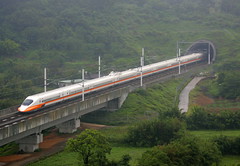
Taiwan High Speed RailImage by jiadoldol via Flickr


Volume 7, Number 12


A weekly digest of events, opinions, and forecasts from


United Rail Passenger Alliance, Inc.

America’s foremost passenger rail policy institute


1526 University Boulevard, West, PMB 203 • Jacksonville, Florida 32217-2006 USA

Telephone 904-636-7739, Electronic Mail info@unitedrail.org • http://www.unitedrail.org


--------------------------------------------------------------------------------

This week we look first at Amtrak’s slow pace, then at continued nationwide wrong-think surrounding Amtrak’s new venture into high speed rail; and we wrap up with a guest commentary by our Andrew C. Selden.

“In the unlikely event of a cabin depressurization, oxygen masks will appear overhead. Reach up and pull the mask closest to you, fully extending the plastic tubing, fasten the straps, and begin breathing normally… If you are seated next to a small child or someone needing assistance, secure your own mask first, then assist the child.”

— Airplane safety announcement

Consider a dramatization of the above starring Amtrak’s Joseph Boardman as the passenger, and network expansion as the child. Faced with the upcoming depressurization of its system through aging equipment, Amtrak is now in the process of securing its own mask with an equipment order. This is no little feat, but Congress still holds the strings. The mask isn’t even on yet, and as the air drains away, what are the prospects for the little form in the next seat?

Readers of This Week have had plenty to say about Amtrak’s progress, or lack thereof. Charles McMillan wrote:

I just finished reading your March 31st issue and I have just visited the two universities in Montana, Meeting with Faculty/Students/Staff and interested local citizens who want to see the restoration of the North Coast Hiawatha reinstated. In fact the consensus is to pretty much take the bull by the horns and get America back to the forefront of technology and world leadership in all areas of Science and Business. They are very adamant about this!

Their desire for Amtrak to get off of this NEC mentality and get a nation wide rail passenger system in place is unparalleled. They are disgusted with Joe Boardman and the attitude of the present board of directors in this regard, because they see no real growth on the part of Amtrak in the form of expanding routes around the country. They keep asking “how much growth in ridership can Amtrak realize just by operating their present routes without adding more trains,coaches or service”? “Can’t they (Amtrak) see that expansion is the key to real growth.” These are some of the thoughts of the general public and our Univesity system students.

We are continuing to garner support for this N.C.H. train all across the northwest including Minnesota.

Jerry Sullivan echoes a sentiment of frustration at,

Amtrak’s absolute refusal to restore the Sunset, or even a connecting train, to Florida. The only train I rode regularly was the Sunset prior to August 2005, and I have not been on a train since, except for excursions. Amtrak has become irrelevant; although I despise flying, Southwest Airlines is now my forced choice until Amtrak gets off their backside on the Sunset issue.

Until last year’s flawed Gulf Coast report is revisited and corrected, and until enough new — not just replacement — equipment is available, probably nothing will happen. Amtrak may be the only company whose product is desperately wanted by everyone but refuses to offer more of it.

As to markets and expansion, Christopher Parker noted, in reference to the speed comparison table:

[At that time,] top speeds were held by limiteds that were mostly overnight sleepers, a market [ceded] to the airlines… You should be comparing today’s trains to the stopping [all-stop local] trains of old. The other factor is we live in a more open and safety conscious world – routine disregard of speed limits is impossible now, as are top speeds over 79mph without automatic train-stop.

I wonder if railroads had the regulative freedom to run very fast if the fate of the passenger train would have turned out differently. Speed makes a huge difference in staying competitive. With some exceptions (IC), today’s top speeds aren’t much different.

True, after a number of accidents fifty years ago, legislation was passed that did limit train speeds. Modern safety devices warrant revisiting those speeds, as does the pending implementation of Positive Train Control, along with satellite, GPS, wireless technology, and computer control. There must be an equilibrium point of higher speeds versus construction and maintenance costs. How to implement a mixing of relatively high speed passenger trains in an era of double-stack containers and long unit coal trains is no easy task, but a worthwhile one. Mr. Parker suggests, that with good track and “cheap technology to detect open switches, dark territory should be good for 70-79 mph.”

And while railroads no longer have the monopoly on business travel, but European experience suggests there is plenty of market here for a slogan like “we are your rolling hotel.” A businessman at a conference in Phoenix could have a late dinner, board the midnight sleeper, and be in downtown Los Angeles by morning in plenty of time for a 9am meeting. Mr. Parker responds, “Let’s start by getting sleepers back on the [Washington-Boston] Night Owl or whatever they call it now.” Could not be repeated across the country?

Amtrak’s newest focus is on high speed rail. As yet they have little involvement in most of the pending projects, so let us see the fine mess they are getting into.

Over the last few weeks we have compared Wisconsin’s pragmatic expansion approach to Florida’s Bullet Train That Doesn’t Connect (Daniel Carleton, 23 March 2010). We will look at Colorado’s venture into high speed rail in a moment, but first consider the California high speed project, which started some years ago along the lines of the Florida fiasco. Each refinement, we are pleased to report, generally tended toward a more logical approach. Maglev was eliminated in favor of compatible steel-wheel technology, permitting shared rights-of-way and stations. Nevertheless, room for improvement still exists in the “Plays well with others” department:

In a letter dated 23 March 2010, the Orange County Transportation Authority (OCTA) and the Los Angeles County Metropolitan Transportation Authority (Metro) ask the California High Speed Rail Authority (CAHSRA) to please revisit and consider “a rational shared use option in the Anaheim to Los Angeles segment of the CAHSRA project… In November of 2009, the Federal Railroad Administration (FRA) issued its first High Speed Passenger Rail Safety Strategy which provides a strategy for the development of shared use corridors. We believe this safety strategy has direct applicability to” the L.A.-Anaheim corridor and they point out that “reports prepared by the CAHSRA staff and consultants did not contemplate any discussion of the rationalization of passenger services in the Anaheim to Los Angeles segment… [part of] the second busiest passenger rail corridor in the nation… we would like to make these services more coordinated and integrated.”

One could well read this as a formal, polite way of saying, “You’re doing it wrong,” and one does wish that high speed trains, where they are built in this country, integrate with local trains and transit as well as they do in Germany, for example. In Germany they have even figured out how to run a streetcar into a regular train station, where you might see one on the platform alongside an ICE high-speed train. If the Germans can master the engineering and those safety features to give easy cross-platform transfers, why can’t we?

Meanwhile at the northern end of that California corridor, the San Francisco Chronicle reported on April 3rd that Caltrain, facing “plummeting sales tax revenues and shrinking ridership” could be forced “to eliminate its midday, night and weekend service, and return to its roots as a commuter-only railroad.” Yet an article there the previous day noted of the new High Speed project, “New numbers put the price of the Anaheim-to-San Francisco segment alone at $42.6 billion.”

Why are we spending millions on high-speed rail studies to the detriment of existing services? Why are we further planning new trains that will hurt, instead of complement, the few successful ones we have spent decades building? Cannot even railroad people work together or has too many years of fighting the highway lobby fractured the passenger train industry?

Colorado is poised to make the same mistake. Railway Track and Structures on March 30th reported,

A study of possible high-speed, intercity rail for Colorado has found that lines between Fort Collins and Pueblo and between Denver International Airport and Eagle County have the best “operating and cost-benefit results” of the options evaluated… The full system carries a $21.1-billion price tag, but Harry Dale, chairman of the Rocky Mountain Rail Authority, which produced the study, said the rail system would probably be built in phases…

The feasibility study… took 18 months to complete and cost $1.4 million… “It might be 10 to 20 years before we actually build anything,” [Dale] said…

The study identifies a $3.32-billion rail segment from DIA to downtown Denver and then south to Colorado Springs as a likely first phase [,which Dale said] would not compete directly with [the] Regional Transportation District’s planned East Corridor commuter train that will link the airport and Denver’s Union Station.

“This [HSR] is not meant to be fare-subsidized,” Dale said of the proposed high-speed rail system. “Average speeds must be superior to travel by car, or nobody will ride. There have got to be time savings to make it worthwhile.”

Does it not matter that almost every new well-planned light-rail and regional-rail system in the West has met, exceeded, or far exceeded ridership expectations? Why spend money planning a second “high speed” system paralleling a regional train we haven’t even built yet? Why do we keep having to fight the superfast fallacy? Frequency, dependability, and the matrix of connections are what attract people to trains — not high speeds. Dr. Adrian Herzog’s Matrix Theory, despite being proven repeatedly, continues to be ignored.

— William Lindley, Scottsdale, Ariz.

p.s., Mr. Selden’s guest commentary follows.

Why Joseph Boardman Can’t Succeed
By Andrew Selden

Joe Boardman is a fine fellow, and an experienced rail administrator, but his tenure is doomed to be another failure as CEO of Amtrak, for the simple reason that his strategy for the company is to pour ever more capital and effort into the exact same business strategies and plans that have failed the company consistently for four decades. This is evidenced by Amtrak’s latest strategic “plan” released late this winter.

“Amtrak Planning” has come to be as much of an oxymoron as “Amtrak Accounting.” Key elements of the latest plan:

Upgrade interiors and add WiFi on Acela trains, with leather seats, new tray tables and improved at-seat power outlets.
NEC infrastructure enhancements such as a new Niantic River drawbridge in Connecticut, new power supply equipment for New York – Washington, new switches at Chicago Union Station, new car shops at Los Angeles, station renovation at Wilmington, Delaware, fire safety improvements in the Hudson River tunnels, car renovation at Beech Grove, NEC track and wire maintenance, etc.
Study its “poorest performing long-distance routes” to identify possible changes. These routes include the Sunset Limited, Eagle, Cardinal, Capitol Limited and California Zephyr. (No mention of chronically underperforming short routes.)
Expand state-funded short corridors.
Install PTC on Amtrak-owned track.
Increase security.
Replace large parts of the company’s locomotive and car fleet.
Now, this all sounds wonderful, and many observers leapt on the last item as proof that “Amtrak was home free and the Age of Aquarius was upon us.” No one paused to ask, “With the U.S. trillions of dollars in debt and piling on new debt just as fast as we can sell bonds to the Chinese, how is Amtrak going to pay for all this?”

Even worse, no one seemed to notice that Amtrak’s plans were nothing more than a reshuffle of the same tired 40-year-old business plan that has put Amtrak into a financial black hole. (Amtrak’s net loss worsened again last year, proving once again that the billions “invested” so far into the NEC, Acela, and all the other infrastructure projects has produced a negative rate of return on investment.) No one asked: “Based on 40 years of consistent failure and steadily worsening financial results, why should we continue pouring billions of new dollars of federal support down the same old black hole?”

This ultimately is why Mr. Boardman cannot succeed: recycling failed business strategies is not “planning.” Doubling the bet on a losing position is a poor strategy.

When Amtrak released its wish list of new engines and rolling stock in March, it took independent analysis by URPA professionals to point out that the “new fleet” strategy reflected a net shrinkage of lift capacity in the national system.

But, there may be a growing awareness inside Amtrak that they are missing out in their long distance markets. At an Amtrak conference in Chicago in March, some interesting ideas were surfaced. A URPA attendee reported:

“Amtrak made official their intent to restructure the Sunset and Texas Eagle routes by operating a daily Los Angeles-San Antonio-Chicago train with a connecting San Antonio-New Orleans train. Amtrak has divided their 15 long-distance trains into three groups of five. The five worst performers – including the Sunset and Eagle – will be addressed this year, the middle five in 2011, and the five best – such as the Empire Builder and Southwest Chief – will be tweaked beginning in 2010. The undesirability of tri-weekly service on any route was noted.

“Amtrak seems to be grasping – and willing to emphasize publicly – the importance of their long distance trains. One of the slides in a presentation : ‘Long Distance Trains are Fundamental to Amtrak’s Mission and Future.’ The slide’s charts showed that long distance trains provided 15 percent of Amtrak’s riders, but 24 percent of revenue, and 39 percent of Amtrak’s train miles but 46 percent of passenger miles.”

As promising as this is, it still fails to reflect any understanding of how explosive growth could be if Amtrak were to address two simple questions:

What would long distance ridership, passenger miles and revenue be if Amtrak actually added capacity to existing trains, especially in peak periods? Long distance capacity and available seat miles have been flat, if not down, for two decades. Since these trains run nearly full much of the year, no growth is even possible without added capacity.
What would long distance ridership, passenger miles and revenue be if Amtrak better interconnected its routes, so that its trains could serve hundreds of new origin-destination city pairs? Examples: extend a Missouri state corridor train to Omaha, to connect St. Louis, Kansas City and intermediate points to the Central Transcontinental Corridor – Denver, Salt Lake City, Reno, Sacramento and the San Francisco Bay area; or, drop a coach and sleeper from the Chief, at Barstow, to run over Tehachapi Pass to Bakersfield, connecting to a San Joaquin, linking the entire Southwest Transcontinental Corridor to the Central Valley and the San Francisco Bay area.
Even if one assumes that these new services perform no better than the known performance of the existing trains, these small increases in operations, by opening up many hundreds of new long distance city pairs, will triple output, and revenue. Now there is a capacity issue, and a growth strategy, all in one.


--------------------------------------------------------------------------------
If you are reading someone else’s copy of This Week at Amtrak, you can receive your own free copy each edition by sending your e-mail address to


freetwa@unitedrail.org


You MUST include your name, preferred e-mail address, and city and state where you live. If you have filters or firewalls placed on your Internet connection, set your e-mail to receive incoming mail from twa@unitedrail.org; we are unable to go through any approvals processes for individuals. This mailing list is kept strictly confidential and is not shared or used for any purposes other than distribution of This Week at Amtrak or related URPA materials.


All other correspondence, including requests to unsubscribe should be addressed to


wlindley@unitedrail.org


Copies of This Week at Amtrak are archived on URPA’s web site, www.unitedrail.org


URPA leadership members are available for speaking engagements.


Reblog this post [with Zemanta]

Thursday, January 07, 2010

This Week In Amtrak

Sunset Limited in Houston.Image via Wikipedia


This Week at Amtrak; December 10, 2009


A weekly digest of events, opinions, and forecasts from


United Rail Passenger Alliance, Inc.

America’s foremost passenger rail policy institute


1526 University Boulevard, West, PMB 203 • Jacksonville, Florida 32217-2006 USA

Telephone 904-636-7739, Electronic Mail info@unitedrail.org • http://www.unitedrail.org


Volume 6, Number 50


Founded over three decades ago in 1976, URPA is a nationally known policy institute which focuses on solutions and plans for passenger rail systems in North America. Headquartered in Jacksonville, Florida, URPA has professional associates in Minnesota, California, Arizona, New Mexico, the District of Columbia, Texas, New York, and other cities. For more detailed information, along with a variety of position papers and other documents, visit the URPA web site at http://www.unitedrail.org.


URPA is not a membership organization, and does not accept funding from any outside sources.


1) Just when we thought things were slowing down for the Christmas season ... word has come the Amtrak Board of Directors has authorized taking the current tri-weekly Sunset Limited and turning it into a daily operation.


The new version of the Sunset Limited – and, most likely, the Sunset Limited name will regrettably be retired, in a death before its time – will make the daily Texas Eagle a daily train all the way from its present daily endpoint in San Antonio, Texas to Los Angeles. For the first time in decades, the fabled Sunset Route of the former Southern Pacific Railroad and now Union Pacific Railroad will have daily service. The Texas Eagle will now be a Chicago-Los Angeles daily train. There is hopeful speculation the less than spectacular Texas Eagle name will be retired, too, and perhaps replaced with something more appropriate such as restoring the former Southern Pacific/Rock Island famed name, the Golden State. Other names, such as the lackluster California Eagle, have also been suggested.


Cities and towns with current tri-weekly service now having daily service from a full service train include


Del Rio, Texas

Sanderson, Texas

Alpine, Texas

El Paso, Texas

Deming, New Mexico

Lordsburg, New Mexico

Benson, Arizona

Tucson, Arizona

Maricopa, Arizona (Phoenix)

Yuma, Arizona

Palm Springs, California

Ontario, California

Pomona, California

and, into Los Angeles Union Station.


For the segment of the current Sunset Limited route between San Antonio and New Orleans, a new daily stub train will be established, with coach and a first class coach service, along with a food service car. The schedules of this yet-to-be-named train will coordinate with the new version of the Sunset at San Antonio.


When this plan first surfaced earlier this year at the Railroad Passenger Association of California meeting in Los Angeles, many had hoped through car service from Los Angeles to at least New Orleans would remain. Alas, in this version, that is not to be; passengers traveling from points west of San Antonio will have to change trains for cities, towns, and hamlets east of San Antonio.


Many are hoping that will change; there are other points in the Amtrak system where that type of operation takes place, notably on the Lake Shore Limited and Empire Builder.


As an interesting note, Alpine, Texas, most known for its wide open spaces and almost total lack of denizens, will now have daily train service with sleeping cars, and a full service diner, but Houston, Texas, one of the largest cities in America, will have daily service with only coaches, a first class coach service, and some sort of diner/lounge food service. Somewhere, somebody at Amtrak thinks that’s a peachy idea.


Stations east of San Antonio which will now have daily coach service on the new stub train include


Houston, Texas

Beaumont, Texas

Lake Charles, Louisiana

Lafayette, Louisiana

New Iberia, Louisiana

Schriever, Louisiana

and, New Orleans Union Passenger Terminal.


There is no information as to when this service will commence, and on what schedules the two trains will operate.


2) What of service on the Sunset Limited route east of New Orleans?

Don’t hold your breath. Amtrak’s Gulf Coast report which it published late this summer made pretty plain hash of what the company wants before it will consider restoring this much-missed and much-needed service.


We will give the Amtrak Board of Directors some credit for embracing Brian Rosenwald’s plans for the Sunset Limited west of New Orleans, but the board will receive a collective lump of coal in its Christmas stocking for doing nothing to restore the immorally-stopped service east of New Orleans.


If you are reading someone else’s copy of This Week at Amtrak, you can receive your own free copy each edition by sending your e-mail address to


freetwa@unitedrail.org


You MUST include your name, preferred e-mail address, and city and state where you live. If you have filters or firewalls placed on your Internet connection, set your e-mail to receive incoming mail from twa@unitedrail.org; we are unable to go through any approvals processes for individuals. This mailing list is kept strictly confidential and is not shared or used for any purposes other than distribution of This Week at Amtrak or related URPA materials.


All other correspondence, including requests to unsubscribe should be addressed to


brucerichardson@unitedrail.org


Copies of This Week at Amtrak are archived on URPA’s web site, www.unitedrail.org and also on www.todaywithjb.blogspot.com where other rail-related writings of Bruce Richardson may also be found.


URPA leadership members are available for speaking engagements.


J. Bruce Richardson

President

United Rail Passenger Alliance, Inc.

1526 University Boulevard, West, PMB 203

Jacksonville, Florida 32217-2006 USA

Telephone 904-636-7739

brucerichardson@unitedrail.org

http://www.unitedrail.org


Reblog this post [with Zemanta]

Wednesday, September 30, 2009

This Week in Amtrak

CHICAGO - MARCH 13:  Amtrak cars sit in a rail...Image by Getty Images via Daylife

This Week at Amtrak; September 22, 2009


A weekly digest of events, opinions, and forecasts from


United Rail Passenger Alliance, Inc.

America’s foremost passenger rail policy institute


1526 University Boulevard, West, PMB 203 • Jacksonville, Florida 32217-2006 USA

Telephone 904-636-7739, Electronic Mail info@unitedrail.org • http://www.unitedrail.org


Volume 6, Number 40


Founded over three decades ago in 1976, URPA is a nationally known policy institute which focuses on solutions and plans for passenger rail systems in North America. Headquartered in Jacksonville, Florida, URPA has professional associates in Minnesota, California, Arizona, New Mexico, the District of Columbia, Texas, New York, and other cities. For more detailed information, along with a variety of position papers and other documents, visit the URPA web site at http://www.unitedrail.org.


URPA is not a membership organization, and does not accept funding from any outside sources.


1) Now, there is no doubt. Amtrak doesn’t want to be in the passenger railroad business. Last week Amtrak released a requested study on Ohio’s “3 C” corridor, which runs from Cleveland to Cincinnati via Columbus and Dayton. And, Amtrak released a preliminary draft for discussion for the much-awaited Pioneer route restoration between (Chicago), Denver, and the Pacific Northwest. The part of the route from Chicago to Denver would travel over the existing California Zephyr route, but from Denver westward it would be a restored route.


We will examine each proposal, with the Ohio examination coming in the next issue of This Week at Amtrak, but it’s clear Amtrak is pricing the costs of these routes so high it’s trying to discourage backers and political entities along the route it really doesn’t want to create or restore either of these routes, much in the vein it did with the previous Gulf Coast report earlier this summer.


Yes, of course, any good businessman makes a presentation which is conservative on sales projections, and high on costs. That way, when things work out like they are supposed to beyond the projections, there are no nasty little surprises. But, Amtrak has gone to such extremes in both of these instances, one can only begin to guess at the metrics Amtrak used to create these studies. Good business sense certainly never came into play when putting these studies together.


One consistent component of these two studies and the previous Gulf Coast study is Amtrak expects individual states to pony up money for these trains, and doesn’t seem to assume any responsibility for being a national passenger train operator, which transcends state boundaries.


2) To read the Pioneer preliminary report asking for comment before final submission to Congress on October 15th is to truly understand corporate shallowness.


For years, Amtrak has gotten away with running the Empire Builder with a Portland, Oregon section separate from the Seattle section by splitting and joining the train in Spokane, Washington. Just as Amtrak does also with the Boston section of the Lake Shore Limited separate from the New York City section, nearly a complete train is operated, minus a dining car. Both of these operations miss a huge revenue producing opportunity for a full, second frequency to operate over the majority of the route.


Time and again, we know a second frequency on any route not only boosts ridership, revenues, and revenue passenger miles significantly, but it also spreads the infrastructure costs such as stations over two trains instead of one.


The Silver Meteor and Silver Star on the Right Coast travel nearly identical routes between New York City and Miami, with the Star diverting from the Meteor’s route to traverse the old Seaboard Air Line Railroad route via Raleigh, North Carolina and Columbia, South Carolina, and also call at Tampa, Florida. Less than four hours is added to the running time of the Star versus the Meteor, and the payback for that is reflected in two million additional revenue passenger miles generated for the Star over the Meteor’s performance.


The Silver Meteor generated in Fiscal Year 2008 $30,538,800 in revenue, 194,454,000 revenue passenger miles, and carried 319,800 souls an average length of trip of 608 miles. The Silver Star generated $28,111,900 in revenue, 196,924,000 revenue passenger miles, and carried 367,100 passengers an average length of trip of 536 miles.


The Empire Builder generated $59,389,600 in revenue, 409,480,000 revenue passenger miles, and carried 554,300 passengers an average length of trip of 739 miles. The Lake Shore Limited generated $24,212,000 in revenue, 152,329,000 revenue passenger miles, and carried 345,600 passengers an average length of trip of 441 miles.


You can easily see the strength of both the Silver Meteor and Silver Star, and it’s also easy to imagine if the Portland section of the Empire Builder became the Western Star as its own, second frequency all the way to Chicago how much fiscal strength and transportation output it would generate, as would a second frequency of the Lake Shore Limited into Boston serving the same purpose.


So, Amtrak’s plan for the possibility of a restored Pioneer to is add three cars to the California Zephyr between Chicago and Denver, consisting of a coach, coach/baggage, and sleeper. In Denver, a dedicated diner/lounge and separate locomotive would be added to the minuscule consist and form the Pioneer to the Pacific Northwest, terminating in either Portland or Seattle (Seattle being the better option of the two.).


Amtrak projected ridership and revenue for the Pioneer is too small, too. As said above, while being conservative in projections is the best method, Amtrak projections tend more to fatalism than objectivity.


Amtrak has produced four options for restored Pioneer service, Option 1 being a Salt Lake City-Seattle choice, with 102,000 passengers and $11.6 million in revenue projected.


Option 2 is a Denver-Seattle choice, with 111,000 passengers and $13.1 million in revenue projected.


Option 3 is a Salt Lake City-Portland choice, with 82,000 passengers and $7.6 million in revenue, and Option 4 is a Denver-Portland option with 95,000 passengers and $9.2 million in revenue projected.


Option 2 is consistently the best choice, even though through Amtrak’s projections it also has the greatest cost. Option 2 restores service over Union Pacific’s fabled Overland Route through Wyoming, which would bring service to another state currently without passenger rail benefits.


Much of Amtrak’s projections are based on ridership and revenues from the former Pioneer, which ceased operations in 1997. In FY 1992, Pioneer ridership peaked at 156,000 passengers a year. Amtrak states in its preliminary report it expects lower ridership because of stiffer airline competition in the region. Amtrak likes to sell itself short with silly statements like this; it never seems to understand the uniqueness of its own product and the desirability of its product among all classes of travelers.


Amtrak is projecting per mile passenger revenue of 12.2 cents, which would place it only above the Sunset Limited, with revenue of 12.1 cents per passenger mile. It’s a mystery why Amtrak would use this number, since the California Zephyr generates 14.5 cents per passenger mile, the Southwest Chief 13.3 cents per passenger mile, and the Empire Builder 14.5 cents. Why there is any presumption of such a low passenger mile figure can only be explained that Amtrak doesn’t want this train to come back.


The 111,000 figure for ridership is easily low by 25,000 passengers, but, if a second frequency all the way from Chicago to Denver and then a single frequency to Seattle was used because it is a better choice, then a ridership figure of 250,000 to 300,000 is more likely. Yes, this would require more equipment, but, that’s the cost of having the burden of meeting consumer demand.


When you couple realistic passenger mile revenue of 14.5 cents per passenger mile as is found on the California Zephyr with the ridership of a second frequency, suddenly the Pioneer is not only a good idea, but a great idea. Perhaps Amtrak doesn’t want to do this because it is afraid of a new service being successful? After all, it’s very difficult for Amtrak today to hide the outright success of its long distance trains, so adding another train would just add to Amtrak’s problems of explaining why long distance trains always work better than state supported corridor trains with greater transportation output and greater efficiencies in every area.


Training and personnel preparation is another area where Amtrak’s proposal seems to be from outer space. Amtrak wants to budget $6.6 million for crew training for Option 2. Why? Perhaps, Amtrak is considering taking kindergarten students and paying for their entire education (including advanced university graduate studies degrees) and, a lifetime later, making them train and engine crew members. The Pioneer is proposed to operate over a route that is already a freight railroad route; there is no blazing of trails going on here. Between Portland and Seattle, the route is an existing Amtrak route, so it’s just a matter of adding more crew to the crew base, not creating an whole new cadre of employees. As far as the portion of the route between Denver and Portland, it is not rocket science to recruit and train railroad employees. Amtrak has obviously based its numbers of taking raw employees off the street and turning them into railroaders, and then doubling that cost for a final project figure. In the real world, that is not only unrealistic, but just silly.


On the subject of equipment, Amtrak says it doesn’t have enough equipment on the wreck line it could fix, or other cars in storage to get this service moving. It wants (like in the Gulf Coast report) up to four years to develop and build new equipment, at a cost of $123 million for an expected need (for the too short consist) of 27 cars and locomotives, total. That breaks down to over $4,500,000 for each piece of equipment. Perhaps they are projecting all of this equipment will be made of gold and platinum? This figure is way too high, plus, a few pieces of equipment could come from Amtrak’s wreck line at a much lower price for rehabilitation instead of new build. Amtrak says it needs to buy four new locomotives in this equipment group, but it has seven wrecked P42s in its inactive fleet, plus 30 stored P40s, and nine stored F40s. There are other bits and pieces of Superliner equipment Amtrak has that could easily supplement this equipment request without having to buy everything new.


The report goes on and on in this vain vein. Probably, the numbers Union Pacific Railroad have submitted for track upgrades are a good starting point for a wish list, and it would help all parties concerned for some infrastructure improvement on the line.


As far as station costs are concerned, Amtrak worries greatly about taking some existing buildings and having to upgrade them for Americans With Disabilities Act compliance. While this has great merit, it always seems to be Amtrak’s default position on any new project; it doesn’t have the money to spend for ADA compliance. After over a decade without service, many of the route stations have either been removed or converted to other purposes. There will be a great need for new station facilities. However, this is a reasonable expense for cities and towns that wish to have passenger rail service to share the expenses. If they want passenger rail service, provide the portal for that, just like for airlines.


Amtrak says it will need $469,800,000 to restart Pioneer service, with Denver as the jumping off point. The majority of that is $324,100,000 for track and signals, including the coming need for Positive Train Control.


An educated guess says this cost is $150,000,000 too high, including unrealistic training, equipment, and new station costs. By the time a realistic number is agreed upon between Amtrak and the Union Pacific Railroad, that $469 million should be closer to $320,000,000.


Ridership, revenue, and revenue passenger mile projections are tremendously under-represented, and operating expenses are tremendously over-represented. When the true figures meet in the middle, farebox recovery should be in the 50% or higher range (As opposed to Amtrak’s guess of 28%).


So, at this point, if you’re an elected official of any of the states hoping for a restored Pioneer, what do you do? Amtrak wants $469 million in start-up costs, and then it expects ongoing subsidies to run a train that is positioned in the most expensive way it can be to drain government treasuries.


Here’s an idea. Let Amtrak submit its grossly flawed report, with all of the figures as gospel. Then, spend some more money and some more time (After all, Amtrak wants four years or more to restore this service, so to them time is not a factor.), and find a credible passenger rail consulting firm to create a real route analysis, using real world numbers, and then take that report and beat Amtrak over the head with it until it comes to its senses and becomes realistic on what it will take to restore the Pioneer as part of its long distance system.


3) Here is the most compelling part of the Amtrak Pioneer report.


[Begin quote]


These projections reflect the fact that all or virtually all of the equipment required for Pioneer restoration would have to be purchased new. Despite growing ridership, Amtrak’s long distance equipment fleet is smaller now than it was when the Pioneer operated. Due to funding constraints, Amtrak has not ordered any new long distance equipment since the early 1990s, and most of the “Heritage” cars built for other railroads that Amtrak acquired at its formation have been retired due to age. Amtrak’s existing fleet of bi-level Superliner cars is insufficient to meet equipment requirements on the nine long distance trains that currently use Superliner equipment, and Amtrak has only a small number of repairable “wreck status” Superliner cars. In addition, if Amtrak is to continue to provide existing services on long distance routes, it must in the very near future replace nearly 100 remaining “Heritage” cars that are now more than half a century old.


Amtrak has recently issued a request for proposals for the acquisition of 130 single-level long distance cars, primarily to replace the remaining Heritage cars (although funding for this purchase has not yet been identified). Purchasing additional single-level cars to equip a restored Pioneer would not be an optimal solution. Single level cars would accommodate fewer passengers, and operation of single-level Pioneer cars to/from Chicago on the bi-level California Zephyr would trigger a need for additional Superliner “transition” cars (which are in particularly short supply) equipped with a high-level door one end and a single-level door on the other.

A purchase of new bi-level equipment for the Pioneer, which would take approximately four years for design, procurement and construction, would have to be part of a larger equipment order. The high upfront design and tooling costs associated with building passenger rail cars make it uneconomic to construct them in small quantities. Amtrak is preparing a comprehensive equipment fleet strategy that will, among other things, address the existing shortage of bi-level Superliner cars that limits capacity on Western long distance trains. An order for new bi-level equipment, which would be subject to funding availability, could provide the means to acquire additional equipment for new services such as a restored Pioneer.


[End quote]


What is Amtrak saying, here? Has Amtrak actually said – in writing, in an official document, no less – it has demand for long distance trains that is not being met? (Gasp!) Could this be true? Amtrak has unmet demand on trains which are not corridor trains? Could this be a whole line of revenue Amtrak is ignoring? What about taking more cars out of the wreck line and storage yard and putting them into service? Would that imperil Amtrak’s ongoing business plan which is to mainly request government subsidies instead of generating revenue inhouse?


And, take a look at the line, “Amtrak is preparing a comprehensive equipment fleet strategy that will, among other things, address the existing shortage of bi-level Superliner cars that limits capacity on Western long distance trains. An order for new bi-level equipment, which would be subject to funding availability, could provide the means to acquire additional equipment for new services as a restored Pioneer.”


(Gasp! again) NEW SERVICES? Our Amtrak? Is someone actually preparing a vision for the future for Amtrak? Inquiring minds want to know.


3) While you’re trying to wrap your mind around that concept just above, here’s an editorial which is appearing in the October 2009 issue of RAILPACE Newsmagazine, which is appearing on news stands today. This commentary is by Tom Nemeth, Editor-in-Chief of RAILPACE, and is used with his permission.


[Begin quote]


EDITORIAL


By Tom Nemeth


Amtrak: Getting the Lead Out


Now that Amtrak has adequate funding for operations and growth, while enjoying unprecedented public and political support, it is time for a management makeover. Amtrak service today, with a few exceptions on some western long-hauls and the Acelas, is beginning to look like the final days of Penn Central. While top management obsesses about photographers, on-time performance continues to lag, trains are dirty, shopworn, and overcrowded. What is the meaning of a “reserved train” when passengers are required to stand between Wilmington and Washington, as a friend did on Train 94 on a recent Friday. This editor endured a Business Class coach from Trenton to Newport News on Train 99 on March 28 with reeking toilets. A round trip on the Texas Eagle on June 15 and June 23 last year, in addition to being 8 hours late each way, revealed shopworn Superliners badly in need of a facelift. Another colleague, writing Amtrak in protest of a rather rude trainman, was advised that Amtrak management is not responsible for the behavior of its crews. Granted that working a crowded train is not easy, but there must be recognition that the company (and Federal funding) exists for the benefit of Amtrak’s customers, the riding public. In short, it appears that top management just doesn’t care.


There are other Amtrak customers too. The commuter railroads whose spine is the Northeast Corridor, are not treated any better by Amtrak’s insular management.The faulty design of the ARC rail tunnel now being built under the Hudson River, which will not connect to Penn Station in Manhattan, is partly the fault of Amtrak, which did not want a seat at the table when the project was in initial design, a fatal flaw that will haunt regional rail advocates for generations. Amtrak management just didn’t care about “NJ Transit’s tunnel.” New York’s MTA continues to struggle with Amtrak’s inability to execute its responsibility for the Long Island Rail Road East Side Access project. This represents a lack of accountability by Amtrak management, who are in a unique position to influence the outcome of these multi-billion dollar investments. Amtrak’s own engineering department continues to lack competent leadership, allowing substandard quality concrete ties onto the Northeast Corridor (now being replaced at great expense), and serious structural cracks in a bridge in Elizabeth, NJ, to go unnoticed by inadequately trained maintenance workers.


But where IS management? Corporate culture on Norfolk Southern and other successful railroads dictates that Division Superintendents and Engineering Department officers are not to be found sitting in their offices; rather they get out and ride the trains regularly and observe the property firsthand. On Amtrak, they sequester themselves behind desks and await their long-sought retirement day.


Then there’s the issue of Amtrak operations. Shrinking consists in an era of growing ridership hardly makes sense. Amtrak’s “One Size Fits All” policy for its long-distance trainsets is also bizarre. One would expect that Western train consists would swell in the summer months, while Florida bound consists would lengthen significantly in the winter season.


Amtrak’s culture is one of meetings and seminars, and hiring consultants to produce “studies” for a laissez-faire management that doesn’t want to work to resolve the issues themselves.


Meanwhile, Amtrak’s lethargic bureaucracy continues to balloon. The agency continues to be a dumping ground for failed bureaucrats and retirees from other government agencies eagerly awaiting retirement. In fact, many already seem to be there.


This is not a Democratic or Republican partisan issue, rather, it concerns the willingness of elected officials to finally purge Amtrak’s management ranks of Bush-era minions and install new, energetic top leaders who are committed to growth and expansion; whose actions speak louder than words (and their consultants’ reports.)

Nearly a year after the U.S. election, Amtrak still does not have a corporate Strategic Plan for growth. As of this writing, management still does not have a Fleet Plan in place, nor new equipment on order. Management has become so moribund that Joe Szabo, the recently-appointed Administrator of the Federal Railroad Administration, recently had to direct Amtrak Acting President Joe Boardman to come up with a Fleet Plan. Hello.


Amtrak’s Bush-era management team has become more insular and combative, and dismissive of its long term supporters and customers; witness Amtrak’s illegal Photography Ban, perhaps the Boardman Administration’s only “accomplishment” this year. Boardman, a career bureaucrat, disdains individual discussions with media editors and freelance photojournalists concerning Amtrak’s strategic plans and initiatives, and has refused to acknowledge communications from citizens and customers regarding Amtrak’s Photo Ban.


Change must start from the top, and there are a number of great rail executives who stand ready to lead Amtrak out of its chaos this fall, when Acting President Joseph Boardman’s term is finished. These luminaries include Gene Skoropowski, managing director for California’s Capitol Corridor Joint Powers Authority, the agency responsible for intercity passenger rail service linking Sacramento with the Bay Area. Skoropowski has spearheaded growth and development of intercity and corridor passenger rail in California, including implementation of CalTrain’s “Baby Bullet” trains. Peter Cannito, former Executive Vice President of Engineering at Amtrak, and retired president of Metro North Railroad, brings a wealth of engineering expertise. Dennis F. Sullivan, former Amtrak Executive Vice President, is a seasoned Operations railroader who will bring customer focus to Amtrak. These three individuals form the backbone of a team that will inspire performance among Amtrak employees and get the company moving forward.


While politics is a necessary aspect of Amtrak’s presidency, it cannot be the only aspect. It is essential now to rebuild Amtrak’s management team, to run the company as a railroad and as a business, to achieve a vibrant and growing national system.


The U.S. had an extensive passenger rail system until the 1960s, when financial losses caused for-profit railroads to jettison their passenger services. Now that Federal and State governments have begun to accept responsibility for funding a national passenger rail system, there is growing support for breaking the 38-year old Amtrak monopoly on intercity passenger service, and allowing freight railroads and/or private operators to take over Amtrak routes, or even launch new services. This may be the Amtrak Board’s last chance to install competent, growth– and customer– oriented management, or the current groundswell of public and political support for passenger rail— and Amtrak’s monopoly of it— may soon come to an end.


[End quote]


Okay, Amtrak, more and more people in the non-Amworld are wondering what you’re up to; the “business as usual” status quo is no longer acceptable. Do something. The days of laying around and whining about the world being so terribly unfair are over. You’re expected to perform, just like everyone else.


If you are reading someone else’s copy of This Week at Amtrak, you can receive your own free copy each edition by sending your e-mail address to


freetwa@unitedrail.org


You MUST include your name, preferred e-mail address, and city and state where you live. If you have filters or firewalls placed on your Internet connection, set your e-mail to receive incoming mail from twa@unitedrail.org; we are unable to go through any approvals processes for individuals. This mailing list is kept strictly confidential and is not shared or used for any purposes other than distribution of This Week at Amtrak or related URPA materials.


All other correspondence, including requests to unsubscribe should be addressed to


brucerichardson@unitedrail.org


Copies of This Week at Amtrak are archived on URPA’s web site, www.unitedrail.org and also on www.todaywithjb.blogspot.com where other rail-related writings of Bruce Richardson may also be found.


URPA leadership members are available for speaking engagements.


J. Bruce Richardson

President

United Rail Passenger Alliance, Inc.

1526 University Boulevard, West, PMB 203

Jacksonville, Florida 32217-2006 USA

Telephone 904-636-7739

brucerichardson@unitedrail.org

http://www.unitedrail.org

Reblog this post [with Zemanta]

Tuesday, September 29, 2009

This Week In Amtrak

Empire BuilderImage via Wikipedia

This Week at Amtrak; September 4, 2009


A weekly digest of events, opinions, and forecasts from


United Rail Passenger Alliance, Inc.

America’s foremost passenger rail policy institute


1526 University Boulevard, West, PMB 203 • Jacksonville, Florida 32217-2006 USA

Telephone 904-636-7739, Electronic Mail info@unitedrail.org • http://www.unitedrail.org


Volume 6, Number 35


Founded over three decades ago in 1976, URPA is a nationally known policy institute which focuses on solutions and plans for passenger rail systems in North America. Headquartered in Jacksonville, Florida, URPA has professional associates in Minnesota, California, Arizona, New Mexico, the District of Columbia, Texas, New York, and other cities. For more detailed information, along with a variety of position papers and other documents, visit the URPA web site at http://www.unitedrail.org.


URPA is not a membership organization, and does not accept funding from any outside sources.


1) An interesting collection of mail came flying over the This Week at Amtrak transom this week. Plus (see item number five, below) an answer from Congresswoman Corrine Brown on the future of passenger rail east of New Orleans and into Florida.


First, a regular rider of the Empire Builder from cold country.


[Begin quote]


Allow me to share my observations about Amtrak's "state of good repair" on it's most important train (at least outside the vaunted Northeast Corridor), the Empire Builder. I refer to this train often as Amtrak's "most important" or "most successful" train simply because it earns more revenue, by a wide margin, than any other single train they operate.


I have had the opportunity to travel on the Empire Builder several times this summer for short trips (about 300 miles one way, 600 round trip each time), on personal business. I have done these in coach on a daytime leg of the itinerary, between Milwaukee and St. Paul, but have made the point of walking the train each time to look at the interior and gauge the patronage, and I have also used the lounge and diner each time.


You may recall several years ago, when Amtrak went through its most recent spasm of trying to starve itself into prosperity by cutting way back on the quality of on board food service on its overnight trains, it also conducted an experiment by actually upgrading the Empire Builder to see if an elevated level of service and quality would support a higher fare level than on the run-of-the-mill long distance train.


As part of the experiment, the Empire Builder is supposed to be (but, this year rarely is) equipped with all Superliner II rolling stock and the better engines, to assure a top quality customer experience. The idea, I suppose, was to use all recently-refurbished rolling stock to minimize the frequency of equipment malfunctions like air conditioning failures, ratty carpets, inoperative toilets and doors, etc. They also staffed the Builder exclusively from the Seattle crew base, using mostly re-trained, top-quality on board service staff.


The dining car kept the previous Amtrak-standard meal service, with Amtrak china and stainless flatware, and more-or-less cooked on board meals. The train already had some of the best time-keeping in the country, due to attentive dispatching by BNSF Railroad on the Builder's "home rails" on the ex-Great Northern Railroad "High Line" across northern Montana and North Dakota. (On other trips, I have seen BNSF put their top-priority freight "Z-trains" on a siding to let the Builder run through.) And, they added a summer-only "upstairs guy" to work the upper level snack kiosk in the lounge car (in addition to the full snack bar downstairs), between Chicago and Whitefish. The Empire Builder does not offer a separate first class lounge environment like the "Pacific Parlour Car" on the Starlight, or the "Park" cars on VIA's Canadian, and other overnight trains.


What I have seen this summer, however, in terms of the rolling stock is a sadly degraded environment. The fares are as high as ever (sleeper fares especially are breathtaking on this train), but, the cars are not clean, even on No. 7 westbound leaving Chicago; some are smelly; restrooms are not in good shape physically or mechanically (i.e., they work, but it seems there is always some issue with them – water splashing around from the faucets, toilets don't flush, door locks are jammed, etc.); surfaces are badly worn out in places, leaving a third-world impression of tattered and worn, ill-kept, trains. Signage is worn out or missing, or crudely hand-written and taped up. Things are literally falling apart inside the cars.


The lounge cars are not well-kept, with many seats patched, and floors worn out. And again, this is supposed to be Amtrak's best effort (in the west).


I have NEVER seen any main-line train in this kind of physical condition in Europe (except in the United Kingdom).


The dining car, on each trip on No. 7, has sold out at dinner and turned away customers, despite serving from 5 P.M. through to well after 9 P.M. Sporadically, for a variety of reasons, the diner has resorted to plastic plates and utensils ("the dishwasher is broken" or "we weren't stocked properly at Chicago").


There have been discussions inside and outside the company this summer about promoting this and the other long distance trains with a renewed advertising effort. But, I have to say I am skeptical, based on my trips this summer. I fear almost any ad campaign is likely to create a consumer expectation which will be inevitably disappointed by the actual travel experience, even if employees are well behaved, and the train is on time.


A majority of the other customers with whom I have interacted are still first-timers or foreigners, so even in 2009 many "first impressions" are being formed with every trip. Since mid-June, each Empire Builder I have ridden has had more than 300 passengers on board between St. Paul, Minnesota and La Crosse, Wisconsin, or vice versa. Conductors frequently make public address system announcements to the effect the Builder is or will shortly be completely full, and people cannot use two seats for one person.


The sleepers appear to be heavily – if not fully – booked. They are operating a single coach as an extra car between Chicago and St. Paul, and it appears to sell out each trip (it runs in the computer as "Train 807/808"). Amtrak turns over anywhere between 90 and 125 passengers at St. Paul on each train. One cannot help but wonder how many other would-be customers have been turned away this summer for lack of carrying capacity. That adds up to a lot of people who, if not exactly "never-agains," are at least left with negative impressions, and far from a "come back soon" experience.


It is hard to experience an on-board environment like this, where there is both physical/mechanical decay and a slow erosion of service quality, in a train carrying so much promise and potential. It's almost heartbreaking at times. And, at times one gets angry, wondering what this train could be if management had chosen to invest a trivial fraction of the $1.3 billion dollars in subsidy they get each year from congress into keeping these cars in an actual state of good repair, and supporting the on-board service people, to create a truly premium travel experience.


Northwest Airlines airplanes aren't rolling junk, even though parts break periodically, and I'll bet money no brand-name cruise ship is even remotely like these aging Superliners. It just doesn't have to be this way on a premier passenger train. Amtrak already has that much money available. They just haven't chosen to spend it here. It has gone to other uses, because first former President and CEO Alex Kummant and now Interim President and CEO Joseph Boardman have chosen to use it elsewhere instead of here. And that is disappointing, and a lost opportunity.


Cordially,

A perpetual optimist


[End quote]


This is yet another example of a promise Amtrak management made to its employees it has made a conscious decision not to keep. When the crew base for the Empire Builder was moved from Chicago to Seattle, there was a promise made to employees who chose to work this train, telling them they would have first-rate equipment to work with and provide their passengers good service. Oops! It didn’t take very long for Amtrak to slip back into its wicked ways, and start putting junk equipment back on the Empire Builder.


The country this train traverses is breathtaking. The route of the Empire Builder rivals that of its VIA Rail Canada cousin to the North, The Canadian. between Vancouver and Toronto. Tourists from all over the world are willing to pay big bucks to ride the Canadian and experience a level of passenger service often unknown on Amtrak.


But, here’s the kicker. Most of the equipment on The Canadian is half a century old, or older. The Canadian runs Budd built equipment originally designed and ordered for Canadian Pacific Railway when The Canadian was the flagship of a combined travel system that stretched nearly around the world and included passenger trains, ocean-going cruise liners, and an airline.


VIA Rail Canada has lately let some of that equipment slide into a less than perfect state of repair, but it is still much better maintained than newer equipment on Amtrak which is half of its age, or even younger. The VIA equipment underwent a major renovation, but that was about 20 years ago.


With all of the cash Amtrak’s long distance trains throw off to the company, why is there constantly a choice made to squeeze these trains until it hurts, even though they are the geese laying the golden eggs?


2) This came from another part of the country.


[Begin quote]


Dear Mr. Richardson,


I have really enjoyed your TWA articles and the website for the last nine years since they provide an alternative to the doom and gloom that I've read from most railfans. Your group's solutions to this country's passenger rail system are very unique.


I have some thoughts in regards to a recent column. I would actually go a bit further than the reader in the August 19th issue and turn O'Hare into a second main Chicago station based on former Amtrak Reform Council member James Coston’s comments in the April 5, 2007 edition, where he talked about Union Station being “beyond obsolete” due to “crowd control and user friendliness problems.” Why not have a stop at one of the world's busiest airports? It would provide air travelers and locals another option. I will also suggest Union Station be skipped by some O'Hare trains and be served by a select few trains primarily for transfer purposes to/from other trains.


Even though I don't live in the Windy City, it's a good thing they have four major train stations left over from the Golden Age of Rail. I believe once we know the operators of certain Midwest High Speed Rail routes (and it's very likely that Amtrak will be outbid on some of these contracts), some of the other companies may want to leave Union Station to less crowded areas.


Here are how the other three main stations in addition to Union Station could play a role in a post-monopolistic intercity rail industry:


A) The Oglivie Transportation Center (former CN&W station) could provide service for Hiawatha service to the Twin Cities and Green Bay, Wisconsin. Also, another operator could choose to serve alternate stops between Chicago and Milwaukee, like Kenosha and Racine.


B) Millennium Station. The Randolph Street station could host Illini and Saluki routes, the super HSR St. Louis service (if it can get pulled off), and maybe, Cleveland service; and


C) The La Salle Street Station could host Quad Cities/Iowa/Omaha service and/or Cleveland service.


To alleviate the problem of changing trains and operators, HSR authorities like MWHSR should work out a special transfer program for passengers if they have to transfer from one station to another operator at a different station in the same city. That would guarantee passengers a connection (e.g., A passenger on the westbound Capitol Limited needing to take a high-speed train to Madison would get his or her transfer at Union Station and take a cab to the Ogilvie Transportation Center to continue on to Madison).


[End quote]


Impressive thoughts, aren’t they? Passenger rail historians will recall it was common in the pre-Amtrak days to shuttle both passengers and passenger rail cars between stations in Chicago for through-train service.


It’s not hard for many people to peer into the future and see a fascinating world of passenger rail. Amtrak seems to be the only group of people constantly incapable of doing this.


3) And, finally, these thoughts came from Georgia.


[Begin quote]


Thank you again for this [last] weekend's editions of TWA. As always, they continue to be enlightening. Here are some random thoughts from my Monday Morning brain.


I do not wish to disparage Dr. Herzog's academic mind and practical experience. In reading his proposal, has Host Railroad cooperation been taken into consideration? I feel like three routes daily on all those lines listed would work great on a privately owned, passenger-only right of way, but in the real world of constant delays (some Amtrak's fault, others the Hosts' fault) and even one-per-day run trains regularly (quarterly, perhaps?) encroaching on the train ahead of it, and then turn-arounds and bustitution to get people where they need to go, to multiply that liability as well by three, would seem to clog up the freight network in a manner that the Hosts would not care to take such risk on.


My random thought on HSR is that it should overlay current Amtrak routes and be completely separate (preferably not even run by Amtrak). If you take Dr. Herzog's plan and you overlay an HSR system on top of it, you would have major cities connected with few, if any, stops in between.


Stations would be co-located with current Amtrak stations, but all new. It would have to be all new because HSR should never be envisioned without being at least Class 8 service with a dedicated ROW and no grade crossings.


Boston would be connected to Miami with stops in Providence, Hartford, New York Penn, Trenton, Philadelphia, Wilmington, Baltimore, Washington, Richmond, Raleigh, Columbia, Savannah, Jacksonville, Orlando, and West Palm. You could break it up with Washington being the focal terminus. The existing Amtrak system would then be Dr. Herzog's "milk run" stations, taking people from the co-located Amtrak/HSR stations and moving them to their local destination.


My thoughts aren't completely random, as this is very similar to the way HSR was introduced in Japan nearly 50 years ago. “Shinkansen” means “New Trunk Line,” and that's what they did – all new ROW with major stations co-located with local service to intermediate locations (that were not necessarily along the same ROW).


Additionally, there is a desperate need for SE to NW corridors. But I think you know that already.


[End quote]


Dr. Herzog was a primary supporter of changing the way Amtrak deals with its host railroads. Like many others of us at United Rail Passenger Alliance, Dr. Herzog felt Amtrak underpays its host railroads for use of tracks and dispatching, and Dr. Herzog felt a new bond should be forged where everyone played equally, without winners or losers when it came to private, freight railroads hosting Amtrak passenger trains.


For so many years, we have all been indoctrinated with the thought Amtrak can’t run trains because host railroad main lines are clogged with freight trains.


While there is some validity to this, that concept has often been a convenient excuse for host railroads to subvert the law which they agreed to at the formation of Amtrak which allows Amtrak access to any two chosen steaks of rust in the country, pending a deal where maintenance costs are worked out if upgraded rails are necessary to host passenger trains safely and comfortably.


For Amtrak to grow and prosper, the word “no” needs to be filtered out of its corporate vocabulary.


If a passenger route can support more than one daily frequency (which is the case on EVERY passenger route Amtrak runs.), then what adjustments need to be made between Amtrak and its host railroad to make this happen? More sidings? Some other type of realignments? Never has the time been more providential than now to determine what needs to be done to host more passenger trains and at the same time have the freight railroads not suffer any inconvenience for the sake of Amtrak passengers.


The freight railroads, through the Association of American Railroads, have indicated a willingness to sit down and discuss more passenger trains. Government has indicated a willingness to come up with funding mechanisms to make this happen.


Now is the time to focus on the future and why things can be accomplished, not why not things can’t be accomplished.


4) Had a conversation with the map maker referred to in the last edition of TWA about the continuing work of creating a map of the late Dr. Adrian Herzog’s vision for a full and robust Amtrak system.


The map maker is still hard at work.


5) To date, we have heard no official word from Congresswoman Corrine Brown of here in Jacksonville in regard to Amtrak’s Gulf Coast Service report she inserted a million bucks into Amtrak appropriation last year to pay for.


However, her primary aide which handles transportation issues, Nick Martinelli was quoted this week by reporter Leo King on www.examiner.com.


[Begin quote from Mr. King’s article of Thursday, September 3, 2009]


Returning to Amtrak and trains along the Gulf Coast, he said, “Any rational person would say, ‘We need to address some of the issues with the costs on the long lines, – the Sunset Limited, when we get that back – and, of course, running the whole way to L.A. Those prices are really expensive and there are flights that are cheaper, but you have to think of the system holistically, and I think that’s the way the Congresswoman and a lot of people do.”


The Sunset may not return, but there is movement to bring passenger rail service from New Orleans to Jacksonville and on to Orlando.


“No question. The Congresswoman would kill them if they didn’t. That’s ideal. It is expensive and the problem that we’re facing now is that states have to be partners in this system to maintain the things and do that instead of ‘Look, we’ve got no money. The federal government wants us, they need to do it.’


Martinelli said “They presented a couple of options. Amtrak isn’t even love with running that Sunset Limited line because it’s expensive for them, so they weren’t going to kill themselves to rebuild the line, but CSX was up in a year, had the system up and going. That’s something we’re going to have to pressure Amtrak [on].”


[End quote]

Well. Many of us were waiting for a comment from Congresswoman Brown on what she got for her (our) money with the Amtrak report.


Now, we know. Her office wants to pressure Amtrak on restoring service, BUT, Mr. Martinelli said “now that state have to be partners [financially].”


So, does this mean no train unless Mississippi, Alabama, and Florida pony up the money?


And, of course, we know this brings us to the precipice of the very, very slippery slope that if Amtrak can put on a mask and use a gun to hold up the three states east of New Orleans, then a precedent is set and it can try this type of robbery ANYWHERE ELSE in the country (Except, probably, the sainted Northeast Corridor, where no states EVER have to pay for anything.).


Somebody needs to stop this madness, right now.


If you are reading someone else’s copy of This Week at Amtrak, you can receive your own free copy each edition by sending your e-mail address to


freetwa@unitedrail.org


You MUST include your name, preferred e-mail address, and city and state where you live. If you have filters or firewalls placed on your Internet connection, set your e-mail to receive incoming mail from twa@unitedrail.org; we are unable to go through any approvals processes for individuals. This mailing list is kept strictly confidential and is not shared or used for any purposes other than distribution of This Week at Amtrak or related URPA materials.


All other correspondence, including requests to unsubscribe should be addressed to


brucerichardson@unitedrail.org


Copies of This Week at Amtrak are archived on URPA’s web site, www.unitedrail.org and also on www.todaywithjb.blogspot.com where other rail-related writings of Bruce Richardson may also be found.


URPA leadership members are available for speaking engagements.


J. Bruce Richardson

President

United Rail Passenger Alliance, Inc.

1526 University Boulevard, West, PMB 203

Jacksonville, Florida 32217-2006 USA

Telephone 904-636-7739

brucerichardson@unitedrail.org

http://www.unitedrail.org

Reblog this post [with Zemanta]