Wednesday, March 23, 2011

This Week in Amtrak

1DSC_7506-Taiwan High Speed Rail, Railroad 高速鐵...Image by 棟樑‧Harry‧黃基峰‧Taiwan via Flickr

This Week at Amtrak Vol. 8 No. 5
From the Editors…

This week a post-mortem of Florida’s latest foray into High-Speed Rail.

There was no Plan B

Oh I used to be disgusted… and now I try to be amused. - Elvis Costello

On February 16, Florida's Governor Rick Scott announced that the State of Florida would not move forward with the Federal plans to build a high-speed railway between Tampa and Orlando International Airport. Similar announcements had already been made in Wisconsin and Ohio earlier this year. So what is the big deal?

Well, if one were to believe the political rhetoric that has been fired across the bow since then, one might come to the conclusion the governor has cancelled every holiday on the calendar and shot everyone’s favorite pet. The U.S. Transportation Secretary, Ray LaHood, extended the deadline for accepting the Federal monies, $2.4 billion, so as to give the state just one more last chance. On March 1, two State senators filed suit in the Florida Supreme Court, as citizens, not on behalf of the Senate, to order the governor to take the money. Right about now, Governor Scott is probably wondering if he should have stayed in his native American Midwest. Nevertheless the answer is still “no.” So what is the big deal?

The U.S. Department of Transportation was willing to let go of projects in Ohio and Wisconsin that were not really high-speed rail, but rather state-of-the-art conventional trains running at conventional speeds on improved conventional track. The HSR label was only added to offer the illusion of progress to sell this imperious immediacy of interest. However, as they were not true HSR they were expendable. The sum total of rejected Federal monies was less than half of the ultimate total offered to Florida, and was quickly dispersed to other states. Florida, it would seem, is an entirely different story.

“You recall unpleasant memories: of hours wasted in slow moving traffic; of disquieted children in the backseat of your car; of rushing to the airport to discover your flight canceled; of missing important business appointments; and of the hassles involved in moving around this great state. Those difficult days, though, remind you how fortunate you are to live in a state where logic prevailed in the mid 1990s. Relaxing into your plush, expansive seat, you sigh contentedly when an attendant brings your drink. Just before you doze off, lulled into a peace-filled rest by the train’s near-silent motion, you briefly wonder, ‘Who made all this possible?’” - Opening statement from the Florida Overland eXpress Executive Summary, 1996.

Fifteen years ago, the vision was crystal clear; a fast train connecting three of Florida’s largest metro areas in comfort and style. The planning was solid but the money was scarce, and the whole thing seemed to come to naught in 1999. Then in 2000, an amendment to the State Constitution was approved by Florida voters, and in 2001 the State Legislature enacted the Florida High Speed Rail Authority Act; however, in 2004 Florida voters repealed the 2000 amendment, citing the expense of such a project.

To say there are a tenacious few who continue to keep the flame alive for fast trains in the Sunshine State would be an understatement. Five years after the voting public made their opinion clear, a Federal initiative sought to overrule local sentiments. With a seemingly ever- larger flow of Federal monies, a scheme was hatched to invest $2.4 billion in just the 84-mile Tampa-Orlando leg of the system under the auspices of building a national network of fast trains. There was no referendum, there was no ballot initiative; just an imperious immediacy of interest from Washington, D.C. With the nation in general and the State of Florida in particular suffering the ravages of hard economic times, any infusion of cash -- from any source -- seemed like a godsend. And with other trains on the national drawing board, Florida did not feel alone. But once again there was one rather large string attached: The potential large outlay of local funds. For this reason, the governor cancelled the project. Once again money was a big deal.

High-speed trains are not evil. However, nowhere on earth do they operate in a vacuum. In France, the national railway operates everything from urban transportation to high-speed trains. While they operate around 14,000 trains every day, only a relative handful are high speed. For a high-speed train to be successful it needs feeders to connect to places where the riding public actually wants to go. As of right, now these types of networks do not exist in Central Florida.

In what may appear as a case of bitter grapes, a ridership report was released just after the project was cancelled. Picked up by various news outlets was the figure of “3.3 million annual riders” and “would have made money from Day One.” This report was produced, for $1.3 million, by the firms of Steer Davies Gleave and Wilbur Smith Associates. In March 2010 Wilbur Smith Associates along with HNTB, in a joint partnership, were selected as program manager for passenger rail in the State of Florida. Moreover, the much-touted report was nothing more than five pages of numbers, with no justification for how those figures were compiled. The reader may read into this with impunity.

The initial route of 84 miles was chosen in large part due to the relative low cost of building, possibly $3 billion if one includes moderate overruns; however, connecting Central Florida with Central Florida now seems like an oxymoron. This fact was not lost on a recent article by Michael Cooper in the New York Times, “Tampa and Orlando are only 84 miles apart, generally considered too close for high-speed rail to make sense. The train trip, with many stops along the way, would have shaved only around a half-hour off the drive. Since there are no commercial flights between the two cities, the new line would not have lured away fliers or freed up landing slots at the busy airports.”

Ultimately the fast train in Central Florida would have been of little to no practical use for the everyday traveler. It would have missed all of the town centers on its route, thus would not have been a catalyst for urban development or renewal. A state-of-the-art conventional train on improved extant tracks would pass through the historic town centers, would be a catalyst for development, and should cost less than a third of the now-defunct fast train. But without the “HSR” label, it is not sexy enough for consideration by those who worry about their legacy.

In retrospect, perhaps the Orlando to Miami leg of the plan should have been considered first. At 240 miles, just over two and a half times the length of Tampa-Orlando, it certainly would have cost over two and a half times as much; however, connecting Central Florida with South Florida does make sense both politically as well as financially, and it certainly would be much less expensive than the postulated $42 billion price tag for the full build-out proposed in California.

With Florida now officially out of the high-speed rail business, attention turns to California and the building of America’s first true high-speed train between the metropolises of Fresno and Bakersfield. Instead of Central Florida it will be left to the Central Valley to iron out specifications, codes, analyses, and operating procedures for all American fast trains to follow. This is probably not what the administration envisioned as the next great leap in transportation for the country.

Ultimately the administration placed all its bets on Central Florida in the belief that everyone was on the same page; that everyone believed in the concept of high-speed rail. In doing so, they never contemplated what to do if everyone was not on the same page. In short, they had no plan B. If connecting Central Florida with Central Florida seemed obtuse, then what would connecting the 35th- and 58th- largest cities in the nation seem like?

For now, those passionate purveyors of fast trains in Florida must once again close their plan books and return them to their shelves. Again, they will have to wait for the day when someone whisking along at over 150 mph will ask, “Who made all this possible?” Perhaps someday, but not today.


Enhanced by Zemanta

Friday, March 18, 2011

Pedestrian Dead Zones

A TRAX train passing the Frank E. Moss Federal...Image via Wikipedia

Just because you build nice wide sidewalks and create a barrier between cars and pedestrians (such as trees) does not mean you will create an environment that conducive to pedestrian activity. To create pedestrian activity you need to have someplace to walk to but also reduce the number of barriers that exist to actually using those sidewalks to get somewhere.

Despite its very long blocks, there is some good pedestrian activity in downtown Salt Lake City from North Temple to about 350 South. If you travel any farther south than that you will see a remarkable decrease in the number of pedestrians. There is several causes of this drop off in pedestrian activity and I will cover some of the major ones in this posting.

Since Main Street is home to the TRAX light rail line I will start off at the corner of 400 South and Main. On the northwest corner of the intersection with have a court house. Court houses tend not to foster pedestrian activity because they are a single point destination, in other words people may go to the court house but that is the only reason they head there.

They are currently expanding the court house to take up most of the block from Main Street to West Temple. This will create a large barrier to pedestrian activity in the area. With court houses becoming even more fortified these days this makes court houses even more unfriendly toward pedestrian activity these days.

Here is a picture of the current court house looking north:


Here is a picture looking south diagonally from corner of 400 South and Main toward the corner of 500 South and West Temple.


Does this look like a thriving pedestrian and transit friendly downtown area or does it look like a parking lot of a suburban office park? This block of parking is made worse because of Salt Lake City's extremely long blocks. To the left of the picture is the Court House TRAX station and on the next block at State Street is another court house.

There is apparently a long story involving this parking lot barrier that covers the block between 400 South, 500 South, Main and West Temple. Despite all the opportunities that exist for development of this block with a TRAX station at the front door this lot will most likely stay as it is for the foreseeable future.

Once you walk pass the parking lot you face a new barrier for pedestrians-the 500 South and 600 South speedways to Interstate 15:


However, it is not three and four lanes of speeding cars that create a barrier to creating an effective pedestrian environment, it is the development that has occurred along the two streets. Because 500 South and 600 South are the two primary access streets to Interstate 15, the area along the two streets have become lodging row.

You would think that lodging facilities would want to foster pedestrian activity in the area but instead most lodging facilities are designed on two principles:

1. Everyone will arrive by car so there is no need to create effective pedestrian access points.
2. Especially if the lodging facility has on sight restaurants, the goal is to ensure the people staying at the facility only use their restaurants or have to get in their car and try to find parking if they want to eat somewhere else.

If you look at the picture above, you will notice that there is no pedestrian access point from the building in the picture to street level. This building is the Little America Hotel that covers all of the block with its sister property the Grand America Hotel taking up half of the block on the far side of Main Street (there is some irony that the Grand America was home to Railvolution back in 2005).

The next two pictures show the main entrance of both hotels on Main Street. While there is some pedestrian access to both hotels it is design more to foster getting guests between the two facilities than actually create any pedestrian activity on Main Street.


To be fair, the Little America does have a pedestrian entrance to its restaurant on Main Street about halfway between its main entrance and 500 South but it appears that there is few people that use it since pedestrian traffic on this section of main street is non-existent.

South of 600 South you have there is some areas of abandoned or barely used businesses and past 700 South you encounter several car dealerships including the Mark Miller Toyota Sprawl lot that completely kills most pedestrian activity in this neighborhood.

Heading back north we move one block west to West Temple and you have the only access point to the Little America from West Temple and as you can see from the picture it is not exactly pedestrian friendly:


To be fair to the Little America/Grand America hotels, they are not the only culprits as the Embassy Suites at 600 South and West Temple shows with its very small sidewalk providing the only pedestrian access to the hotel:


In fact I all of the hotels except for Motel 6, had very poor to no pedestrian access points to the hotel. This next photo is back at 500 South looking south toward 600 South with the Little America on the left. As you can see the east side of West Temple has the right elements for pedestrians, there is just too many barriers to using it.


Finally you look back toward downtown, so close yet so far away.


You can build sidewalks and put trees in to create an environment that should foster more pedestrian activity, but if development or the lack of it and street design creates barriers to pedestrians all sidewalks in the world will not encourage people to use them.


Enhanced by Zemanta

Tuesday, March 08, 2011

Do we need TOD Certification that goes beyond LEED Certification

Some people appear to be under the mistaking impression that just because a building is LEED certified, the building is not only energy efficient but also transit friendly. To dispel that theory, take a look at a recently LEED certified building in Salt Lake City: Mark Miller Toyota.


Mark Miller Toyota sits on the corner of 700 South and West Temple just south of the downtown area. While the downtown area can be fairly walkable despite the extremely long blocks, this part of downtown sees very little pedestrian activity. In a future posting I will discuss how dead zones of pedestrian activity can be created using this area as an example but lets get back to the topic at hand.

This dealership is right on the main North-South TRAX line but the only stops are a couple of blocks away. There is several dealerships in the neighborhood that make this area very pedestrian unfriendly. In fact, Mark Miller takes up three quarters of a city block and we are not talking Portland, Oregon blocks here, no we are talking Salt Lake City blocks.


Ironically if you walk to the right of this photo to the next block you will find some live/work units.


While the Mark Miller building itself may be LEED certified, overall it is nothing but a sprawl lot that creates a barrier between the hotel/motel area of downtown and neighborhoods to the South. The area to the south has suffered from a lack of a cohesive connection to the downtown area and these dealerships do not help.

While LEED gives us a good start, we need something that goes beyond LEED and truly shows us if a building supports a pedestrian, bicycle and transit environment.


Monday, February 28, 2011

What to do with Route 176

South Pasadena City HallImage via Wikipedia
In previous entries I did a short history of LA Metro's route 176 and a brief description of route. As promised today I am going to look at the 176 from a marketing prespective, look at some alternatives to make the line more successful and finally look at some alternatives for the western end of the line to keep some bus service in the section of route that has no announced replacements.

First of all, there is two things that is currently hurting route 176.

The first is the current schedule of the 176. Right now the buses run every 70 minutes.You could basically call this a bean counter schedule. The present route requires a 55-minute running time so with layovers you can run the service with only two buses. While a bean counter may like being able to run the route with only two buses, it will not attract any choice riders because of the lack of frequency.

While a 60-minute frequency still would not be enough to attract a large number of choice riders, at least the buses would be running at a schedule to remember. Having the ability to know that a bus should always come at six after the hour makes riding the bus simple compared to the bus comes at different times at every hour of the day.

Another item that hurts the 176 from a marketing perspective is the lack of major destinations along the route. As I mentioned in the route description the route does service a major industrial park but they have their own built in limitations. The bus also serves a major tourist destination in the San Gabriel Mission but very few tourist will venture onto Metro buses, especially in the suburban areas that bus service is extremely sparse.

The route does not service any major shopping centers either. Alhambra has a small 20 year old minor mall, but it has no regional draw. Except for the downtown South Pasadena area, most of the retail along the route is aging grocery store centers and strip malls which are not conducive to riding the bus.

One of the problems faced by many Metro routes is the long held philosophy of Metro's predecessor RTD and Metro itself. Their concept was to run a bus as far as it could in the same corridor creating extremely straight but long routes. The problem with the 176 is that there is not a lot of through streets in the area that do not go into NIMBY land, so the route was always one of compromise.

What the 176 is a community feeder line that the RTD turned into an extremely long route that did not work. Sadly, RTD's successor has also done a poor job of designing routes that are not major corridor routes or designing any routes at all. There has been few changes to the bus routes outside the ones that were forced on Metro by the Bus Riders Union Consent Degree.

What can be done to change the route?

While none of these proposals would be acted on, here are some ideas to create a more successful route 176.

Idea one would actually restore a portion of the route to Glassell Park but avoid the section of Division Street which caused all the NIMBY issues due to worn out 70+ year old concrete with its sub base worn down by erosion.


View Larger Map

Not only would restore service on a portion of Avenue 50 and El Paso that loss service a couple of years ago, but it would also add service along a portion of York Blvd that has never had bus service and add service to the biggest regional mall in the area.

However, the potential customers who would travel to the mall would be residents of South Pasadena who would most likely not be willing to ride a bus through Highland Park. The route would also duplicate part of one of the Glendale Beeline routes and MTA Route 183 which could be seen as a negative.

Idea two is a variation of Idea One.


View Larger Map

Back in the 1980 period, RTD proposed major changes to transit service in order to change routes so that they did not look anything like the streetcar routes that once existed. In the vain attempt to eliminate anything that resembled old streetcar routes, RTD proposed to replace service on then route 6 (now 83) on York Blvd with a reroute of Route 430 (176) along York.

The downside of this is that the frequency of the 83 along York is every 25 minutes so the present frequency of the 176 would not satisfy riders along that portion of York Blvd. However, it would also have the benefit of creating new service on the section of York Blvd north of Eagle Rock Blvd that has never had bus service before.

Here is a third idea that adds service not only to the Glendale Galleria area but also serves the Glendale Metrolink station and provide connections to Bee Line.


View Larger Map

The benefits that all these proposals have in common is to increase the number of major destinations served by the route (although they would still be on the extreme end of the line), add service to areas that do not presently have any, and provide new connection opportunities that do not presently exist with the 176.

The question is would the increased ridership justify the increased cost? The present scheduling of the route would nulify any improvements to the destinations served due to the lack of service frequency.

Since Metro is planning to save the eastern portion of the route, here is an idea to save service on the western portion of the route. Now this would have been easier if Metro still operated route 262, however that route is now Montebello Bus Lines Route 30. The route could be extended from its present terminus at Garfield/Atlantic/Huntington Drive triangle to replace the portion of Route 176 to Highland Park. This would eliminate that evil duplication that occurs in Alhambra and save service through South Pasadena to Highland Park.

The ultimate issue with the route is something that cannot be resolved and that is the economic and social divide that separates South Pasadena from the other communities the 176 travel through. The best solution which is Metro has no concept in operating, will be to work with the city of South Pasadena and set up a Call N ' Ride operation for the city providing every half hour connecting service to the Gold Line. This would provide service to those that need it in the area plus provide convenient connections to other services.

When push comes to shove, there is few people who will probably notice when the 176 disappears from the landscape. After 35 years of being ignored except to cut service to the bones, there is few riders left to really care what happens to the western portion of the route.

Thursday, February 24, 2011

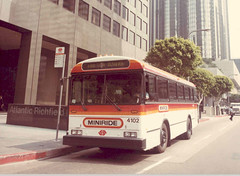
A Trip on Route 176

Miniride #4201 in downtownImage by Metro Transportation Library and Archive via Flickr
Last time I gave a brief history of LA Metro's Route 176. Today I will describe the route and some of the social-economic situations that exist along the line.

Map and schedule of the 176.

As I mentioned yesterday, the 176 currently starts its run near the corner of Figueroa and York in Highland Park. The actual end of the line is behind a aging 70's shopping center. At the corner of the shopping center is a fast food restaurant that used to be very good although I have not been there in several years.

Highland Park used to be a streetcar suburb but these days is sadly better know for the large amount of gang violence that takes place in the area. It is not an area you would want to be walking around after the sun goes down and sometimes even when it is up.

After leaving its layover zone the 176 turns on Avenue 64 before turning left onto York Blvd and crosses the elegant York Avenue Bridge. To the west you can see the very tall former Santa Fe bridge that the Gold Line now travels across. If the payment has worn down enough on the York bridge you can see railroad tracks in embedded in the street (unless they have been removed in the last few years). These are not former Pacific Electric tracks but are the only remains of a profitable former Union Pacific branch line that used to run all the way to Pasadena. However, when Interstate 210 was put in the tracks were forced out.

After you cross the bridge over the Arroyo Seco you have not only gone over a divide in the land, but you have also crossed a major economic divide. You have now entered the city of South Pasadena who has infamously been fighting the construction of a freeway segment for many years. Don't get the idea that there is a up-swelling of anti-car attitude in the city, they want the freeway they just in somewhere else (read between the lines: over toward the Los Angeles border in the less affluent part of town).

The first stop in the city used to generate some peak loads as there was a clothing manufacturer located here but it has been gone for many years and the riders with it. The line then makes brushes the Gold Line before heading north on Pasadena which turns into Mission Street. At the corner of Mission and Meridian is the Gold Line's stop in South Pasadena with the 176 being the only full time bus service the station sees.

The route then travels through the small South Pasadena business district which does not look all that different from the scenes shot here for the 1980's Michael J. Fox film "Teen Wolf". At the corner of Fair Oaks and Mission you have a connection with Metro Route 260 and there is also the Fair Oaks Pharmacy which features a classic soda fountain counter.

Once pass Fair Oaks the route travels through a residential area before turning onto Garfield and traveling along the San Marino/South Pasadena border. The route then crosses Huntington Drive and once again moves out into the city of Alhambra. Until the route turns onto Main Street, the 176 shares the route with Montebello Municipal Bus Route M30. Once the route turns onto Main Street it travels through the heart of the Alhambra Business District. Along Main Street the 176 shares the street with the 79 which means that along two of its primary corridors it shares the streets with other routes and we know how some transit circles see any duplication of service as something to be avoided.

Just after Main Street turns into Las Tunas the 176 turns onto Mission and passes the San Gabriel Mission. Metro plans to continue serving the rest of the 176 route by extending another route to run from El Monte to this intersection since it is the busier section of the line.The route along Mission is mostly residential with some small businesses located along the way. Most of the neighborhoods would rate as lower middle class.

The route continues down Mission, turns onto Rosemead Blvd sharing the street with the 266, then travels through the Telstar Industrial Park before making its way to the El Monte Bus Station. The Industrial Park is another generator of business but like most industrial parks generates those riders at only shift change times.

That gives you a very basic concept of the route. Next time I plan to look at the route from a marketing prospective to see what is the major failings of the route and what can be done to make the route more viable. I will also look at some alternatives to keep service along most of the route.

Enhanced by Zemanta

Wednesday, February 23, 2011

A Look at Los Angeles Metro's 176

Logo of the Los Angeles County Metro Rail and ...Image via Wikipedia
Like most transit systems across the country, Metro in Los Angeles has been facing tough economic times. However, like the rest of its brethren in California, they have also been facing a double whammy of recession and money being taken out of transportation to shore up its crumbling general fund by the former governor. Now Metro is proposing to cut even more service in June including route 176 which travels from Highland Park to the El Monte Station at the eastern end of the El Monte Busway.

The 176 is near and dear to my heart because I spent many years living along the route and riding it. Here is the map and schedule of the current 176.

The route first started as a Pacific Electric bus traveling from Mission and Fair Oaks in South Pasadena to Alhambra connecting several of the PE's major rail lines. The bus line was later extended to replace rail service and for many years was route 79 traveling from Main and Garfield in Alhambra through South Pasadena and Highland Park and ended up at Huntington Drive and Monterey Road.

In April, 1976 the RTD, Metro's predecessor, revamped routes in the San Gabriel valley and surrounding areas, and the little 79 was split up into two other lines. The first line, the 143, took the park of the 79 from Highland Park to Huntington and Monterey Rd. and continued all the way to East LA. The 143 was latter merged with route 425 and later renumbered 256 which continues today although it has also faced being axed at one time or another over the last few years.

The 430 took over the other part of the 79 from Highland Park to Alhambra plus portions of other routes to create the present 176. In early 1977, the route was extended from Highland Park to Glassell Park via Ave 50 replacing a short shuttle route. For 30+ years the 430/176 traveled back and forth between Glassell Park and El Monte with little notice until the portion between York and Figueroa in Highland Park to Glassell Park was cut in order to allow Metro to retire its remaining and aged 35 foot RTS buses.

That brings up to the present time and the very real possibility that this route will probably meet its demise in a few months. I am going to use this route as a case study on what can be done to route that has largely been ignored for 30 years to improve its performance, the socially-economic conditions that apply to the line, and some alternatives to the Metro proposal.

In the next entry I will describe the current route and some of the different neighborhoods the bus travels through and other interesting facts about the route.
Enhanced by Zemanta

Sunday, February 20, 2011

This Week in Amtrak

Penn Station (New York City)Image via Wikipedia
From the Editors…

Beware the ides of… February? This week a brief of some current events.

Just How Much is that Wild Goose?

“A billion here, a billion there, pretty soon it adds up to real money.”- Senator Everett Dirksen

Just how many names can one give to a hole in the ground? What does one name a hole that does not really exist? This particular hole, meant to connect suburban New Jersey with New York City, has had many names and titles. A decade and half ago, it was known as the “Trans-Hudson Express Tunnel” (THE Tunnel) or, deridingly, as the “tunnel to Macy’s basement.” Later known as “Access to the Region's Core,” (ARC) ground was officially broken in June of 2009. On October 27, 2010, New Jersey Governor Chris Christie (New Jersey being the only state officially participating in this project) gave it a new name: Dead. Concerned that the $8.7 billion undertaking would spiral to Big Dig proportions, the governor decided the price was too rich for New Jersey’s blood. There were meetings and more meetings between Trenton and Washington, but despite Federal demand for payback of $271 million, the project was axed once and for all… or so it seemed.

On February 6, 2011, a new player, Amtrak, rode into town along with U.S. Senate representation from New Jersey. Together, they announced a new scheme to build, and a new name: The “Gateway Tunnel.” They intend to spend $50 million for more design and engineering work, with a potential cost of $13.5 billion for completion. (It would appear Governor Christie’s concerns over costs were more than prescient.)

Two days earlier, the City of New York contracted with Parsons Brinckerhoff, Inc. to (quickly) study the feasibility of extending the No. 7 subway line west, under the Hudson River to NJ Transit’s station at Secaucus, New Jersey. Unlike the previous tunnel plans, this would allow riders transferring at Secaucus access to the West Side of Manhattan, Times Square, Grand Central Terminal, and Queens, without traversing an already-full Pennsylvania (Penn) Station.

Unlike the ARC, the Gateway Tunnel (actually two tunnels with one track each), proposed by Amtrak and friends, will not terminate north of Penn Station or Macy’s basement. Rather, it will run directly into Penn Station, adding to its already burgeoning passenger congestion. Currently, Penn Station handles a daily crush of some 600,000 persons. The existing century-old, twin single-track tubes handle a maximum of 23 trains per hour. It is expected the new Gateway Tunnel will allow for an additional 21 trains per hour. No source for this project's funding was cited.

Just two days later, on February 8, Vice President Joe Biden announced a new Administration initiative to spend $53 billion over the next six years on High-Speed Rail projects nationwide. The goal is to allow high-speed train access to 80 percent of the public within 25 years. Again, no source for the requisite funds was cited.

Not everyone is onboard with the immediacy of interest in “High-Speed Rail.” As has been reported in these pages before, many have advanced their political careers on “stop the train” platforms; therefore, it does not portend well that the two U.S. Representatives who declared this initiative “dead on arrival” are the House Transportation Committee Chairman and Railroads Subcommittee Chairman.

John Mica (R-Fla.) was his usual sanguine self in frankly appraising this development: “This is like giving Bernie Madoff another chance at handling your investment portfolio.” Mica is none too happy about the previous $10 billion pledged for HSR, or about the involvement of the Federal Railway Administration (FRA) in the HSR corridor selection process; and is especially displeased with the continued interference of the National Railroad Passenger Corporation. “Amtrak hijacked 76 of the 78 projects, most of them costly, and some already rejected by State agencies,” said Mica. “Amtrak’s Soviet-style train system is not the way to provide modern and efficient passenger rail service.”

Bill Shuster (R-Penn.) also had his take on this latest HSR missive: “The Administration continues to fail in attracting private investment, capital, and the experience to properly develop and cost-effectively operate true high-speed rail.” … “Government won’t develop American high-speed rail. Private investment and a competitive market will.”

To date, $271 million has already been spent. This includes $26.3 million for property acquisition in New Jersey for what was the ARC project; and $50 million has been proposed for more study of “ARC-lite.” Of the $10 billion pledged for “High-Speed Rail,” at least $1 billion has already been spent. To keep this all in perspective, Amtrak currently has on-order 70 new railcars for Eastern trains at approximately $2.3 million per each. The $1.321 billion already spent and proposed could have purchased over 500 of these railcars, expanding Amtrak's existing fleet by one-third. The problem with a wild goose chase is that regardless of the amount of money or resources expended, one still may not wind up with the goose.

An “E-Ticket Ride” to Fantasyland

Lathen, a small city of some 11,000+ souls (in 2009), may not ring a bell in the minds of those from outside the Emsland district in Lower Saxony, Germany. Yet, Lathen boasts what may be considered the world's fastest form of overland transportation. This is where ThyssenKrupp's Transrapid Maglev test track extends over 30 kilometers. If one is interested in buying one’s very own maglev transportation system, then Lathen is the place to visit. The test track was built to devise, test, improve and (most importantly) sell the concept of maglev; nothing more, nothing less. It does not see active scheduled service for the general public to ride.

The team members involved in writing, editing, and publishing this newsletter are all current or former residents of the State of Florida. As such, we have been watching intently the now almost-daily developments, with the latest incarnation of fast trains here being Florida High-Speed Rail. On February 16, newly-elected governor Rick Scott officially turned down $2.4 billion in Federal funds earmarked for the initial east-west, Tampa-Orlando route (roughly 80 miles). His reasoning for doing so included projected cost overruns and questionable ridership/revenue projections. This has become quite the firestorm in Tallahassee, and may rage for some time to come.

Governor Scott was not the only one questioning the validity of this project. At this year’s Southwest Rail Conference, one presenter succinctly pointed out that American HSR supporters were “attempting to have their icing without bothering to bake the cake.” Specifically he added, “Florida needs to mature its HSR plans.” Transporting tourists from theme parks to the beaches on the Gulf of Mexico is not a mature reason for building HSR.

When the go-ahead for High-Speed Rail projects came early last year, it was like popping the cork on a bottle of long-fermenting ideas. For Florida, it was a matter of dusting off the plans for the stillborn Florida Overland eXpress of 1996. When proponents for Florida HSR were questioned about the validity of this endeavor, the answer was curt and simple: The state already owns the right-of-way, and the environmental impact studies are complete. It is true that both of these prerequisites are a major hurdle for any project; still, is it not odd that public benefit was not one of the top two reasons for building?

Would Tampa-Orlando HSR be of anymore use to riders than the test track in Lathen? The simple reality is: No. It was not, nor was it ever meant to be, a serious contender for moving residents about the Sunshine State. As much as Lathen proved the workability of maglev, so too would Florida HSR be merely a vehicle to test and prove the feasibility of High-Speed trains in America. Every nation that has ventured into the HSR arena has had to develop its own system, with its own parameters to suit that nation's specific needs and conditions. The United States will be no different. Those involved with Florida HSR have been in talks with the FRA about requirements for vehicles traveling at hitherto-unseen speeds. As State Senator Paula Dockery said, “This was going to be a model for the nation.”

Numerous potential companies and consortia of companies have been eagerly awaiting the expected payout to develop all the systems for such a project. Now that it appears Florida HSR has been scrubbed, those would-be builders are scrambling. Without Florida, where else will they “beta test” their product? Without Federal money, who will pay to develop new, or adapt existing, technology for use in America?

Had the Tampa-Orlando line been built, the technology would have been built, tested, redesigned, retested, ad nauseam until everything was ready for primetime; after which, maybe the second phase of Florida HSR, a north-south, Orlando-Miami route (roughly 230 miles), would have been built. Tampa-Orlando is, however, a bit of a misnomer. In reality, the Eastern terminus is not the city of Orlando, but rather the airport (which bears its name, but is nowhere near Orlando). The western end is not the beautifully-restored downtown Union Station, but rather a parking lot off the highway. The likelihood of drawing riders was about par with drawing bees with vinegar. No matter how technically successful this may have been, would the public tolerate the spending of billions more of public monies in order to go to Miami?

Universal Truths

Every project has to start somewhere; and someone has to pay for it. Whereas private dollars may combine with public monies and actually build the line on State property between Tampa and Orlando, what about the future? When the champagne stops flowing and the confetti settles, there will still be a train to run. Will those private dollars still be there to fund its operation? When all is said and done, Florida HSR is nothing more than a novelty, a $2+ billion tourist attraction for foreign and domestic visitors to gawk at before moving on to the next attraction. Speaking as a resident this very expensive, publicly-funded tourist trap is the last thing we need here.

Enhanced by Zemanta

Friday, February 18, 2011

New Name and expanded focus...

For those arriving on this page today expecting to see Transit In Utah...surprise this blog has a new name to go along with some change in focus in the next few months and some changes in my personal life.

As I mentioned a few months ago I tried to expand the focus of the blog from covering happenings in Utah but also covering areas of interest across the United States and Canada especially in the cities I have good familiarity with such as Southern California, the San Francisco Bay Area, Utah, Las Vegas, Charlotte, Portland, Spokane and Seattle.

I might move the blog to a different platform once I study more on the different options and I have registered the follow url: http://www.urbanplanningandtransportation.com which is directing to this page at the present time and the forcible future.


The main reasons for these changes is that there is going to be a major change in my personal life over the next 4 months. While I have kept my personal life and this blog separate since its inception, this blog is actually driving some of the changes in that life.

While I do have a degree in Business Management (a two year degree) and tons of experience, the last few years have been difficult. Before I attended Railvolution in October, I was thinking of returning to school but was torn because Utah schools would not accept most of my credits so was looking at moving back to Spokane where my credits were earned. However, our first choice was to move to either Portland or Seattle and after talking to Portland Community College I found out they would take my existing credits which is great since I only need a few classes to get a transferable degree.

From there I plan to apply and attend Portland State University to get degrees in Urban Planning and Economics.

In May I will traveling up to Portland in order to find a place to live. My goal is to find a place with easy transit access to the PCC campuses and PSU. There is some other changes going to take place in March that is going to affect the type of apartment I can find. I hope you enjoy reading of my adventures of trying to find a place to live that meets these requirements.

In my years doing this blog we have seen a lot of changes both good and bad both in Utah and across the nation. I hope to make it back down to Salt Lake in August for the opening of the new TRAX lines since I have been watching progress on the these lines since they were first proposed but am not sure at this time.

To my regular readers, I hope you will continue enjoying this blog, I plan to continue providing observations on urban planning and transportation.
Enhanced by Zemanta

Monday, February 14, 2011

This Week in Amtrak

Shinkansen 700T train head at Kaoshung depot, ...Image via Wikipedia
This week a tale of caution, a tale of woe, a tale of passenger rail investment in our 21st Century.

Beware the Law of Unintended Consequences

Basic physics teaches us that for every action there is a reaction. The sociologists tell us such reactions may bring unintended consequences; unanticipated and potentially undesirable outcomes. It is widely held that such unintended consequences fall into one of three categories: Positive, negative, and perverse (wherein the results of the reaction are opposite to what was intended). Prominent sociologist Robert Merton cited numerous reasons for this lack of foresight, but perhaps the most dangerous in the political arena is the “imperious immediacy of interest” wherein “…paramount concern of the immediate excludes consideration of further or other consequences …”

At this time last year, passenger rail was garnering more than its usual share of the public eye. This was entirely due to the Administration’s said goal of building “High-Speed Rail” projects all around the country, even likening these to the Federal Interstate Highway program of the 1950s. As a result, many states pulled their decades-old dreams for intrastate passenger trains off their respective shelves, shook off the dust, and slapped on “High-Speed Rail” labels. One of these was the state of Ohio which wrote, in part, in its High Speed Intercity Passenger Rail Application of October 2009:

"During the past 35 years, the State of Ohio has continued planning for the reinstitution of passenger train service on its Cleveland-Columbus-Cincinnati corridor and vested several state agencies with that responsibility. In 1973, the Ohio Legislative Service Commission (LSC) moved to ‘study the feasibility’ of establishing a rapid transit system connecting Ohio’s ‘major cities’ in response to the Arab Oil Embargo. In 1977, the Ohio Rail Transportation Authority (ORTA) was created by the Ohio General Assembly to continue feasibility planning. In 1979, the Ohio legislature passed a law urging neighboring states to join them in exploring the potential for the development of a regional rail system within the Great Lakes Region. Following the 1982 defeat of a statewide sales tax initiative to advance high speed rail service, ORTA was abolished and its staff moved to the Ohio Department of Transportation.

“The initiative advanced in 1991 when the Intermodal Surface Transportation Efficiency Act of 1991 (ISTEA) was enacted funding safety improvements at highway-rail grade crossings on corridors that were ‘designated’ as high-speed intercity passenger rail corridors based on their present utility and their potential for future development. It was in 2000 that the FRA designated the 3C Corridor as an extension of the Chicago Hub network and included the primary points or cities along the line: Cleveland, Columbus, Dayton and Cincinnati.

“Subsequent and current initiatives to advance passenger rail service in Ohio have been the responsibility of the ORDC, which was established by the Ohio General Assembly in 1994. In 1996, ORDC joined the Midwest Regional Rail Initiative (MWRRI), which calls for the development of a ‘Chicago Hub’ a system envisioned as a 3,000-mile rail system with eight passenger corridors serving 60 million people in a nine state region. The most current Midwest Regional Rail System (MWRRS) Plan report was issued in October 2004.”

Another of these was the state of Wisconsin. Although its rail aspirations were not as long-lived as Ohio, Wisconsin did bring its checkbook. In July 2009, the state entered an agreement with Talgo America to purchase two train sets for $47 million. As part of that agreement, Talgo would establish an assembly plant within the state’s borders. In doing so it would set the standard for the Midwest. Its High-Speed plan, also of October 2009, was the guideline for reintroducing service of some 85 miles between the state capital of Madison and Milwaukee. Although tagged with the “High-Speed” label the proposed service would never have exceeded 110 mph. The plan read in part:

“WisDOT is the lead state for the [Midwest Regional Rail Initiative] and will manage the efforts of the Steering Committee to identify the preferred train set equipment type. WisDOT also is involved in the nationwide effort to identify and acquire the preferred train set equipment through their involvement in the Next Generation Corridor Equipment Committee (mandated by the Passenger Rail Investment and Improvement Act of 2008, Section 3605).”

Talgo, for its part, kept its end of the bargain. They set up shop in the former Tower Automotive facility in Milwaukee with the promise of jobs in an area perpetually hit by hard times. The train sets to be delivered are of the new Talgo Series VIII, which are to be fully FRA-compliant and needing no waivers. The two sets ordered in 2009 will be placed in service on the existing Chicago - Milwaukee Hiawatha service. (The state of Oregon also ordered two sets, also to be built in Wisconsin.) It was initially hoped that two more train sets would be ordered for the expanded Madison - Milwaukee service. Ultimately, a new maintenance facility would be established in Madison.

At face value, this seemed like a good idea; a state connecting its largest city to its capital. New Mexico accomplished the same in 2008 when it connected Albuquerque with Santa Fe; however, the New Mexico Rail Runner has the look and feel of a commuter train, and has a total length of 97 miles. Recently the Commonwealth of Virginia announced its intention to connect its second largest city, Norfolk, with the state capital of Richmond, a distance of 109 miles. At no time in either case was the moniker “High-Speed” ever used or applied.

As with most parties these days, however, after the champagne stops flowing and the music stops playing, comes the stark dawn of day. The HSR party was no different. This ersatz High-Speed Rail was deemed as grossly indulgent in an era of austerity. New regimes elected to high office in Ohio and Wisconsin view HSR as too rich for their blood. Both new projects have been canceled, and the Federal monies reallocated to other states.

Talgo, for its part, will continue to hold up its end of the bargain; however, instead of filling the 125 positions originally projected, it will fill just 65. The four train sets on order for Wisconsin and Oregon will be completed by 2012. If no new orders are secured by then, the Milwaukee plant will only be used as a maintenance base for Wisconsin’s equipment. [As we go to press it has been reported Talgo shall move its operation to Illinois. Details of this shall be forthcoming.]

It was believed by many that these projects of Ohio and Wisconsin were reasonable -- and realistic -- due to their basic nature. Despite the “High-Speed” label, they were really in fact just a return to the past, with schedules that would not have been out of pace just two or three generations ago. Since these were really conventional trains and not the gold-plated fast trains of another continent, it was hoped those in charge would see past the HSR-“imperious immediacy of interest“; however, this was not to be. Even though all that glitters is not gold if it is perceived by the public to be gold, then it is a target. And whereas the call was for “High-Speed Rail” to be built around the country, it appears its collapse will doom many conventional rail projects as well. Can any other reaction be more “perverse?”


Enhanced by Zemanta

Thursday, February 10, 2011

UTA TRAX S70 cars


On Monday UTA held a press photo event to see the new Siemens Low Floor S70 light rail vehicles now testing on the Sandy line. UTA also announced that the cars should enter regular service in the spring.


Thursday, January 27, 2011

This Week in Amtrak

Amtrak GG1 904 at Harrison, New Jersey, June 1975Image via Wikipedia
From the Editors…
Something is turning 40, and oddly enough someone wants you to know about it. This and other more somber milestones are covered this week.

Of Time and (Wall) Space

If you are not already aware, Amtrak intends to make very sure you will be: On May 1, the National Railroad Passenger Corporation (NRPC) -- yes, that is still Amtrak’s legal name -- will achieve 40 years of existence. According to its internal newsletter, Amtrak Ink, there are numerous outlets planned to observe this latest milestone. There will be a commemorative book for which Amtrak has already canvassed its employees for pictures. There will also be a video by “an Emmy award-winning producer.” Also, “Beech Grove is renovating surplus equipment and restoring one F-40, one P-40, three baggage cars, and an Amfleet food service car for a special 40th anniversary `museum train' that will travel across the country to many employee locations.” Since when has Amtrak had “surplus” equipment?

One thing is for certain, this year’s Amtrak wall calendar makes the pronouncement loud for all to hear: “AMTRAK CELEBRATES 40 YEARS OF SERVICE.” Superimposed over a map of the original route structure are over a dozen snapshots from those early years of “rainbow consists” and '70s fashion sense. The lovely Patty Saunders is captured in her go-go boots and early Amtrak uniform. The first Amtrak-painted locomotive is seen in a one-of-a-kind design of black with a wrap-a-round pointless-arrow logo. (Mercifully, that was not repeated.)

It is a wonder to contemplate the journey of the last four decades; yet, this wall hanging of 24 by 33 inches is quite the reminder of an uncertain era not that long ago. On the original system map, in the lower left corner of the montage, is the directive, “Service from Fort Worth to Houston will be shifted from Temple route to Dallas route as soon as possible after May 1, 1971.” Imagine, direct service between Houston and the Dallas-Ft. Worth metroplex. In the lower right of the map is seen the line and station stop for Wildwood, Florida. Just above that, between snapshots of the original Metroliner and a bedraggled Coast Starlight, is the line depicting the service we once enjoyed between Chicago and Florida. Today both of those are distant memories, as service to the Sunshine State has been continuously marginalized over 40 years. Was it something Florida said?

Perhaps most telling is the stylized logo all the way in the lower corner of the montage. As a depiction of motive power progress, five caricatures are arrayed from left to right, displayed in five different paint schemes. On the left is an Amtrak-painted GG-1 electric, internationally recognized as the finest example of electric traction ever to see service under wire. Designed by the Pennsylvania Railroad in 1934, the GG-1 fleet would serve her masters and successors until the 1980s. On the right of the lineup is depicted an Acela Express train, the antithesis of the GG-1.

On this calendar, Amtrak touts itself as “America’s Railroad,” but wait -- there is a picture used in the ad campaigns from its formative years, showing an employee (not a model) standing between the gauge of the rails, holding a large-scale replica of a passenger rail car. The tag line for the ad was the vow to “make the trains worth traveling again.” In 1971, the year the NRPC (now Amtrak) was created, the trains already were worth traveling. Crowds showed up to ride in the peak of summer, 1971; then again in winter, 1971-72. Amtrak did not have the wherewithal to keep up with such demand. When the railroads, in their original role as sole source contractors, did what they could to keep up, the pushback to stop doing that came from inside -- Amtrak! It was a downhill slide from there. After 40 years of false starts and unfulfilled promises, is it not time to hold Amtrak to its word?

In Memoriam

As we muddle our way through the winter season, we wish to pause for a moment to reflect on the lives of three men who, in their own separate ways, left their mark on American railroading:

Eugene K. Garfield worked for the Johnson Administration in the 1960s as Assistant to the Secretary of Transportation, Alan S. Boyd, in the then newly-minted U.S. Department of Transportation. It was during his tenure that a feasibility study for an auto-ferry service between the Northeast and Florida was conducted, and concluded that the service would be potentially profitable but best left for the private sector. After returning to the private sector in 1968, Garfield set about making that study a reality, and from 1971 to 1981 he ran the private Auto-Train Corporation. The original Auto-Train eventually succumbed to financial troubles and the infrastructure was purchased by Amtrak. Garfield died at the age of 74 on December 26, 2010, in Hollywood, Florida. Reflecting on his life reminds us that the entrepreneurial spirit in transportation in not dead, but merely dormant, in a generation that has been taught otherwise.

James A. (Jim) Boyd was a prolific railroad photographer and writer. Much more that just the average railfan, Boyd worked for the Electro-Motive Division of General Motors as a field service representative. In 1972, Boyd began his long association with Carstens Publications, eventually becoming editor of Railfan (later Railfan & Railroad) magazine from 1974 to 1998. Additionally, he authored many Trains magazine articles as well as dozens of books. Boyd brought a sense of discipline and decorum to the railfan ranks. His guiding influence will be sorely missed. Boyd died at the age of 69 on December 31, 2010, in Newton, New Jersey.

Robert G. (Bob) Lewis was that rare, perfect blend of knowledgeable railfan and professional railroader. Between 1934 and 1941 he worked for the Pennsylvania Railroad, and briefly for the Bessemer & Lake Erie. Following the war and a brief return to railroading, he joined the Simmons-Boardman Publishing Corporation. He worked in various editor positions for Railway Age magazine until 1956, when he was named Magazine Publisher. He retired in 1995, but maintained the title of Director of Special Projects. All through his professional travels, he had his camera with him, and amassed an impressive collection of photographs of America’s railroads.

Bob died at the age of 94 on January 5, 2011, in Ormond-by-the-Sea, Florida, but not before this author had the opportunity to meet him at the High-Speed Ground Transportation Association convention in 1996. Lewis was as congenial and approachable as anyone could be.

Later, as a result of merciless prodding by his former co-workers, a number of his photos were published in book form in Off the Beaten Track -- A railroader’s life in pictures (Simmons-Boardman, 2004). Having obtained a copy, this author made an appointment to stop by and garner an autograph. The welcome was warm and sincere. The meeting was as touching as it was informative. Lewis said the real reason behind starting the publication of International Railway Journal in 1961 was just to have an excuse to travel the world. We discussed the issues of the day including, of course, what to do about Amtrak.

With the completion of these distinguished runs the sun shines less brightly over the railway; reminding us of our own finite existence and the need to make our remaining days count. All too soon, the weeds will overgrow and obscure our tracks.
Enhanced by Zemanta

Thursday, January 20, 2011

A Transit Day for all weather...

Took my first transit trip of the new year yesterday. I started off at the intersection of California Avenue and Pioneer. I had originally planned to take the route 232 to downtown but because of the rain I was running late and just missed the bus heading to downtown.

I decided to walk down to 1700 South since I could catch either a 232 or 248 and thought that a 248 would come around 8:48. As I was walking down to 1700 South the weather changed from rain to hail.

Just a couple of minutes after I arrived at the first stop for the 248 a 1999 Gillig Advantage pulled up with a couple of passenger and we headed to the Ballpark TRAX station.

UTA is finally putting in a permanent bus shelter in at Central Station which should do a pretty good job of keeping customers out of the elements while waiting for bus. While I was walking around the station I also saw the new Gillig Advantage BRT Hybrid buses were in service on routes 2 and 550.

While at the station I also walked over and check out the new bicycle center. While the center looks nice there was not a single bike in the bike parking area. While I don't know how it is doing overall, you have to wonder if it is not suffering from the poor location of the station.

From Central Station I rode some of the "getto" UTDC ex-San Jose VTA cars that are usually running on the University line. While the cars could have used a good interior revamp when they were refurbished, they are still in better shape than bus would be of comparable age.

As usual the train was packed by the time it left Gallivan Plaza but I got off at Library to spend some time doing paperwork at the Downtown Library. From there I did some walking around the south downtown area before taking TRAX and route 232 to my starting point.

Oh and the weather changed again. When I arrived at the Library it started to snow but by the time I left it was sunny but cold. It then clouded up during the rest of the trip. A little bit of weather for everyone...

Well it wasn't an exciting trip report but it there will some good ones coming up in a few months. In May I will be making a trip to Portland and all my travel in Portland will be on Tri-Met and after June 15th I will be riding transit almost every so I should have some interesting comments then.

However, on this trip I did get a few ideas for upcoming postings so look for them soon.


Tuesday, January 18, 2011

This Week in Amtrak

ViewlinerImage by Madbuster75 via Flickr
From the Editors…
And now a (highly) condensed look at the year past through the eyes of This Week at Amtrak.

2010, A.D. [Amtrak Defined]
As we enter our eighth year of publication, we find the world of passenger railroading in a greater-than-usual state of flux. Obviously, the biggest curveball thrown may be summed up in three little words: High- Speed Rail. After the “Vision for High-Speed Rail” and High-Speed Rail guidelines of 2009, we waited in expectation for January 28, when $8 billion worth of specific American Recovery and Reinvestment Act rail projects would be announced. It took months for the euphoria to subside. Then came reality; mid-term election candidates began to run on platforms advocating stoppage of HSR projects in their respective states. Freight railroads found the punitive federal guidelines “surprising” and “frightening.”

Then things got interesting.

On January 5, after an initial one-year term as President, Joseph H. Boardman was granted (by the Amtrak Board) a permanent position. On January 11, an Amtrak press release announced, “AMTRAK READY WITH BIG PLANS FOR 2010 -- New Year brings major projects and new initiatives.” This was hardly the first announcement heralding “big plans.” As with so many other forward-looking statements of years past, this was generally received with a sigh. As events would later prove, however, some rather big things did actually happen.

March 6 saw the first Town Hall meeting co-sponsored by Amtrak and Trains Magazine. Well-attended and featuring the presence of Amtrak Chairman Tom Carper, as well as Joe Boardman, there were those inside the corporation who decried this “foamers’ forum.” Even so, there was positive dialogue about photography and updates on equipment rebuilding at the Beech Grove Repair Facility, using stimulus money. A train of three cars and a locomotive were on display for all in attendance to tour (and photograph).

March 31 was the end of an era at Amtrak. Cliff Black, long-time (and long-suffering) Chief of Communications and employee since 1981, retired. For years, it had been his quotes, his voice which represented Amtrak to the general public. Through each change of leadership at Amtrak, and there were several, the one constant had been Black's deft handling of the news media. Any of us seeking good honest information knew Cliff Black was the man to see. While keeping on-message for his employer, he never led the news media astray; an amazing feat in today's world of journalism. Suffice it to say, this is a retirement well earned and richly deserved.

July 23 brought what was perhaps the biggest, most jaw-dropping initiative undertaken by Amtrak all year, and possibly all decade: The order for 130 new Viewliner 2 single level cars with an option for 70 more to replace the remaining Heritage baggage cars and diners. Was this shocking turn due to a previously-unrealized corporate need? No. As far back as 15 years ago, Amtrak's then-president Thomas Downs described the remaining Heritage cars in service as “junk.” Was this, then, as a result of a sudden jump in demand for sleeping car space on eastern trains? No. Sleeper space has been at a premium, especially in the East, since the retirement of the last Heritage sleepers in 2006. Ever since the 50-unit fleet of Viewliner sleeping cars entered service in 1995-96, we have been waiting for the rest of the Viewliner fleet to supplant the last of the Heritage fleet. We have waited… and waited… and waited. When Amtrak announced, on January 11, “a comprehensive and detailed plan to replace and expand its fleet of locomotives and passenger railcars” they could have warned us that this time they really meant it.

The Washington Times of September 12 reported on a Congressional probe of the sudden ouster of Amtrak Inspector General Fred Weiderhold, the previous year. Quoting from draft copy, “Because of his expertise, the [Amtrak] Board viewed Weiderhold as a threat.” Also found were “excessive fees” paid to outside law firms by Amtrak’s Law Department and, due to the circumstances surrounding Mr. Weiderhold’s departure, “It was not a truly voluntary resignation as Amtrak management had suggested in public statements.” There was some attention given in the Halls of Congress which, thus far, has amounted to nothing beyond lip service. But as Chicago Cubs fans are used to saying, “maybe next year.”

On October 16, a Norfolk Southern freight train departing Enola Yard across the river from Harrisburg, Pennsylvania, en route to Hagerstown, Maryland and points South, derailed in downtown Harrisburg. The rear of the train was still west of the Amtrak station, precluding the eastbound Pennsylvanian from entering. Many will use such an incident to demonize the freight railroads and to call for building separate tracks. Ironically, that is exactly what NS has been attempting to accomplish in the area for a number of years. Currently, when freight trains to or from the south enter or depart Enola Yard, they are required to cross the Susquehanna River twice (and pass the Amtrak station), a process which adds hours to transit times. NS has been working with the State to rebuild a former connection on the south side of Enola Yard at Lemoyne. The process has been held up for the usual political reasons (concerning which a boxcar could not care less). Until this has resolution, efficiency will suffer. Passenger rail will suffer. Egos will continue to be stroked. A similar incident occurred July 2, and for what? For less than 1,300 feet of track. Sometimes the answer really is that simple.

Also in October came an admission of the obvious. One year earlier, the contract to run the Virginia Railway Express commuter service, held by Amtrak for 18 years, was awarded to the French company Keolis. Amtrak did not like this intrusion into its turf. As documented by veteran reporter Don Phillips, “The battle then turned bitter, and Amtrak and its unions turned nasty. Union officials made it clear to employees that if they signed with Keolis, they would be fired immediately by Amtrak and permanently blacklisted. Crews who agreed to stay with Amtrak not only received a $5,000 bonus but were guaranteed a job. Amtrak, meanwhile, even tried to hire crews laid off from New Jersey Transit who had been approached by Keolis. The idea was to prevent Keolis from hiring enough crews to run the system by takeover day, June 28.” Yet, in spite of all the chicanery and dirty tricks Keolis did begin service (albeit delayed) and continues to operate. By October of 2010, Amtrak President Joe Boardman finally admitted, “We know we did not provide the right answers,” and “I see a lot more competition coming forward.” Amtrak considers itself to be the sole keeper of American passenger railroading. Considering its isolationist history, this is understandable; however, the word is getting around that there are others willing to ante up to the table. Amtrak has promised to behave. Will it?

Finally, on December 20, Norfolk Southern and the Commonwealth of Virginia entered an agreement to reintroduce passenger service to Norfolk. This is funded by “an $87 million Rail Enhancement Fund grant” which, when translated into English, means these are state monies, not Federal or ARRA grant. Yes Virginia, there really are states who take the initiative in their passenger rail programs.

2010 promised to be the year of “High-Speed Rail.” Ultimately, it came in like a lion and went out like a lamb. HSR was touted as the savior of our economy; an engine for creating jobs in much the same way as the Interstate Highway System of two generations ago. Rhetoric was thick. Substance was lacking. The proposed fast trains look sleek and sexy, but where is the business case to justify them? No one is against creating jobs, but with at least $8 billion in the offing, the question is begged: Is this a good, sustainable transportation policy?

Perhaps the biggest story in passenger rail is the one that did not happen.

Amtrak’s manifesto of January 11 predicted, in part, “the purchase of several hundred single-level and bi-level long distance passenger railcars and more than a hundred locomotives.” New Viewliners were ordered in July, followed by a contract for new electrics in October. Unlike many of the HSR initiatives, these orders have had no political opposition. Yet as 2010 wrapped up, there were no “bi-level long distance passenger railcars” on the horizon. As pointed out by Andrew Selden, URPA Vice President, “This is the one application of capital available to Amtrak that promises a quick and positive return on incremental invested capital. No other investment opportunity, honestly accounted for using GAAP measures, offers anything even close to this. Yet Amtrak refuses to pursue it.”

As the year has drawn to a close, the same basic route map remains in place. Apologists are grateful the map has not shrunk any further. Advocates wonder why, in an era of so much talk of rail, the map is not growing. The Sunset Limited still does not venture any further East than New Orleans, and is carried on Amtrak’s daily status as "Hurricane`Katrina' Aftermath & Service Adjustments - Sunset Limited: Normal service resumed 03Nov05, with the exception of Trains 1 and 2 between Orlando and New Orleans."

True, there was much more talk about passenger rail this past year than in recent memory. The small order for equipment was positive, yet after so many years of benign neglect, this can hardly be counted as a fresh start. “What is needed most in 2011, following what happened in 2010, is a better, more rigid plan for creating new trains which have a higher guarantee of success and financial reward, instead of becoming yet another burden on the overburdened taxpayers,” said Bruce Richardson, URPA President.

As the afterglow of the latest surge in HSR interest fades into memory, it is clear that sleek, fast trains do not exist in a vacuum. Around the real high-speed world, fast trains succeed as part of a vast integrated network; the trains, by themselves, would be nothing more than pricey tourist attractions. Amtrak would appear to have figured this out, as evidenced by its current equipment orders, and wish list from last January. Unless projects of this type are embraced, to build upon the few successes of this past year, then the whole enterprise is for naught; hopefully, it will not be too little, too late.

Enhanced by Zemanta