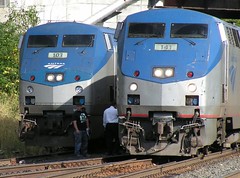
 Image via Wikipedia
This Week at Amtrak; October 22, 2009
A weekly digest of events, opinions, and forecasts from
United Rail Passenger Alliance, Inc.
America’s foremost passenger rail policy institute
1526 University Boulevard, West, PMB 203 • Jacksonville, Florida 32217-2006 USA
Telephone 904-636-7739, Electronic Mail info@unitedrail.org • http://www.unitedrail.org
Volume 6, Number 44
Founded over three decades ago in 1976, URPA is a nationally known policy institute which focuses on solutions and plans for passenger rail systems in North America. Headquartered in Jacksonville, Florida, URPA has professional associates in Minnesota, California, Arizona, New Mexico, the District of Columbia, Texas, New York, and other cities. For more detailed information, along with a variety of position papers and other documents, visit the URPA web site at http://www.unitedrail.org.
URPA is not a membership organization, and does not accept funding from any outside sources.
1) Well. A lot has been happening in the two weeks since the last This Week at Amtrak was published. Before we get into some specifics, we first need to hear what Minnesota Association of Rail Passengers and United Rail Passenger Alliance Vice President of Law and Policy Andrew Selden has to say on the current state of Amtrak.
[Begin quote]
By Andrew C. Selden
Amtrak blinds itself, in its endless posturing to fool its bankers in Congress, by measuring its performance by numbers that do not really matter, while ignoring or burying numbers that do matter. As a result, it makes decisions, including strategically important allocations of precious investment capital, on the basis of fundamentally misleading data.
The most glaring example is Amtrak's endless blathering about "ridership." Ridership is only a measure of a sale transaction. It does not differentiate among the size of the sales. One "rider" from New Haven to Boston is, by this yardstick, exactly equal to one rider from Washington, D.C. to Boston, or even Los Angeles to Boston. Amtrak makes this worse by blurring useful sales data (ticket prices) into averages by which they measure (actually, it's just arithmetic, not really "measuring" anything) "yield," which is the average revenue per passenger mile on a train or route. This tends to reinforce the false belief any one passenger is pretty much the same as any other.
In an urban transit system where every passenger pays the same fare, that might be okay.
But on Amtrak, where a typical "corridor" customer might pay $10 to $30, but a family in a sleeper to the west coast could be paying $1,000 or more, these "riders" are decidedly unequal. Fifty of the former are less than two of the latter. But Amtrak is obsessively focused on "ridership."
A yardstick Amtrak tries to hide, and apparently never uses to make important resource allocation decisions, is load factor. Load factor is the percentage of your inventory you are able to sell. Airlines live and breathe load factor.
Load factor is available seat miles (total inventory) divided by revenue passenger miles (seat-miles sold to paying passengers).
Load factor ("LF") matters greatly. Among other things it is a perfect measure of capital efficiency, and where a business is over-invested vs. under-invested. It is an indirect measure of opportunity cost. A trend analysis of LF is a tell-tale for a growing or a dying business.
It indicates whether an operation has achieved an efficiency of scale, or needs to ramp up, or down, its application of capital assets to achieve an efficiency of scale. The NEC's low load factors show Amtrak is already over-invested there: it offers much more inventory than it can sell for $30, or even give away. Long distance trains, with high load factors, show where Amtrak is under-invested, turning away potential $1,000 customers by the hundreds.
Simple "ridership," without consideration of load factor, is classic "Amtrak accounting" that disregards the cost and utilization of capital. If you have a rich uncle who doesn't care, or a politically-oriented appropriations committee that has other objectives, or a gullible state agency that doesn't seem to get it (a la Oklahoma and the Heartland Flyer), then one can disregard capital costs, load factor, and utilization. Ready access to "free" capital (but always with a heavy political and opportunity cost) obscures that.
Suppose a train or route has a LF of 40% (NEC average is about 40%). Suppose the LF is static, or even growing slowly. Is that a good thing? Or does that suggest the capital – represented here by the rolling stock, the overheads and even the relationship and rent costs with the host railroad – might be better applied elsewhere?
In other words: Can those trainsets produce, or earn, even more someplace else?
Real world, actual example: take a standard KFC restaurant with 72 seats grossing a million a year, and is often "full" (i.e., has a very high LF). It is a cash cow. The owner is happy. His banker is happy. But an investment banker focused on returns on capital (i.e., making money by maximizing output) will say, "Bulldoze this obsolete, underperforming asset. Get rid of it. It is a parasite. It is an obstacle to growth and profit. In its place, build a new, larger KFC with 150 seats and a bigger kitchen and a drive-through, that is physically capable of growing into a TWO or even three million a year store." And if the KFC instead were a lightly-used 40-seater that was doing $500,000 a year and showing no real growth, even if it were steadily profitable at that level, any rational analysis would conclude the store should be closed outright, and maybe re-located across town by the Wal-Mart, or out by the interstate. LF as well as cash flow, market share, and earnings are all part of the constant analysis that should be done of any commercial activity.
Amtrak NEVER does that. Amtrak instead fools itself and fools its bankers in Congress and its client state governments with phony-baloney data about transaction volumes ("ridership") and other irrelevancies.
ITEM: Amtrak's net loss last year was UP from the year before, for the umpteenth year in a row, even after all the subsidy and the deferred maintenance and the shrunken fleet and all the other voodoo accounting. That is why Amtrak is still a sinking ship, and why Interim President and CEO Joe Boardman, just like his several predecessors, is no different from Captain Edward Smith of the White Star Line. And trains like the Harrisburg – Philadelphia locals, or Acela, or the Heartland Flyer, with their low load factor, whatever the ridership, are just like that tiny scrape in the hull that eventually worked its disproportionate magic on the fortunes of the RMS Titanic.
[End quote]
2) Amtrak issued another route renewal report, and issued a final report on a second route.
The Pioneer route report, which was commented on previously in this space, was issued in a final form with no real changes in how Amtrak perceives to put this train between Denver and Seattle back into service at extremely high costs and a too long lead time, despite questioning from two United States Senators along the route, Senator Crapo of Idaho, and Senator Wyden of Oregon.
The new report issued was for restoration of the North Coast Hiawatha (Originally, the North Coast Limited, pre-Amtrak.) over the original Northern Pacific Railroad tracks. This route will parallel the Empire Builder route, but make a more southerly trip. Pre-Amtrak, the Empire Builder and the North Coast Limited were strong rivals between Chicago and Seattle, and both routes have breath-taking mountain scenery. The North Coast Hiawatha was one of the trains massacred by the route cuts of the Carter Administration.
Amtrak wants – yes, we’re not kidding – over one billion dollars to restore this route, with the bulk of the money going to track upgrades. After the Burlington, Northern Pacific, and Great Northern railroads were all folded into one company (which eventually became BNSF when the Santa Fe was added to the mix), the Northern Pacific route was considered redundant to the Great Northern (Empire Builder) route, and was downgraded. Part of the route in Montana was sold to a short line operator, too.
All of that aside, Amtrak has come out with ridiculously high figures for route restoration, including an amazing $330,000,000 just for six trainset of new equipment, including locomotives. This works out to an astounding $4,500,000 per piece of equipment, which is not only impossible to justify, but incredible anyone could present this figure with a straight face. Additionally, Amtrak demands millions and millions of dollars for crew training, as it has done in previous reports.
This analysis of the North Coast Hiawatha landed in the This Week at Amtrak mailbox.
[Begin quote]
Amtrak North Coast Hiawatha Report Reflects Apathy and Atrophy; Fails to Answer Many Questions
By Joseph D. Henchman
October 17, 2009
Introduction
On October 16, 2009, Amtrak published the North Coast Hiawatha Passenger Rail Study as required by the Passenger Rail Investment and Improvement Act of 2008 (PRIIA). That law required Amtrak to produce a report within one year of October 16, 2008 examining the feasibility of restoring passenger rail service between Chicago and Seattle via the former Northern Pacific mainline in Southern Montana.
Confronted with a political environment favorable to the expansion of its services, the report suggests an institution whose marketing and innovative instincts have atrophied. The report’s tone reflects a determination to drag out the timeline and extract as many subsidies as possible rather than seriously consider how a successful passenger rail service in the study area can be implemented.
Below are specific areas the report is insufficient or raises serious concerns.
Amtrak penalizes the study train for diverted passengers from other trains, but does not credit it for passengers fed to other trains.
Amtrak’s report penalizes the ticket revenue of the North Coast Hiawatha by $8 million because Amtrak estimates the train will divert passengers from the Empire Builder, a heavily-patronized Amtrak train (693 passengers each train in FY 2009 through July) that also operates daily between Seattle and Chicago. Amtrak goes so far as to say that the diverted revenue will “increase Amtrak’s direct operating loss.”
This analysis is incomplete for two reasons. First, the Empire Builder is often sold out for being over capacity, so an additional train may have the net impact of freeing up space on that train to be sold to others, wiping out any revenue loss. Second, and more importantly, Amtrak does not estimate additional revenue for other trains from the addition of the North Coast Hiawatha (or if they do, they don’t report it). Few Amtrak long-distance passengers ride end-to-end, with many taking shorter trips often involving transfers to other trains. On the west end is the Seattle-Portland Cascade train as well as the long-distance Coast Starlight to California. On the east end are services to St. Louis, New Orleans, Washington, Boston, New York, and Michigan. Added service into and out of Seattle and Chicago will result in additional revenues for all of these trains. If Amtrak “penalizes” the North Coast Hiawatha for “diverting” passenger revenue from trains, it should also “credit” the North Coast Hiawatha for “feeding” passenger revenue to other trains.
One approach Amtrak did not take would be to estimate system-wide revenues and expenses from the addition of the North Coast Hiawatha. This would give a true picture of the actual incremental cost of service expansion. Amtrak is also studying the expansion of services in several other routes, and is producing piecemeal reports on financial impacts, one-by-one. As Amtrak adds trains and frequencies, the additional options stimulate demand beyond that of one-train-on-one-corridor. A comprehensive approach of these proposals would be necessary for informed decision-making.
Amtrak Inexplicably Buries Its Conclusion that the Train Will Cost Its Operating Costs
There are two types of costs associated with running trains. One are relatively fixed costs that do not vary with the number of trains (system reservations and website, management costs, station costs), and the other are costs that vary with the number of trains (crew costs, fuel, payments to host railroads, and to some extent equipment maintenance). Amtrak’s estimate of North Coast Hiawatha operations, put in these terms, is as follows:
Passenger Related Revenue (not including $8 million revenue penalty for diversions from Empire Builder) – $51,000,000
Variable Expense: Fuel – $7,400,000
Variable Expense: Train Crew Labor – $13,000,000
Variable Expense: On-Board Services Labor – $14,700,000
Variable Expense: Mechanical – $11,900,000
Total Variable Expenses – $47,000,000
Net, Variable Expenses – +$3,000,000
Non-Variable: Station & System Expenses – $27,100,000
Total, All Expenses – $74,100,000
Total Net, All Expenses – ($24,100,000)
Farebox Recovery, Variable Expenses Only – 108.5%
Farebox Recovery, All Expenses (Amtrak reduces the farebox recovery by 10 percentage points by excluding the diverted revenue to the Empire Builder) – 68.8%
Amtrak’s long-distance service requires subsidies to cover its operating shortfalls [Based on Amtrak accounting methods]. Few if any recover 68.8% of their costs for all expenses, or actually break even on variable expenses, as Amtrak estimates here. Why Amtrak buries this information is inexplicable. One possibility would be that acknowledging Amtrak will run a train with a rather positive financial performance undermines its argument that massive subsidies are required to operate it.
Note: Amtrak does not clarify whether its estimate of system and route costs are the amounts that will be assigned to the North Coast Hiawatha or whether they are incremental costs of adding the train. For example, assume (using made-up numbers) Amtrak spends $100,000 a year operating the existing station at Fargo, North Dakota (which the North Coast Hiawatha would stop at), and $5 million a year running its existing national reservation system. Assume also Amtrak’s cost estimates in the report include line-items of $50,000 for the Fargo station and $200,000 for system reservations (they don’t; those items are not broken out). Does that mean Amtrak is spending an additional $250,000 when the North Coast Hiawatha is launched, or rather the North Coast Hiawatha will be assigned $250,000 of existing costs?
If the latter, it is relevant information, but its inclusion warps the decision-making process. Among Amtrak’s costs of operating the North Coast Hiawatha would be costs Amtrak is already incurring, and will incur whether the route is launched or not. To use economics terms, a decision-maker would be erroneously looking at average cost instead of marginal cost.
If it is the former, Amtrak needs to justify the $27 million in route and system expenses beyond merely saying they are “other direct expenses.” The amount reflects a third of the expenses associated with running the train, and while not suspect on its face, it does raise questions. Why does Amtrak’s report not include a technical appendix itemizing the costs it has estimated?
Amtrak Provides Just One Option: A Single, Slow, Short Train over the Entire Route
Unlike here, Amtrak’s past studies have often included a series of operating options. The recent Pioneer Service Study looked at several different alignments, the Sunset Limited Service Study looked at different service options, and the Ohio Service Study looked at different frequency options. Here, however, Amtrak provides no option other than one single, slow, short train. Given Amtrak’s own ridership and cost estimates, this is indefensible. It also allows Amtrak to demand higher subsidies than would be required to operate the North Coast Hiawatha.
The report recommends the establishment of one round trip a day along the 2,300 mile route on a 49 hour schedule, for an average speed of 47 M.P.H. (The North Coast Limited in 1956 managed 46.5 hours, so Amtrak proposes a train slower than one run 50 years ago.). The train would consist of locomotives, a baggage car, a crew car, two sleeping cars, three coaches, a dining car, and a lounge. Since each sleeping car has a maximum capacity of 49 and each coach has a maximum capacity of 74, that would mean a total train capacity of 320.
On page 28, Amtrak estimates even this slow, single train will result in 359,800 passengers a year, or 492 per train. On the face of it, this suggests the train will fill 153% of its capacity. Of course, few passengers will ride end-to-end, resulting in turnover en route. It would be useful to know Amtrak’s estimate of passenger-miles or load factor, but the report does not provide those numbers. Even if each seat turns over once per trip, the load factor would still be 76% (which would make airlines envious).
Amtrak’s report handicaps itself by limiting the train’s capacity. Many of a train’s expenses are fixed (engineer and conductor costs, for instance) or grow only minimally (fuel and service attendant costs, for instance) with additional cars. In the past, American passenger trains have operated with 16 to 22 cars (Today, in Canada, the Canadian transcontinental often operates with 22 cars in high season). The only serious limiting factor on train lengths are station platform lengths and locomotive power (itself limited based on the route’s curves and grades) and the ability to transmit hotel power from the locomotive to the rest of the train; usually 18 cars in the United States is the maximum train length because of this. Amtrak provides no information on why it limits the North Coast Hiawatha to nine cars (with only five being revenue cars) other than it lacks the imagination to try for more.
Since Amtrak’s proposed train already has locomotives, a baggage car, a crew car, dining car, and lounge, any additional cars would be revenue cars generating sleeping or coach ticket revenue. A 14-car train, for instance, would double the North Coast Hiawatha’s capacity, potentially doubling its revenue and most certainly not doubling its costs. Given Amtrak’s ridership estimates, such a capacity expansion would be justifiable. Amtrak does not investigate this option.
Amtrak also does not investigate the option of greater frequencies or runs over segments of the route (aside from noting that Washington State would not object to running trains to Minneapolis instead of all the way to Chicago). As Amtrak has discovered with service in California and Illinois, additional trains each day can reduce subsidies because (1) added frequencies can mean equipment spends less time idle at each end and (2) added frequencies can increase revenue from additional riders taking advantage of more options. A second frequency 12-hours off of the proposed schedule would be a natural consideration, as would additional day-train frequencies between segments of the route. It is unfortunate Amtrak looks at additional frequencies not as expanding passengers options and thus revenue, but rather as something to be penalized for “cannibalizing” passengers and revenue from existing trains.
Most transportation providers offer travelers options. One of Amtrak’s largest weaknesses is many of its trains run only once per day, resulting in equipment sitting idle for 6-18 hours at each end and passengers giving up if they cannot work with Amtrak’s one timetable option. Twice the trains can in many cases result in more than twice as many passengers. Fixed route costs, such as station operating costs (here estimated to be $27.1 million), can also be spread over more trains. As noted above, Amtrak estimates that the train’s operation itself, exclusive of system and route costs, will break even.
Amtrak Does Not Investigate Marketing Options
Amtrak’s report also provides no discussion of service options or marketing opportunities. The report mentions the North Coast Hiawatha’s Livingstone station is not far from Yellowstone National Park, but does not enlighten the reader as to whether Amtrak will capitalize on that beyond leaving passengers at Livingstone. (In the past, the Northern Pacific Railroad ran shuttle trains and later shuttle buses to the park.) The private Grand Canyon Railway in Arizona offers four different accommodation options, including a basic coach seat option. The higher-priced options include snacks, entertainment, and Grand Canyon National Park admission. In Europe, the CityNightLine overnight train service offers several different accommodation options, with higher-priced options including welcome wine or beer, an array of magazines, and breakfast on arrival. Other Amtrak trains have included parlor lounges, observation cars, children’s playrooms, quiet cars, wine tastings, and enroute tour guides. Other ideas could include on-board treadmills or weight equipment, video arcades, taverns or bars, or gift shops. Amtrak’s report shows no creative thinking with regard to providing services to passengers, an important aspect of its operation.
This is particularly indefensible in that Amtrak requires the purchase of brand-new railcars to launch the service, and estimates it will take 4-5 years to begin operations after funding becomes available. If Amtrak needs five years and new trainsets to provide exactly what it has provided for years on other routes, it is not thinking sufficiently creatively.
Amtrak’s report also provides no discussion of joint marketing opportunities for other popular attractions along the route, including the Mall of America in Minneapolis; historic tourist attractions in Butte, Montana (a larger town which Amtrak inexplicably writes off without bothering to estimate the costs of serving it despite rails existing and being on the train’s route, even though it reports that public and Montana Department of Transportation comments strongly favored studying operating service via Butte) and Bozeman, Montana; airports; and small-town communities currently without rail service in Washington State.
Conclusion
Throughout the report and its actions in recent history, Amtrak views its role as merely common-carrier transportation handling passengers when they show up. Instead, Amtrak should push itself to figure out how it can develop a market, providing a travel experience. Doing so will improve the bottom line for the company and for taxpayers, but requires shaking Amtrak out of its apathy and atrophy.
Questions Unanswered by Amtrak In Its Report
1. What is Amtrak’s estimate of the load factor for the North Coast Hiawatha, and how many passenger-miles will it generate?
2. What are the system-wide and marginal revenues and costs associated with launching the North Coast Hiawatha, including additional revenues to other trains from its operation?
3. How many of the cost items within Amtrak’s estimated $74.1 million in estimated North Coast Hiawatha operating expenses will be incurred whether or not the train route is launched?
4. What are the revenue and costs associated with other operating options, such as a longer train of 14-22 cars, or additional frequencies?
5. What additional level of capital investment would be required to raise average operating speed to 55 M.P.H. (42 hour schedule), 65 M.P.H. (36 hour schedule), or 75 M.P.H. (31 hour schedule)?
6. Given that Amtrak will be purchasing new equipment for these trains, what innovative ideas will Amtrak explore for the equipment?
7. What marketing opportunities will Amtrak explore for the operation of the trains, to maximize passenger travel experience and develop the market?
8. What are the costs associated with operating via Butte, Montana?
9. How would a system-wide expansion of train lengths and frequencies for long-distance trains change the operating performance of this route?
10. Why does Amtrak estimate so many people will ride the North Coast Hiawatha, relative to other long-distance trains?
About the Author
Joseph Henchman lives in Arlington, Virginia, and is interested in transportation economics and rail planning. He works as an attorney and policy analyst with a non-profit think tank in Washington, D.C., but this report is not associated with that organization. His email address is jdhenchman [at] yahoo.com.
[End quote]
3) Amtrak has now issued four reports since the end of the summer. First, the Sunset Limited – East of New Orleans/Gulf Coast report (Amtrak doesn’t want to run the service); the Ohio 3-C report for restored service between Cleveland, Columbus, and Cincinnati (Amtrak doesn’t want to run the service), the Pioneer report for restored service between Denver and Seattle (Amtrak doesn’t want to run the service), and, finally, the North Coast Hiawatha restored service report (Amtrak doesn’t want to run that service, either).
When you add up Amtrak’s estimates to restart these four routes, it’s over $2,000,000,000 (that’s two billion dollars, if you don’t want to count zeros).
In reality, if Amtrak really wanted to do any of these projects, the estimates are probably high by at least 40%, if not a full 50%. But, when you’re a planner for a quasi-governmental agency and you’re accustomed to spending someone else’s money (That would be money which belongs to you, the taxpayer.), costs don’t really matter. What matters is convenience and lots of bells and whistles (No pun intended.). Amtrak’s dream world dictates all new equipment, extravagant stations where smaller ones will do, crew training costs which are incomprehensible to any railroad professional, and a gold-plating of railroad infrastructure “just in case” the railroads want their entire right-of-way wish lists fulfilled at someone else’s expense.
All of this leads to the inescapable, sad conclusion that until Amtrak has a new management team which has any inkling of a vision for the future which includes new passenger car orders, a business plan based on reality instead of only raiding government treasuries, or without fantasies of ignoring the conventional passenger rail business because of the glamour of an incorrect assumption Amtrak will be the exclusive high speed rail operator (there’s a thought to give you nightmares for a week), restored long routes such as the North Coast Hiawatha may not be the best plan.
As presented, Amtrak’s four route restoration plans are a prescription for disaster.
The Gulf Coast report laments Amtrak went to all of the trouble of studying multiple scenarios, and settled on four, all of which Amtrak has priced too high. The reality of the Gulf Coast report is if Amtrak simply extends the City of New Orleans from New Orleans to Orlando, Amtrak will instantly reestablish a Chicago-Florida train, restore service on the Gulf Coast, and have a powerhouse operation for the cost of one extra trainset for the City of New Orleans (due to current too long equipment layovers in New Orleans) and the cost of Positive Train Control installation on the CSX line between New Orleans and Jacksonville.
The Pioneer report wants to set up a separate operation for the Pioneer between Denver and Seattle, with through-cars on the back of the California Zephyr between Chicago and Denver. Amtrak never considered the huge benefit of running a second frequency in the form of the Pioneer between Chicago and Denver, apparently because it would be too much trouble, no matter how much of a financial gain would be found.
The Ohio report wants to set up a pretty good service, but with a lousy end point in Cincinnati so the service will not connect withe the Cardinal; Amtrak continues its reckless policy of not often enough offering connecting trains just in case some passengers may want to travel on more than one route to reach a final destination.
None of the reports take into account the matrix effect of connectivity, more travel choices, or more stations served. Amtrak can only see costs, instead of benefits.
Little of Amtrak’s work reflects it was created by anyone with real concepts of passenger service, what’s overall best for passengers, or what posture best serves Amtrak – and, our country – financially.
For right now, until some of this changes, Amtrak may best serve itself and all of us by making some logical, small steps which will strengthen the company financially. Things like Kansas City-Omaha, Oklahoma City-Kansas City, Peoria-St. Louis, Savannah-Jacksonville, or Barstow-Bakersfield (/San Jose). Maybe think about Harrisburg-Newark via the Lehigh Valley.
Even easier would be to add truly new Superliner capacity to the existing long distance trains, to start to capture many of those $1,000 tickets Amtrak is losing now because the sleepers are full at various peak load points.
For those hoping for restoration of routes which never should have went away, this fall is truly a season of discontent. Amtrak seems to have gone out of its way to make things as difficult as possible for any returning trains, yet its chairman of the board and some senior executives are making presentations around the country about how Amtrak is the perfect organization to be the exclusive high speed rail operator for new services in America.
Until Amtrak gets its house in order and demonstrates it has some – any! – vision, no one (even government bureaucrats) are going to be foolish enough to anoint Amtrak as the high speed rail operator.
4) Last Saturday, October 17, 2009, a determined band of people met together here in Jacksonville, Florida. The group named itself the Sunset Marketing and Revitalization Team, and has been meeting for over a year now at various locations along the former transcontinental route of the Sunset, prior to its unceremonious loss of the east end of the route beyond New Orleans due to Hurricane Katrina in 2005.
John Sita, Jr. of New Orleans is chairman of the SMART group, and Jerry Sullivan of Jacksonville was the gracious host of the meeting.
The meeting lasted three hours, and the SMART members represented a number of states along the route, both east and west of New Orleans. One SMART member from Louisiana made an all-rail trip from his home to the meeting. To cover the roughly 600 miles from New Orleans to Jacksonville without the Sunset, he rode first to Washington via Birmingham, Atlanta, and Charlotte on the Crescent for a full day and a night, and then took the Silver Star from Washington for the afternoon and overnight trip to Jacksonville. Whew! Talk about dedication ...
Without getting into the various discussions and deliberations the group had, what is notable is the very need for the existence of this group. This group has no formal sponsorship, and is completely self-funded. These people banded together because they feel their quasi-governmental national passenger rail carrier has failed in its duty and obligations to restart the Sunset Limited east of New Orleans, and has constantly failed during the entire existence of Amtrak to make the Sunset Limited a daily train between Los Angeles and New Orleans (And Orlando when the train ran its full route.).
In the real, non-Amtrak world, this group should never have been necessary. If Amtrak had the compunction to live up to its mandate as a national rail carrier, there would be no discussion about the gaping hole in Amtrak’s route map between New Orleans and Jacksonville. An entire region of the country is disenfranchised for passenger rail service because Amtrak isn’t clever enough to figure out how to make the Sunset a success.
So, a group whose membership is more than 50 souls is working together to take the place of a taxpayer funded organization’s planning department to figure out how to make the Sunset Limited viable. Amtrak should be terribly embarrassed.
If you are reading someone else’s copy of This Week at Amtrak, you can receive your own free copy each edition by sending your e-mail address to
freetwa@unitedrail.org
You MUST include your name, preferred e-mail address, and city and state where you live. If you have filters or firewalls placed on your Internet connection, set your e-mail to receive incoming mail from twa@unitedrail.org; we are unable to go through any approvals processes for individuals. This mailing list is kept strictly confidential and is not shared or used for any purposes other than distribution of This Week at Amtrak or related URPA materials.
All other correspondence, including requests to unsubscribe should be addressed to
brucerichardson@unitedrail.org
Copies of This Week at Amtrak are archived on URPA’s web site, www.unitedrail.org and also on www.todaywithjb.blogspot.com where other rail-related writings of Bruce Richardson may also be found.
URPA leadership members are available for speaking engagements.
J. Bruce Richardson
President
United Rail Passenger Alliance, Inc.
1526 University Boulevard, West, PMB 203
Jacksonville, Florida 32217-2006 USA
Telephone 904-636-7739
brucerichardson@unitedrail.org
http://www.unitedrail.org
![Reblog this post [with Zemanta]](http://img.zemanta.com/reblog_e.png?x-id=efeb7a4b-5068-4fc5-b33b-9db1e9f1da9f)


![Reblog this post [with Zemanta]](http://img.zemanta.com/reblog_e.png?x-id=64395960-ff23-44cf-9a4e-0cff9d989e69)