Showing posts with label Joseph Boardman. Show all posts

Thursday, April 08, 2010

This Week in Amtrak

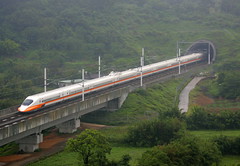
Taiwan High Speed RailImage by jiadoldol via Flickr


Volume 7, Number 12


A weekly digest of events, opinions, and forecasts from


United Rail Passenger Alliance, Inc.

America’s foremost passenger rail policy institute


1526 University Boulevard, West, PMB 203 • Jacksonville, Florida 32217-2006 USA

Telephone 904-636-7739, Electronic Mail info@unitedrail.org • http://www.unitedrail.org


--------------------------------------------------------------------------------

This week we look first at Amtrak’s slow pace, then at continued nationwide wrong-think surrounding Amtrak’s new venture into high speed rail; and we wrap up with a guest commentary by our Andrew C. Selden.

“In the unlikely event of a cabin depressurization, oxygen masks will appear overhead. Reach up and pull the mask closest to you, fully extending the plastic tubing, fasten the straps, and begin breathing normally… If you are seated next to a small child or someone needing assistance, secure your own mask first, then assist the child.”

— Airplane safety announcement

Consider a dramatization of the above starring Amtrak’s Joseph Boardman as the passenger, and network expansion as the child. Faced with the upcoming depressurization of its system through aging equipment, Amtrak is now in the process of securing its own mask with an equipment order. This is no little feat, but Congress still holds the strings. The mask isn’t even on yet, and as the air drains away, what are the prospects for the little form in the next seat?

Readers of This Week have had plenty to say about Amtrak’s progress, or lack thereof. Charles McMillan wrote:

I just finished reading your March 31st issue and I have just visited the two universities in Montana, Meeting with Faculty/Students/Staff and interested local citizens who want to see the restoration of the North Coast Hiawatha reinstated. In fact the consensus is to pretty much take the bull by the horns and get America back to the forefront of technology and world leadership in all areas of Science and Business. They are very adamant about this!

Their desire for Amtrak to get off of this NEC mentality and get a nation wide rail passenger system in place is unparalleled. They are disgusted with Joe Boardman and the attitude of the present board of directors in this regard, because they see no real growth on the part of Amtrak in the form of expanding routes around the country. They keep asking “how much growth in ridership can Amtrak realize just by operating their present routes without adding more trains,coaches or service”? “Can’t they (Amtrak) see that expansion is the key to real growth.” These are some of the thoughts of the general public and our Univesity system students.

We are continuing to garner support for this N.C.H. train all across the northwest including Minnesota.

Jerry Sullivan echoes a sentiment of frustration at,

Amtrak’s absolute refusal to restore the Sunset, or even a connecting train, to Florida. The only train I rode regularly was the Sunset prior to August 2005, and I have not been on a train since, except for excursions. Amtrak has become irrelevant; although I despise flying, Southwest Airlines is now my forced choice until Amtrak gets off their backside on the Sunset issue.

Until last year’s flawed Gulf Coast report is revisited and corrected, and until enough new — not just replacement — equipment is available, probably nothing will happen. Amtrak may be the only company whose product is desperately wanted by everyone but refuses to offer more of it.

As to markets and expansion, Christopher Parker noted, in reference to the speed comparison table:

[At that time,] top speeds were held by limiteds that were mostly overnight sleepers, a market [ceded] to the airlines… You should be comparing today’s trains to the stopping [all-stop local] trains of old. The other factor is we live in a more open and safety conscious world – routine disregard of speed limits is impossible now, as are top speeds over 79mph without automatic train-stop.

I wonder if railroads had the regulative freedom to run very fast if the fate of the passenger train would have turned out differently. Speed makes a huge difference in staying competitive. With some exceptions (IC), today’s top speeds aren’t much different.

True, after a number of accidents fifty years ago, legislation was passed that did limit train speeds. Modern safety devices warrant revisiting those speeds, as does the pending implementation of Positive Train Control, along with satellite, GPS, wireless technology, and computer control. There must be an equilibrium point of higher speeds versus construction and maintenance costs. How to implement a mixing of relatively high speed passenger trains in an era of double-stack containers and long unit coal trains is no easy task, but a worthwhile one. Mr. Parker suggests, that with good track and “cheap technology to detect open switches, dark territory should be good for 70-79 mph.”

And while railroads no longer have the monopoly on business travel, but European experience suggests there is plenty of market here for a slogan like “we are your rolling hotel.” A businessman at a conference in Phoenix could have a late dinner, board the midnight sleeper, and be in downtown Los Angeles by morning in plenty of time for a 9am meeting. Mr. Parker responds, “Let’s start by getting sleepers back on the [Washington-Boston] Night Owl or whatever they call it now.” Could not be repeated across the country?

Amtrak’s newest focus is on high speed rail. As yet they have little involvement in most of the pending projects, so let us see the fine mess they are getting into.

Over the last few weeks we have compared Wisconsin’s pragmatic expansion approach to Florida’s Bullet Train That Doesn’t Connect (Daniel Carleton, 23 March 2010). We will look at Colorado’s venture into high speed rail in a moment, but first consider the California high speed project, which started some years ago along the lines of the Florida fiasco. Each refinement, we are pleased to report, generally tended toward a more logical approach. Maglev was eliminated in favor of compatible steel-wheel technology, permitting shared rights-of-way and stations. Nevertheless, room for improvement still exists in the “Plays well with others” department:

In a letter dated 23 March 2010, the Orange County Transportation Authority (OCTA) and the Los Angeles County Metropolitan Transportation Authority (Metro) ask the California High Speed Rail Authority (CAHSRA) to please revisit and consider “a rational shared use option in the Anaheim to Los Angeles segment of the CAHSRA project… In November of 2009, the Federal Railroad Administration (FRA) issued its first High Speed Passenger Rail Safety Strategy which provides a strategy for the development of shared use corridors. We believe this safety strategy has direct applicability to” the L.A.-Anaheim corridor and they point out that “reports prepared by the CAHSRA staff and consultants did not contemplate any discussion of the rationalization of passenger services in the Anaheim to Los Angeles segment… [part of] the second busiest passenger rail corridor in the nation… we would like to make these services more coordinated and integrated.”

One could well read this as a formal, polite way of saying, “You’re doing it wrong,” and one does wish that high speed trains, where they are built in this country, integrate with local trains and transit as well as they do in Germany, for example. In Germany they have even figured out how to run a streetcar into a regular train station, where you might see one on the platform alongside an ICE high-speed train. If the Germans can master the engineering and those safety features to give easy cross-platform transfers, why can’t we?

Meanwhile at the northern end of that California corridor, the San Francisco Chronicle reported on April 3rd that Caltrain, facing “plummeting sales tax revenues and shrinking ridership” could be forced “to eliminate its midday, night and weekend service, and return to its roots as a commuter-only railroad.” Yet an article there the previous day noted of the new High Speed project, “New numbers put the price of the Anaheim-to-San Francisco segment alone at $42.6 billion.”

Why are we spending millions on high-speed rail studies to the detriment of existing services? Why are we further planning new trains that will hurt, instead of complement, the few successful ones we have spent decades building? Cannot even railroad people work together or has too many years of fighting the highway lobby fractured the passenger train industry?

Colorado is poised to make the same mistake. Railway Track and Structures on March 30th reported,

A study of possible high-speed, intercity rail for Colorado has found that lines between Fort Collins and Pueblo and between Denver International Airport and Eagle County have the best “operating and cost-benefit results” of the options evaluated… The full system carries a $21.1-billion price tag, but Harry Dale, chairman of the Rocky Mountain Rail Authority, which produced the study, said the rail system would probably be built in phases…

The feasibility study… took 18 months to complete and cost $1.4 million… “It might be 10 to 20 years before we actually build anything,” [Dale] said…

The study identifies a $3.32-billion rail segment from DIA to downtown Denver and then south to Colorado Springs as a likely first phase [,which Dale said] would not compete directly with [the] Regional Transportation District’s planned East Corridor commuter train that will link the airport and Denver’s Union Station.

“This [HSR] is not meant to be fare-subsidized,” Dale said of the proposed high-speed rail system. “Average speeds must be superior to travel by car, or nobody will ride. There have got to be time savings to make it worthwhile.”

Does it not matter that almost every new well-planned light-rail and regional-rail system in the West has met, exceeded, or far exceeded ridership expectations? Why spend money planning a second “high speed” system paralleling a regional train we haven’t even built yet? Why do we keep having to fight the superfast fallacy? Frequency, dependability, and the matrix of connections are what attract people to trains — not high speeds. Dr. Adrian Herzog’s Matrix Theory, despite being proven repeatedly, continues to be ignored.

— William Lindley, Scottsdale, Ariz.

p.s., Mr. Selden’s guest commentary follows.

Why Joseph Boardman Can’t Succeed
By Andrew Selden

Joe Boardman is a fine fellow, and an experienced rail administrator, but his tenure is doomed to be another failure as CEO of Amtrak, for the simple reason that his strategy for the company is to pour ever more capital and effort into the exact same business strategies and plans that have failed the company consistently for four decades. This is evidenced by Amtrak’s latest strategic “plan” released late this winter.

“Amtrak Planning” has come to be as much of an oxymoron as “Amtrak Accounting.” Key elements of the latest plan:

Upgrade interiors and add WiFi on Acela trains, with leather seats, new tray tables and improved at-seat power outlets.
NEC infrastructure enhancements such as a new Niantic River drawbridge in Connecticut, new power supply equipment for New York – Washington, new switches at Chicago Union Station, new car shops at Los Angeles, station renovation at Wilmington, Delaware, fire safety improvements in the Hudson River tunnels, car renovation at Beech Grove, NEC track and wire maintenance, etc.
Study its “poorest performing long-distance routes” to identify possible changes. These routes include the Sunset Limited, Eagle, Cardinal, Capitol Limited and California Zephyr. (No mention of chronically underperforming short routes.)
Expand state-funded short corridors.
Install PTC on Amtrak-owned track.
Increase security.
Replace large parts of the company’s locomotive and car fleet.
Now, this all sounds wonderful, and many observers leapt on the last item as proof that “Amtrak was home free and the Age of Aquarius was upon us.” No one paused to ask, “With the U.S. trillions of dollars in debt and piling on new debt just as fast as we can sell bonds to the Chinese, how is Amtrak going to pay for all this?”

Even worse, no one seemed to notice that Amtrak’s plans were nothing more than a reshuffle of the same tired 40-year-old business plan that has put Amtrak into a financial black hole. (Amtrak’s net loss worsened again last year, proving once again that the billions “invested” so far into the NEC, Acela, and all the other infrastructure projects has produced a negative rate of return on investment.) No one asked: “Based on 40 years of consistent failure and steadily worsening financial results, why should we continue pouring billions of new dollars of federal support down the same old black hole?”

This ultimately is why Mr. Boardman cannot succeed: recycling failed business strategies is not “planning.” Doubling the bet on a losing position is a poor strategy.

When Amtrak released its wish list of new engines and rolling stock in March, it took independent analysis by URPA professionals to point out that the “new fleet” strategy reflected a net shrinkage of lift capacity in the national system.

But, there may be a growing awareness inside Amtrak that they are missing out in their long distance markets. At an Amtrak conference in Chicago in March, some interesting ideas were surfaced. A URPA attendee reported:

“Amtrak made official their intent to restructure the Sunset and Texas Eagle routes by operating a daily Los Angeles-San Antonio-Chicago train with a connecting San Antonio-New Orleans train. Amtrak has divided their 15 long-distance trains into three groups of five. The five worst performers – including the Sunset and Eagle – will be addressed this year, the middle five in 2011, and the five best – such as the Empire Builder and Southwest Chief – will be tweaked beginning in 2010. The undesirability of tri-weekly service on any route was noted.

“Amtrak seems to be grasping – and willing to emphasize publicly – the importance of their long distance trains. One of the slides in a presentation : ‘Long Distance Trains are Fundamental to Amtrak’s Mission and Future.’ The slide’s charts showed that long distance trains provided 15 percent of Amtrak’s riders, but 24 percent of revenue, and 39 percent of Amtrak’s train miles but 46 percent of passenger miles.”

As promising as this is, it still fails to reflect any understanding of how explosive growth could be if Amtrak were to address two simple questions:

What would long distance ridership, passenger miles and revenue be if Amtrak actually added capacity to existing trains, especially in peak periods? Long distance capacity and available seat miles have been flat, if not down, for two decades. Since these trains run nearly full much of the year, no growth is even possible without added capacity.
What would long distance ridership, passenger miles and revenue be if Amtrak better interconnected its routes, so that its trains could serve hundreds of new origin-destination city pairs? Examples: extend a Missouri state corridor train to Omaha, to connect St. Louis, Kansas City and intermediate points to the Central Transcontinental Corridor – Denver, Salt Lake City, Reno, Sacramento and the San Francisco Bay area; or, drop a coach and sleeper from the Chief, at Barstow, to run over Tehachapi Pass to Bakersfield, connecting to a San Joaquin, linking the entire Southwest Transcontinental Corridor to the Central Valley and the San Francisco Bay area.
Even if one assumes that these new services perform no better than the known performance of the existing trains, these small increases in operations, by opening up many hundreds of new long distance city pairs, will triple output, and revenue. Now there is a capacity issue, and a growth strategy, all in one.


--------------------------------------------------------------------------------
If you are reading someone else’s copy of This Week at Amtrak, you can receive your own free copy each edition by sending your e-mail address to


freetwa@unitedrail.org


You MUST include your name, preferred e-mail address, and city and state where you live. If you have filters or firewalls placed on your Internet connection, set your e-mail to receive incoming mail from twa@unitedrail.org; we are unable to go through any approvals processes for individuals. This mailing list is kept strictly confidential and is not shared or used for any purposes other than distribution of This Week at Amtrak or related URPA materials.


All other correspondence, including requests to unsubscribe should be addressed to


wlindley@unitedrail.org


Copies of This Week at Amtrak are archived on URPA’s web site, www.unitedrail.org


URPA leadership members are available for speaking engagements.


Reblog this post [with Zemanta]

Thursday, January 07, 2010

This Week in Amtrak

Amtrak ChilledImage by ahockley via Flickr


This Week at Amtrak; January 5, 2010


A weekly digest of events, opinions, and forecasts from


United Rail Passenger Alliance, Inc.

America’s foremost passenger rail policy institute


1526 University Boulevard, West, PMB 203 • Jacksonville, Florida 32217-2006 USA

Telephone 904-636-7739, Electronic Mail info@unitedrail.org • http://www.unitedrail.org


Volume 7, Number 1


Founded over three decades ago in 1976, URPA is a nationally known policy institute which focuses on solutions and plans for passenger rail systems in North America. Headquartered in Jacksonville, Florida, URPA has professional associates in Minnesota, California, Arizona, New Mexico, the District of Columbia, Texas, New York, and other cities. For more detailed information, along with a variety of position papers and other documents, visit the URPA web site at http://www.unitedrail.org.


URPA is not a membership organization, and does not accept funding from any outside sources.


1) Welcome to the seventh year of This Week at Amtrak, where there is always the hope, dream, and desire Amtrak will become a responsible part of our nation’s domestic transportation network.


Hope always springs eternal. Reality always disappoints.


Where are we this January that we weren’t last January?


We still do not have a permanent president of Amtrak (see the next item below).


We still do not have an expected passenger equipment order which will expand the fleet.


We still do not have a funded marketing plan which will increase ridership nationwide.


We still do not have every train in the system operating on a daily schedule.


We still do not have anything but a bare, inadequate, skeletal national system.


We still do not have anyone publicly leading the company with a future vision or growth plan.


We do have a plan to take the Sunset Limited west of New Orleans to a daily operation, but we don’t have a plan to restore the illegally stopped service east of New Orleans.


We do have some executives at Amtrak who are anxious to make the company perform better and provide better service, but they are hamstrung by the cadre of executives who seem to be there mostly for the retirement package.


We do have a desire on the part of many Americans of all ages to ride trains, but there are not many trains to ride.


We do have other competent passenger train operators in this country waiting for the opportunity to move beyond providing commuter services to real intercity services.


We do now exist in the era of anticipating coming high speed rail, but it’s going to be a long, long process getting there.


We do have visionaries like former Federal Railroad Administration Administrator Gil Carmichael who have developed realistic plans for the future, but often these learned and inspiring voices seem to be talking in the wilderness more than to receptive audiences in Washington, no matter how long and hard they talk and make a great deal of sense.


We do have people like Andrew Selden of Minneapolis, Minnesota who not only understand the business of passenger railroading, but are willing to create a vision and plan for the future.


Where are we in January 2010 versus January 2009? Another year has gone by without much major happening in the world of Amtrak.


Keep in mind, that has occurred intentionally on the part of Amtrak; it has had a plethora of opportunities, and it has chosen to focus on planning for the expected panacea of high speed rail and ignore its core business of 79 M.P.H. conventional trains. Maybe that’s why so many foreign passenger rail operators, from across both the Atlantic and Pacific Oceans have expressed an interest in developing high speed rail in the United States. These astute businessmen have looked at Amtrak and found it wanting in so many ways; they must figure competing for Amtrak for a chunk of business is like shooting fish in a barrel.


2) There is always someone in a company who has the zest and drive to make things happen. Eh, not so much at Amtrak.


The Amtrak Board of Directors, which will never be mistaken for a body which takes bold action, has extended indefinitely the tenure of interim President and Chief Executive Officer Joseph Boardman.


The Amtrak board currently consists of five voting members, one being Mr. Boardman. There are four vacant seats on the board, two of which have nominees awaiting Senate confirmation. Two seats have no announced appointees; apparently the White House and various and sundry Members of Congress haven’t agreed upon who gets those seats (If anybody asks, we can recommend a cadre of highly competent potential board members, none of which have the type of conflicts the two current nominees have, and each would be a stellar addition to the board.).


So, in a fit of bold caution, the Amtrak board extended Mr. Boardman’s contract and made a statement saying a permanent president of Amtrak would not be announced until the board is more fully populated.


Hmmmm, let’s see. When was the last time the Amtrak Board of Directors was fully populated?


Seriously, anybody know?


You have to go all the way back to the end of the Clinton Administration to find a legal quorum of board members.


In the interim during the Bush years, stars like former board chairman David Laney and some others held things together and worked through a number of problems while the White House dithered and the Senate obfuscated about appointing qualified board members.


So, Mr. Boardman gets to keep his job a while longer.


Okay, let’s get to the bottom line. There is certainly a rational argument to be made about a board of directors hiring a chief executive, and then new members of the board arrive and find the chief executive not to their liking. We’ve already seen that scenario play out with the unlamented departure of former Amtrak President and CEO Alex Kummant. Even though Mr. Kummant departed over disagreements about a number of issues, it was never an ideal situation to have a CEO hired by a departed board expected to meet the needs of a new board.


The big complaint really centers around the White House. Guys, it’s been a full year, now. That is more than enough time to find and screen political appointees to the Amtrak board. There are a number of qualified people just waiting in the wings, hoping for a chance to lead Amtrak into a better era and a more prosperous time. But, the Amtrak board, always a bottom of the barrel issue for any White House administration, remains a sideshow, and – highly regrettably – business as usual reigns.


In the interim, how about some leadership from the United States Department of Transportation and/or the Federal Railroad Administration? How about setting some goals for Amtrak and creating a true surface transportation policy?


How about SOMEONE doing SOMETHING? Doing ANYTHING? Dan Pardue of Raleigh, North Carolina, when trying to do problem solving with non-cooperative equipment or non-cooperative clients, always says “Do something, even if it’s wrong. At least some action is being taken, and perhaps the right answer will come along by starting some sort of process.”


Amtrak, here at This Week at Amtrak we will gladly provide you with Mr. Pardue’s telephone number so you can call him for some tutoring. Please, start some sort of process to start doing something – anything, please.


In 2009, a year which will go down in the annuals of history as a truly misbegotten year, Amtrak received record amounts of free federal monies. Stimulus money flowed, and regular budget money flowed.


While Amtrak did start whittling away at a backlog of projects which are nice to have completed, most of those projects (with the stark exception of rolling stock rehabs) will not generate any additional revenues for Amtrak. Most of the projects are just things which needed to be done, and had been neglected; some for decades.


Again, Amtrak has an unprecedented opportunity for change and upgrading itself as a company and our nation’s domestic passenger railroad.


But, Amtrak seems to be doing a bang up job of wasting that opportunity, instead of taking advantage of so much manna from the federal treasury.


We give Mr. Boardman credit for stabilizing some things, and he gets a huge “attaboy” for leading the company to accepting Brian Rosenwald’s excellent work of starting the process of converting the Sunset Limited west of New Orleans into a daily – yet, still a bit flawed – operation. We’re waiting for some leadership on what will happen east of New Orleans, and we keep hearing whispers the Cardinal, perhaps one of Amtrak’s most scenic routes, will be lifted from the doldrums and waste of a tri-weekly operation.


But, Mr. Boardman, in his interim post, is still head of the company, and he still sets the daily tone and pace of the company. We do expect some sort of future vision, even if it’s just a building block to be used by a permanent CEO. We do expect some sort of growth plan, and we do expect an equipment order beyond the rather paltry announcements which have been made for replacement equipment, only.


In short, even if it’s interim leadership, we do expect leadership.


Amtrak is an ongoing enterprise, with a long-forgotten mandate and mission to provide the United States of America with a national passenger train service. Keeping Amtrak in a state of suspense because the White House and Members of Congress can’t decide on political appointees for the board of directors is not only wasteful, it’s sinister and displays an outright prejudice against all of us who understand and cherish passenger rail travel.


Mr. Boardman, please start the process. The Obama White House, please do your duty and populate the Amtrak Board of Directors. United States Senate, please fulfill your advise and consent duties as outlined in the constitution so the Amtrak board seats can be filled in an expeditious manner.


Somebody, somewhere, please, don’t leave us all hanging.


3) Amtrak ended 2009 battling the late fall/early winter Blizzard of 2009, with a pretty good record. Chicago got penalized by one of its host railroads dumping a freight train off the tracks, causing a huge traffic jam, and it took a while to get things back to normal. No penalty to Amtrak. On the Northeast Corridor, while the airlines just threw up their collective hands and said they weren’t flying in the bad weather (it’s kind of tough to blame them when the weather is that nasty), Amtrak did mostly fulfill its duty as the all-weather common carrier and kept a lot of trains running, as did its host railroads south of Washington, even though trains were woefully late. Too many trains were cancelled during the busy holiday period (it’s especially vexing Amtrak chose to cancel the Palmetto, even though the majority of its run was south of the destruction of the storm), but transportation still was available.


There were too many mechanical malfunction reports of Amfleet cars on the NEC with doors which were frozen open. Gosh, those cars have only been around for a bit more than three decades now, in the heat of summer and the cold of winter, one has to believe someone in that vast period of time could figure out how to overcome Budd’s design flaws of the vestibule doors freezing in the open position when the car is full of passengers traveling at 100 M.P.H. and the icy wind is tearing through the interior of the car and passengers.


Going further into winter, Amtrak has been battling more weather-related problems and the country has been battling record cold temperatures and storms. (It MUST be all of that global warming; what other explanation could there be for such a cold and cruel start of what most likely is going to be a long, cold, bitter winter?) Some trains are running more than a dozen hours late, other trains just seem to be disappearing off of the schedule, and are never being launched out of their terminals.


This is when Amtrak’s too thin fleet reserves come back to bite it. Inbound equipment that normally turns for the next day’s outbound train suddenly is stranded on a siding somewhere on the far side of nowhere, and there’s no spare equipment to put on the road. Passengers and crews are stranded; things spin more and more out of control, and eventually system gridlock occurs. Remember all of that old equipment that used to sit around, but is gone, now? Wouldn’t it be nice to have that for occasions just such as this winter?


Before the Age of Amtrak, the private passenger railroads always kept a slice of their old equipment fleets around for use in emergencies. It wasn’t pretty, and it wasn’t the most efficient stuff in the world, but it got passengers to a destination when nothing else could. Amtrak has scrapped or sold all of its old equipment; after all, since it gets lots of free federal monies from the government treasury it doesn’t have to worry about keeping passengers happy by providing them the transportation they paid for in advance. Amtrak can just annul as many trains as it wants, and say “so sorry, so sad” to its stranded passengers, and keep totaling up the tab to be paid for by Congress next budget year.


What a way to run a railroad.


If you are reading someone else’s copy of This Week at Amtrak, you can receive your own free copy each edition by sending your e-mail address to


freetwa@unitedrail.org


You MUST include your name, preferred e-mail address, and city and state where you live. If you have filters or firewalls placed on your Internet connection, set your e-mail to receive incoming mail from twa@unitedrail.org; we are unable to go through any approvals processes for individuals. This mailing list is kept strictly confidential and is not shared or used for any purposes other than distribution of This Week at Amtrak or related URPA materials.


All other correspondence, including requests to unsubscribe should be addressed to


brucerichardson@unitedrail.org


Copies of This Week at Amtrak are archived on URPA’s web site, www.unitedrail.org and also on www.todaywithjb.blogspot.com where other rail-related writings of Bruce Richardson may also be found.


URPA leadership members are available for speaking engagements.


J. Bruce Richardson

President

United Rail Passenger Alliance, Inc.

1526 University Boulevard, West, PMB 203

Jacksonville, Florida 32217-2006 USA

Telephone 904-636-7739

brucerichardson@unitedrail.org

http://www.unitedrail.org


Reblog this post [with Zemanta]

Thursday, December 10, 2009

This Week in Amtrak

Northbound Pacific Surfliner Cab Car crosses C...Image via Wikipedia

This Week at Amtrak; December 7, 2009


A weekly digest of events, opinions, and forecasts from


United Rail Passenger Alliance, Inc.

America’s foremost passenger rail policy institute


1526 University Boulevard, West, PMB 203 • Jacksonville, Florida 32217-2006 USA

Telephone 904-636-7739, Electronic Mail info@unitedrail.org • http://www.unitedrail.org


Volume 6, Number 48


Founded over three decades ago in 1976, URPA is a nationally known policy institute which focuses on solutions and plans for passenger rail systems in North America. Headquartered in Jacksonville, Florida, URPA has professional associates in Minnesota, California, Arizona, New Mexico, the District of Columbia, Texas, New York, and other cities. For more detailed information, along with a variety of position papers and other documents, visit the URPA web site at http://www.unitedrail.org.


URPA is not a membership organization, and does not accept funding from any outside sources.


1) Paul Dyson, the Never Say Die President of the Rail Passenger Association of California and Nevada sent yet another love letter to Amtrak Interim President and CEO Joseph Boardman.


[Begin quote]


5th December, 2009


Mr. Joseph H. Boardman

President and Chief Executive Officer

NATIONAL RAILROAD PASSENGER CORPORATION

60 Massachusetts Avenue NE

Washington DC 20002


Via Fax to 202 XXX-XXXX (1 pages total)


MORE UNACCEPTABLE SERVICE FAILURES ON PACIFIC SURFLINER


Dear Mr. Boardman:


Once again I must write to you about the catastrophic service failures on the Pacific Surfliner service. As I write hundreds of passengers are stranded by the locomotive failure of train 769 at San Diego. As a result I have been told that 796 from Goleta will be covered by buses this evening even though it would be possible to deadhead a crew to cover the service.


This is a repeat of the disaster of the day before Thanksgiving when you should have had every available manager and every piece of rolling stock in service. Instead passengers waited for hours for trains that were as much as 6 hours late. There is no excuse for the lack of action by Amtrak. We demand that you:


– Make arrangements with the commuter operators Metrolink and Coaster to make standby trains available to you, with extra crews available to operate them.


– Hire in some of the hundreds of idle freight locomotives and put a freight and a passenger locomotive on every train until you have put your own equipment in a state of good repair.


– Negotiate a power pooling arrangement with the commuter operators. Many of their locomotives operate only about 30 hours per week.


We are tired of excuses and inaction. We will be asking for a congressional hearing and state hearings to find out why California is paying so much to Amtrak for corridor service and getting so little in return.


We look forward to your early response.


Yours faithfully,

ORIGINAL SIGNED


Paul J. Dyson

President

pdyson@railpac.org

818 XXX-XXXX

cc RailPAC Board , LOSSAN Board, Bill Bronte, Division of Rail


[End quote]


2) Mr. Dyson has perhaps directly targeted finding a solution to Amtrak’s ongoing misadventures. Even though Amtrak top executives directly appear before Congressional committees, they often leave with only a slap on the wrist and business as usual recommences.


Those with a good understanding of history recall this same type of mischief took place with VIA Rail Canada in the late 1980s. In a parliamentary form of government such as in Canada, it doesn’t take an “act of Congress” to get things done; it only takes a vote in the Prime Minister’s cabinet to institute often drastic actions. That happened with VIA when it was unresponsive to its owner’s (the federal government of Canada) wishes, and ended up with its budget slashed so mercilessly, over half of VIA’s long distance system simply disappeared.

No one wants to see Amtrak any smaller than it is today, but, at some point, Amtrak’s management must be made to understand they are not operating in a vacuum and they cannot operate on hubris alone in perpetuity.


3) Here is a letter which ended up in This Week at Amtrak’s mailbox this past week; it’s being circulated among over 30 state passenger rail associations. The natives are definitely restless, and the Army seems to be close to being in a state of agitated rebellion. Somebody better make sure the stockade doors at Amtrak are sturdy and can withstand assault.


[Begin quote]


A CALL FOR CHANGE AND NATIONAL VISION


An open letter to Amtrak


We in the rail-passenger advocacy community, along with friends and well-wishers outside the movement, are longtime supporters of expanded and improved rail passenger service in the U.S. As part of our support for passenger trains, we have supported Amtrak, standing by it and defending its funding in good times and bad.


Now the times have changed, and the temper of our advocacy must change with it. The Obama administration’s embrace of passenger rail, including its unprecedented commitment $8 billion in American Recovery and Reinvestment Act funds, has lifted the nearly four-decade threat against American passenger trains. The breathing space afforded by this sea-change in public policy allows advocates to switch from a posture of defense to a more sober and measured examination of the American passenger train.


We are deeply concerned by Amtrak's apparent unwillingness to embrace change, its reluctance to express a national vision and, most of all, its failure to develop a National Growth Plan with annual ridership targets, programmed frequency expansions, openings of new routes, and a major equipment-acquisition program designed both to support and stimulate ridership growth and route expansion.


Amtrak seems unaware that a transportation revolution is under way in America. The Obama Administration and progressive leaders are now offering Amtrak an opportunity for expansion and growth. Unfortunately, Amtrak continues to be plagued by the same drift, inertia and self-doubt of the past. Indeed, Amtrak president Joseph Boardman himself noted that “there are a whole host of people here who don't know whether to believe,” implying that people who cannot make the transition will have to leave the company.


President Boardman must now follow through on his observation.


Amtrak must realize that if it is to prosper, it must make itself relevant to America's transportation needs to the point of being indispensable. It must take a proactive role in the design of our national rail passenger system rather than merely executing plans developed and funded by others.


For the last 30 years Amtrak’s “business plan” has been: “If anybody wants us to run trains we’ll run them—just bring a check.” Outside of the Northeast Corridor, this message has been directed solely to state governments and has resulted in the addition of primarily intra-state trains. There has been no acknowledgment of any interstate route obligations beyond what Amtrak inherited from the private railroads. The company does not acknowledge any obligation to grow the interstate or overnight part of its business and has never designed a blueprint or sought funding for doing so.


For example, in years past Amtrak could have offered to share the costs of developing a showcase corridor, such as Chicago-St. Louis, to demonstrate to Congress and to other regions of the nation how a properly designed, funded and operated passenger-rail service could stimulate economic growth in the communities it served. It could have advocated the development of such a service between Chicago and Florida, or between booming city pairs in the underserved Sun Belt, such as Phoenix and Los Angeles, or Dallas and Houston. Such a success would have led to calls for more service elsewhere, ensuring a better future for Amtrak, while blunting calls for its demise.


But Amtrak never displayed the necessary initiative, and its absence did not go unnoticed by Amtrak’s adversaries as they subjected the company to one shutdown scenario after another.


It is time for Amtrak to be its own best advocate, as well as the advocate for the traveling public and for passenger trains themselves. It can only strike the public as odd that while the president, the congressional leadership, the advocacy community and dozens of state departments of transportation call for a passenger-rail buildup, Amtrak itself is silent.


A good first step for Amtrak to begin embracing the future would be through the placement of an equipment order large enough to allow system and frequency expansion. The company's current request for a 130-car order of new Viewliner II single-level cars and an option for 70 more cars, while praiseworthy, shows no vision for the future and ignores present and future capacity needs. This order will do little more than replace old, worn-out equipment. It will not allow for any meaningful expansion. To its credit, Amtrak recently proposed an additional 500- car order for new, standardized coaches, but these cars will only replace worn out Amfleet cars running primarily on the Northeast Corridor. It ignores the needs of the Superliner fleet and does nothing to address the need for new routes and additional frequencies on existing routes.


When the ARRA funds suddenly became available in 2009, Amtrak didn’t even have a wish list ready and is only now belatedly beginning to talk about a large-scale acquisition program. Amtrak needs to get started on that list now. But, it must do more than propose an order for cars or locomotives. Priority should also be given to route planning and expansion. It should develop a real vision for expansion of the current Amtrak system, laying the foundation for a truly national network. The “Grid and Gateway” proposal by the National Association of Railroad Passengers represents an excellent start.

Amtrak needs to evangelize governors, mayors, chambers of commerce, major colleges and universities and regional economic-development authorities about the good news robust train service can bring. It must champion trains nationally and regionally and lobby Congress for a national budget sufficient to support multi-state route expansions. It must court Congress, the Obama Administration, states, local leaders and others to promote its own survival and prosperity by developing plans for expansion that do not depend solely on the largesse of state legislatures. If Amtrak fails to do this, its relevance will continue to be a question in the minds of many.


Apologists may plead that Amtrak has had to fight just to stay alive and has no “juice” to support a culture of growth. But even in a hostile environment – which all private businesses and public-sector agencies encounter at one time or another – real leaders continue to prepare plans and wish lists, float trial balloons and put together pilot projects to demonstrate a concept and build public support for more ambitious programs.


We in the advocacy community have supported and defended Amtrak over the decades, but that support is conditional. If Amtrak wants our continued support, it will have to change, and soon. Amtrak must embrace the future, and if that means separating itself from those who feel comfortable only with the past, so be it. Nothing less will be acceptable. We are committed to the creation of a truly national rail passenger system by all possible means, whether it’s through Amtrak or some other approach.


The time to build a national passenger-rail system is now and Amtrak must become proactive and forward-thinking or risk its own demise.


[End quote]


Here is the only proper response to this letter: Amen.


At last word, less than a half dozen state passenger rail associations have summoned the collective intestinal fortitude to endorse this letter. Many seem content to continue to do nothing and metaphorically play the fiddle while Amtrak burns around them.


Now is not the time for cowardice; now is the time for action. If you are an active member of a state passenger rail association, demand your association not only endorse this letter, but begin to take action to force Amtrak to live up to its obligations to every American.


As long as Amtrak management thinks it can continue to feed at the public trough and not have to worry about support, then it will continue to operate as it does today with managers more worried about hanging on long enough to collect their pensions rather than creating and growing a national passenger rail system which is robust and viable.


Make it your personal New Year’s resolution to make Amtrak accountable to you and every other taxpayer in America. If we’re going to spend public money to keep Amtrak going, then we should be realizing a public benefit.

4) More from Ken Orski at Innovation NewsBriefs. This is Volume 20, Number 23; further information is available at www.innobriefs.com.


[Begin quote]


December 5, 2009


The Selling of Transportation Reform


A small but influential group of individuals gathered recently at the downtown Washington office of University of Virginia's Miller Center of Public Affairs at the invitation of its Director, former Virginia Gov. Gerald Baliles. The bipartisan group included two former U.S. Transportation Secretaries and some 30 key players and opinion leaders who constitute what could be loosely described as Washington's permanent transportation policy establishment.


The purpose of the meeting was to solicit advice on a set of recommendations stemming from the Miller Center's transportation conference (see, "Reconsidering the Current Paradigm: Notes from the Miller Center Transportation Conference," NewsBrief, September 17, 2009). While the discussion dealt with a number of discrete issues to be addressed in the report, the central challenge was posed succinctly by Gov. Baliles at the outset of the meeting. The transportation sector, he suggested, is being neglected despite the evidence of a mounting crisis – aging infrastructure, growing traffic congestion, strained freight and logistical facilities. Both the Congress and the Administration are extemporizing rather than taking bold steps to avert the looming crisis. Where is the outrage? Baliles asked. Why is there no popular outcry? And what can we do to overcome this inertia? How can we create a sense of urgency and develop a narrative that will reverberate with the public, capture the media's attention and goad Congress and the Administration into action? The Governor's conclusion: we must involve "the three Ps": the Public, the Press and the Politicians.


What follows is some reflections stimulated by the Miller Center discussion. Specifically, can we sell the notion that continued inaction on the transportation front is placing the nation at risk? Can we elevate the need for greater transportation investment and program reform to a higher priority on the nation's policy and legislative agenda? And how can we rally the public, the press and the politicians to support these goals?


The Public


Does the public perceive a genuine "transportation crisis?" Opinions differ. While catastrophic failures such as the bridge collapse in the Twin Cities are a powerful reminder of the need for constant vigilance, such dramatic failures are happily few and far between. The public does not necessarily share the transportation officials' sense of urgency or alarm about "crumbling infrastructure." The Minneapolis bridge collapse is a fading memory. And while the severity of metropolitan traffic congestion and its adverse impact on the economy and people's lives are readily acknowledged, the driving public has grown skeptical that more money or program reform will bring effective congestion relief. Perhaps they have come to accept the truth of the oft-repeated skeptical refrain that "you cannot build your way out of traffic congestion." What is more, traffic congestion leaves vast stretches of rural and small-town America unaffected and unconcerned. As one participant pointed out, the average nationwide commute time of 25.5 minutes has not increased for the past eight years according to Bureau of the Census data. Traffic congestion may be of great concern to many individual communities, but it is not necessarily perceived as a "crisis" deserving national attention.


Contrast this with the strong public support for climate change action. Until recently, at least, the need to curb greenhouse gas emissions received substantial public support. (This support has reportedly declined precipitously in the wake of "Climategate" – the recent disclosure of climate data manipulation at the U.K.'s Climate Research Unit.) The issue resonated strongly with the public because global warming was perceived as a potentially catastrophic threat to mankind ("planet in peril"). Traffic congestion and an occasional bridge collapse have not reached – and we doubt they will ever reach – the same level of concern and apprehension (or mass hysteria, depending on your point of view.)


We offer the above arguments not to refute the need for action, but to suggest that they provide a plausible explanation why there has been no public outcry about the stalled transportation authorization and no groundswell of public demand for a reform of the transportation program.


Supporting a Transportation Vision


If evoking an impending transportation crisis is not a convincing way to gain public support, could an appeal to the people's sense of vision be more effective? After all, America's transportation history has been marked by a series of ambitious transportation initiatives – Erie Canal and the transcontinental railroad in the 19th century, the Interstate Highway System, the urban rail transit networks and the air navigation system in the 20th century. Can't public support be rallied around a bold new transportation infrastructure agenda suitable for the 21st century? The positive reception given to President Obama's high speed rail initiative would suggest that a new transportation vision can still capture the public imagination. And if a giant new infrastructure program on the scale of the Interstate Highway Program no longer is financially feasible, could one not enlist public support for a more modest capital program that could still enhance the nation's infrastructure and contribute to economic growth? The answer, we believe, is a tentative "yes" – provided, as one participant noted, that the infrastructure plan is presented as a collection of tangible projects that could capture the public's imagination, rather than vague and poorly understood promises "to improve transportation performance."


The Press


The popular press and mass media can be captivated by and serve as an effective communicator of bold new transportation visions – especially ones with a high technological content. The daily press and television also can effectively dramatize and draw public attention to spectacular transportation failures such as a bridge collapse or traffic gridlock. But the media's attention span is short and its ability to stay on subject is limited by a constantly shifting news focus. Moreover, many of the issues central to transportation reform are considered as too arcane by newspaper editors and editorial writers to be of interest to the general public. Trade and "niche" publications do provide more depth but their outreach and influence are limited to the client groups they serve. In principle, the blogosphere could serve as a useful educational tool. However, constituency-driven blogs are often tendentious and advocacy-driven. To properly inform and educate public opinion requires a flow of accurate information, diverse views and impartial analysis. Most blogs do not meet this test. We are left with a conclusion that getting one's message across will require a sophisticated outreach strategy that includes ability to connect with opinion makers outside the traditional communication channels.


The Politicians


There are several explanations for the delayed plans to enact a transportation bill and more generally for transportation's relatively low standing on the list of Congressional and Administration priorities. The most obvious reason is the already crowded Obama policy agenda and the importance of the competing priorities of health care overhaul, the challenge of job creation, financial regulatory reform, and climate change.


Deficit Financing and Higher Taxes Are Off the Table


Contributing to the legislative inertia on the transportation front is the Administration's reluctance to use deficit financing or raising taxes to support expensive new government initiatives. Administration officials have signaled that the President's focus next year will bear heavily on bringing the deficit down. This mindset is matched on Capitol Hill. Lawmakers are conscious of the political and economic danger of increasing the national debt and reluctant in an election year to consider measures that would add to the soaring deficit. As one participant remarked, the political community refuses to buy into the crisis scenario or admit there is an infrastructure problem. Or else the problem is not viewed as serious enough to warrant additional deficit spending.


There is an equal reluctance to consider tax increases. Proposals to enhance the Highway Trust fund revenue by raising the gas tax – to the extent such proposals are still heard these days – are coming from interested stakeholder groups and lobbyists rather than from the grassroots. And those meet with a skeptical reception on Capitol Hill, a bare 12 months before mid-term congressional elections. One telling indication has been the unwillingness of the House Ways and Means Committee to consider a tax hike to fund Rep. Oberstar's proposed $500 billion surface transportation bill.


Suggestions as to other sources of funding – such as a National Infrastructure Bank or a federal capital budget, mileage (VMT) fees and financial transaction fees – have likewise met with deep congressional and White House skepticism.


Short-term vs. Long-term funding


To be sure, there exists a possibility of a short-term infusion of funds in the context of a new job creation initiative. Highway and transit interests have seized on the White House "jobs summit" on December 3 to push for an $84 billion package of "ready-to-go" projects, and the House is readying a jobs bill that would provide up to $70 billion for "shovel-ready" infrastructure projects and aid to small business. However, this places transportation advocates in a quandary. They need to be part of the current job creation dialogue in order to stake out a claim to any stimulus funds that might be forthcoming. However, any short-term infusion of funds will remove – or at least seriously reduce – congressional urgency to act upon the larger need for strategic investment in transportation infrastructure aiming to promote long-term economic growth. This dilemma was evident in President Obama's remarks at the jobs summit. What's good in the long term, Obama is reported to have said, may not necessarily work as an immediate short term jobs stimulus, currently the Administration's paramount objective. There are tensions in the process of allocating infrastructure spending, he said, between immediate "shovel-ready" projects as opposed to long-term visionary projects. He intimated that the short-term goal to spur job growth would take priority in choosing projects over the long term need for strategic infrastructure investment. But some observers have raised questions whether even immediate "ready-to-go" transportation projects, such as pavement re-surfacing and highway beautification, create new jobs or merely keep existing DOT and contractor road crews fully occupied.


The Clouded Future


Thus, the prospect for an early enactment of a reform-oriented multi-year surface transportation authorization remains murky. Rep. James Oberstar (D-MN), chairman of the House Transportation and Infrastructure Committee, has abandoned his quest to enact a six-year $500 billion bill by the end of the year in the face of continued Senate and House leadership opposition. Instead, he announced during a press conference on December 2, that he would agree to a six-month extension of the existing program, provided that there is an agreed upon time line for enacting a longer-term authorization. One possibility could be a staged process consisting of a two-year "front-loaded" transportation bill focused on job creation, followed by a longer-term bill containing broad policy reforms. However, at this point, the constantly shifting dynamics concerning the need for and type of a jobs stimulus makes any predictions about congressional action at the expiration of the current short-term extension on December 18 a mere speculation. Only one thing is certain: getting the lawmakers to enact an ambitious long-term surface transportation program in the tax- and deficit-averse political climate of an election year would be an uphill struggle.


[End quote]


5) And, on this final note, this missive arrived at This Week at Amtrak. Good thoughts for all to consider from Evan Stair of Passenger Rail Oklahoma.


[Begin quote]


I thought you might like to take a look at the new Amtrak 2009 national route map. Isn't it pretty? I especially like the photograph of the train crossing at the top. Look at the inclusion of all those magnificent buses that flesh out the system... making it look twice as large as it really is.


Oops... I guess someone forgot to tell the cartographer to remove the New Orleans to Florida segment of the Sunset Limited... Oh... excuse me? I guess Amtrak considers this just a "service disruption" so it has a rightful place on the map?


Seriously, several questions come to mind:


1) If this IS just a service disruption, then why did they have to study its restoration? Why not just start operating it again?


2) Since this is just a "service restoration" why did Amtrak see a need to study alternatives to its pre-Katrina operation?


3) Since this is a federally funded route disruption, shouldn't the financing of the restoration match that of its pre-Katrina operation? It seems that Katrina erased everything but the red ink on the National map.


Needless to say, the four-year-and-counting "service disruption" and inclusion of an operational line on the Amtrak system map that has not operated for four years should be a source of embarrassment to Amtrak. In fact, it is false advertising. This map is displayed in Amtrak depots across the nation; possibly even travel agencies. It is included within travel planners and timetables. Fortunately, travel planners and timetables explain the situation. However, where is the disclaimer on the system map?


[End quote]


If you are reading someone else’s copy of This Week at Amtrak, you can receive your own free copy each edition by sending your e-mail address to


freetwa@unitedrail.org


You MUST include your name, preferred e-mail address, and city and state where you live. If you have filters or firewalls placed on your Internet connection, set your e-mail to receive incoming mail from twa@unitedrail.org; we are unable to go through any approvals processes for individuals. This mailing list is kept strictly confidential and is not shared or used for any purposes other than distribution of This Week at Amtrak or related URPA materials.


All other correspondence, including requests to unsubscribe should be addressed to


brucerichardson@unitedrail.org


Copies of This Week at Amtrak are archived on URPA’s web site, www.unitedrail.org and also on www.todaywithjb.blogspot.com where other rail-related writings of Bruce Richardson may also be found.


URPA leadership members are available for speaking engagements.


J. Bruce Richardson

President

United Rail Passenger Alliance, Inc.

1526 University Boulevard, West, PMB 203

Jacksonville, Florida 32217-2006 USA

Telephone 904-636-7739

brucerichardson@unitedrail.org

http://www.unitedrail.org


Reblog this post [with Zemanta]

This Week in Amtrak

Track approaching Medway Viaducts. {{location ...Image via Wikipedia

This Week at Amtrak; November 24, 2009


A weekly digest of events, opinions, and forecasts from


United Rail Passenger Alliance, Inc.

America’s foremost passenger rail policy institute


1526 University Boulevard, West, PMB 203 • Jacksonville, Florida 32217-2006 USA

Telephone 904-636-7739, Electronic Mail info@unitedrail.org • http://www.unitedrail.org


Volume 6, Number 47


Founded over three decades ago in 1976, URPA is a nationally known policy institute which focuses on solutions and plans for passenger rail systems in North America. Headquartered in Jacksonville, Florida, URPA has professional associates in Minnesota, California, Arizona, New Mexico, the District of Columbia, Texas, New York, and other cities. For more detailed information, along with a variety of position papers and other documents, visit the URPA web site at http://www.unitedrail.org.


URPA is not a membership organization, and does not accept funding from any outside sources.


1) Today is the Tuesday before the Wednesday before Thanksgiving, and Wednesday is considered by everyone to be just about the busiest travel day of the year, even in times of recession.


Once again, Amtrak is making its usual Herculean effort on the Northeast Corridor to shuttle holiday travelers between Washington, New York City, and Boston.


This year, there are also some additional services on the West Coast in California, and some extra goodies elsewhere.


However, once again, there is a notable lack of beefing up of long distance trains throughout the nation; Amtrak apparently feels only people on the Left Coast and Right Coast, north of Virginia, celebrate Thanksgiving, and the rest of the country – as usual – are left to fend for themselves for holiday travel.


Part of the problem is Amtrak’s lack of equipment, due to its deliberate plan to keep as much long distance equipment as possible out of service to save on maintenance costs. Never mind the revenue lost or new passengers to be served; Amtrak managers only receive recognition and bonuses on money saved, not money spent to improve the company’s core financial position.


2) All of that aside, it is important to pay respect to all of the Amtrak employees who will be working long and hard on Wednesday and Thursday, and throughout the holiday weekend taking care of their passengers. Amtrak is still a 365 day a year operation, and no matter that it’s Thanksgiving, Christmas Day, or any other holiday, dedicated Amtrak employees are out on the road, manning ticket windows in stations, cleaning cars in coach yards, and refueling locomotives all over the country, and we thank them for taking care of our needs while they are away from home and their families.


3) You may want to glance again at the date of this missive; one month from today is Christmas Eve. Finished your shopping, yet?


4) Thanksgiving also marks another milestone: Amtrak Interim President and CEO Joseph Boardman marks the completion of his single year contract this week as Amtrak’s chief steward. Since no announcements have been made to the contrary, everyone can only assume his one year contract has been extended ...


William Lindley of Scottsdale, Arizona has some thoughts on the subject.


[Begin quote]


By William Lindley


Those of you who held General Motors shares and now hold the converted "Motors Liquidation Company" will be pleased (sarcasm alert) to know that according to their website (https://www.motorsliquidation.com/?evar10=InvestorInfo_MotorsLiquidation), at the end of the bankruptcy proceedings, it is the Company's expectation your remaining interest in "common stock will have no value."


We could argue who was to blame for GM's failure – the unions? the management? the corporate culture? too much government regulation? not enough government assistance? – but the crux of the matter is, the board of directors – and particularly the president – are ultimately responsible for a corporation's performance. It was the board's, and the president's, responsibility to either guide the company to stability, or advise the stockholders far in advance of an impending failure. The board, and particularly the president, failed to do so.


No-one should be much interested in placing blame now, though; words have little value, results have much.


By the same token, we expect interim Amtrak president Joseph Boardman to be clear about his company's future. Many of us have heard him speak, with positive impressions. Yet the results that matter – reports stuffed with lackluster, unimaginative excuses instead of positive plans for restoring furloughed routes or opening new ones – ultimately rest under his watch. The failure to order equipment sufficient even to maintain current routes, ultimately rests under his watch.


Look out your window. Do you see a tree or a shrub? It is doing one of two things – growing or dying. There is no middle ground, there is never stagnation. A business is the same way. Grow, or die.


Is it Amtrak's intention simply to go gentle into the good night? If not, where is the bold plan, where is the vision for growth? Eagerly, we await.


[End quote]


If you are reading someone else’s copy of This Week at Amtrak, you can receive your own free copy each edition by sending your e-mail address to


freetwa@unitedrail.org


You MUST include your name, preferred e-mail address, and city and state where you live. If you have filters or firewalls placed on your Internet connection, set your e-mail to receive incoming mail from twa@unitedrail.org; we are unable to go through any approvals processes for individuals. This mailing list is kept strictly confidential and is not shared or used for any purposes other than distribution of This Week at Amtrak or related URPA materials.


All other correspondence, including requests to unsubscribe should be addressed to


brucerichardson@unitedrail.org


Copies of This Week at Amtrak are archived on URPA’s web site, www.unitedrail.org and also on www.todaywithjb.blogspot.com where other rail-related writings of Bruce Richardson may also be found.


URPA leadership members are available for speaking engagements.


J. Bruce Richardson

President

United Rail Passenger Alliance, Inc.

1526 University Boulevard, West, PMB 203

Jacksonville, Florida 32217-2006 USA

Telephone 904-636-7739

brucerichardson@unitedrail.org

http://www.unitedrail.org


Reblog this post [with Zemanta]