Showing posts with label Rail Passenger Serivce. Show all posts

Friday, May 11, 2012

This Week at Amtrak

CP Rail Loco in Thunder Bay ON
CP Rail Loco in Thunder Bay ON (Photo credit: Wikipedia)


From the Untied Rail Passenger Alliance 
This Week at Amtrak; Vol. 9 No. 5

A very heartfelt thanks to all who contributed to this issue.

From the Editors…


So you think you know a thing or two about the railroad business. Oh really?


The “invisible hand” versus “the art of the possible”


It is no secret that railroads, as investment opportunities, have regained a stature not seen since what has been labeled as “the gilded age.” With such attention, however, comes great responsibility. Since about the most recent turn of the century, there remain seven major railroads in North America: Union Pacific, BNSF Railway, Norfolk Southern, CSX, Kansas City Southern, Canadian National and Canadian Pacific. It is also no secret that the Canadian Pacific is perceived as the weakest of the seven. Although one of the smaller roads, it still boasts a market cap of $13.2 billion and an enterprise value of $17.7 billion.


For those of us with our boots on the ground, there have long been signs of increasing trouble at CP. Now the trouble is in the top office. In late October, 2011, Pershing Square Capital Management, an activist hedge fund based in New York City, announced it had acquired a 12.2 percent stake in CP. Between then and now, the stakes have only risen to a current 14.2 percent, and the relationship between Pershing Square and the CP board has become bloody.


Contrary to your statement in the letter that we “acknowledge” that we have no plan to improve Canadian Pacific’s operating performance, we do have a plan, and we have made that plan clear both in our initial meeting and in subsequent communications with you. Our plan is to transform Canadian Pacific from the worst performing railroad in North America into one of the best by effectuating a cultural and operational transformation of Canadian Pacific which begins with a new leader. – Excerpt from January 3, 2012 letter from Pershing Square’s William Ackman to CP chairman John Cleghorn


Pershing Square is now promoting to shareholders a slate of seven alternative directors as part of its CP turnaround strategy. Two of these are significant: Stephen Tobias and E. Hunter Harrison.


For most, these names may not ring a bell; but for railroaders, these men are superstars. Both of them are past recipients of the Railway Age Railroader of the Year award: Tobias, as Norfolk Southern Chief Operating Officer and later Vice Chairman; Harrison, as President and Chief Executive Officer of CP-rival Canadian National. Tobias was a lifelong employee of NS and its predecessors, starting in 1969 as a junior engineer. He worked his way through the ranks over the next four decades until being named Vice Chairman and Chief Operating Officer in 1998. He retired from NS in 2009. Harrison’s work history is not as straightforward. He started in1964 with the St. Louis-San Francisco Railway, which later became part of the Burlington Northern. Later, he would be President of the Illinois Central which was acquired by Canadian National in 1998. He retired at the end of 2009 as CEO. It is anticipated that Harrison would reprise that role at CP if Pershing Square’s seven alternative directors are elected by the stockholders. One slight problem: That job is currently held by Fred Green.


The past six months have seen quite the flurry of activity at CP’s headquarters in Calgary, Alberta. Press releases, video streams of meetings and letters to stockholders have literally flowed unabated in preparation for the annual stockholders meeting set for May 17. A letter to the shareholders dated March 7, 2012 sets the company’s tone:


CP’s management team is aggressively and successfully executing on the Company’s Multi-Year Plan and has the full support of the Board of Directors. Your Board and management team firmly believe the CP’s string, established relationships with customers will continue to create significant value for shareholders. Strong and profitable customer relationships are essential to maintaining and expanding the volume growth that underpins CP’s Multi-Year Plan to increase earnings per share, drive down the railroad’s operating ratio and deliver greater shareholder value. The Board believes that Pershing Square’s demand that the Company replace its CEO, Fred Green, with Hunter Harrison would put at severe risk the significant forward momentum the Company is making on the Multi-Year plan.


Interestingly, CP developed and released its “Multi-Year Plan” in January; two months after Pershing Square had announced its investment.


It should be noted that none of what has transpired was at the behest of Washington or Ottawa. What we see at work has been described as “the invisible hand,” that is, when enough people believe the bottom line could be improved, something will be done.


Meanwhile, back in Washington…


Something that has been mentioned repeatedly by transportation advocates is the undying loyalty of the current presidential administration to “rail.” As evidence, they point to the administration’s mention of “High-Speed Rail” in a State of the Union speech. As we have covered here in the pages of This Week, the latest iteration of domestic “Fast Train Fever” is going the way of the previous cycles, with the last gasp — California’s HSR dreams — on life support, and the pulse slowly ebbing into silence. Rail was not mentioned in the latest State of the Union address of this past January. Perhaps the administration has given up hope on rail. If so that may explain its latest nomination:


President Obama has nominated former U.S. Rep. Yvonne Brathwaite Burke, a trailblazing fixture in Los Angeles area politics, to the AMTRAK board of directors, the White House announced Thursday.

As a young attorney in 1966, Burke made history when she became the first African American woman elected to the state Assembly. She was elected to Congress in 1972 and served until 1978. In 1979 she was appointed to a vacancy on the Board of Supervisors but lost her election bid the following year in a racially charged contest. In 1992, she won election to the board from a different district.
 – Los Angeles Times, March 29, 2012 


Before proceeding any further, let us be clear that we are not, in any way, minimizing Representative Burke’s long and distinguished record of accomplishments. She most definitely blazed trails, and when the doors would not open, she broke through them. That said, what does she know about railroads and their governance?


Currently, the seven members of the Amtrak board are: Thomas C. Carper (Chairman of the Board), Nancy A. Naples (Vice Chairman of the Board), Joseph H. Boardman (Amtrak President and CEO), Anthony R. Coscia, Bert DiClemente, Jeffrey R. Moreland, and Ray LaHood (U.S. Secretary of Transportation). Of these, only Mr. Moreland has a working history with a railroad. Starting in 1978, Mr. Moreland joined the Santa Fe Railway as Assistant General Attorney, in 1994 became Vice President for Law and General Counsel for Santa Fe’s parent company, and later retired with the same title from BNSF Railway.


It has been intimated that Amtrak has lacked a true operating foundation since 1993, when the legendary Graham Claytor retired. What did he bring to the table?


Graham Claytor had, first of all, had the stature on the Hill that we needed, but more importantly, he came out of a business environment. Even though he was a rail buff, which he was, he was a businessman, first and foremost, and that’s what we need at Amtrak. – Kathleen Gordon, Amtrak Senior Director, e-Commerce, retired, Amtrak: The First 40 Years 1971-2011, RK Publishing


Mr. Claytor never singled out one aspect of the corporation to blame for all of its faults. He knew the Northeast Corridor was a drain on finances, but accepted that fact as federal welfare to state-run operations. Under Claytor, Amtrak was a fairly well run “traditional” railroad focused on a national system. After his demise, however, the company morphed into a government agency with ferocious survival instincts. It became very NEC-centric, and continued that path by expanding its corridor service with state partners, particularly California.


Politics, “the art of the possible,” is not concerned with the bottom line, but rather short-term survivability. Politicians count on the short-term memories of their constituents to traverse the delicate tightrope walk that is their elected term in office. Railroading, on the other hand, is anything but a short term-enterprise. All railroads need long-term planning to succeed, and a core philosophy to be the thread that weaves those plans together. Since politics are by their very nature mercurial, anything beholden unto politics will be inefficient and unreliable. That pretty much explains Amtrak after 40 years.


There have been many attempts to recruit people with railroading (or at the very least, transportation) experience to the Amtrak board. Mr. Claytor was appointed Amtrak president in 1982, coming out of retirement. This was one year after Congress had altered Amtrak’s original board structure and governance, in which the four railroad common stockholders were represented on the Amtrak board and the common stock had voting rights. (The eviction of the railroad shareholders from the board and their disenfranchisement was of dubious constitutionality, but was never challenged.)


The pendulum was to swing in the other direction in 1997, when the Amtrak Reform and Accountability Act ended the monopoly voting rights of the preferred stock, held only by the Department of Transportation, restoring the original voting status of the railroads’ (now including the corporate successor of Penn Central) common stock. Nevertheless, Amtrak has continued to ignore the common shareholders, in violation of District of Columbia corporate legal requirements.


The 1997 legislation also mandated a nonpartisan expert board of directors, using language parallel to the National Transportation Safety Board statute . All directors were to possess “technical qualification, professional standing, and demonstrated expertise in the fields of transportation or corporate or financial management,” and could not be “representatives of rail labor or rail management.” Sadly, these requirements were flouted by the initial board appointments by the Clinton Administration. The following regime would attempt to follow the rule of law only to feel the blowback from the usual sources:


Bush appointees to Amtrak board foreshadow breakup and privatization

President George Bush’s proposed nomination of three new members to Amtrak’s board of directors foreshadows the administration’s support for breaking up the national passenger rail system and selling off its most profitable parts to private industry.

Among the nominees is Louis S. Thompson, who retired earlier this year from the World Bank. Thompson began his career at the Transportation Department and played a role in creating Amtrak. At the World Bank, Thompson spearheaded successful efforts to privatize railroads in Argentina, Chile, Mexico and Romania; he also played a role in similar efforts to privatize railroads in China, India and Russia.

The second nominee is Robert Crandall, who retired from the chairmanship of American Airlines parent company AMR in 1998. Since then, Crandall has served on several boards, including Halliburton, the company formerly headed by Vice President Dick Cheney. The last nominee is Floyd Hall, a long-time Republican fundraiser and former executive of companies such as Singer Sewing Machine Co., the Grand Union Co. grocery chain and KMart.
 – Brotherhood of Locomotive Engineers and Trainmen quoting the World Socialist Web Site, Published by the International Committee of the Fourth International (ICFI), 30 September 2003


Subsequently, all the actual appointees were virtually devoid of any of the listed qualifications, and consisted mainly of elected officials, lobbyists, and others of similar background.


The pendulum was to swing yet again in 2008, with the enactment of the Passenger Rail Investment and Improvement Act (PRIIA). The 1997 board statute was completely repealed, and replaced with a new, larger (nine- versus seven-member) board structure, with language openly inviting the appointment of politicians and the politically connected. The following are listed in PRIIA as alternative and independent qualifications for board membership: “general business and financial experience, experience or qualifications in transportation, freight and passenger rail transportation, travel, hospitality, cruise line, or passenger air transportation businesses, or representatives of employees or users of passenger rail transportation or a State government.” PRIIA also made the Amtrak board avowedly partisan, with a formula usually applied to multi-member federal agencies: “Not more than 5 individuals appointed…may be members of the same political party.” (“Balanced representation” of “major geographic regions served by Amtrak” is a recommended, but not required, consideration.) The ensuing appointments have been predictable.


One by one, each potential expert appointee has not passed political muster for one reason or another. Ultimately the jobs go to those who will not make anyone uncomfortable within the company, including, above all, the NEC orientation of Amtrak. Thus, it again appears that the status quo is not endangered. How will this all end? The words of Mr. Claytor from two decades ago now seem prophetic:


“Not everybody knows, and it does not always come through in the press, that the basic statute provides that Amtrak is not to be a government agency and is to be operated as a for-profit, privately owned railroad corporation. If it weren’t for that, a lot of us wouldn‘t be here, because I don’t‘ think that it is possible to run a railroad as a government agency and not have it be a disaster.” – Interview with Graham Claytor, Trains magazine, June 1991


Enhanced by Zemanta

Friday, December 24, 2010

This Week in Amtrak

Southwest Chief at Raton PassImage via Wikipedia

We are privileged to present the following commentary by Russ Jackson. Russ is a decades-long URPA vice president. He is also a founding member and Secretary of the Rail Passenger Association of California (RailPAC); the largest, most active rail passenger advocacy group in that state. Russ regularly attends and reports on state rail meetings of the San Joaquin, Coast Rail, and Capitol Corridors.

The passenger trains operated by the Atchison, Topeka & Santa Fe Railway between Chicago and the West Coast are the stuff of legend. Their post-war fleets of stainless steel trains were, and are, considered the gold standard for American passenger railroading. Everybody knows the Super Chief ran over Raton Pass. They forget that the El Capitan was a separate train for most of its existence, but they vaguely remember that there was a different train called the Chief that also ran over Raton Pass. They remember that the San Francisco Chief ran through Amarillo, but they forget that the line through Amarillo also saw half of a train called the Grand Canyon; the other half of the Grand Canyon ran over Raton Pass!

Something else that apparently few people remember is that right up until Amtrak, the Santa Fe served Denver directly, with service between Denver and La Junta. In fact, there were two round trips per day until 1967. There were two trains a day through Amarillo before the Postal cuts in 1967, and there was one train daily right up until Amtrak.

It has been proposed that the one remnant of this once-proud lineage, Amtrak’s Southwest Chief, be rerouted some 790 miles off its current route through Raton Pass to the prominent BNSF Railway transcontinental mainline through Amarillo. This week, Mr. Jackson examines this proposition.

What Happens if the Southwest Chief is Rerouted?

Commentary by Russ Jackson, RailPAC

Every once in a while, the rerouting of Amtrak Trains 3 and 4, the Southwest Chief, off the traditional line from Albuquerque, New Mexico to Hutchinson, Kansas arises, because the line has virtually no BNSF freight traffic in Colorado and New Mexico any longer. That is a true statement. The railroad no longer uses the Chief, and has diverted through freights to the soon-to-be fully double-tracked "Transcon" line, farther south. This was the historic route of Santa Fe's San Francisco Chief prior to Amtrak. In recent months, Amtrak has been forced to add 40 minutes to the Chief's schedule due to a BNSF lowering of the speed limit on the very rough trackage in western Kansas and Colorado, such that Train 4 now departs Los Angeles at 6:15 PM. The BNSF has offered to move the train to the Transcon line, which as we will see, is more populated. The State of New Mexico now owns the line within its borders and runs the very successful Railrunner trains on the portion south of Santa Fe to Albuquerque. The BNSF still owns the rest.

Well then, what would happen if Amtrak had to abandon the line?

Would New Mexico pay to maintain the line through Raton Pass? Would Colorado step up and pay to maintain their portion of the line? Would Kansas pay? Would a "short line" purchase it, knowing there are almost no freight customers? Would Amtrak pay a higher share of the maintenance? Would anyone pay to rebuild it? Would the BNSF pay for a portion of an abandoned line? The answers to these questions are likely to be "No."

All right, then what would be lost in a reroute?

Certainly, there is the loss of the "absolutely spectacular and incomparable" scenic route through Raton Pass, as stated by URPA's Bruce Richardson, "but how many millions of dollars a year in track maintenance is that scenery worth?" In this case economics will eventually govern the results, even though Amtrak CEO Joseph Boardman has said he is "not interested in" moving the train.

Here are the FY ‘09 Amtrak ridership and revenue statistics for the abandoned towns; but not including Albuquerque, as that ridership could be largely retained by having the Railrunner act as a shuttle to Belen, thereby avoiding Amtrak’s having to back up into Albuquerque.

Station FY09 Riders FY09 Revenue
Lamy, NM 13,012 $1,623,108
Las Vegas, NM 4,456 335,144
Raton, NM 15,066 1,572,789
La Junta, CO 6,809 658,928
Lamar, CO 1,722 162,363
Trinidad, CO 3,923 388,961
Dodge City, KS 4,248 429,647
Garden City, KS 6,930 712,501
Hutchinson, KS 4,045 396,749
Totals 60,211 $6,280,190

(Statistics found on Great American Stations)

To Amtrak Accounting, that might be "chump change," but to the people who live in those towns and use the train it can be a matter of life and death, just as was the case for the Empire Builder across North Dakota and Montana.

Yes, there is also a human cost. On my October trip to northern New Mexico, I stopped for a visit at the Las Vegas, NM, Amtrak station, which is not staffed by Amtrak but is the city's nicely-restored Intermodal Facility in the Historic Railroad District. Employees handle questions about Amtrak travel, and there is a Quik-Trak ticket machine.

Transportation Facility Manager Debra Trujillo was aware there was talk of a potential loss of the train, and expressed concern for her town's people, many of whom are senior citizens who would have no transportation alternative. Greyhound does not serve the town. She said many people ride the train to Albuquerque for medical appointments, or into Colorado to visit relatives. While dealing with Amtrak can be difficult, she is looking forward to the American Recovery and Reinvestment Act (ARRA) stimulus-money-funded new, ADA-compliant platform; although as of the date of my visit, construction had not yet begun. I urged Manager Trujillo to let Amtrak and the political establishment know how important the train is to her city, and to muster the other cities on the route to do the same.

What would Amtrak gain by rerouting the train?

Many observers felt Amtrak should have also retained the San Francisco Chief when it began in 1971. To go into these towns now would mean they would be starting over, selling rail passenger service after 40 years of absence. Here are the current populations of the new station cities, not their metro areas. It is not a prediction of ridership, but one can certainly see the temptation to reach out to new customers. The towns listed below are not all the stations that were served by the Santa Fe's train, but are the most likely stops:

Station Population
Vaughn, NM (flag stop?) 463
Clovis-Portales, NM 45,124
Hereford, TX 14,455
Amarillo-Canyon, TX 200,183
(major university at Canyon)
Pampa, TX 17,204
Alva, OK 4,738
Woodward, OK 12,206
Wellington, KS 7,812
Wichita, KS 361,420

(Statistics from Rand McNally map book)

Eventually, the decision may be out of the hands of the cities, the railroad or Amtrak. That would be unfortunate and would probably be a big black eye for all. The BNSF's Joseph Faust told the Amarillo Globe-News on October 8 that Amtrak is free to use the freight tracks in Amarillo, but that option "would require a great deal of study." The historic passenger station is used by an auction house, but is still standing; as is the brick platform. Amtrak's Marc Magliari told the newspaper, "Right now (the delays) are not significant. Our intention is to stay on the current route."

This writer urges all parties to work to preserve this service area and work to restore the San Francisco Chief into the Amtrak long-distance system; yes, to San Francisco from Barstow, up the San Joaquin Valley. That would be a bonanza for Amtrak ridership and revenue. Years ago, the Amtrak agent in Stockton told me that he could fill a sleeping car on the train every day, in the old days. Think future, Amtrak!
Enhanced by Zemanta

Monday, August 16, 2010

Getting to the Great Outdoors

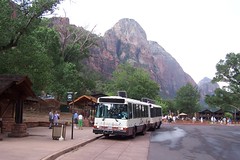
Shuttle Busses at Zion LodgeImage by J. Stephen Conn via Flickr
The Mobilizing the Region blog from the New York/New Jersey/Connecticut tri-state area has an interesting blog entry about America’s Great Outdoors Initiative.

Getting to “America’s Great Outdoors”

One of the major points made in the entry is that the Obama Administration is holding get meetings about the great outdoors but there is almost no talk about transportation issues when it comes to the "Great Outdoors".

One of the biggest problems our great outdoors are facing right now is transportation. While many national parks have shuttle systems and other tour options, only Utah's Zion Park has gone to the extreme of banning cars because of how many traffic jams is being created by automobiles in the park.

On the other hand the Grand Canyon proposed building a light rail system to make it easier to shuttle around the park but was stopped by conservative politicians in the Grand Canyon state.

However, while some parks such as Zions may be dealing with transportation within the park, most parks and the administration is doing nothing about getting people TO the national parks and other outdoor activities.

For example, while have to use the shuttle buses to travel through Zions in the peak season, unless you take one of the tour buses from the Las Vegas area your only option in reaching Zions by automobile. Arches on the other has the opposite problem. While there is private carriers that provide service from the Salt Lake area to Moab, the only way to access Arches without a car is by escorted tours. The problem with escorted tours is they give you little freedom and can be very costly.

Yellowstone National Park is another example of a park that is having issues with the number of automobiles using it. However, once again the non-automobile options are very limited. While they have restarted bus service around the park, the options for getting there is limited. You can use AllTrans from Salt Lake City to Jackson you have to take a tour from there. Until a few years ago Greyhound offered a daily bus from Salt Lake City to Bozeman via West Yellowstone but that route died when Greyhound went through one of its reorganizations a few years ago.

Glacier and Yosemite are probably two of the best options if you are doing a national park car free. To visit Glacier you can take Amtrak to West or East Glacier and take the shuttle options for there. Yosemite on the other hand has train and bus service to Merced where you can take Yosemite transportation to the park from there.

Lets take a look closer to home. Previously I have gone over my problems with the UTA's ski bus service. However, the service does provide a good function by getting people to ski areas and reduce the need to drive especially during the dangerous conditions that occur in winter.

The question is, what do people do the rest of the year to reach the mountains? UTA does provide two round trips a day up to the Alta/Snowbird area when the ski buses are not running, they are useless for most people trying to access recreation areas. For example when I go hiking near Brighton there is no option except to drive.

While it is great to encourage people to use the great outdoors, we also need to look at how people are going to travel and get around once they get there.
Enhanced by Zemanta

Thursday, June 10, 2010

This Week in Amtrak

Southeastern "Javelin" unit 395018 a...Image via Wikipedia


Volume 7, Number 16
June 10th, 2010


A weekly digest of events, opinions, and forecasts from


United Rail Passenger Alliance, Inc.

America's foremost passenger rail policy institute


Jacksonville, Florida USA

Telephone 904-636-7739, Electronic Mail info@unitedrail.org . http://www.unitedrail.org

------------------------------------------------------------------------
This week: A brief report from each coast and then we look at some Amtrak finances.

On the right coast, some good news for the passenger rail manufacturing industry, and a lesson in perseverance. Around 1974 when I was in fourth grade my parents took me to a public meeting about Washington Metro.
Even then, I loved studying maps; and one of the "future extensions" was to Dulles Airport. A mere 35 years later, that line may have a chance to finally be built --- which is quite quick, really, compared to Boston's extension of its Red Line past Harvard (proposed in 1912, with the Cambridge segment completed in 1985). In any case, here's is part of WMATA's press release
:

Metro's Board of Directors approved a contract today (May 27) to
have Kawasaki Rail Car, Inc., manufacture 428 new generation
Metrorail cars known as the Series 7000 cars at a cost of $886
million. The cars will address Metro's number one safety priority to
replace its oldest rail cars (Series 1000).Of the 428 cars, 128 of
the cars will enable the expansion of Metro service on the Dulles
rail corridor and 300 of the cars will be used to replace Metro's
oldest rail cars (Series 1000), which will improve safety and
reliability of Metro's fleet. The Dulles rail cars will be funded by
the Metropolitan Washington Airports Authority...
The delivery schedule calls for the cars to start arriving on Metro
property in 2013, and undergo a rigorous, months-long inspection
process. All 428 cars are scheduled to go into service by 2016....
Kawasaki Rail Car, Inc., will manufacture the new rail cars in
Lincoln, NE...

Kawasaki has built single and double level commuter railcars, as well as NYCTA subway cars, partially at the Lincoln plant with final assembly at Yonkers, New York. At least one factory in America will be busy for awhile.

Now to the left coast, where Democratic Congresswoman Anna Eshoo /ponders in the San Francisco Chronicle/
what will happen to Caltrain's nearly forty thousand daily riders in California's anemic budget, even as plans for high speed trains in the same corridor proceed, threatening Caltrain on a variety of levels:

For many months, the people of the 14th Congressional District have
been worried -- and justifiably so -- about what high-speed rail
could mean to their communities. Now comes word of financial
difficulties that threaten the future of Caltrain, the spine of the
Peninsula transportation system and the little train that could, and
does so much, to serve us...

The High Speed Rail Authority has to hit the reset button, improve
its reputation and assuage Peninsula residents, who have every
reason to fear that this project will be a nightmare... We need to
see what high-speed rail will do for us, not only to us. In other
words, we need high-speed rail on the Peninsula to be a betterment,
not a detriment. One of the betterments we expect is an improved
Caltrain, and that is something that can be done right now...

Perhaps California will look at England's "Javelin" trains, the long-anticipated high-speed commuter trains that only recently replaced a large part of the usual fleet of electric trains between London and the southeast Kent coast. The /Evening Standard/ reports
:

The 140mph hour Southeastern trains linking Kent to London were
launched with great fanfare [in] December [2009]... [the fleet of]
29 Japanese Javelin trains were expected to be embraced by commuters
as they cut an hour from the London-to-Dover route...

But [train operator] Southeastern has now halved the length of six
of its trains because not enough people are using the services
following complaints they are too expensive and uncomfortable. The
fares cost a third more than those of conventional trains....

Commuters have complained the trains only take them to St Pancras
and they then must cram on to "normal" Victoria or Cannon
Street-bound services, which have been reduced to accommodate the
Javelin trains.

Commuter John Cherry, from Chatham, said the new service had proved
a "disaster" for many.

He said: "Passengers for Victoria lost their peak period services
and now pack on the remaining reduced services or the Cannon Street
services as people do not wish to go to St Pancras."

Another traveller said passengers have "rebelled against being
forced to use an even more expensive service with uncomfortable
trains which terminate in a place no one wants to be..."

This is exactly what could happen in California if new high-speed trains bypass many existing stations and run to a new terminal that does not connect to BART and Muni properly. One could also maintain the same thing has happened with Acela from its inception.

Finally this week we look at the wonderful world of Amtrak-o-nomics.
Bruce Chapman of the Discovery Institute wrote on June 1
of a "Developing scandal at Amtrak" --

I served on the Amtrak Reform Council ten years ago and was
frustrated, ultimately, by the failure of the Bush Administration
and the Republican Congress to press harder for changes to Amtrak
that would have made that entity more transparent in its finances
and more collaborative with the private sector...

The Bush folks knew we needed reform, but couldn't deliver it, and
wouldn't fund the transition to a public-private partnership. The
Obama people are prepared to spend plenty, but not to reform the system.

Now we are seeing the public beginning to a scandal

of unknown proportions at Amtrak. It broke in the /Washington Times/
today.

The scandal could be the grounds for a true new beginning in
passenger rail. America needs rail, not just as an alternative
choice to roads and airplanes in carrying freight, but also in
carrying people on many inter-city corridors.

The article to which he refers is from the /Washington Times/ via Mass Transit Magazine, and titled Amtrak 'Misled' Congress on Finance

When Amtrak assured Congress it was on a "glide path" to free itself
of federal subsidies early last decade [2001], a handful of top
executives secretly had reason to know better. In fact, the rail
service was on the verge of bankruptcy.But Amtrak's public
assurances were based on far more than overly rosy financial
projections... What authorities ultimately unraveled was that two
former Amtrak officials, in fiscal 2001, either booked false or
incorrect accounting entries in Amtrak's monthly financial
statements or failed to report the activities.

Mr. Chapman sees hope in this adversity, and perhaps there may be some; but let us remember that "Amtrak accounting," like "military intelligence," is at best a questionable subject. If you have not recently read Ayn Rand's /Atlas Shrugged/, please hasten to your local library or bookstore for a copy. This tome of over a thousand pages is well worth the reading, or re-reading. Published in 1957, and focusing on American national politics and economic structure, it recounts the tale of a Dagny Taggart who struggles to keep her family's transcontinental railroad afloat against a tide of socialism and nationalization, and a Hank Rearden who invents a revolutionary steel-replacing metal only to encounter the same destructive forces.

In the book, Wesley Mouch's Steel Unification Board is proposed to lift the heavy restrictions previously imposed on Rearden, with a Plan explained by the government representative:

"Our Plan is really very simple," said Tinky Holloway, "...every
company will produce all it can, according to its ability [with all
earnings collected and assembled by the government]; at the end of
the year... [we will] distribute these earnings by totaling the
nation's steel output and dividing it by the number of open-hearth
furnaces in existence... The preservation of its furnaces being the
basic need, every company will be paid according to the number of
furnaces it owns..."

Rearden, who heads the nation's only remaining innovative steel-making plant, retorts:

"Well, let me see," said Rearden. "Orren Boyle's Associated Steel
owns 60 open-hearth furnaces, one-third of them standing idle and
the rest producing an average of 300 tons of steel per furnace per
day. I own 20 open-hearth furnaces, working at capacity, producing
750 tons of Rearden Metal per furnace per day. So we own 80 'pooled'
furnaces with a 'pooled' output of 27,000 tons, which makes an
average of 337.5 tons per furnace. Each day of the year, I,
producing 15,000 tons, will be paid for 6,750 tons. Boyle, producing
12,000 tons, will be paid for 20,250 tons... Now how long do you
expect me to last under your Plan?"

You may recognize here the accounting basis for Amtrak's "Route Profitability System," which derived from the federal Interstate Commerce Commission's formulas for determining passenger train profits and losses. Amtrak, in a 1997 National Association of Railroad Passengers meeting, admitted that revenues were pooled, and expenses were allocated to trains "subjectively" [sic].

In this as in every instance where Karl Marx's "from each according to his ability, to each according to his need" has been applied, the doom of failure is not far off.

Case in point: My apartment complex sends me a water bill each month.
The total number of gallons used by the complex --- for each apartment, plus the pool and irrigation --- is added up, and divided by a formula involving the square footage of each unit and the number of registered occupants. This means that if I do my part and conserve water, I am punished because my parsimony is a microscopic fraction of the total, so I am charged effectively the same amount; yet if I squander water and let it run all day, my bill is again hardly unchanged. Clearly, then, the incentive is to waste water.

The manager of an Amtrak train is faced with the same quandry. Carry more passengers and you are allocated a much larger share of expenses, even though your revenues increase only slightly. Ideally you would carry zero passengers, because then your train would have zero expenses on an allocated basis.

Is it any wonder Amtrak has gone precisely no-where in its almost forty years of existence?

Please do read /Atlas Shrugged,/ for we will be looking at it again quite soon.

Meanwhile: The moment someone says, "Don't worry, I'm from the government, I'm here to help!" is the moment you should look for the exit.

------------------------------------------------------------------------
If you are reading someone else's copy of This Week at Amtrak, you can receive your own free copy each edition by sending your e-mail address to


freetwa@unitedrail.org


You MUST include your name, preferred e-mail address, and city and state where you live. If you have filters or firewalls placed on your Internet connection, set your e-mail to receive incoming mail from twa@unitedrail.org ; we are unable to go through any approvals processes for individuals. This mailing list is kept strictly confidential and is not shared or used for any purposes other than distribution of This Week at Amtrak or related URPA materials.


All other correspondence, including requests to unsubscribe should be addressed to


wlindley@unitedrail.org


Copies of This Week at Amtrak are archived on URPA's web site, www.unitedrail.org


URPA leadership members are available for speaking engagements.


William Lindley
c/o wlindley.com, l.l.c.
PO Box 3621
Scottsdale, AZ 85271
480-947-6100

Enhanced by Zemanta

Monday, July 13, 2009

This Week in Amtrak

The Northbound AmtrakImage by Rob Shenk via Flickr

This Week at Amtrak; July 13, 2009


A weekly digest of events, opinions, and forecasts from


United Rail Passenger Alliance, Inc.

America’s foremost passenger rail policy institute


1526 University Boulevard, West, PMB 203 • Jacksonville, Florida 32217-2006 USA

Telephone 904-636-7739, Electronic Mail info@unitedrail.org • http://www.unitedrail.org


Volume 6, Number 22


Founded over three decades ago in 1976, URPA is a nationally known policy institute which focuses on solutions and plans for passenger rail systems in North America. Headquartered in Jacksonville, Florida, URPA has professional associates in Minnesota, California, Arizona, New Mexico, the District of Columbia, Texas, New York, and other cities. For more detailed information, along with a variety of position papers and other documents, visit the URPA web site at http://www.unitedrail.org.


URPA is not a membership organization, and does not accept funding from any outside sources.


1) It’s 10:30 A.M. on any morning of the year, and Amtrak train number 97, the southbound Silver Meteor, is racing southward through Northeast Florida on its way to the barn in Miami, due in the Hialeah/Miami suburb station more than eight hours later. Once the flagship train – complete with the trademark Pullman Sun Lounge – of Seaboard Air Line Railroad’s Silver Fleet, the Meteor is traveling over SAL’s once arch rival’s Atlantic Coast Line main line south of Jacksonville. Today, the Meteor is hosted by SAL/ACL successor CSX.


The Silver Meteor has a baggage car, sleeping cars, full diner, lounge, and coaches. It’s the coach passengers who have that look of quiet desperation, just waiting for their station stop to come so they can get off the train. Orlando, home of Walt Disney World and other Central Florida world-famous attractions is still two and a half hours away. Many of the train’s passengers will detrain at the Orlando station, with visions of Mickey Mouse dancing in their heads. A surprising number of passengers will also board in Orlando, headed south into Florida’s cattle and orange grove country, on the way to South Florida’s Gold Coast and the solid metropolitan area from north of West Palm Beach all the way to Miami and beyond.


The diner has been closed after breakfast for more than an hour, and the lounge car has its typical denizens, some working on their first – or second or third – morning eye-opener. Everywhere you look, passengers and crew look weary. The train and engine crew are fresh, having boarded in Jacksonville for the trip to Miami after a good night’s sleep. The onboard services crew is on the last eight hours of their shift which began several days before at the Miami crew base for their northbound trip to New York City, and the turn to come home on the southbound Silver Meteor. By union contract in these modern times, each of these employees which are designated as safety employees, are entitled to four hours of sleep the previous night. Some get more, some of the sleeping car attendants get less if they have entraining or detraining passengers along the route during their designated sleep periods.


You can look at the coach passengers and easily say to yourself, this group of people needs a bath. The passengers who boarded in New York City at Penn Station have been on the train for more than 19 consecutive hours, the Washington, D.C. passengers 15 hours, and the Richmond, Virginia passengers 13 hours. If the coach was full, these people were trying to sleep with 53 of their new best friends, some sitting next to total strangers, crying or restless children, or fidgeting smokers on a non-smoking train. No one got a good night’s sleep, and this morning, the coach itself looks like it’s been hosting people for the 1,000 miles its traveled. The floors are messy, the trash bins are getting full, and the restrooms could use some attention.


For coach passengers, there are no showers, and the tiny restroom offers some opportunity to clean up a bit, but only if you’re not a large person.


Are we there yet? is written on everyone’s face.


The Silver Meteor’s sleeping car passengers are faring somewhat better. They each had a bed with real linens and blankets and soft pillows for the night, and most passengers took advantage of the gentle rocking motion of the car, pretending they were back in an infant’s cradle. Each sleeping car has a community shower for the roomette passengers, those traveling in full bedrooms have their own individual shower. There is plenty of hot water for bathing and cleaning up, and fresh clothes come out of the suitcases. Upon awakening, coffee or orange juice along with a newspaper was available from the sleeping car attendant to help brace for the day before the full breakfast in the dining car which was included in the price of the sleeping accommodation.


Sleeping car passengers, too, look a bit road-weary, but they can comfortably nap in their private accommodation without worry of someone waking them up, other than for the call to luncheon.


Detraining coach passengers gather their belongings and step off the train relieved to be at their destination. Sleeping car passengers tip the car attendant and gather their bags on the platform and go in search of their local transportation, ready to face the day at their destination.


Does this sound like class warfare? Nah, it’s just the very real difference between traveling on Amtrak in coach or in a sleeping car.


Coach travel is fine for daylight travel if you really like being in a long, silver tub with dozens of other strangers and travelers, just like on an airplane or in a bus.


But, for overnight travel, it’s tough to beat the comforts and conveniences of sleeping cars.

The difference in fares is dramatic. New York City to Orlando on the Silver Meteor for two people in coach, one-way costs a total of $308.00. In a full bedroom, the same two travelers taking the same trip would pay $973.00. Both of these fares are based on summer season travel in August.


There is a huge difference of $665 for the same 21+ hour trip. For the extra cost dinner and breakfast is included, and lunch, too, if you eat quickly enough to finish before the train arrives in Orlando at the scheduled time of 12:55 P.M. You get two beds, a shower, toilet, sink, towels, and all of the other usual comforts of a rolling hotel room, including most importantly the ability to close the door, turn off the light, and go to sleep in a bed with pillows, fresh sheets, and blankets.


Too rich for your blood? Yes, it’s pricey, but Amtrak regularly fills the sleeping cars on the Silver Meteor and its sister train, the Silver Star. In fact, sleeping car business does well on all Amtrak long distance trains, with the full, more expensive bedrooms usually selling out before the smaller roomettes designed for one regular size person or two very small people.


Amtrak, always feeling like it must be proletariat, seldom has placed much emphasis on its sleeping car business, and has always focused on the much less desirable, and lower revenue generating coaches. When calling an Amtrak reservations center, often only coach seats are offered; passengers have to ask about sleeping cars.


VIA Rail Canada, Amtrak’s cold country cousin to the north, however, has always placed a high emphasis on its sleeping car business and offers a variety of sleeping car accommodations choices, ranging from the very old Pullman Company-style open berths to elegant drawing rooms, designed with two lower berths and one upper berth. On VIA, it’s the drawing rooms which sell out first.


Amtrak, as it’s ordering new single-level Viewliner sleeping cars and hopefully planning to order new Superliner sleeping cars, needs to revisit the wonders and many advantages of drawing rooms.


Looking at the demographics of Amtrak’s sleeping car passengers, much of the business comes from middle-aged and older traveling couples, people who want two lower berths in their sleeping accommodation, not one upper and one lower. To make this happen, wealthier passengers often pay for two full bedrooms which open en suite to offer a single space with two lower berths.


Amtrak doesn’t care if two people buy space designed for four people, because the cost to feed four people has been factored into the fare (Money Amtrak keeps without complaining when it only has to feed two people.), and the high revenue from selling two bedrooms instead of one looks pretty good.


Well, actually, it’s not so good, because if that same space had been sold to four passengers instead of two passengers, an additional $234 in rail fare (Amtrak charges sleeping car passengers the lowest bucket rail fares in addition to the accommodations charges for each passenger.) would have been collected. If a new design was hatched for sleeping cars which reshuffled priorities to maximize revenue and passenger satisfaction, each sleeping car would have at least four bedrooms, one drawing room, and perhaps seven or eight roomettes.


When the Viewliners were designed, three basic mistakes were made in this experimental car. First, no public restroom was included in the design. When the toilet facilities in any given room are non-functioning, and all accommodations are sold, passengers either have to impose on the facilities of the car attendant (not a good idea) or go to a restroom in another car. All in all, very inconvenient and unprofessional in the design. Second, instead of the former six full bedrooms which were found in the predecessor Heritage 10 roomette, six bedroom cars, only three full bedroom were included, one being a handicapped room. Third, no drawing rooms with three berths were included.


When the original 10/6 sleeping cars were designed during the World War II era, roomettes for one passenger were primarily designed for traveling businessmen. If a passenger was a midnight sailor and had to make use of the toilet, he had to get out of bed, open the door to the room, and back into the hallway inside of a closed curtain to raise the bed which folded down over the toilet, and then repeat the process to go back to bed. In the Viewliners, smaller beds are used and allegedly passengers can access the micro-size toilet which is not covered by the bed when the beds are in use. This, however, does require a certain knowledge of gymnastics to accomplish that feat.


In the process of all of this, Viewliners have fewer full bedrooms, and more roomettes, which contain two beds instead of one bed as found in the 10/6 roomettes. However, since the overall floor space remains about the same as the old roomettes, trying to squeeze two normal sized adults into this space leaves much to the imagination and to be desired, not to mention you have two people using non-private toilet facilities, which harkens back to some Pullman accommodations on western trains prior to World War II. In the Heritage fleet, as in the fleets of all of the pre-Amtrak passenger railroads, a number of all-bedroom cars were found, offering a choice of bedrooms, drawing rooms, and compartments, but no roomettes.


When Amtrak ordered the Viewliners, only 50 were purchased, replacing nearly double that number of Heritage sleepers, allegedly, again, because Viewliners held more passengers so fewer cars were needed. In reality, Amtrak made a conscious decision to restrict the number of sleepers in its fleet, and have less accommodations for sale overall, thereby restricting sleeping car revenues.


Prior to the arrival of the Viewliners in the mid-90s, it was common for the Florida long distance trains and the Crescent between New York and New Orleans to have five or more sleeping cars per train. Today, five cars have been replaced by two or three sleeping cars per train, with dramatically fewer bedrooms for sale, and fewer roomettes, too.


Let’s stop for a moment and do a quick comparison. Amtrak and its many True Believers, egalitarian to the core and non-believers that those who wish to pay for better accommodations should suffer along with the rest, for years made the claim the company makes more money from coach passengers than from sleeping car passengers. Oh, really? Well, no, it doesn’t.


Let us stick to our same trip model, from New York City’s Penn Station or Orlando, Florida. Just for comparison purposes, using fares quoted today for travel in about a month’s time in August, weigh the income from a full coach with 54 passengers to a full Viewliner sleeping car with all accommodations sold. The fully sold out coach brings in ticket revenue of $8,316. The fully sold out sleeping car brings in ticket and accommodations revenue of $10,433, more than $2,000 more in revenue.


And, yes, each of those sleeping car passengers will consume food in the dining car that’s included in the cost of the accommodation. However, it’s doubtful even the most ravenous group of sleeping car passengers, eating full dinners and breakfasts, will consume $2,000 worth of food.


And, yes, many of those coach passengers will also find their way into the dining car, adding extra revenues. Even if every coach passenger spent a total of $25 on dinner and breakfast in the dining car, they would only spend an additional $1,350, still not adding up to the additional revenue from the sleeping car.


Remember, those sleeping car passengers will have other opportunities (Although limited by Amtrak.) to spend money on the train in for form of alcohol sales in the dining car and alcohol and snacks sales in the lounge car. Plus, travelers in sleeping cars are also more likely to have a higher amount of disposable income to spend on the train in the diner and lounge than coach passengers.


Overall, if Amtrak took a page from the VIA Rail Canada book and understood the high value of sleeping and dining car business, it would be eager to operate more sleeping cars, instead of scoffing at sleepers as something that are somehow unpatriotic to operate because of egalitarian concerns.


2) The ideal train – whether long distance or short distance – has a variety of accommodations. Back in the days prior to Amtrak of the Pennsylvania Railroad’s Congressional Service (The Pennsy was the builder and original owner of what is today Amtrak’s Northeast Corridor.) between New York City’s Pennsylvania Railroad Station and Washington, D.C., passengers had a choice of coach seats, parlour car seating, or private accommodations in sleeping cars set up for day use. The Pennsylvania recognized not one size fits all for travel accommodations, and a good number of passengers were willing and able to pay additional fares for larger seats in less crowded cars, or completely private accommodations with private plumbing in each accommodation. This wasn’t class warfare, this was a recognition of the marketplace and the proper exploitation of the marketplace for (Gasp!) profit.


Congressional Service trains also had a combination of full dining cars, parlour bar lounges, coffee shop taverns, and grill cars. Depending on the size of the train, time of day operated, or level of service advertised, there were drinking and dining choices appropriate for the service.


Amtrak’s Metroliners had first class seating which was three across: one seat, an aisle, and then two larger than normal coach seats. The Metroliners, which were also originally designed by the Pennsylvania Railroad, intentionally recognized the different tastes of travelers, and how accommodations charges could be both profitable and fun.


There is little reason why today’s Amtrak long distance trains cannot have some innovation in coach seating with a few modifications to existing equipment to create a first class/parlour car service with accompanying accommodations charge.


The installation of showers in first class coaches would be a great improvement, and a shower service could either be included in the accommodation price or sold separately onboard by the car attendant when providing towels and bathing articles.


Changing seating from four across to three across is another simple innovation for part of the cars; adding special areas for family travel where five or six seats are clustered together for large groups or families is also an inviting concept.


Adding a self-service food service area, offering 24-hour coffee, cold drinks, and light snacks and perhaps newspapers enhances the experience without dramatically taking away from lounge car sales. Including dining car meals in the price of a first class coach seat adds instant, guaranteed revenue for the dining car and an excellent perk for passengers.


Working on the same principle as for sleeping cars which produce higher revenue for every car carried, first class coach, with fewer coach seats per car, but higher fares for additional parlour car/first class coach seating would serve two excellent purposes: First, those not wishing to spend the costs of full sleeping car accommodations would have a good second choice for travel comfort, and second, fewer passengers in an upscale environment make for a much more pleasant trip overall then being jammed in a long distance coach with 53 of your closest, new best friends.


Coach class could remain for those taking shorter trips or those seeking truly budget accommodations.


3) The idea is to create a broader market for passenger train travel, higher revenues for Amtrak, and a better travel environment.


No one will dispute the annoyance and discomfort of air travel. What was once glamorous has become more than annoying and almost punitive. Today’s air travel is today’s agony. It’s not uncommon for someone to wonder if flying is really “worth it” for all of the hassles one has to go through, from the removal of shoes before you can be allowed to board the aircraft to a total restriction of what you can carry with you on the airplane. Speed does not always trump every other consideration.


Amtrak has a golden opportunity to become the carrier of comfort and convenience, and the carrier of value.


As said before in this space, Europeans are often shocked at the low cost of Amtrak coach travel; if Amtrak chooses to upgrade its service and accommodations offerings, based on how well sleeping car accommodations are sold today, Amtrak has a grand opportunity to become a carrier of first choice instead of a carrier of last choice – or even worse, the forgotten carrier. Amtrak remains America’s best kept secret. Imagine the demand if even a third of Americans knew passenger rail service was available to them.


4) >From Amtrak This Week, that OTHER publication, not to be confused with This Week at Amtrak. Amtrak This Week is the company’s employee news and information publication.


[Begin quote]


July 13, 2009


First Stimulus-Funded Car Returning to Service


Today, President and CEO Joe Boardman, U.S. Senator Tom Carper (D-Del.) and other elected officials were in Wilmington, Del., as the first car refurbished with funds from the American Recovery and Reinvestment Act departs Bear Car Shops on its way back to the active fleet.


“The real story today is about people – the Amtrak passengers who will ride in these rehabilitated cars and the workers who are doing a great job bringing them back to life,” said Boardman, noting that the additional seating capacity on its trains will help connect families, further business relationships, and position Amtrak for expected future growth in ridership.


The car, Amfleet II Coach 25103, was built in 1982 but has been out of service since April 2005, when it was damaged in a rail yard accident in Florida. It is the first of 60 Amfleet cars that will be returned to service by early 2011. The Amfleet I and II cars in the project are either being converted, rehabilitated from wreck status or undergoing a Level 3 overhaul. The cost per unit ranges from $615,000 to $1.4 million depending on the level of work being done.


Two additional ARRA-funded projects will put 15 diesel locomotives and 21 long-distance cars back in the fleet over the same time period. The combined cost of the three projects is $91 million.


“An expanded fleet is a critical part of our ability to grow,” said Vice President of Policy and Development Stephen Gardner. “We need these cars as we pursue new service in partnership with states and also to increase capacity along existing routes where demand exceeds what we can currently offer.”


To meet the labor needs of refurbishing and overhauling nearly 100 cars in under two years, the Mechanical department has expanded its force by adding 160 new positions between facilities in Wilmington and Beech Grove, Ind. Competition was extremely high, as the company received 3,200 applications and conducted more than 400interviews to fill the 160 positions.


[End quote]


If you are reading someone else’s copy of This Week at Amtrak, you can receive your own free copy each edition by sending your e-mail address to


freetwa@unitedrail.org


You MUST include your name, preferred e-mail address, and city and state where you live. If you have filters or firewalls placed on your Internet connection, set your e-mail to receive incoming mail from twa@unitedrail.org; we are unable to go through any approvals processes for individuals. This mailing list is kept strictly confidential and is not shared or used for any purposes other than distribution of This Week at Amtrak or related URPA materials.


All other correspondence, including requests to unsubscribe should be addressed to


brucerichardson@unitedrail.org


Copies of This Week at Amtrak are archived on URPA’s web site, www.unitedrail.org and also on www.todaywithjb.blogspot.com where other rail-related writings of Bruce Richardson may also be found.


URPA leadership members are available for speaking engagements.


J. Bruce Richardson

President

United Rail Passenger Alliance, Inc.

1526 University Boulevard, West, PMB 203

Jacksonville, Florida 32217-2006 USA

Telephone 904-636-7739

brucerichardson@unitedrail.org

http://www.unitedrail.org

Reblog this post [with Zemanta]