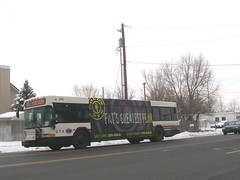
Image via Wikipedia
I have commented many times on the difficulties presented to transit agencies with the passing of the Americans with Disabilities Act. One of the biggest difficulties is the bill created an unfunded mandate that transit agencies need to provide services to those with disabilities but provided no money to actually provide the service.
Notice, I am NOT saying that people with disabilities should not have transportation however, what we have to recognize the the service is costly and the funding has to come out of a transit agencies operating budget which means that route service has to be cut to provide paratransit service.
Depending on the transit agency, the average cost to provide service is anywhere from $25.00 to $35.00 per rider which is several times higher than providing regular bus service or even more times higher per passenger for most light rail services.
However, the ADA did not just require transit agencies to provide a totally separate transit system. It also required transit agencies to make their regular bus service accessible. At first this included adding wheel chair lifts. For some agencies such as RTD in Los Angeles this was not a big deal since they started ordering buses with wheelchair lifts back in 1977 with the 200 buses they received from American Motors General.
Gradually transit bus manufacturers and transit agencies transitioned from high floor buses with wheelchair lifts to low floor buses. While the wheelchair lifts were expensive to maintain the low floor buses have their own disadvantages including lower passenger capacity and other design issues.
To reduce the cost of Paratransit service transit service has a couple of alternatives to make it more efficient.
Once solution that many transit agencies have done is contracting out Paratransit service to private operators. Of course transit agencies are ripped to shreds over the service provided by the contractors and how they do not care about the disabled. The question has to be asked, since the service is essentially a glorified taxi service and not true transit service, are transit agencies doing the right thing by contracting out the service.
Another way to reduce the price of Paratransit service is for agencies to limit those who ride paratransit service to those most in need. Those who do not meet the standards for Paratransit service then have to ride regular bus service. While that reduces cost it is also fodder for activist and also slows down regular transit service since it takes longer to get those people on and off the bus service.
A third way that transit agencies are reducing the cost of Paratransit service is to only provide service to the 3/4 of a mile limit from a regular bus routes that is mandated federally. Once again this is extremely controversial and is blasted by those located outside that service area.
Finally you have the Flex and Call N Ride routes that Denver and Salt Lake have implemented that provides both regular route and off route service with small vans that substitute for regular paratransit service.
Whichever route a transit agency decides to take to reduce the cost of Paratransit service, they will be criticized for the decisions they will make. However, transit systems have a fine balancing act of providing transit service to the maximum number of people possible with limited funds (that are even more limited during these economic times).
Of course the ultimate solution would be to build livable cities that someone with limited mobility can get the services they need without long trips. One of the often overlooked aspects of livable development is that if people with disabilities are able to live with easy reach of businesses and services they use frequently, they fewer trips they will need on Paratransit service.
Until then transit agencies will have to continue to do the balancing act will continue between cost and needs.