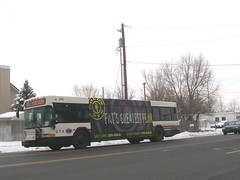
Over the last few months I have watched in interest the battle over raising fares on the Paratransit service known as Flextrans. Those of you who read my blog on a regular basis know my feelings on what is wrong with Flextrans so I will not repeat it too much here.
What is really frustrating about this whole debate is that there is no willing to compromise to make a better solution especially on the part of special needs advocates. They would advocate cutting regular bus service to keep Flextrans at its present levels no matter what the cost. You would think that this would put a certain group who shall remain names and worthless in a pickle because they want more bus service not less however, thanks to one of the local road warriors they have come up with a solution.
The road warrior has advocated making the people on TRAX "pay the price" for daring to actually want to ride TRAX by making them pay a surcharge to keep the overpriced Flextrans service running everywhere possible.
So let me get this right, we will take the group using the most cost effecient form of transit in the area who already pay taxes to keep FLEXTRANS running, and make them pay even more for the service that by law they have no right to ride. Of course the road warrior will always remind you that they are paying for transit if they don't ride it but lets remember that at least they have the right to ride it, TRAX riders cannot ride FLEXTRANS.
That brings up one of the biggest problems that has been created by the Fedrally unfunded mandate the ADA. As I remember the ADA had the noble purpose of giving people with disabilities equal access and that included transit service. Part of that included putting in high cost wheelchair lifts and kneelers on the high floor buses that were a maintance nightmare. Then we moved on to the low floor buses which is a boone not only to the handicapped but also to the elderly and others who had a hard time getting up the steps. The problem of course is that the low floor buses seat fewer passengers and do not hold up compared to their high floor brethren.
However, the ADA also created a second transit system for those who could not reach the regular bus route and that is where FLEXTRANS comes in. So not only do we have equal access to transit but we have a special privilage service that only a select group get to ride. Now this would be problem if the cost were reasonable but instead, it cost 20 times more per passenger than does someone boarding TRAX or 10 times more than a passenger on the bus.
Up to this point UTA like many transit systems provided FLEXTRANS service beyond the federal requirements. However, as the cost has gone up, tax revenue has gone down, and other transit funding sources have dried up, it is becoming clear that something must be done to make FLEXTRANS more effecient and cutting out areas that are not required by ADA is a good place to start.
Am I saying that people outside the area should be left out in the cold so to speak? Of course not but we also need to realize that is not a transit issue but a community issue.
The County Council has chimed in on the issue and opposed the FLEXTRANS price increases. However, once again the council doesn't offer any solutions to the problem, they just want to score some political points by saying they were not in favor of the price increase. If the county council really wants to do something, maybe they should come up with some funding alternatives for the service since this is a community issue.
Clearly we need long term solutions to the high cost of FLEXTRANS and the disabled advocates need to come to the table with some good ideas instead of the usual dog and pony shows.
![Reblog this post [with Zemanta]](http://img.zemanta.com/reblog_e.png?x-id=94f2d741-fb56-4ec5-b3e5-c2bbc9721c28)