Showing posts with label ADA. Show all posts

Friday, December 03, 2010

The Balancing Act of Paratransit Service

This is a sample of all services provided unde...Image via Wikipedia
I have commented many times on the difficulties presented to transit agencies with the passing of the Americans with Disabilities Act. One of the biggest difficulties is the bill created an unfunded mandate that transit agencies need to provide services to those with disabilities but provided no money to actually provide the service.

Notice, I am NOT saying that people with disabilities should not have transportation however, what we have to recognize the the service is costly and the funding has to come out of a transit agencies operating budget which means that route service has to be cut to provide paratransit service.

Depending on the transit agency, the average cost to provide service is anywhere from $25.00 to $35.00 per rider which is several times higher than providing regular bus service or even more times higher per passenger for most light rail services.

However, the ADA did not just require transit agencies to provide a totally separate transit system. It also required transit agencies to make their regular bus service accessible. At first this included adding wheel chair lifts. For some agencies such as RTD in Los Angeles this was not a big deal since they started ordering buses with wheelchair lifts back in 1977 with the 200 buses they received from American Motors General.

Gradually transit bus manufacturers and transit agencies transitioned from high floor buses with wheelchair lifts to low floor buses. While the wheelchair lifts were expensive to maintain the low floor buses have their own disadvantages including lower passenger capacity and other design issues.

To reduce the cost of Paratransit service transit service has a couple of alternatives to make it more efficient.

Once solution that many transit agencies have done is contracting out Paratransit service to private operators. Of course transit agencies are ripped to shreds over the service provided by the contractors and how they do not care about the disabled. The question has to be asked, since the service is essentially a glorified taxi service and not true transit service, are transit agencies doing the right thing by contracting out the service.

Another way to reduce the price of Paratransit service is for agencies to limit those who ride paratransit service to those most in need. Those who do not meet the standards for Paratransit service then have to ride regular bus service. While that reduces cost it is also fodder for activist and also slows down regular transit service since it takes longer to get those people on and off the bus service.

A third way that transit agencies are reducing the cost of Paratransit service is to only provide service to the 3/4 of a mile limit from a regular bus routes that is mandated federally. Once again this is extremely controversial and is blasted by those located outside that service area.

Finally you have the Flex and Call N Ride routes that Denver and Salt Lake have implemented that provides both regular route and off route service with small vans that substitute for regular paratransit service.

Whichever route a transit agency decides to take to reduce the cost of Paratransit service, they will be criticized for the decisions they will make. However, transit systems have a fine balancing act of providing transit service to the maximum number of people possible with limited funds (that are even more limited during these economic times).

Of course the ultimate solution would be to build livable cities that someone with limited mobility can get the services they need without long trips. One of the often overlooked aspects of livable development is that if people with disabilities are able to live with easy reach of businesses and services they use frequently, they fewer trips they will need on Paratransit service.

Until then transit agencies will have to continue to do the balancing act will continue between cost and needs.

Enhanced by Zemanta

Tuesday, February 12, 2008

The Cost of Paratransit Service.


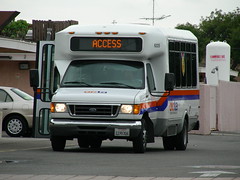
OCTA Access
Originally uploaded by So Cal Metro
In the first part of this series I discuss what was done with the regular bus network in order to comply with the Americans with Disabilities Act. Now its time to discuss the other part of the puzzle, the Paratransit service called Flextrans here in Utah.

The Anti-Hunger Coalition and its band of yellow shirts and the Transit Riders Union both try to portray TRAX as the reason why bus service is being slashed. It is an easy target for those who do not look closely and the numbers and truly sees what is happening. However, TRAX is not to blame when it comes to the cutting of bus service. Just take a look at some of these financial numbers

Just a note: I am using numbers from UTA’s 2006 budget. So that no one could say the ridership numbers were too high, I cut the actual ridership numbers on TRAX by 20% but left the others alone. Of course the some would argue that UTA is padding the numbers but the numbers are in line with transit systems across the nation and the world.

I also want to point out that I am NOT saying Flextrans is not needed, I am just pointing out the cost of the system compared to the rest of the transit system.

So here are some numbers to think about. Looking at costs vs. passengers, TRAX cost $1.37 per passenger. So in other words TRAX is covering its above the rail expenses (meaning direct operating cost) and contributing to overhead. This makes TRAX the second most efficient light rail system getting beat only by San Diego. However, the numbers are in line with the other systems as they are very close with the exception of Los Angeles but that is another story.

On the other hand, it cost $3.31 per passenger on the bus system. So not only is it not covering its direct operating cost, it is not contributing to overhead. This is one an area that UTA can improve since it is one of the more performing systems.

Finally you have Paratransit service. It cost $24.95 per passenger for every passenger that boards the Paratransit service. To put this in perspective if UTA did not have to provide Paratransit service, bus service could be increased 17% percent overnight. In addition Paratransit handles only 4% of the numbers TRAX does and 2.5% of the bus system.

So as you can see, what is costing the bus system is carrying the weight of the Paratransit service not TRAX.

Now the ADA was designed to give those that needed it, equal access which is a good goal. However, wasn’t equal access created by putting wheelchair lifts or the creation of low floor buses? This gives everyone the same access to transit service to everyone. However, the requirement for Paratransit service creates special services that everyone else is not entitled to ride.

Since Paratransit service is needed by those who use it, but is essentially a taxi cab social service, should the transit system budget be responsible to take care of it? Or should it be the responsibility of the social services agencies?

We also know how the Paratransit passengers screamed when UTA started requiring them to pay more for there services than regular bus service (although the amount of difference has dwindled). Should Paratransit riders be expected to pay more for the premium service they require?

These are not easy questions to answer.

Thursday, February 07, 2008

What is Costing UTA?


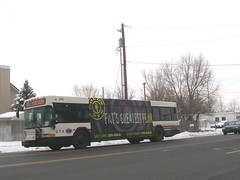
UTA Route 45 Gillig Advantage
Originally uploaded by jmdspk
Today I will begin a four part series on what is really costing the UTA. As regular readers will know, I have been critical of organizations such as the Anti-Hunger Coalition and the Transit Riders Union as they often become pawns of anti-transit forces and also demonize the rail program as being cause of all the problems.

However, in this series I will point out the most costly program the UTA has to deal with and that is satisfying ADA requirements. Let me make it clear I am not trying to debate the needs of the ADA, I am point out what it cost to deal with it. In part one I will deal with the regular bus system, in part two I will discuss Flextrans and in part three I will go over the latest demands of the ADA, and fourth I will discuss some solutions.

In the late 70's wheelchair lifts started appearing on buses. The SCRTD in Los Angeles was one of the first agencies to purchase them with their AMG buses in 1977. However, until the ADA took effect, most transit agencies avoided them.

One of the problems with wheelchair lifts is that they can be extremely costly to operate and have been prone to multiple troubles. In addition the sidewalks need to be designed to be able to let the driver safely deploy the lift and everyone familiar with Salt Lake area sidewalks know they were not designed for that.

As a solution to problem of the lifts the bus manufacturers started coming out with low floor buses such as the Gillig Advantage pictured operating on route 45.

The idea of the low floor bus first came out with the Transbus program by the Federal Government in the late 70's. However most of the current bus manufacturers pulled out the program due to escalating cost, however when the ADA came along the bus manufacturers again started looking at the low floor buses.

There is two advantages of low floor buses:
-No Wheelchair Lift
-Faster loading and unloading of passengers if the transit system takes advantage of them (which UTA has not except in the poorly design BRT scheme on 3500 South).

There also several disadvantages:
-Reduced Seating Capacity
-Increase maintenance cost especially the front end
-Not Customer Friendly

There is other issues but those can be traced to poor build quality due to the transit systems not holding the manufacturers feet to the fire to build a better bus.

In conclusion, transit systems lost capacity and faced increased cost to cooperate the ADA. However, the real cost is Paratransit and in the next part of series I will go over the cost of providing Paratransit (Flextrans) service.