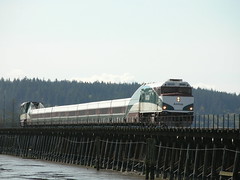
Showing posts with label Union Pacific. Show all posts

Saturday, June 12, 2010

Front Runner Construction Update

Salt Lake City Intermodal HubImage via Wikipedia


Greetings,


Construction is progressing on UTA’s FrontRunner South Provo to Salt Lake Commuter Rail line.

Below is the FrontRunner South construction update for June 12 – 18. Please visit UTA’s FrontRunner South Webpage to learn more about the project.


Visit www.flickr.com/rideuta to view exclusive FrontRunner South construction photos.


Area 16 — Downtown Salt Lake City to 4500 South (Murray)


Construction Activity:

Crews will form, tie rebar and pour concrete for one of the 3300 South bridge abutments and also begin work on the bridge’s wrap-around walls. At the 4500 South bridge crews will continue installing temporary shoring and excavation.


Traffic Impacts:

There will be lane restrictions in both directions on 3300 South during off-peak hours this week.


Please note that Central Avenue has reopened until crews resume work on the bridge walls.


Salt Lake Central Station:

Station complete.


Area 15 — 4500 South (Murray) to Wasatch Street/8000 South (Midvale)


Construction Activity:

Crossing upgrades will be made at the 4800 South crossing this week. Upgrades include signal and track work, the installation of concrete medians and signs, road striping, and asphalt replacement. At the 5300 South bridge crews will form, tie rebar and pour concrete for a cheek wall and also pour concrete for one of the bridge’s piers. Crews will be installing slope paving at the 7200 South bridge.


Traffic Impacts:

The 4800 South crossing will be closed from Monday, June 7 through Sunday, June 13.


There will be a lane closure with flaggers on Vine Street on Monday from 7:00 a.m. until noon.


There will be lane restrictions in both directions on 5300 South during off-peak hours this week.


There will be shoulder work on 7200 South this week.


Murray Station:

Crews will backfill the footings for the Murray Station platform.


Area 14 — Wasatch Street/8000 South (Midvale) to 14600 South (Bluffdale)


General Information:

Considerable progress has been made on the flyover structure west of Salt Lake Community College’s Miller Campus at 9800 South. The 642-foot flyover bridge features a 40-foot-high bridge deck that will allow FrontRunner to travel from the east to the west side of Union Pacific Railroad’s track way. The flyover structure’s approaches consist of keystone block MSE walls filled entirely with lightweight fill to minimize settlement.


Construction Activity:

Storm drain work continues between Wasatch Street and 9000 South and work on the walls continues at the flyover bridge. Storm drain work also continues at 10000 South and work will begin on a wall just south of 10000 South this week. At 10600 South crews will be drilling a shaft for the bridge Saturday night through Monday morning. Between Jordan Gateway and 11400 South crews will work on a water line and between 11400 South and 12300 South crews will excavate and embank the track way as well as install field fence. At the Bangerter Highway bridge, crews will repair the north sidewalk, strip forms from one of the piers and install shoring, drill soil nails and excavate at the north abutment.


Traffic Impacts:

The eastbound lane on 10000 South will be closed Monday through Wednesday; there will be flaggers directing traffic.


On 10600 South, all westbound lanes and the eastbound left lane will be closed from Saturday, June 5, at 8:00 p.m. until Monday, June 7, at 5:00 a.m.


There will be truck traffic with flaggers on 11400 South Monday through Friday.


There will be lane restrictions in both directions on Bangerter Highway during off-peak hours this week.


South Jordan Station:

Lightweight fill for the job is being stored at the station site.


Draper Future Station:

There are no construction activities to report.


Area 13 — 14600 South (Bluffdale) to Thanksgiving Point (Lehi)


Construction Activity:

Crews will continue to demolish the old Union Pacific track at the Mesa Siding. They will also begin creating access on the west side of the tracks below the Thanksgiving Point golf course to prepare for excavation of the slope.


Traffic Impacts:

There are currently no impacts to motorists in this area.


Area 12 — Thanksgiving Point (Lehi) to Main Street (American Fork)


General Information:

Crews are currently constructing two major bridges in Lehi at 2300 West and 2100 North. The 2300 West bridge will allow FrontRunner to travel over Lehi City’s future 2300 West road project and the 2100 North bridge will span UDOT’s future Mountain View Corridor, 2100 North roadway. The 2100 North bridge will feature abutments on each end of the bridge and five center piers. For the purposes of this publication, the piers are numbered 1 through 5 starting at the southern end of the bridge.


Construction Activity:

At the 2300 West bridge crews will install sheet shoring and begin excavation for the south abutment and form and tie rebar for the north abutment. At the 2100 North bridge crews will pull the sheet shoring at pier #5 and form the bridge deck. Structural backfill and surcharge will also be placed at the bridge. Between 2100 North and 1220 North crews will be plowing for duct bank and also installing power for signal houses. Prep work will begin for retaining wall construction between 900 North and 500 West and chain link fence will be installed between 500 West and Main Street. Between 200 South and 300 South crews will construct a wall and utility work will take place between 300 South and Center Street.


Traffic Impacts:

There will be truck traffic with flaggers in the following locations this week:

· Garden Drive near the golf course, Monday through Wednesday

· Garden Drive near Cranberry Farms, Monday through Wednesday

· 1500 North, Monday and Tuesday

· 300 South, Monday through Wednesday


Lehi Station:

A portion of the Lehi Station Park and Ride Lot is now open for public use.


Crews will form, tie rebar and pour concrete for the pedestrian tunnel footings and also continue work on the base for the ramp and stairs.


Area 11 — Main Street (American Fork) to University Parkway (Orem)


Construction Activity:

Between the American Fork Station site and 200 South crews will conduct mass embankment work and install a water utility box at the Pioneer Crossing project. Between 100 West and 100 East crews will be placing bottom ballast and near the 1100 South crossing crews will be constructing a retention pond. Crews will realign the road near the 1500 South crossing in American Fork and construct track between Geneva Road and 400 South in Orem. Finish work for crossing upgrades will take place this week at the 400 South crossing and between 400 South and 800 South crews will place a ballast mat. Fencing will be installed at the soil nail wall constructed near University Parkway.


Traffic Impacts:

There will be truck traffic with flaggers in the following locations in American Fork this week:

· American Fork Park and Ride, Wednesday through Friday:

· Storrs Avenue, Monday and Tuesday

· 100 West, Monday and Tuesday

· 1100 South, Wednesday through Friday

· 1500 South, Monday and Tuesday


There will be lane restrictions at the 400 South crossing in Orem this week.


American Fork Station:

Crews will install sidewalk and continue landscaping work at the Park and Ride Lot.


Vineyard Future Station:

There are no construction activities to report.


Orem Station:

Crews will work on snowmelt facilities.


Area 10 — University Parkway (Orem) to Center Street (Provo)


General Information:

Significant progress has been made in Area 10 along the Union Pacific Railroad corridor between University Parkway in Orem and Freedom Boulevard in Provo. Crews have prepared a path for FrontRunner by grading and clearing the right-of-way and relocating water lines. Drainage and irrigation installations are generally complete in this area, and main line earthwork has been finalized from University Parkway to 2000 South in Orem and from the Provo River bridge to 500 West in Provo. At-grade crossing improvements have also been completed in Provo at 2000 North, 2800 West, 1680 North, 820 North, Draper Lane, 900 West, 700 West, 500 West and Freedom Boulevard.


Construction Activity:

Between University Parkway in Orem and 2000 North in Provo, crews will install a perforated under drain, prepare the sub grade and place sub ballast. Crews will surface, line and dress the track between 1680 North and 820 North, install chain link fence near the Provo River bridge, place ties between 820 North and the Provo River bridge and excavate the track area south of University Avenue.


Traffic Impacts:

There are currently no impacts to motorists in this area.


Provo Station:

Crews will continue to place granular fill for the platform.

Thanks again for your interest in the FrontRunner South project. If you have construction-related questions,
please call our 24-hour construction hotline at 1-888-800-8854.


Enhanced by Zemanta

Wednesday, September 30, 2009

This Week in Amtrak

Amtrak Cascades Mud Bay Surrey BC 08-04-2005 1...Image by Stephen Rees via Flickr

This Week at Amtrak; September 18, 2009


A weekly digest of events, opinions, and forecasts from


United Rail Passenger Alliance, Inc.

America’s foremost passenger rail policy institute


1526 University Boulevard, West, PMB 203 • Jacksonville, Florida 32217-2006 USA

Telephone 904-636-7739, Electronic Mail info@unitedrail.org • http://www.unitedrail.org


Volume 6, Number 39


Founded over three decades ago in 1976, URPA is a nationally known policy institute which focuses on solutions and plans for passenger rail systems in North America. Headquartered in Jacksonville, Florida, URPA has professional associates in Minnesota, California, Arizona, New Mexico, the District of Columbia, Texas, New York, and other cities. For more detailed information, along with a variety of position papers and other documents, visit the URPA web site at http://www.unitedrail.org.


URPA is not a membership organization, and does not accept funding from any outside sources.


1) Word has come from Gil Carmichael, former Federal Railroad Administration Administrator and Chairman of the Amtrak Reform Council.


[Begin quote]


PRESS RELEASE

For Immediate Release


ITI's Gil Carmichael Calls for holistic transportation policy


- Says Two, New Intermodal Trust Funds Should Subsidize "Ethical" Intermodal Transportation System -


DENVER, CO, September 18, 2009 – In recent comments to the 68th Annual Meeting of the Southeastern Association of State Highway and Transportation Officials (SASHTO), held in Biloxi, Mississippi, Gil Carmichael, Founding Chairman of the Board of Directors of the Intermodal Transportation Institute (ITI) at the University of Denver, said the key to solving the nation's 21st century transportation problems lies in establishing a holistic approach funded by two, new intermodal trust funds – one for freight movement, the other for passenger transit, and both based on miles traveled.


Speaking to a technical session of 1,200 government and association members from 12 states and the Commonwealth of Puerto Rico, addressing today's transportation challenges, Carmichael said the nation needs to establish an ethical and sustainable "intermodal" transportation system that incorporates both freight and passenger rail in order to produce a new transportation structure that meets 21st century needs. This system should be a joint public- and private-sector initiative that builds and expands upon the success of the Interstate Highway System of the last century.


"The Interstate Highway System that was built has served us well," he said. "But today we have a population that has doubled in 50 years; we have a deteriorating and badly congested transportation infrastructure that cannot meet consumer demand; and we have a growing global economy that requires interconnected, intermodal transportation. The solution to meeting this century's challenges lies in building 'Interstate 2.0', an ethical, fuel efficient, intercity, rail freight and passenger transportation system that reconnects our center cities, bus and transit lines, energizes our economy, and sustains our environment. It is a logical and necessary next step forward."


Among the challenges addressed by the two-day conference was the major dilemma of how a new transportation policy and such a massive intermodal transportation system would be paid for – especially with the end of the highway trust fund and declining gas tax revenues in sight. Carmichael offered several paradigms to address this concern:


• Develop a Holistic Transportation Policy. "Historically, this nation has had a 'single mode' mindset." he said. "Our federal government and state DOTs have not addressed transportation as an interconnected, intermodal system, choosing instead to address each mode independently. That myopic approach will no longer work in our global business environment. Today, the public and private sectors need to partner and address our transportation requirements as they relate to two intermodal modes – freight and passenger rail. This involves utilizing our 240,000 miles of existing (and paid for) rail Rights of Way (ROW) and upgrading about 30,000 miles of it to high-speed, grade-separated track. We should provide the private railroads with a 25 percent investment tax credit to encourage them to upgrade and double- and triple-track their main lines to increase speeds and double capacity. A high-speed rail network that reconnects our center cities, major airports, and ports is vital to 21st century transportation and economic development."


• Create Two Intermodal Trust Funds. "One of the dilemmas we are faced with is: how do we pay for this intermodal system?" he asked. "We paid for the Interstate Highway System with a highway trust fund from gas tax usage. The gas tax worked well for the highway and it is about to expire. To replace it, I strongly recommend the U.S. put into place two, new intermodal trust funds to pay for this new multimodal transportation system. There would be one tax for intermodal freight movement and another for passenger transit. And it would be simple to implement cost per mile traveled rather than cents per gallon."


• Reorganize State DOTs to Oversee Intermodal Transportation. "With a new intermodal transportation system in place, we should reorganize our state DOTs so we have two separate departments that are responsible for intermodal freight transport and passenger transit, respectively," he explained. "We can no longer afford to administer effective transportation policy on a single mode basis. States would also build or lease high-speed track on the private railroads' ROWs to allow new, modern, intermodal freight and passenger trains."


• Utilize Our New Technologies. "We have the technology, such as GPS and PTC, to make this intermodal transportation system work, and technology continues to advance," said Carmichael. "High-speed tracks could be grade separated just like the Interstate Highways so we can safely run passenger trains at 110-125 MPH and freight trains at up to 90 MPH, vastly increasing freight capacity. This could cut highway fatalities by at least 50 percent and drastically reduce the stress, wear and tear, and cost of maintaining the highways, thus extending its life.”


• Increase Freight Capacity and Stimulate the Economy. "A major public-works project of this magnitude will add millions of new and permanent jobs, will produce a prosperous economy, just as Interstate I did, and will build a long-lasting, truly sustainable transportation system," said Carmichael. "We can electrify the rails by mid-century, producing a new source of energy and weaning ourselves off of our dependence on foreign fossil fuels. It will then be an ethical and sustainable system that increases freight capacity and protects our environment."


In closing, Carmichael said: "A new holistic, ethical transportation policy will build upon the strengths of each mode, will reduce injuries and deaths, will be environmentally benign, will not waste fuel, will not cost too much to use, and will provide ongoing economic stability. This 21st century intermodal transportation infrastructure will use the ‘steel wheel and steel rail’ – the same as it did in the 19th century – as its fundamental element of transport."


About ITI


The Intermodal Transportation Institute at the University of Denver offers an Executive Masters Program that awards a Master of Science in Intermodal Transportation Management from the University of Denver. This graduate degree program prepares transportation industry managers for the increasingly complex, global business environment where knowledge of finance, quantitative processes, supply chain, law, and public policy issues as well as freight, passenger, and intermodal transportation operational strategies are critical management tools for success. For more information on the ITI Executive Masters Program call: 303-871-4702 or visit: www.du.edu/transportation.


[End quote]


Whatever plan moves us into the future – and Mr. Carmichael usually has the sharpest eye on the future – is going to have to find new ways to pay for the next generation of railroads and highways. The original highway trust fund at one time was sacrosanct, and left alone. Too many uninspired members of Congress kept looking at the pool of money and thinking about how many local pork barrel projects in their districts could be funded with someone else’s money, and ever since then, the highway trust fund lost its integrity. If Congress has the will to plan correctly for the future, it will have the necessary nerves of steel to set up new funding mechanisms which again become sacrosanct and are dedicated to the very important cause of surface transportation. It’s time for Congress to adopt the stepchild and call it its own.


2) The gun haters are going nuts. This week, the Senate passed a bill requiring Amtrak to restore the rights of gun owners to transport guns on Amtrak under proper safety precautions in baggage cars.


To read some of the hilarious, delirious ravings of the gun haters, you would think the Senate is inviting known terrorists to a tea party and asking them to bring along their weapons of choice.


Amtrak used to allow guns onboard trains in baggage cars, prior to September 11, 2001. Since then, Amtrak – acting on its own after 9/11 and the later Madrid train bombings – banned guns from its trains.


However, the Senate, in an overwhelming majority vote, has told Amtrak either figure out a way to get the guns safely and securely back on trains, or your free federal monies go away, as soon as March of 2010.


The gun haters, with great whining and gnashing of teeth, have said it’s impossible to make this happen.


More rational people have reminded one and all we have this controlling document in our lives as Americans – it’s know as the Constitution for those who may have forgotten about it with everything going on in Washington these days – which plainly and loudly says Americans have the right to own and carry guns.


These same rational people also like to point out the TSA (Those same passenger-friendly people who love to watch us take off our shoes in airports.) already has lots of plans in place for things like guns on Amtrak.


The sooner they return, the better.


3) Union Pacific Railroad, the railroad everyone thinks loves to hate passenger trains, apparently is willing to make some money embracing one particular passenger train.


The Chicago Tribune reported today, in a story datelined Denver, the Ski Train may be back this winter, operating between Denver and the Winter Park resort. Previously operating for 69 years, the Ski Train was thought to be dead when its previous owner ended the operation and sold his passenger rail equipment to a Canadian scenic passenger operator.


In came Iowa Pacific Holdings, with former Amtraker Ed Ellis now as President of Iowa Pacific, and the Ski Train is back on schedule. Iowa Pacific operates other short passenger routes, mostly as scenic and entertainment trains.


Mr. Ellis said Iowa Pacific would use Iowa Pacific equipment and contract with Amtrak to provide train and engine crews. A deal has not been finalized with Amtrak.


Okay, let’s take a roll call.


Union Pacific, which, through its official spokesman once described Amtrak as “novelty transportation,” is striking a deal with an operator to allow a seasonal, regularly scheduled passenger train operate over its tracks, which it could have easily let go away after the original operator pulled out.


Then, Amtrak, which sometimes thinks of itself as “novelty transportation” instead of being an important part of our domestic surface transportation network, is in the process of cutting a deal with someone else to run passenger trains.


Gosh (gasp!), could capitalism in passenger rail be rearing its allegedly ugly head and someone has figured out how a passenger rail operation can make money for all parties concerned?


What’s wrong with these people? Aren’t they listening to all of the alleged experts that continuously drone on and on and on that only government is capable of running any sort of passenger train in the proper manner (Which means at a loss.)?


4) Lots of mail came into the This Week at Amtrak e-mailbox after the last issue of TWA calling for another operator to replace Amtrak.


Here’s a sample.


[Begin quote]


As the British would say: "Here, Here" to your latest newsletter! What about a new corporation formed by a consortium of freight railroads to run a national passenger railroad system? Since there is little more consolidation to be done between the big boys, perhaps the congress and courts would approve such a novel arrangement as there would be no freight competition issues. The freight lines would benefit from aid in infrastructure construction, and having open knowledge of all passenger operations, the freight lines would certainly be more flexible in schedule development/alternate routes even over competing lines since the passenger business would benefit all of them. Now, that "by George" would be a nice trick to pull off, especially since it might even make sense!


[End quote]


[Begin quote]


The message both Joe & Joe (Boardman and Biden) should hear is: If you can't do it right, don't do it at all. Give it up!


I like the idea of shutting-down Amtrak, but suggest a slight variation.


Keep Amtrak in operation. However, quarantine Amtrak between Washington, DC; Boston, Springfield, Massachusetts; Albany, New York; and Harrisburg, Pennsylvania. Transition the remainder of the inter-city passenger rail network, and the franchise rights for additional rail services, to one or more other entities.


If Amtrak believes their NEC is so profitable and is the only part of their network deserving investment, as demonstrated by their actions, and trains in the remainder of the country are bleeding amounts of red-ink exceeding the combined inventory of all retail stationery stores, give Amtrak what it wants!


Let's see how long Amtrak can survive with the NEC and a reduced or zero subsidy.


[End quote]


5) And, finally, this advertisement for a vacant position for a qualified person at Amtrak came floating in to TWA.


[Begin quote]


Inspector General - Eff. 09/04/09 Choose actions for Inspector General - Eff. 09/04/09 Apply Remember

Location: District of Columbia-Washington

Req. Number: 90000243

Description: THE SAFETY OF OUR PASSENGERS, OUR EMPLOYEES, THE PUBLIC AND OUR OPERATING ENVIRONMENT IS OUR HIGHEST PRIORITY!


Position Title: Inspector General

Department: Office of Inspector General

Location: Washington, DC

Posting #: 90000243


INTERNAL AND EXTERNAL APPLICANTS


SUMMARY OF DUTIES: Amtrak's IG reports to the Chairman of Amtrak's Board of Directors and the Congress. The IG will keep them currently informed, by means of periodic reports required by the IG Act, concerning fraud and other serious problems, abuses, and deficiencies relating to the administration of programs and operations administered or financed by Amtrak, to recommend corrective action concerning such problems, abuses, and deficiencies, and to report on the progress made in implementing such corrective action. Amtrak's Inspector General will:

-Serve as the conscience of Amtrak.

-Work with Amtraks Board of Directors and the Congress to improve program management.

-Maximize the positive impact and ensure the independence and objectivity of Amtrak OIGs audits, investigations and other reviews.

-Use Amtrak OIGs investigations and other reviews to increase integrity and recommend improved systems to prevent fraud, waste and abuse.

-Be innovative, question existing procedures, and suggest improvements to programs.

-Where appropriate, build relationships with program managers based on a shared commitment to improving program operations and effectiveness.

-Work with Amtrak to address company-wide issues, both independently and collectively.


EDUCATION: An undergraduate degree is required.


PERFERRED EDUCATION: An advanced or Masters degree in an applicable field is preferred.


WORK EXPERIENCE: The Inspector General should have the following:

-Be an independent-minded leader who possesses the integrity to ensure Amtrak’s full compliance with the IG Act.

-Either be a sitting Inspector General or Deputy Inspector General, or have recent similar experience.

-A minimum of 10 years cumulative progressively responsible administrative, managerial and supervisory experience that provides extensive knowledge of auditing and inspection practices, law enforcement policies and procedures, accounting, internal controls, financial analysis, law, management analysis, public administration, and/or investigation techniques.

-A comprehensive knowledge and understanding of the audit, investigation and evaluation standards issued by the Council of Inspectors General on Integrity and Efficiency and the Government Accountability Office.

-Direct experience working with upper management, the media and Congress.

-Significant experience in management and a thorough understanding of Federal and IG audits, investigations, law enforcement and evaluations involving large scale companies and operations.

-Evidences familiarity with the Comptroller General's auditing standards.

-Ideally, have an understanding of railroad operations.

-Strong analytical skills and judgment to support critical decision making.

-Unquestioned ethical standards, high level of integrity, sound professional judgment, strong leadership skills, an understanding of business acumen, a high level of common sense and the ability to think logically.

-The ability to work under pressure and make sound decisions with limited information.

-Significant experience with leadership, human capital, and managing budgets.

-The ability to build a strong team; the IG should not be intimidated by a talented staff.

-Strong coalition-building and interpersonal skills to form solid relationships both internally and externally; s/he can work through internal conflicts and/or disagreements successfully.

-Excellent written and oral communication skills, including a strong ability to present to audiences both large and small.

-High energy and committed work ethic.

-No personal or professional relationships with Amtrak that would hinder the candidate's ability to be objective and independent with respect to audits and investigations of Amtrak and its operations.


OTHER REQUIREMENTS: The Amtrak Inspector General will have the responsibility of assuring best practices in the Amtrak OIG. The Inspector General will supervise over 90 OIG employees in conducting independent, objective audits, evaluations and investigations relating to Amtrak programs and operations.


This individual must demonstrate credibility, integrity and objectivity, be a strong communicator internally and externally, and have extensive relevant experience.


The successful candidate will have a strong commitment to the Amtrak mission. The candidates commitment should reflect an interest to help build the Amtrak enterprise, creating best practices for a "first class" organization for the passengers, employees and stakeholders. The successful candidate must also demonstrate an equally strong commitment to implementing all requirements of the IG Act.


SUPERVISORY RESPONSIBILITIES: 99 employees and 8 ARRA employees


TRAVEL: Less than 25%


AMTRAK EMPLOYEES MUST COMPLETE A JOB OPPORTUNITY APPLICATION TO APPLY FOR THIS POSITION.

Hiring Range: $246,000.00 - $268,000.00

Annually

Last Date to Apply: 09/30/09

Position Type: Permanent

Job Category: Inspector General

Years of Experience: 10 - 15

Travel Requirements: <25%

Relocation Benefits May Apply: Yes

Classification Agreement: No

Referral Bonus: 2500 pts


[End quote]


Well, Amtrak ASKED for all of the right things. It’s another story as to whether or not the new IG will be able to accomplish anything without the type of interference which seems to have occurred in the immediate past.


If you are reading someone else’s copy of This Week at Amtrak, you can receive your own free copy each edition by sending your e-mail address to

freetwa@unitedrail.org


You MUST include your name, preferred e-mail address, and city and state where you live. If you have filters or firewalls placed on your Internet connection, set your e-mail to receive incoming mail from twa@unitedrail.org; we are unable to go through any approvals processes for individuals. This mailing list is kept strictly confidential and is not shared or used for any purposes other than distribution of This Week at Amtrak or related URPA materials.


All other correspondence, including requests to unsubscribe should be addressed to


brucerichardson@unitedrail.org


Copies of This Week at Amtrak are archived on URPA’s web site, www.unitedrail.org and also on www.todaywithjb.blogspot.com where other rail-related writings of Bruce Richardson may also be found.


URPA leadership members are available for speaking engagements.


J. Bruce Richardson

President

United Rail Passenger Alliance, Inc.

1526 University Boulevard, West, PMB 203

Jacksonville, Florida 32217-2006 USA

Telephone 904-636-7739

brucerichardson@unitedrail.org

http://www.unitedrail.org

Reblog this post [with Zemanta]

Wednesday, September 24, 2008

UTA Announcement

Front RunnerImage by jotor via Flickr

FrontRunner—Now Serving Pleasant View!

Commuter Rail Service Expands in Weber County.

What: UTA is hosting a community celebration in preparation for opening FrontRunner service to Pleasant View.

When: Saturday, September 27, 2008 9:30 a.m. to 11:30 a.m.

Where: Pleasant View FrontRunner Commuter Rail Station

(2700 North Highway 89 in Pleasant View)

Who: Speakers:

John Inglish, UTA General Manager

Fred Oates, UTA Board Member

Tim Hjorten, Pleasant View Mayor Pro Tem

Lou Ann Christensen, Brigham City Mayor

Craig Dearden, Weber County Commissioner

Info: 9:30 a.m. Celebrations begin with food and music

10 a.m. Speaking Program begins

10:30 a.m. Public Invited to board FrontRunner

10:45 a.m. Inaugural ride departs to Ogden and back

11:30 a.m. FrontRunner arrives back in Pleasant View

UTA will open regular, limited service to Pleasant View on Monday, Sept. 29, 2008. To reach the Pleasant View station, UTA will operate FrontRunner trains on Union Pacific track. FrontRunner service will initially be limited to one morning train (departing Pleasant View at 6:38 a.m.) and one evening train (departing Salt Lake at 5:10 p.m.) UTA will increase service to Pleasant View around the start of 2009 as Union Pacific Railroad makes additional track and signal upgrades.

Reblog this post [with Zemanta]

Sunday, September 21, 2008

This Week in Amtrak

SAN BERNARDINO, CA - MAY 15:  A freight train ...Image by Getty Images via Daylife

This Week at Amtrak; September 22, 2008

A weekly digest of events, opinions, and forecasts from

United Rail Passenger Alliance, Inc.

America’s foremost passenger rail policy institute

1526 University Boulevard, West, PMB 203 • Jacksonville, Florida 32217-2006 USA

Telephone 904-636-7739, Electronic Mail info@unitedrail.orghttp://www.unitedrail.org

Volume 5, Number 26

Founded over three decades ago in 1976, URPA is a nationally known policy institute that focuses on solutions and plans for passenger rail systems in North America. Headquartered in Jacksonville, Florida, URPA has professional associates in Minnesota, California, Arizona, New Mexico, the District of Columbia, Texas, and New York. For more detailed information, along with a variety of position papers and other documents, visit the URPA web site at http://www.unitedrail.org.

URPA is not a membership organization, and does not accept funding from any outside sources.

1) It’s been a lousy month for passenger rail. The horror of the Metrolink crash in Southern California with over two dozen deaths and dozens more passengers injured will remain with us for a long, long time.

Too many reports from both the news media and insiders have pointed to the simple cause of this passenger rail holocaust as human error – a locomotive engineer who wasn’t paying attention to his job, blowing through a red signal, running a closed switch, and crashing head-on into an oncoming Union Pacific freight train.

2) It didn’t take long for several things to happen, including plaintiffs running to the courthouse to file lawsuits, Metrolink senior management dissolving into disarray, a hue and cry from unions and others wanting to implement positive train control, and blame placed on Metrolink’s private operating company for being the low bidder and thus demanding too much out of its employees.

Can we be candid with each other? No matter what the cause of this wreck, whether it was sloppy human error on the part of the deceased Metrolink engineer, an instant fatal heart attack for the deceased engineer, or him just closing his eyes long enough to rub an errant cinder from his eye, if there would have been a second pair of eyes in the locomotive, this accident would not have happened.

The oncoming Union Pacific freight train had a second pair of eyes in the locomotive, belonging to the train’s conductor. Since the days of the caboose are long gone, conductors have ridden comfortably in the cab of freight train locomotives along with the engineer. Both stay vigilant for signals and oncoming problems.

Metrolink, like Amtrak, on short runs uses one engineer, with only one pair of eyes in the locomotive’s cab. Yes, there is a deadman switch which automatically stops the locomotive unless manually set in a short certain period of time, but that doesn’t do much for missing signals when the engineer isn’t paying attention.

The reason, of course, for a single engineer is for the railroad to save money. In this case, the savings to Metrolink of an assistant engineer’s salary on that particular train will instead cost someone $200 million (the federally-mandated cap on accident settlements), plus the cost of new equipment, cleaning up the mess, and lost revenue.

When putting together a business plan, the idea is to factor in ALL costs, and see if a profit can be made. Naturally, business people want costs to be as low as possible, so profits can be realized. That’s all okay, because that’s the way the system works, and it’s a good system. However, when you’re talking about safety issues, sometimes the most cost-effective way is not the best way.

3) Some agitate for a system known as positive train control, which is based on a global positioning system. Every locomotive – thus, every train – is outfitted with this system, and every dispatcher knows every moment where every train is located, including if a train is or is not where it’s supposed to be at that moment.

This is nothing new; it’s been around on some railroads for many years, and, even before the age of global positioning systems, there still was a system of positive train control. People at railroads are no dummies, and they can figure things like this out.

It costs a lot of money to implement and monitor these systems. Since the Metrolink crash, the estimate has been in the billions of dollars for every railroad to install and implement the system nationwide.

Positive train control is a good thing, but ... for the cost, would it still be cheaper, more efficient, and, safer, to put a second pair of eyes in every locomotive cab? Has anyone done a cost/effect study on this? Have the unions taken a position of wanting positive train control, but not more employees?

4) The long term, fascinating part of this Metrolink mess concerns the California courts. Many of us in the real world outside of California know that state’s courts to be, shall we say, less than normal when it comes to rendering reasonable decisions. In other words, it’s a paradise for attorneys seeking to color outside of the lines.

So, Congress mandated a cap of $200 million for damages in any railroad crash, including crashes by Amtrak and Metrolink, and every other commuter operation. You may recall this was one of the areas of contention which kept Central Florida from having a new commuter rail system this year, because CSX didn’t want any liability for crashes of its freight trains with commuter trains on state owned commuter tracks. (Exactly the identical scenario Union Pacific faces in California with the Metrolink crash, where UP was only traveling over the route using trackage rights, not infrastructure ownership.)

California attorneys have already sent smoke signals up via the news media they will try and get around the $200 million cap so their clients have a "fair share" of the financial pie from this crash. Legal observers will be keen to watch these developments for a number of reasons.

Passenger rail observers need to be watching these developments as if their lives depended on it, because the entire future of passenger rail may very well depend on these court cases.

Freight railroads hosting long distance and commuter passenger trains will always first make the case their tracks are unavailable for use by passengers because of capacity constraints. But, really, the greatest fear is liability.

The motto of every tort attorney is "sue anything that moves, or, better yet, anything or anyone who has deep pockets." Since the dawn of the railroads nearly 200 years ago, there has always been a belief by the public that no one or no organization has any deeper pockets than railroads, no matter how close any single railroad may be to bankruptcy.

Tort attorneys inherently believe the public – no matter how ignorant, stupid, or just plain dumb – should be protected from themselves, especially by companies with deep pockets. If tort attorneys had their way, our entire existence would consist of being wrapped in a protective cocoon from the moment we are born until we die, and heaven help the cocoon that wasn’t fire proof, earthquake proof, or idiot proof.

Without a doubt, the Metrolink crash, especially since it was a result of human error, will have a cooling effect on any railroad’s desire to discuss new passenger service. It’s just too much of an exposure to risk.

But, you say, there are insurance companies to cover these losses up to $200 million. No, not really. Even if SOME of the cost is bourne by good risk management and insurance underwriting, there is still millions of dollars of exposure that can’t be covered by insurance (Not to mention the mere cost of the insurance premiums.).

Thanks to sky high gasoline prices, commuter rail has become attractive to many people and many local and state governments. What’s old has become new, and it looks good. But, one commuter rail engineer, paying more attention to texting on a cell phone than doing his job, may have put a stake through the heart of a resurgence of commuter and passenger rail. A lot of freight railroad presidents and vice presidents are going to have to be persuaded all over again how attractive the income from passenger and commuter rail is before they will happily allow more trains on their tracks.

Or, there will be more deals like the proposed deal here in Central Florida where the state or some regional or local entity will out and out purchase the tracks and infrastructure, and the freights will become tenants with trackage rights, but absent any liability whatsoever for any type of crash, spill, derailment, or hangnail found on a civilian due to freight train operations.

Everybody wants something from the freight railroads, but few realize how much the freight railroads have at risk when even a trespasser steps onto railroad property.

We are reminded again about the brainless trespasser in Boston who, during the night, climbed on top of a parked Amtrak Acela train set at the Boston terminal, touched a hot overhead wire, and just about fried himself to death. Instead of him being prosecuted by Amtrak for trespassing and a number of other misdemeanors, he’s suing Amtrak (you can’t make this stuff up) because his attorney says Amtrak SHOULD HAVE KNOWN IN ADVANCE a drunk college-aged young man was going to find the top of a parked Acela train set in the middle of the night at a closed passenger station an attractive place to practice his climbing skills and then be stupid enough to touch a live electrical wire. Since these dregs of the human gene pool are everywhere, it’s easy to understand why railroads want as little human interaction as possible. When you put people in passenger and commuter trains, you’re flying into the statistical face of something going wrong and some passenger and their attorney deciding the deep pockets of the railroad just caused them to hit the legal lottery jackpot.

4) We mourn the death of the Metrolink passengers and the deaths of railroad crews. We praise the rescue teams, who witnessed unspeakable carnage in that Metrolink coach where the locomotive was plowed halfway back into the car by the impact of the wreck. We live in fear of the tort attorneys and what mess they are going to make of commuter and passenger rail.

We live brightly for another day where every train arrives at its terminal intact, on time, and with everyone healthy.

If you are reading someone else’s copy of This Week at Amtrak, you can receive your own free copy each week by sending your e-mail address to

freetwa@unitedrail.org

You MUST include your name, preferred e-mail address, and city and state where you live. If you have filters or firewalls placed on your Internet connection, set your e-mail to receive incoming mail from twa@unitedrail.org; we are unable to go through any individual approvals processes for individuals. This mailing list is kept strictly confidential and is not shared or used for any purposes other than the distribution of This Week at Amtrak or related URPA materials.

All other correspondence, including requests to unsubscribe, should be addressed to

brucerichardson@unitedrail.org

URPA leadership members are available for speaking engagements.

J. Bruce Richardson

President

United Rail Passenger Alliance, Inc.

1526 University Boulevard, West, PMB 203

Jacksonville, Florida 32217-2006 USA

Telephone 904-636-7739

brucerichardson@unitedrail.org

http://www.unitedrail.org

Reblog this post [with Zemanta]

Tuesday, September 16, 2008

The Metrolink Incident.

Map of the Metrolink system.Image via Wikipedia I have waited a few days to post this so that more details would come out and we would have more facts.

First of all, the tragedy in Los Angeles involving a Metrolink Commuter train was a very tragic accident that should have never happened. We know that the train ran a red signal and hit a Union Pacific freight train head on. Lets review what the Metrolink Train did wrong: first the train ran a red stop signal, and second the engineer was not calling out signals.

Apparently this can be attributed to the fact that the engineer of the Metrolink train was possibly texting on his cell phone. First of all, most railroads have banned the use of cell phones while operating train equipment so that should not be happening. Second, if this is indeed true, then this engineer caused a accident that not only took his own life but the lives of 24 innocent people. This was truly human error and should have never happened.

Sadly some people (you can guess who this people are) are using this tragidy to promote their anti-transit philosophy including Randall O'Toole who seems to be a hero of a certain group here in Salt Lake City. Sadly accidents happen but overall riding the rails is safe. To put it in prospective about 25 people die in auto accidents every six hours. In addition thousands of commuter trains travel the rails every day of the year without incident.

I have to say I am pretty dissapointed with Metrolink itself. The public relations person Denise Tyrrell came out with a statement admiting it was operator error apprently with the approval of the Metrolink CEO. Now she has been forced to resign because the board of directors felt the statement was premature (or more importantetly the National Transportation Safety Board was unhappy). Apparently she is being used as a scapegoat even though it is now pretty clear that the statement was correct. So unlike some companies who have taken a bad situation and made it good, Metrolink has just given itself a worse black eye than it already had. Maybe some in the Metrolink board need to read Public Relations 101?

The Metrolink was a tragedy that should have never happened and my heart goes out to those who lost loved ones in the incident.
Reblog this post [with Zemanta]

Wednesday, July 23, 2008

Front Runner beyond 2015?

Rail tracks.Image via WikipediaPreviously I went over some ideas for future expansions of TRAX and streetcar lines (April 14th and 24th) once the 2015 projects are done. One area I did not go over was Front Runner beyond the Front Runner South line.

Once the Front Runner projects are completed and it is running from Payson to Brigham City, there will be little room for expansion. The most likely expansion of Front Runner commuter train service would be from Brigham City to Logan. However, the rail line would be at a disadvantage since the current main line of the Union Pacific travels out of the way to reach Logan. The train could overcome the route disadvantage since there would be few intermediate stops (one to serve the Tremonton area and the other south of Logan so with upgraded tracks the trains could operate at 79mph for extended periods.

Beyond an expansion to Logan there is two long term projects to be undertaken.

The first is to put in more double track were feasible. There is some bottle necks in the system that will take lots of funds to make this happen including several bridges that would have to be replaced. Secondly, part of the line through Davis and Weber counties is already butting up against homes so land would have to be acquired in some instances. However, as the line grows in importance double tracking will become more critical.

Finally, the line should be electrified in the long run. The ultimate solution would be to run EMU's along the route. EMU's can accelerate faster than a locomotive hauled train making the trip even faster than it is now. The downside is that the Federal Railway Administration's policy on rail car buff strength. The current requirements are so high that no off the shelf equipment is legal which means anything used in the United States cost more than any other country in the world.

One current problem may actually create a solution to this problem. With Diesel at all time highs, more cities may start looking toward electrifying their commuter railroads. If more cities would jump on the bandwagon and run EMU's, economies would kick in making it less expensive.

Front Runner will be the vital regional connector in our transportation future. We have only seen the tip of the iceburg on what it can do.

Zemanta Pixie