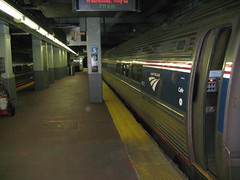
 Image by Patrick Rasenberg via Flickr
This Week at Amtrak; March 9, 2009
A weekly digest of events, opinions, and forecasts from
United Rail Passenger Alliance, Inc.
America’s foremost passenger rail policy institute
1526 University Boulevard, West, PMB 203 • Jacksonville, Florida 32217-2006 USA
Telephone 904-636-7739, Electronic Mail info@unitedrail.org • http://www.unitedrail.org
Volume 6, Number 7
Founded over three decades ago in 1976, URPA is a nationally known policy institute that focuses on solutions and plans for passenger rail systems in North America. Headquartered in Jacksonville, Florida, URPA has professional associates in Minnesota, California, Arizona, New Mexico, the District of Columbia, Texas, and New York. For more detailed information, along with a variety of position papers and other documents, visit the URPA web site at http://www.unitedrail.org.
URPA is not a membership organization, and does not accept funding from any outside sources.
1) This word arrived last week from Gil Carmichael, via the University of Denver Graduate Studies Intermodal Transportation Institute. Mr. Carmichael is one of the two greatest visionaries in America (the other being Andrew Selden) for the future of passenger rail.
[Begin quote]
PRESIDENT OBAMA'S ECONOMIC STIMULUS PACKAGE PROMOTES 21ST CENTURY TRANSPORTATION VISION OF "INTERSTATE II," SAYS ITI'S GIL CARMICHAEL
– $8 Billion Targeted for High-speed, Intercity Rail Equivalent to Phase One of "Interstate II" –
DENVER, CO, February 26, 2009 – In a speech entitled "Railroad-based ‘Interstate II,’" delivered to the Fourth Annual Railroad Night at Michigan Technological University in Houghton, Michigan, Gil Carmichael, Founding Chairman of the Board of Directors of the Intermodal Transportation Institute at the University of Denver and a former Federal Railroad Administrator, said the $787 billion economic stimulus package, recently signed by President Barack Obama, is the most ambitious transportation infrastructure program put forth in the U.S. since the 1950s, when President Eisenhower initiated the development of the Interstate Highway System.
"Wrapped inside the $111 billion devoted to much-needed infrastructure spending in his American Recovery and Reinvestment Act, Obama's stimulus plan very significantly allocates $8 billion for intercity high-speed rail transportation and another $1.3 billion for Amtrak," said Carmichael. "This is the first phase of what should be a three-part, high-speed, intercity transportation blueprint that will connect all our major cities, ports and airports via rail," Carmichael told the audience of students, faculty, and representatives from major railroads. "This is the first time an intermodal strategy, with a strong emphasis on rail, has been proposed by government to meet the North American transportation system's requirements for both freight and passenger transport."
Carmichael told the audience this new approach represents the most economical, fuel-efficient, and environmentally sustainable vision for improving our transportation network in this country, and it will help us achieve energy independence. Carmichael calls this new vision of transportation Interstate II, as opposed to the 43,000-mile, four-lane "Interstate I" Highway System that was begun 50 years ago; and said "President Obama clearly understands this necessary, new approach to meeting 21st century transportation needs."
"The nation has enough highways, albeit, most of them are badly in need of repair and suffering from massive gridlock due to a doubling of our population since they were built. What the U.S. does not have is a rail-based, intercity, rail transportation network like that in Europe and Asia. In those parts of the world, where fuel was priced higher, electric high-speed trains carry hundreds of passengers safely and efficiently between cities and connect to and from major airports. North America has a huge rail system already in place, serving 60 states and provinces with 240,000 miles of route. The rights-of-way are already paid for, and the private sector has done much to upgrade them; but they have been vastly under-utilized for years. Our rail system right now carries only 25 percent of capacity since most of it is single-tracked. By adding 30,000 miles of double- and triple-tracked rail, with grade separations, to our existing system, we can create three times more capacity, connecting millions of people to not only ports, but to airports and center cities, greatly relieving the stress on our overburdened highway system."
Carmichael pointed out that Obama's new infrastructure plan would expand the originally recommended six, intercity, high-speed rail corridors to 13 intercity corridors in phase I and would create developmental partnerships between the private sector and state DOTs. Furthermore, it would be administered by the Federal Railroad Administration, as it should be, and would be fully paid for under the recovery act – not by matching funds.
He also pointed out that the railroad is the only mode of transportation that easily converts to electricity should the world's fossil fuel supply continue to decline, as many predict. It would also offer a vastly more environmentally friendly and ethical form of transportation, providing nine times the fuel efficiency as highway transportation, while operating at speeds of up to 90 miles-per-hour for freight and up to 125 miles-per-hour for passenger transit. "In the foreseeable future, the railroad mode is the only candidate for large-scale benefits from the electrification of a new energy grid, such as President Obama is talking about," said Carmichael. "Electrifying the U.S. rail system would make sense in a future of oil scarcity and would provide us with a 'greener' carbon footprint as we move toward cleaning up the global environment."
"Our nation is experiencing a wrenching reshaping during this time of economic volatility, and by mid-century our lifestyle will be very different from today. Our nation urgently needs a new vision for its outmoded transportation system, and the President's new policy is a step in the right direction," summarized Carmichael. "Phase I of Interstate II represents an important policy shift toward developing and maintaining a 21st century, intermodal transportation network, based on greater cooperation between the freight and passenger rail segments. It will greatly enhance our intercity transit needs. In the future, to build new, national transportation programs, such as Interstate II, partnerships between the government agencies and the private-sector railroads must be promoted. Investing $100-200 billion over the next 15-20 years will create huge numbers of needed jobs, stimulate economic growth, and provide us with a beautiful, 21st century, high-speed, intermodal freight and passenger system."
About ITI
The Intermodal Transportation Institute at the University of Denver offers an Executive Masters Program that awards a Master of Science in Intermodal Transportation Management from the University of Denver. This graduate degree program prepares transportation industry managers for the increasingly complex, global business environment where knowledge of finance, quantitative processes, supply chain, law, and public policy issues as well as freight, passenger, and intermodal transportation operational strategies are critical management tools for success. For more information on the ITI Executive Masters Program call: 303-871-4702 or visit: www.du.edu/transportation.
[End quote]
2) Okay, now we have the big picture in a nutshell. So, where do we go from here? Let’s review.
We have Amtrak – which, depending on your point of view and your basis in reality – is a help or hindrance.
We have a number of other companies vying for a spot at the high speed rail table, some well known, and some not known.
We have 10 discreet high speed corridors already identified, and one extra corridor favored by the senate majority leader. We also have an additional high speed corridor which everyone thinks will be looked favorably upon because it’s in the backyard of the President of the United States.
First, back to Amtrak.
Amtrak is fortunate at the moment to have an interim president and chief executive officer who seems to be doing yeoman’s work cleaning out some of the deadwood found in Amtrak’s cadre of managers at all levels. This exercise could prove to be most interesting, because the outcome will demonstrate the strengths and weaknesses of Amtrak’s entrenched Good Old Boy system and various duchies which have grown over the past three decades. On the upside, some very good managers could finally be released from their restraining bonds and be allowed to fully accomplish their goals in an honorable manner.
On the down side, many of Amtrak’s ongoing habits are some which are best not spoken about in polite company, but desperately need to change. Included in these are Amtrak’s (And, it’s wholly owned lapdog organizations and sycophant enablers.) continually bad habit of underestimating itself by unilaterally and continuously spreading the lie that no passenger rail systems in the world make money when we know empirically systems in The Netherlands, Germany, and Japan do make money, along with others.
3) Here’s a burning question of the moment (Be assured the old, false canard about under funding has nothing to do with this question.): If, after nearly 38 years of existence, Amtrak has no viable business plan for the future other than to drain state treasuries for the cost of expensive to operate and low-return short corridor trains, has no equipment plan in place to replace its fleet of aging equipment, and has never achieved a greater position than one tenth of one percent of the overall domestic intercity domestic transportation marketplace, why does any reasonable person expect that merely handing Amtrak billions of dollars of Other People’s Money will change its corporate course and suddenly make Amtrak a leading contender to operate new and shiny high speed trains?
If Amtrak can’t make proven technology work in the United States that used to be the greatest transportation system in the world, how can it plan for and operate new technology that will require innovative thinking grounded in reality and financial expertise?
What reasonable person is willing to risk billions of dollars – at a time when the moment is ripe in the public’s mind for rapid expansion of passenger rail transportation – on a company which, at the end of its fiscal year, usually can’t even afford to restock it’s office supply shelf?
As one former Amtrak manager sagely says, "The money will start moving toward rail. Next, a fundamental change in the culture of passenger rail ... currently, entrenched bureaucrats impede potential new and next generation talent from entering. The merits of passenger rail are moot with these conditions, and a skeletal network will continue while bureaucrats play."
But, back to the good news mentioned above, Amtrak Interim President and CEO Joe Boardman openly told a reporter he is cleaning house at Amtrak, getting rid of the deadwood and hopefully empowering those who can make a difference. Since Mr. Boardman enjoys the full confidence of the Amtrak Board of Directors, this has to be a breath of fresh air both for those inside of Amtrak who have been suffering under the heavy hand of immovable bureaucracy, and those Amtrak watchers on the outside who have constantly been asking why so many Amtrak managers who bring nothing positive to their positions remain on the company payroll.
As noted in this space earlier this year, Amtrak’s Chicago General Superintendent Daryl K. Pesce seems to be one of the managers earnestly making a difference and demanding better and improved performance from his staff.
4) Now, on to the question of the division of the new $8 billion dollars provided by the Obama administration for high speed rail. To no one’s surprise, there is a great deal of competition for this relatively small pool of money (Remember, Mr. Carmichael accurately predicts the final need for funding to get infrastructure in place is $100 to $200 billion over the next 15 to 20 years.).
Today, New York State’s governor announced his state’s new high speed rail plan, and he’s counting on some of that $8 billion to put his plan into action.
California is further along than anyone on its $45 billion high speed rail line, and it’s hoping for a piece of the $8 billion in federal monies.
Minnesota says since it’s high speed rail line originates in President Obama’s backyard it should get a piece of the pie, even though the corridor is not currently recognized by the Department of Transportation.
The Midwest High Speed Rail Association, which has been working long and hard to make high speed rail a reality even before anyone had ever heard of Barack Obama, says it has plans in place, drawings on the table, and shovels just waiting to be used, because its plan is the most comprehensive and it feeds in and out of Chicago, and in the process, will alleviate a number of rail congestion points in and out of Chicago.
Nevada, which usually doesn’t have much to say about high speed corridors, suddenly finds itself at the center of attention because Senate Majority Leader Harry Reid of Nevada says he wants a high speed train running between Anaheim, California (home of Disneyland) and Las Vegas. This announcement came at the same time the $8 billion in funding appeared in the 2009 stimulus bill which passed the house and senate in February.
North Carolina dreams of a high speed corridor, running between Charlotte and Raleigh, and then extending northward over the old Seaboard Air Line Railroad roadbed into Virginia and into Washington, D.C. Add to that the thought of a full Southeast high speed rail route that extends southward to Columbia, South Carolina; into Savannah, Georgia and onto Jacksonville, Florida.
Here in Florida, there are plans for a high speed corridor from Tampa northeast to Orlando, and then taking a sharp right turn southward to the Florida Gold Coast and West Palm Beach, Fort Lauderdale, and Miami, with an extension northward to Jacksonville from Orlando at some point in the future.
And, lastly, Amtrak says it would be pleased to create an entire new Northeast Corridor for true high speed rail to replace the current NEC. No one is quite sure how much that would cost, but it would be one of the most expensive projects in the country because Amtrak envisions an entire new infrastructure over an entire new route.
Who gets funding first? That’s an easy question. Who’s in control of the political process? That’s who gets funding first. Informed opinions say the majority of the $8 billion will stay within 300 miles of Washington, D.C., with some small amounts going to other projects like the Midwest project, California’s two projects, and perhaps some small amount of the money coming to Florida.
Taking the long view, if the new administration’s interest in high speed rail continues, and the federal printing press churning out money doesn’t break down, it’s likely we will see more money for these projects over the next four years.
5) Here is what is going to be critical to the success of high speed rail: whatever projects come on line first have to be measurably successful, both from a social standpoint and a financial standpoint. The old axiom of "build it and they will come" has to hold true, because the full development of high speed rail is a decades-long process, that will take place over a number of presidential administrations of both parties and a number of different ideologies.
Therefore, these first projects MUST stand the test of time and pioneer leading the way for following projects in order to fulfill Mr. Carmichael’s vision.
Since these first projects are likely to be chosen on political rather than financial merits, we can only hope the results will be satisfactory enough to inspire further spending and investment. Which is why the chosen operator of these trains has to be the best available, not the most conveniently available.
6) Joe Boardman is coming up on the four month anniversary of his planned one year stewardship of Amtrak. The handwriting on the wall tells us he walked into a job (like so many of his predecessors) that he had no idea required so much fixing. Basic things like replacement rolling stock for Amtrak’s fleet were not even being whispered among Amtrak’s core executives. Instead, a hodgepodge of disjointed plans were lying around, not making much sense one way or the other. We can hope the Amtrak Planning Department – previously known as the most socialist place in Washington – has a new direction and a new mandate to help create a functioning passenger railroad, not just maintain the status quo by sucking as much money as possible out of government treasuries.
Here is his message to Amtrak employees in the February 29, 2009 issue of Amtrak This Week.
[Begin quote]
Message from the President and CEO
Dear Co-workers,
As I travel across the country, I often meet people who tell me about how much potential Amtrak has. The truth is, Amtrak has seen a promising future since 1971. I know you think you’ve heard it before, but I’d like to tell you why it’s true in 2009.
Three major reasons: For the first time in a long while, we have some clear direction from Congress on the future of Amtrak and passenger rail. The Passenger Rail Investment and Improvement Act is our blueprint and aims to make enduring improvements in passenger rail.
As part of the stimulus bill signed by the president last week, we will receive $1.3 billion to make significant strides on capital programs. Among other things, we’ll return to service 100 cars that are currently sidelined, completely replace the Niantic River Bridge in Connecticut, install more Positive Train Control systems and make major Americans with Disabilities Act modifications to our stations. The law also provides money for states to make rail investments of their own, and they’re coming to us for our expertise.
And we have an administration that seems to be building a legacy defined in part by the development of high-speed rail. I believe that this administration is more likely than any other in recent history to be open to making additional investments in passenger rail.
All of these elements combine to help us realize great potential. But that’s just it — it’s only potential if we don’t believe in the direction we’re taking and make it happen. Sometimes I wonder if we’ve become conditioned to low expectations over the years, surviving from year to year, and thinking that no one expects big things from Amtrak. Well, I expect big things from us. We need to open our collective hearts and minds to the Amtrak we know we can be. That is the safer, greener and healthier Amtrak I envision.
That’s where vision and leading by example come in. I’m not just talking about forward movement, I’m taking the steps. Just last week, I met with vendors about how quickly they can deliver the Viewliners we need for our long-distance fleet. I intend to replace the electric locomotive fleet and am seeking the funding to do that. I want to electrify the railroad to Richmond and I’ll be studying the cost estimates on that next week. And I listen — we have a great deal of talent and dedication; our employees have good ideas and they need to be heard.
The time to harness our future is now and we’re moving ahead with renewed energy. I care very much about our future and I know you do, too. Together, we must embrace the opportunities that are before us and run with them — for us, for our customers and for our country.
Sincerely,
Joe Boardman
President and CEO
P.S. By the way, I know everyone wants to know the details of our proposed "stimulus" capital programs, I’ll share the list with you as soon as we’ve finalized it with the FRA — I wouldn’t want to mislead you.
[End quote]
Lots of red meat there for the True Believers, and lots of good stuff about the future, including the information about the new Viewliner series of long distance cars (Which, by the way, the order as it stands today is less than a third of what it should be to meet all current demand potential.)
The truly scary part if his statement he wants to electrify the CSX (former RF&P) main line south from Washington, D.C. to Richmond, Virginia.
Why?
Why is the interim president and CEO of Amtrak worrying about spending money to electrify someone else’s railroad? Especially when Amtrak can’t reasonably maintain the infrastructure it owns and operates north of Washington? What is there to gain? Why would CSX want to run its diesel freight locomotives under electric catenary for passenger trains?
Since the former RF&P route is the ONLY north-south direct route through the heart of Virginia leading to the Carolinas, Georgia, and Florida, while it is a very attractive passenger route, would CSX ever dream of turning over ownership of this critical route to another company which can’t maintain what it already owns? Not likely.
So, why is Mr. Boardman, who is the fullest of all of the full plates in Washington, spending time dreaming of this and even taking the time to get actual quotes? Shouldn’t this be an issue for the DOT and FRA, and not Amtrak? Mr. Boardman, please, stick to fixing your horribly broken railroad which requires so much attention, and leave issues like this to others. Amtrak as it is requires not only your full attention, but every skill you have to just get it back to a point of being moderately dysfunctional beyond completely dysfunctional.
7) And, finally, the last issue of TWA drew a lot of amusing comments from Amtrak cultists and sycophants who find it inconceivable any passenger railroad in the world makes money, since for decades they have been told the Holy Word is that Amtrak – and, conversely – no passenger rail in the world, makes money.
Just the mere heresy of presenting factual information about this lie sent many into involuntary fits of cultist rage and disbelief, and inspired rambling responses.
Other comments from more rational people contained praise for lifting the veil of lies that have been surrounding passenger rail for lo, these many decades in America.
It’s going to take years to undo the harm done in this country about the true facts of the business of passenger rail. It’s hard to imagine how anyone would actually prefer a system which does not make a profit versus a system which has the potential to break even or make a profit.
Most likely the ghosts of the Vanderbilts and Goulds and Pullmans and Harrimans are heartily laughing at us all day, every day.
If you are reading someone else’s copy of This Week at Amtrak, you can receive your own free copy each week by sending your e-mail address to
You MUST include your name, preferred e-mail address, and city and state where you live. If you have filters or firewalls placed on your Internet connection, set your e-mail to receive incoming mail from twa@unitedrail.org; we are unable to go through any individual approvals processes for individuals. This mailing list is kept strictly confidential and is not shared or used for any purposes other than the distribution of This Week at Amtrak or related URPA materials.
All other correspondence, including requests to unsubscribe, should be addressed to brucerichardson@unitedrail.org
Copies of This Week at Amtrak are archived on URPA’s web site, www.unitedrail.org and also on www.todaywithjb.blogspot.com where other rail-related writings of Bruce Richardson may also be found.
URPA leadership members are available for speaking engagements.
J. Bruce Richardson
President
United Rail Passenger Alliance, Inc.
1526 University Boulevard, West, PMB 203
Jacksonville, Florida 32217-2006 USA
Telephone 904-636-7739
brucerichardson@unitedrail.org
![Reblog this post [with Zemanta]](http://img.zemanta.com/reblog_e.png?x-id=3027158c-b45d-4135-bcdc-f1271279f13c)


![Reblog this post [with Zemanta]](http://img.zemanta.com/reblog_e.png?x-id=4c7f16d1-df56-4e48-970d-b056dc174359)