Showing posts with label Federal Railroad Administration. Show all posts

Tuesday, June 15, 2010

This Week in Amtrak

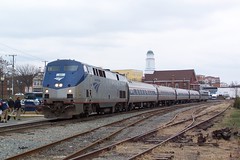
Railway tracks. (NOTE: Uploader says, in uploa...Image via Wikipedia


Volume 7, Number 17
June 14th, 2010


A weekly digest of events, opinions, and forecasts from


United Rail Passenger Alliance, Inc.

America's foremost passenger rail policy institute


Jacksonville, Florida USA

Telephone 904-636-7739, Electronic Mail info@unitedrail.org . http://www.unitedrail.org

------------------------------------------------------------------------

Positive news for commuter operations, and ponderings on the future of high speed and intercity operations. But let us begin with two brief preludes; first, a short poem, called a "Grook" by its author, Danish poet and philosopher Piet Hein.


Thoughts on a Station Platform

It ought to be plain
how little you gain
by getting excited
and vexed.
You'll always be late
for the previous train,
and always in time
for the next.

A second lead-in: a note on why we are all here. Marcus Garnet, of Transport Action Atlantic in Canada, writes in a Progressive Railroading internet journal ,

What is commonly overlooked, is that time spent on a full-service
long-distance train is also available for other purposes, including
overnight sleep, meals, work, meetings, socializing or simply the
enjoyment of scenery. Overnight train travel serves a transportation
function, but also offers a total experience, especially for those
who are able to afford a bedroom. These passengers do not just
travel on the train, they live on the train. Whether for tourists or
traveling Canadians, this is a vital market distinction from other
land transport modes.

Mr. Garnet sums up many of our feelings and motivations for being passenger train advocates. Yes, trains are a vital part of our national infrastructure, but we want trains because of what they do for us personally, what they do for our friends and families and neighbors, what they do for our economy and our ecology. Trains are special and we need many more of them.

One last item, from the Inbox: Reader Ole Amundsen wrote in regard to the referenced article on VIA Rail Ocean Train Service:

The comments around this exceptional piece of work seem to be
getting at the heart-wood of the rail passenger conundrum in this
country. My positions come from being 70 years of age, nurtured by
an old school conservative view of individual responsibility,
educated in business and economics, and experienced in national
agendas...

When Amtrak was started, I was only interested in getting the
/Montrealer/ re-instated so I could avoid driving from my new home
in Vermont to family in Connecticut. It is easy to look back and say
Amtrak should have been done differently: it has performed the task
of "place holder" for passenger rail but that is about it. Those
were dark days for railroads, but we are now in a very different
world: then I paid 16 cents a gallon for fuel oil to heat my drafty
Vermont farm house! Today, we have 75 million boomers aging out;
they control about 75% of the nations wealth, they love to travel,
they are fit but getting more prone to medical situations, they have
"done it all" and want to continue to have adventures, they enjoy
creature comforts and are enjoying being grandparents. This is not a
market block to be ignored, it is not solely a market for "luxury
train travel;" it is a major component of the traveling public which
does not opt for speed alone, but which prefers reasonable mode
frequency, reasonable adherence to published schedules, reasonable
and clean accommodations, reasonable food, accessible and
accommodating equipment and a minimum of hassle...

My friend, the late Paul Weyrich, had all the conservative
credentials a person could have; and he was a strong voice for
passenger rail and trolley ("light rail") as well as integration of
inter- and intra-urban service. This problem, this opportunity, must
be addressed without falling back on old reasons not to, and [there
must be a way we can] come together with fresh ideas on how to
really run the railroad.

Now, on to the news.

The /San Mateo County Times/ reported on 27 May that

Caltrain officials have convinced federal safety authorities to
allow quick European-style electric trains to zip from San Francisco
to San Jose... common in Europe, the smaller electric trains... [had
been considered] unsafe. But after three years of tests and
research, Caltrain will become the first railroad in the nation to
use the technology after being granted a waiver... [this] will
essentially be a pilot operation for the trains, called electric
multiple units. If successful, commuter railroads and planned
high-speed rail networks throughout the nation would have access to
cheaper, greener and faster trains...

Even with several restrictions, the advent of modern equipment used successfully and safely for years elsewhere around the globe is a huge step forward for the implementation of regional rail lines around and between American cities.

For those who saw the Ayn Rand quote last week as being "the politics of the past," we turn to Paul Merrion 's article in Chicago Business this June 10th , regarding high-speed rail (emphasis mine):

In a move that reportedly "stunned" the rail industry, the Federal
Railroad Administration last month proposed stiff terms for the
grant agreements that railroads must sign with states to get funding
to upgrade their rail systems... Among other things, *the FRA said
railroads must be required to pay, without limit, for any further
improvements or fixes needed to meet on-time performance goals* set
out in the grant agreements, or else pay back the federal
grants.Even Boston-based non-profit, National Corridors Initiative
Inc., a high-speed rail advocacy group, questioned whether that is
feasible."While the objective of these guidelines --- to protect the
taxpayer against the (mis)use of their money when federally assisted
railroad projects are built --- is a valid one, the prescriptive,
punitive nature of the proposed FRA regulations are and will be
non-starters for any normal businessperson who has to carefully
assess projects for risks to his company, or face the wrath of his
stockholders," the group said in a statement on its Web site...

The FRA holds over the railroads, not just the billions in high-speed rail grants effectively controlled by Amtrak, but also the impending imposition of Positive Train Control (PTC), a worthwhile safety and capacity improvement but one that will cost billions and take years. It is still not certain how much of PTC the railroads are expected to shell out of their own pockets. Is the Obama administration seriously going to require the railroads to pay /any/ price so Amtrak can operate its government-funded high speed trains?

In parallel developments, concerning the Gulf oil spill, "Obama said he had no interest in undermining the value of BP" (Reuters story , 12 June 2010), but meanwhile "U.S. House of Representatives Speaker Nancy Pelosi said on Friday BP should be subjected to unlimited liability costs and should pay all damage claims" (Reuters story , 11 June 2010). How can one impose unlimited liability without undermining industry? What person or corporation in their right mind would continue operating under those conditions?

(Caution: Ayn Rand reference follows; the timid may avert their gaze.)

In /Atlas Shrugged/, Rand populates her dystopia with officials who do not understand how the world works. Rand's bureaucrats have only ever ridden, as a Mr. Guthrie would put it, "their fathers' magic carpet made of steel," never seeing the engineering brain-power and the technical muscle-power behind a railway, imagining that trains function by magic, that oil pumps itself, that commerce and industry exist in a mythical land of everlasting continuation unaffected by taxes, regulation, and legislation. Rand posits a government whose popular and well-intentioned enactments "for the public good" strangle commerce and industry, slowly as a gentle flurry at first, finally escalating to a murderous avalanche.

Arthur Laffer explained in the /Wall Street Journal/
one June 6th why this neverland of perpetual sameness does not exist:

People can change the volume, the location and the composition of
their income, and they can do so in response to changes in
government policies... It has always amazed me how tax cuts don't
work until they take effect. Mr. Obama's experience with deferred
tax rate increases will be the reverse. The economy will collapse in
2011.

Dire predictions of impending doom aside, will the Obama administration, having already started down the dystopian road (One of the characters in Rand's 1957 book asks, When they nationalized health care, did anyone ask what the /doctors/ wanted?), truly enact scorched-earth policies in one economy sector after another? If so, look for oil and rail executives to be among the first to relocate to Galt's Gulch.

Back in the high speed arena,

Amtrak announced it is reorganizing and establishing a new
department to pursue opportunities to develop new intercity
high-speed rail service in select corridors around the country...

"Amtrak is the unparalleled leader in high-speed rail operations in
America today and we intend to be major player in the development
and operation of new corridors," said President and CEO Joseph
Boardman...

-- Amtrak press release, 22 March 2010


Aside from the omission of a word (does Amtrak intend to be /*a*/ major player, or /*the (only*/) major player?), does it not sound as if Amtrak might be jockeying for a near-monopoly in high speed rail? Will we see a resuscitation of the dead corpse of its former monopoly over all intercity trains, moved to HSR? Prior to the passage of S.738, the Amtrak Reform and Accountability Act of 1997, U.S. Code: US Code, Title 49, section 24701(b) read (emphasis mine):
"Except as provided in section 24306 of this title, a person may provide intercity rail passenger transportation over a route over which Amtrak provides scheduled intercity rail passenger transportation under a contract under section 401(a) of the Act *only with the consent of Amtrak*."

The "monopoly clause" indeed prevented state agencies as well as private companies from even talking to railroads about running passenger trains.
Would Amtrak have approved trains like New Mexico's RailRunner?
Doubtful. Certainly not in the short time it took from its announcement to the first cue for the "Meep-meep!" of the RailRunner departure door chimes.

That provision having been rescinded, will the liability issue now be how private operators are forced out of business?

Perhaps echoing liability concerns voiced frequently by North
America's Class I freight railroads, Amtrak President and CEO Joseph
Boardman has cited similar concerns "emerging as a significant
obstacle to the improvement of existing passenger rail service and
the development of new, including high speed and intercity corridor,
passenger rail service in the United States."

Boardman, in a five-page letter to four congressional leaders dated
Feb. 26, says in part, "The core of the problem is the unwillingness
or inability of a growing number of entities, including states and
other public bodies, to enter into the kind of agreements for risk
allocation ... and/or to purchase insurance at all or at sufficient
levels ..."

"Moreover, the attitude from a number of private parties and state
entities alike seems to be that Amtrak, in significant part because
of its federal funding, should assume the greater share or risk of
liability." That, Boardman warned, could curtail or terminate
state-supported services Amtrak currently provides...

-- Railway Age, 2 March 2010


Airlines are feeling a similar pinch. According to Susan Stellin in the /New York Times/ , this 7 June, reporting from the first meeting of the Future of Aviation Advisory Committee, air travel will look much different within half a decade.
Small cities will continue to lose air service, or at best will have ever-fewer flights at ever-higher prices, while some large cities with aggregated volume will see volumes above today's and low prices from further rate wars.

...Glenn Tilton, United's chairman, stated it more bluntly: "There
are clearly going to be winning cities and losing cities," he said,
addressing the fact that the industry cannot sustain service to
destinations that don't have the passengers to fill planes...

High speed trains have the same problem as airplanes: They just do not serve enough places. California's governor Schwarzenegger has proposed running a "high speed lite" train before he leaves office. Here is what Noel Braymer of RailPAC has to say in a letter to the /Los Angeles Times/:

According to the letter signed by the Governor, it looks like there
are plans to run rail service between Los Angeles and San Diego by
November in about 2 hours. It looks like the new train would only
have 3 stops at Los Angeles, Anaheim and San Diego. Just dropping
the six other intermediate stops would save 30 to 36 minutes on the
current schedule of 2 hours 40 minutes.

Generally express trains are not successful. By skipping stops such
trains also loses the business from those stations. Amtrak has tried
several express trains and they have all failed. A local example of
this was the /San Diegan Metroliner/ which ran for about a year
starting in September of 1984. It rarely carried more than a busload
of passengers. It lost the traffic the other trains carried from the
skipped stations. There was only one train a day leaving Los Angeles
for San Diego in the morning and returning in the afternoon. Saving
10 minutes wasn't worth the extra money for passengers if the return
train ran at an inconvenient time. Another problem with the
Metroliner was most cities with train stations lost a train to run
this new train. Many of these cities had gone to great trouble to
build new or rebuilt their stations and had not been consulted about
this decision. These cities were not happy...

Precisely this same scenario is playing with the English Javelin trains, the California HSR project, the Florida HSR, and soon coming to a minor city near you whose airport terminal will lose scheduled flights.

Looking back to Mr. Garnet's thoughts about the vital market distinction of rail, clearly the nation's towns and smaller cities, the ones left without air service, and nowadays without even bus service or anything at all, are the market for regular passenger trains. Even fifty or a hundred years of mangled government transportation policy cannot hide the basic utility and need of trains over cars and airplanes. The difficulty will be to create something that works more like a free market, replacing today's lack of choice or hope for too many towns and people.

The way forward involves tort reform, reasonable liability caps, and getting government back to /governing/, not operating, passenger trains. The same prescription holds for the freight railroads, the oil industry, even our highway and airway systems. This involves the dreaded "C" word -- Change -- and nobody much likes change; not lawyers, not unions, not management, not stockholders, and certainly not government.

We had better get started quickly.

\\/
William Lindley

------------------------------------------------------------------------
If you are reading someone else's copy of This Week at Amtrak, you can receive your own free copy each edition by sending your e-mail address to


freetwa@unitedrail.org


You MUST include your name, preferred e-mail address, and city and state where you live. If you have filters or firewalls placed on your Internet connection, set your e-mail to receive incoming mail from twa@unitedrail.org ; we are unable to go through any approvals processes for individuals. This mailing list is kept strictly confidential and is not shared or used for any purposes other than distribution of This Week at Amtrak or related URPA materials.


All other correspondence, including requests to unsubscribe should be addressed to


wlindley@unitedrail.org


Copies of This Week at Amtrak are archived on URPA's web site, www.unitedrail.org


URPA leadership members are available for speaking engagements.


William Lindley
c/o wlindley.com, l.l.c.
PO Box 3621
Scottsdale, AZ 85271
480-947-6100

Enhanced by Zemanta

Wednesday, November 26, 2008

This Week in Amtrak

Amtrak Coast Starlight (Train 14) northbound a...Image via Wikipedia

This Week at Amtrak; November 26, 2008

A weekly digest of events, opinions, and forecasts from

United Rail Passenger Alliance, Inc.

America’s foremost passenger rail policy institute

1526 University Boulevard, West, PMB 203 • Jacksonville, Florida 32217-2006 USA

Telephone 904-636-7739, Electronic Mail info@unitedrail.orghttp://www.unitedrail.org

Volume 5, Number 31

Founded over three decades ago in 1976, URPA is a nationally known policy institute that focuses on solutions and plans for passenger rail systems in North America. Headquartered in Jacksonville, Florida, URPA has professional associates in Minnesota, California, Arizona, New Mexico, the District of Columbia, Texas, and New York. For more detailed information, along with a variety of position papers and other documents, visit the URPA web site at http://www.unitedrail.org.

URPA is not a membership organization, and does not accept funding from any outside sources.

1) Joy! We’re still 24 hours away from the official start of the Christmas season when Santa Claus brings up the rear of New York City’s Macy’s Thanksgiving Day Parade, but the holidays are coming a wee bit early.

Today, the Amtrak Board of Directors chose one of its own as Amtrak’s Interim President and Chief Executive Officer for a term of one year, while the board searches for a permanent replacement for the departed Alex Kummant.

Why the unrestrained happiness? Because the board has acted like a normal, professional corporate board and made a wise decision to elevate one of its own members into a daily executive position to keep the company on an even course (Even though that course may be very wrong if it continues to emphasize short distance corridors.).

Federal Railroad Administration Administrator Joseph Boardman, who will be leaving that position January 20, 2009 when the new administration takes power in Washington, and has served since 2005 as the United States Department Secretary of Transportation’s designee on the board, starts his new job today as Amtrak’s Interim President and CEO. It’s a very common occurrence for a sitting board member to take daily control of a company when its chief executive is removed in a unpleasant way, as was Alex Kummant earlier this month.

Here’s the official press release from Amtrak.

[Begin quote]

Amtrak Media Relations
(202) 906-3860


AMTRAK SELECTS TRANSPORTATION INDUSTRY VETERAN AS PRESIDENT & CEO

WASHINGTON – The National Railroad Passenger Corporation Board of Directors announced today that it has chosen Joseph Boardman, a nationally recognized transportation industry professional, to become president and chief executive officer of the company, effective November 26.


Boardman offers nearly 34 years of experience in the surface transportation industry at city, county, state, and federal government levels; most recently as the administrator at the Federal Railroad Administration.


"In an attempt to maintain the momentum at Amtrak, while finding a permanent CEO candidate, the board has appointed Mr. Boardman for one year, but will conduct a search in the coming months for a permanent CEO," said Board Chairman Donna McLean. She added that "Amtrak is at a critical juncture and needs a vigorous management vision and ability to take advantage of this unique time. The board has unanimously chosen Mr. Boardman in this capacity because we have complete confidence that his depth of experience and leadership skills will allow Amtrak to maintain growth and implement the requirements of the recently enacted authorization legislation."

"Joe Boardman knows the industry extremely well, but what makes him exceptionally qualified for the position is that he has the unique perspective of having known Amtrak as a customer and state partner, administrator, and has been involved with Amtrak, in one role or another, over the course of many years," said board Vice Chair Hunter Biden. "Joe is the right person to help Amtrak during this important period," he added.

Having served as administrator of the Federal Railroad Administration since April 2005, Boardman was the Department of Transportation designee on the Amtrak board of directors. Prior to his tenure at FRA, he served as commissioner of the New York State Department of Transportation beginning in July of 1997. There, Boardman led a transformation effort that better enabled the agency to respond to the challenges associated with an expanding global marketplace. In this capacity, Boardman was deeply involved in the operation of the large complement of Amtrak service in the state. In addition, he was chief operating officer of Progressive Transportation Service, Inc., a transportation management company. He was chairman of the Executive Committee of the Transportation Research Board in 2005 and chair of the American Association of the State Highway and Transportation Officials’ Standing Committee on Rail Transportation from 2000-2005.

"I am humbled that the board selected me to lead the company, on an interim basis, at this very exciting time. Over the past decade – in one capacity or another – I have been an active participant in the affairs of Amtrak. I have come to know the company, the culture, a number of employees, and I am keenly aware of the challenges facing us right now," said Boardman. "In my view, a national intercity, interconnected passenger rail service is critically important for the mobility and energy independence of the United States."

Joe Boardman fills the position following the departure of Alex Kummant earlier this month. Chief Operating Officer William Crosbie served as acting CEO in the interim. "The board is grateful to Bill Crosbie for his dedication to Amtrak and for managing the company during the transition," McLean added.

Boardman is a lifelong resident of New York, and is the second of eight children born and raised on a dairy farm in Oneida County, which two of his siblings currently operate. In 1966, he volunteered for service in the United States Air Force, serving in Vietnam from 1968 to 1969. Upon receiving an honorable discharge from the Air Force, he earned a Bachelor of Science in Agriculture Economics from Cornell University in Ithaca, N.Y., and a Master of Science in Management Science from the State University of New York at Binghamton. He presently resides with his wife Joanne in Washington, D.C., and has three grown children.

[End quote]

Many will recall Mr. Boardman’s outrage as commissioner of the New York State Department of Transportation when Amtrak took New York’s money to upgrade and rehab the Turboliners, which were owned by the State of New York and promised for service between Albany and New York City, and then mothballed by Amtrak management because it claimed the Turboliners used too much fuel and carried too few passengers. The train sets were stored out of New York State, and Mr. Boardman let Amtrak know of his unhappiness of the whole mess. Now, he’s running the company. How much better can it get than this, that someone former Amtrak management scammed in recent history is now running the company?

It is important to make note of his statement, "In my view, a national intercity, interconnected passenger rail service is critically important for the mobility and energy independence of the United States." If this statement is interpreted correctly, he’s saying "national intercity" as in "all over the country," "interconnected" as in a "seamless system with decent connections and a smooth flow of traffic," and "mobility ... United States," which, again emphasizes the entire country, and not just relatively useless short, disconnected corridors.

The coming actions of Mr. Boardman hopefully will give us a better view of how the Amtrak Board or Directors believes Amtrak should fulfill its mission of providing a truly nationwide passenger rail service to cities and towns both large and small.

2) Some further information has become public, courtesy of Paul Weyrich, Chairman and CEO of the Free Congress Foundation in Washington, D.C., and former member of Amtrak’s Board of Directors. The following column appeared Monday, November 24th in newspapers around the country, and was released the next day (yesterday, Tuesday, November 25th) through the Free Congress Foundation’s daily commentary service.

Here is Mr. Weyrich’s information.

[Begin quote]

Free Congress Foundation Commentary

The Possibility of a Better Future for Amtrak

By Paul M. Weyrich

November 25, 2008

The 111th Congress recently passed an authorization bill which provides more money for Amtrak than any bill passed in history. President George W. Bush signed the bill. For the first time Amtrak has been granted more money than required to keep the railroad operating. True it is that the appropriators will determine how much money Amtrak actually receives. But for the first time the President-elect has said he supports Amtrak. Moreover, the Vice President-elect rode Amtrak to and from Wilmington, Delaware every day Congress was in session from 1973 through 2008. He said, "I intend to see to it that Amtrak will become a first-class railroad." Amtrak has been carrying a record number of passengers on almost all its trains. Even with gas prices dropping Amtrak has continued to set new records. This is as close to Nirvana as it gets.

So why would Alex Kummant abruptly resign at this moment when an Amtrak President finally can accomplish something? The explanation given by Amtrak itself was inadequate and maybe disingenuous. He has been unavailable to comment. Amtrak officials zipped up like a third-grader’s snowsuit. We don’t know whom the Board has in mind to take Kummant’s place. Amtrak Presidents in the post-Graham Claytor era have not lasted long. With a new more sympathetic Congress, some stability would be appreciated.

After weeks of trying to learn what was going on, I finally determined that there apparently was a personality conflict between Kummant and the Board. It began back in Seattle at an off-site meeting when the Board believed that Kummant talked down to them. Matters continued to deteriorate all summer. It seems that Kummant thought the Board ought to set broad policy and should not be heard from again. Having served on that Board for six years I can tell you that the Board is very active. I was Chairman of the Strategic Marketing Committee. I was continually in touch with management people in my area. In fact, I was the first person on that Board to challenge some of the policies of Graham Claytor. The more the Board continued to intervene in management matters, the more Kummant resented it. Finally the Board made it clear that it regarded Kummant’s tenure as the equivalent of a bad marriage. In fact, Kummant and the Board engaged in a nasty exchange of e-mails. The Board set about trying to come up with a statement which would have given Kummant cover. The decision to let him go was made some time before he actually left. The story got out because Kummant’s packed boxes were seen. Also, a complex California trip which had been designed for Kummant was cancelled. Instead it was an extremely tense time at Amtrak. The Acting President is someone whom David Gunn had brought in. At age 44 he has had a long career in Canadian railroading and transit. He has dual Canadian and America citizenship. His tenure is thought to be short-lived. The Board apparently had been searching for a new CEO even while Kummant was still in charge.

So watch for an announcement, perhaps at the first of the year, of a new CEO who understands that the Board will be active in management issues. Whoever it is will come in at an unprecedented time for Amtrak. The railroad always has had strong support in Congress. This is the first time since President Richard M. Nixon signed the Amtrak Bill against the advice of his aides Haldeman and Ehrlichman that the railroad will have strong support from the Executive Branch. Perhaps this time the Board will come up with a CEO who will cultivate better relationships with Board Members. If there is such a person he or she probably will have a long tenure. If the new person could get along with Board Members life at 60 Massachusetts Avenue, NW, would be much better.

Paul M. Weyrich is Chairman and CEO of the Free Congress Foundation.

[End quote]

3) So, what is Mr. Boardman walking into? Let’s go to the blackboard.

Everyone has seen Amtrak’s constant happy talk about rising ridership and revenues. Yes, well, that’s all very nice if you believe in Santa Claus (If you do believe in Santa Claus, please stop reading, now.).

We will start with Amtrak’s annual report for fiscal year 2007. Keep in mind these are Amtrak figures. Waaaaay in the back of the annual report is a page of performance indicators. A table is shown, displaying figures from FY 98 to FY 07, a 10 year period. Take a look at some of the comparisons.

Federal operating grant (free federal monies) – FY 98, $202 million; FY 07, $485 million, an increase of 140%.

General capital funding – FY 98, $134 million; FY 07, $772 million, an increase of 476%

Operating ratio – FY 98, 1.50; FY 07, 1.48 (Operating ratio is total expenses to total revenue; a profit is only shown when the ratio is under 1.)

Current assets – FY 98, $868 million; FY 07, $605 million, a decrease of 30%

Current liabilities – FY 98, $621 million; FY 07, $960 million, an increase of 55%

Working capital ratio – FY 98, 1.40; FY 07, 0.63, a ratio less than 1 indicates negative working capital

Year-end cash, cash equivalents, and short-term investments – FY 98, $275 million; FY 07, $234 million, a decrease of 15%

On time performance, systemwide – FY 98, 79%; FY 07, 69%, a decrease of 10 percentage points

Systemwide passenger miles – FY 98, 5,304 million; FY 07, 5,654 million, an increase of 7%

Systemwide seat miles – FY 98, 11,426 million; FY 07, 11,568 million, an increase of 1%

Systemwide load factor – FY 98, 46%; FY 07, 49%, an increase of 3 percentage points

Systemwide route miles – FY 98, 22,000; FY 07, 21,000, a decrease of 5%

Train miles – FY 98, 33 million; FY 07, 37 million, an increase of 12%

Passenger miles per train mile – FY 98, 160.7; FY 07, 151.4, a decrease of 6%

Ticket yield (ticket revenue per train mile) – FY 98, 17.8 cents; FY 07, 26.9 cents, an increase of 51%

Yield (Passenger related revenue per passenger mile) – FY 98, 18.9 cents; FY 07, 27.9 cents, an increase of 48%

Average length of trip, per passenger – FY 98, 251.4 miles; FY 07, 219.1 miles, a decrease of 13%

Total revenue per seat mile – FY 98, 14.9 cents; FY 07, 19.5 cents, an increase of 31%

Total expense per seat mile – FY 98, 23.1 cents; FY 07, 29.2 cents; an increase of 26%

Core revenue per seat mile – FY 98, 11.3 cents; FY 07, 16.4 cents, an increase of 45%

Core expense per seat mile – FY 98, 18.8 cents; FY 07, 26.1 cents, an increase of 39%

Systemwide ridership – FY 98, 21.1 million; FY 07, 25.8 million, an increase of 22%

Stations served by Amtrak – FY 98, 508, FY 07, 497, a decrease of 2%

Let’s summarize.

Increases:

• Federal operating grant – 140%

• General capital funding – 476%

• Operating ratio (declined, which is a positive increase)

• Current liabilities – 55%

• Systemwide passenger miles – 7%

• Systemwide seat miles – 1%

• Systemwide load factor – 3 percentage points

• Train miles – 12%

• Ticket yield – 51%

• Yield – 48%

• Total revenue per seat mile – 31%

• Total expense per seat mile – 26%

• Core revenue per seat mile – 45%

• Core expense per seat mile – 39%

• Systemwide ridership – 22%

Decreases:

• Current assets – 30%

• Working capital ratio from positive to negative

• Year-end cash – 15%

• On-time performance by 10 percentage points

• Systemwide route miles – 5%

• Passenger miles per train mile – 6%

• Average length of trip, per passenger – 13%

• Stations served by Amtrak – 2%

More reporting areas increased than decreased. But, it’s the critical areas which decreased which make such a difference:

– Amtrak has a negative working capital ratio, meaning it’s always starved for ready cash

– Current assets are down, giving the company less to work with for growth potential

– On-time performance went from bad to abysmal, and puts the company in a bad light with its passengers

– Systemwide route miles declined, shrinking the system and providing less opportunities for growth

– Passenger miles per train mile declined, meaning fewer passenger were on a train at any one time a train was moving one mile

– The average length of trip sharply declined, and when combined with fewer passenger miles per train mile means Amtrak’s actual transportation output declined (further rendering the ridership figures even more meaningless)

– The number of stations Amtrak serves declined, meaning Amtrak has the potential to reach fewer and fewer Americans.

Some of the areas which increased bring negative results, too.

– A larger federal operating grant means Amtrak was unable to run its own trains with its own resources by a greater deficit.

– A larger general capital funding grant means more things had to be fixed or upgraded, and the physical plant is deteriorating.

– Current liabilities soared, meaning more money is owed, creating more interest expense.

– Total expense per seat mile almost kept pace with total revenue per seat mile, negating gains.

– Core expense per seat mile almost kept pace with core revenue per seat mile, negating gains.

Overall, this is a dismal picture. Amtrak is standing on the steps of the coliseum playing its fiddle while Rome is burning all around it. Amtrak’s foolish and desperate public relations fog it has created to mask its true performance in the end will only hurt the company and the efforts of any honest president and CEO to turn the company around with real financial performance so when it is time to figure costs and benefits of new equipment, new routes, and new trains, the figures will be so skewed no one can make sense of them.

Hopefully, Mr. Boardman, working in harmony with the Amtrak Board of Directors, will cease all of this public relations silliness and start concentrating on the real work of improving Amtrak financially, so the rest of the company can naturally grow.

Here’s a final example. Amtrak says it had a 49% systemwide load factor for FY 07. That’s about 16% lower than it should be for a common carrier to even begin to break even. Amtrak says for the same period of time it took a federal operating grant of $485 million to run every train in the system beyond the revenues generated by the trains.

Okay, if Amtrak is running a 49% load factor, that means the load factor can be increased to 65% without any additional costs of equipment, personnel, stations, or other most major cost factors. We will be talking about very minor increases in items to take care of a larger group of people, and very small incremental costs of the reservations system. But, no increases in extra cars or locomotives or onboard employees because all of these things are in place to serve the current 49% load factor.

So, we spend an extra $25 million in marketing to attract an additional 16% load factor on current trains on current routes on current schedules. Suddenly, we’re up to a 65% load factor. What revenue did we gain by spending that $25 million? Based on current Amtrak figures, an addition 16 percentage points of load factor generates an additional $277 million dollars, with no increases in operating expenses. That $277 million, less the $25 million for increased marketing, leaves $252 million to reduce the federal operating grant need to $233 million systemwide. Using this same logic by adding additional coaches and sleepers to existing trains and/or adding new frequencies on existing routes which will not add any infrastructure costs such as stations costs, and, suddenly, Amtrak’s need for federal operating grants (free federal monies) quickly and easily disappears. That leaves only capital needs which can be dealt with much easier without operating grants, and silly numbers like the Sunset Limited losing over $400 per passenger. With only capital needs for the NEC and a few other isolated spots, there are no losses per passenger.

No matter how much whining there is from those who falsely believe government has to run a passenger railroad because someone says it has to lose money, it’s tough to argue with cold, hard, facts. From a purely operating standpoint, Amtrak is not that far away from running a company which needs operating grants.

We will leave it to other issues of TWA to delve into Amtrak’s unholy accounting, and how many accounting items are mis-categorized and mis-labeled. It’s entire possible that today the long distance system, consisting of the Empire Builder, California Zephyr, Southwest Chief, Sunset Limited, Coast Starlight, City of New Orleans, Lake Shore Limited, Crescent, Silver Meteor, Silver Star, and Auto Train already operate without the need for operating subsidies if everything in Amtrak accounting was properly labeled an allocated.

4) We welcome Mr. Boardman as a learned caretaker of Amtrak’s presidency. We welcome the Amtrak Board of Directors making such a decision in the best interests of the company while the political landscape calms down from the presidential election and change of power in Washington. Even though such an interim appointment in the past brought us the late George Warrington and the accompanying disasters (many of which are reflected still today in the numbers above) when he was permanently awarded the top job, we can’t help but hope for a better Amtrak and a better future under a permanent, new president in the next year.

If you are reading someone else’s copy of This Week at Amtrak, you can receive your own free copy each week by sending your e-mail address to

freetwa@unitedrail.org

You MUST include your name, preferred e-mail address, and city and state where you live. If you have filters or firewalls placed on your Internet connection, set your e-mail to receive incoming mail from twa@unitedrail.org; we are unable to go through any individual approvals processes for individuals. This mailing list is kept strictly confidential and is not shared or used for any purposes other than the distribution of This Week at Amtrak or related URPA materials.

All other correspondence, including requests to unsubscribe, should be addressed to

brucerichardson@unitedrail.org

URPA leadership members are available for speaking engagements.

J. Bruce Richardson

President

United Rail Passenger Alliance, Inc.

1526 University Boulevard, West, PMB 203

Jacksonville, Florida 32217-2006 USA

Telephone 904-636-7739

brucerichardson@unitedrail.org

http://www.unitedrail.org

Reblog this post [with Zemanta]

Monday, October 13, 2008

This Week in Amtrak

Westbound CardinalImage by jpmueller99 via Flickr

This Week at Amtrak; October 13, 2008

A weekly digest of events, opinions, and forecasts from

United Rail Passenger Alliance, Inc.

America’s foremost passenger rail policy institute

1526 University Boulevard, West, PMB 203 • Jacksonville, Florida 32217-2006 USA

Telephone 904-636-7739, Electronic Mail info@unitedrail.orghttp://www.unitedrail.org

Volume 5, Number 28

Founded over three decades ago in 1976, URPA is a nationally known policy institute that focuses on solutions and plans for passenger rail systems in North America. Headquartered in Jacksonville, Florida, URPA has professional associates in Minnesota, California, Arizona, New Mexico, the District of Columbia, Texas, and New York. For more detailed information, along with a variety of position papers and other documents, visit the URPA web site at http://www.unitedrail.org.

URPA is not a membership organization, and does not accept funding from any outside sources.

1) For Amtrak True Believers (to liberally borrow a famous phrase), it’s the best of times, and it’s the worst of times. True Believers believe it’s the best of times because of what’s in the official summary, below, from the House of Representatives Transportation and Infrastructure Committee. Realistic people who believe in the business of passenger rail (as opposed to the welfare state concept of passenger rail as a public right) know it’s business as usual.

[Begin quote]

H.R. 2095, THE RAIL SAFETY IMPROVEMENT ACT OF 2008

DIVISION A – THE RAIL SAFETY IMPROVEMENT ACT OF 2008

H.R. 2095 reauthorizes the Federal Railroad Administration ("FRA") and provides $1.625 billion for our nation’s rail safety program over the period encompassing fiscal years 2009 through 2013. The authorization of the rail safety program expired a decade ago, in 1998.

The bill clarifies that the mission of the FRA is to ensure that safety is the highest priority; creates a new position of Chief Safety Officer; requires the Secretary of Transportation to develop a long-term strategy for improving rail safety, which must include an annual plan and schedule for, among other things, reducing the number and rates of accidents, injuries, and fatalities involving railroads; and requires annual reporting from the Secretary on the Department’s progress in implementing unmet statutory mandates and open safety recommendations by the Department of Transportation’s Inspector General and the National Transportation Safety Board ("NTSB").

WORKER AND PUBLIC SAFETY

Mandates Installation of Positive Train Control. Requires all Class I railroads and intercity passenger and commuter railroads to implement a positive train control system by December 31, 2015, on all main-line track where intercity passenger railroads and commuter railroads operate and where toxic-by-inhalation hazardous materials are transported. In addition, includes a grant program for the deployment of various positive train control technologies, electronically controlled pneumatic brakes, rail integrity inspection and warning systems, switch position indicators, remote control power switch technologies, track integrity circuit technology, and other technologies.

Hours of Service Reform. Provides signal and train crews with additional rest; prohibits them from working in excess of 12 hours; extends hours-of-service standards to railroad contractors; limits limbo time; requires retrofitting or replacement of camp cars; and requires railroads to develop fatigue management plans through a mandatory risk reduction program.

Rail Passenger Disaster Family Assistance. Directs the NTSB to establish a program to assist victims and their families involved in a passenger rail accident, modeled after a similar aviation disaster program.

Locomotive Cab Safety. Requires the FRA to complete a study on the safety impact of the use of personal electronic devices by safety-related railroad employees during the performance of their duties. The study will also look at other elements of the locomotive cab environment that could harm the employee’s health and safety. Based upon the results of the study, the Secretary may establish regulations on the use of personal electronic devices in the locomotive cab.

Training. Establishes minimum training standards for railroad workers; requires certification of conductors; and a study on certification of other classes and crafts of employees, including carmen and signal employees.

Medical Attention. Prohibits railroads from denying, delaying, or interfering with the medical or first aid treatment of injured workers, and from disciplining those workers that request treatment. Also requires railroads to arrange for immediate transport of injured workers to the nearest appropriate hospital.

Emergency Escape Breathing Apparatus. Provides emergency breathing apparatus for all crewmembers on freight trains carrying hazardous materials that would pose an inhalation hazard in the event of unintentional release.

TRACK SAFETY

Concrete Crossties. Directs the FRA to develop and implement regulations for all classes of track for concrete rail ties.

Track Inspection Time. Requires the FRA to study track inspection procedures, including time intervals between inspection, repair priorities and methods, the speed of track inspection vehicles, and the territories inspectors must cover.

GRADE CROSSING SAFETY

Toll-Free Number to Report Grade Crossing Problems. Requires the railroads to establish and maintain a toll-free telephone number for reporting malfunctions of grade crossing signals, gates, and other devices and disabled vehicles blocking railroad tracks.

Sight Distance. Requires the FRA to develop model legislation to encourage States to adopt and enforce laws regarding overgrown vegetation, standing railroad equipment, and other obstructions at grade crossings, which can obstruct the view of approaching pedestrians and vehicles.

Accident and Incident Reporting. Requires the FRA to conduct periodic audits of railroads to ensure they are reporting all accidents and incidents to the National Accident Database.

National Crossing Inventory. Requires railroads to report information, including information about warning devices and signage, on grade crossings to enable the FRA to maintain an accurate inventory of such crossings.

State Action Plan. Requires the Secretary to identify on an annual basis the top 10 States that have had the most grade crossing collisions, and to work with them to develop a State grade crossing action plan that identifies specific solutions for improving safety at grade crossings.

Emergency Grade Crossing Improvements. Establishes a grant program to provide emergency grade crossing safety improvements at locations where there has been a grade crossing collision involving a school bus or multiple injuries or fatalities.

ENFORCEMENT

Penalties for violations. Increases civil penalties for certain rail safety violations from $10,000 to $25,000. The minimum civil penalty remains $500. For grossly negligent violations or a pattern of repeated violations, the maximum civil penalty is increased from $20,000 under current law to not more than $100,000. Also increases the maximum penalty for failing to file an accident or incident report from $500 to $2,500.

Enforcement Transparency. Requires the FRA to provide an annual summary to the public of all railroad enforcement actions taken by the Secretary.

Railroad Radio Monitoring. Authorizes the FRA to monitor certain railroad radio communications for the purpose of correcting safety problems and mitigating the likelihood of accidents or incidents.

Inspector Staffing. Increases the number of Federal rail safety inspectors and supporting staff by 200.

OTHER SAFETY HIGHLIGHTS

Bridge Safety. Requires the FRA to issue regulations requiring each track owner to develop and maintain an accurate inventory of its railroad bridges; determine, and update as appropriate, the safe capacity of each bridge; maintain the original design documents of each bridge, if available, and a documentation of all repairs, modifications, and inspections of each bridge; enforce a written procedure that will ensure that its bridges are not loaded beyond their capacities; conduct regular comprehensive inspections of each bridge; and designate qualified bridge inspectors or maintenance personnel to authorize the operation of trains on bridges following repairs, damage, or indication of potential structural problems.

Solid Waste Processing Rail Facilities. Ensures that State governments are able to protect their citizens against environmental hazards, such as noxious fumes or leaks into groundwater, which could result from operation of a waste processing facility by a railroad.

Tunnel Information. Requires railroads to maintain certain information related to structural inspections and maintenance activities for tunnels, and requires railroads to provide periodic briefings to the government of the local jurisdictions in which the tunnels are located, including updates whenever a repair or rehabilitation projects alters the methods of ingress and egress into and out of the tunnels.

H.R. 2095, THE RAIL SAFETY IMPROVEMENT ACT OF 2008

DIVISION B – THE PASSENGER RAIL INVESTMENT AND IMPROVEMENT ACT OF 2008

H.R. 2095 reauthorizes Amtrak and provides a total of $13.06 billion over five years to help bring the Northeast Corridor to a state-of-good-repair, and encourage the development of new and improved intercity passenger rail service through an 80-20 Federal/State matching grant program. It also provides $1.5 billion for the planning and development of high-speed rail corridors.

Increases Capital and Operating Grants to Amtrak. H.R. 2095 authorizes $5.315 billion (an average of $1.063 billion per year) to Amtrak for capital grants and $2.949 billion (an average of $589.8 million per year) for operating grants. Past inconsistent Federal support has hampered Amtrak’s ability to replace catenaries, passenger cars, bridges, ties, and other equipment necessary for Amtrak to provide service. These capital grants will help bring the Northeast Corridor to a state-of-good-repair, and allow Amtrak to procure new rolling stock, rehabilitate existing bridges, and make additional capital improvements on its entire network. In addition, the operating grants authorized under the bill will help Amtrak pay salaries, health costs, overtime pay, fuel costs, facilities, and train maintenance and operations. These operating grants will also ensure that Amtrak can meet its obligations under its recently negotiated labor contract.

Develops State Passenger Corridors. In an effort to encourage the development of new and improved intercity passenger rail services, the bill creates a new State Capital Grant program for intercity passenger rail projects. The bill provides $1.9 billion ($380 million per year) for grants to States to pay for the capital costs of facilities and equipment necessary to provide new or improved intercity passenger rail. The Federal share of the grants is up to 80 percent. The Secretary of Transportation would award these grants on a competitive basis for projects based on economic performance, expected ridership, and other factors.

Relieves Congestion. H.R. 2095 authorizes $325 million (an average of $65 million per year) out of the State Capital Grant program for "congestion grants" to Amtrak and the States for high-priority rail corridors to increase capacity along certain lines in order to reduce congestion and facilitate ridership growth.

Provides Funding for High-Speed Rail Corridors. The bill authorizes $1.5 billion ($300 million per year) for grants to States and/or Amtrak to finance the construction and equipment for 11 authorized high-speed rail corridors. The Federal share of the grants is up to 80 percent. The Secretary of Transportation would award these grants on a competitive basis for projects based on economic performance, expected ridership, and other factors.

Improves On-Time Performance. By law, Amtrak is given preference over freight traffic on lines outside the Northeast Corridor. However, many of Amtrak’s service routes outside the Northeast Corridor suffer from poor service reliability and on-time performance. This performance prevents Amtrak from retaining and attracting new ridership, and increases Amtrak’s operating costs. The Department of Transportation Inspector General recently reported that if Amtrak achieved an 85 percent on-time performance outside the Northeast Corridor in fiscal year 2006, it would have saved Amtrak $136.6 million, or almost one-third of its operating budget. H.R. 2095 empowers the Surface Transportation Board ("STB") to investigate whether and to what extent delays or failures to achieve minimum on-time performance standards is the result of a host rail carrier. If the host rail carrier is found to be at fault, then the STB may award damages that would be used to improve service on the impacted route.

Reduces Amtrak’s Debt. Federal support of Amtrak was cut drastically in fiscal year 2000 and 2001, forcing Amtrak to assume a large amount of debt just to stay afloat. Amtrak has aggressively targeted this debt, paying down $600 million from 2002 through 2007. H.R. 2095 helps Amtrak to take further steps to reduce its debt, authorizing $1.404 billion (an average of $280.8 million each year) for debt service through FY 2013. This funding will allow Amtrak to focus its resources on improving existing services and making additional capital and operational improvements.

Establishes an RFP for High-Speed Rail Service. H.R. 2095 directs the Secretary of Transportation to issue a request for proposals for projects for the financing, design, construction, and operation of 11 federally-designated high speed rail corridors. Proposals would need to meet certain financial, labor, and planning criteria, as well as a detailed description to account for any impacts on existing passenger, commuter, and freight rail traffic to be considered. If the Secretary receives a qualifying proposal, she would be directed to form a Commission to study any proposals received. The Secretary would issue a report to the Congress on the Commission’s findings and her recommendations for each of the corridors. Any further action on a proposal would need legislative approval by Congress.

Resolves Disputes between Commuter and Freight Railroads. Currently, no Federal guidelines exist to mediate disputes between commuter rail providers and freight railroads over use of freight rail tracks or rights-of-way, nor is there a standard forum for negotiating commuter rail operating agreements. The bill establishes a forum at the STB to help complete stalled commuter rail negotiations, helping our rail network operate as efficiently as possible. This section is identical to a provision of H.R. 2701, the "Transportation Energy Security and Climate Change Mitigation Act of 2007", as ordered reported by the Committee on Transportation and Infrastructure on June 20, 2007.

Provides Funding for Washington Metro System. The bill authorizes $1.5 billion for fiscal years 2009 through 2019 for capital and preventive maintenance grants for the Washington Metropolitan Area Transit Authority ("WMATA"). These funds are not available until WMATA notifies the Secretary of Transportation that certain amendments to the Washington Metropolitan Area Transit Authority Compact have taken effect, including an amendment requiring that all payments by local signatory governments for WMATA for matching Federal funds authorized by this section are derived from dedicated funding sources. In addition, these funds may be used only for the maintenance and upkeep of the Washington Metro system and may not be used to increase the mileage of the rail system. The Federal share of the grants shall be for 50 percent of the net project cost of the project.

[End quote]

What you have just waded through is the executive summary of the long-awaited Amtrak reauthorization from the House and Senate, which has received President Bush’s seal of approval. This reauthorization goes back several years to when former Senator Trent Lott first teamed with Senator Frank Lautenberg for an overdue reauthorization. The bill hung around the Senate for a couple of years, and finally passed, and went to the House where it passed after it was combined with a safety-related bill for required implementation of positive train control (anti-collision) systems nationwide.

Amtrak True Believers have been overjoyed by this bill, believing Amtrak "finally" has the money and recognition it deserves.

Oops! This bill has come at a time when it is the worst of times.

What most people fail to realize is this bill is an AUTHORIZATION, for $13 billion for Amtrak, not an APPROPRIATION for $13 billion for Amtrak.

It really doesn’t matter how much money Congress authorizes for anything; all that matters is how much money it appropriates. When Congress appropriates money, it actually writes a check. An authorization is, in congressional parlance, just a "begging license" an agency or arm of government can use in hopes someone in Congress will make an appropriation based on a previous authorization.

In today’s toxic economy, an authorization is worth much less than it was 10 minutes ago.

When you add up the $700 billion Congress appropriated for the credit crisis rescue plan, and the few other hundred billions here and there Congress and other feds have thrown into various pots these past couple of weeks, suddenly, a trillion dollars has gone missing.

Anyone who believes the budget writers in Congress of either party are going to be willing to up the funding on almost any program other than programs to stimulate the economy, cover the military, or fund essentials probably also believes in the Easter Bunny, too.

Senator John McCain during his campaign has already said should he be elected, he will freeze all government programs at the current level of funding, and determine on a case-by-case basis any budget increases his administration will request, based on all of the monies already spent over the past month.

2) So, while this much anticipated reauthorization does a lot of good things, it changes nothing when it comes to providing more money for Amtrak. It does allow Congress to consider giving more money to Amtrak and passenger rail, but it does not appropriate (write a check) for any new money.

Now, more than ever, Amtrak will have to prove to a broke nation how important a part of the domestic transportation network it really is ... keeping in mind, Amtrak’s total transportation output remains roughly that of motorcycle riders in the country today.

This is the time Amtrak’s numerous misdeeds and gross miscalculations are going to come back to haunt it, as savvy budget writers are going to want to know exactly what they’re getting from Amtrak for their money.

Can Amtrak instantly expand its existing service? No, not even by 10% because it has chosen to let its rolling stock fleet deteriorate to such a point hundreds of passenger cars are out of service, or have been sent to the scrap dealers.

Can Amtrak start new state routes, even if the states pony up the money for them? Not easily, for the same reason. Where is the equipment coming from?

Can Amtrak talk about new routes and new services to meet new demands? Not easily, because it has such a poor relationship with most of its host freight railroads; those private carriers are unwilling to put their bread and butter business of freight hauling at risk to accommodate more Amtrak trains, either in terms of increased frequencies or new routes.

3) Here’s a little gem tucked into the many hundreds of pages of the Amtrak reauthorization. For some reason no rational person can figure out, the qualifications for the Amtrak Board of Directors has been modified to essentially include anyone who has recently been breathing.

The gutting of the list of qualifications for board members means Amtrak will go back to being subject to the stewardship of a collection of political hacks whose only qualification for serving on the board was support of the people in power in Washington.

Once again, the fox will be watching the hen house, because Amtrak board members will not have enough business knowledge or corporate leadership experience to adequately question the many questionable proposals which surface from Amtrak’s executive corps for board approval to become company policy.

We’re going back to the days where anything good that happens at Amtrak is most likely the result of some sort of corporate accident.

4) The reauthorization also includes lots of big bucks for Amtrak to "study" all of the reasons why it refuses to reinstate that Sunset Limited east of New Orleans to Jacksonville (and/or Orlando), and look at some other route revivals, such as the Pioneer and the old North Coast Limited transcontinental route via southern Montana. All three of these routes will be welcome additions to anyone who believes in the business of passenger rail, but the downside is these route will – if reinstated – be done by congressional mandate, such as is the Cardinal route, which currently operates via West Virginia at the behest of Senator Robert Byrd.

New routes are good; congressional mandates, while convenient for route restoration, are not as good. One look at the Cardinal, which is operated in such a half-hearted way by Amtrak, proves the point.

The Cardinal (nee, the C&O’s George Washington), has some of the most spectacular scenery on any route west of the Rocky Mountains. Under Amtrak’s tender mercies, this train is operated only three days a week, mostly with leftover equipment, and no full dining car. A dianoetic person would take one look at this train’s metrics, and declare it has been intentionally set up to fail.

Looking at the Cardinal from a business standpoint, along with the Sunset Limited, and it has some of the greatest potential of any train in the Amtrak system for expansion, growth, and greater revenues.

What will follow for the Sunset east of New Orleans, the Pioneer, or the North Coast Limited if they are imposed on Amtrak under the same conditions? Can we expect a begrudging operation of the trains, but no real effort to make them in any sense successful?

5) From the safety standpoint of the reauthorization, if you’re a railroad manager having to foot the bill for the mandates, you’re not a happy camper. For the rest of us, most of the components of the bill are welcome and will hopefully lead to a safer working environment for all railroaders, railroad passengers, and those doing business with railroads.

6) Various queries have come to This Week at Amtrak about this year’s presidential election, and what we have to look forward to if either candidate wins (For some, "none of the above" is not a bad choice, but that’s another discussion for another place.).

Based on history and what we know today, here is what to expect. Neither candidate of the two major parties has taken a firm stance specifically on Amtrak.

If Senator Barack Obama is the next president, he likely will follow the traditional Democratic Party treatment of Amtrak and consider it a labor issue. What is good for his organized labor constituents will be good for Amtrak. Senator Obama did vote "yes" on the Amtrak reauthorization bill, without comment.

It is important to note there have only been two times in Amtrak’s history where a large part of its route system has been slashed, and both of those times have been under Democrat presidents (Jimmy Carter and Bill Clinton).

Amtrak was formed under a Republican president, Richard Nixon.

If Senator John McCain is the next president, he likely will continue to take a stance against Amtrak, but it’s important to understand why he takes the stance he consistently does, and is often misrepresented for his stance.

If you study Senator McCain’s opposition to Amtrak, it’s not against passenger rail, nor against our country having a viable passenger rail system. Senator McCain has consistently been against the corporate shenanigans played by Amtrak management, and the copious amounts of free federal monies which have been given to Amtrak with no performance measurements attached to the monies. Senator McCain considers the way Amtrak operates (and, based on the bad information which has been supplied to Senator McCain by Amtrak itself) to be wasteful and the product of bad business decisions. As so often happens with anyone who has pushed back against Amtrak True Believers, Senator McCain has been instantly and constantly labeled anti-Amtrak, without explanation.

If Senator McCain is elected president, he is likely to do little to improve Amtrak because of his past experience with it, but, because it has become a popular bipartisan program in Congress, can do little to kill it, either. He most likely will demand more accountability out of Amtrak, which is a good thing. Senator McCain voted "no" on the Amtrak reauthorization, and issued a statement saying it was based on cost, not ideology against passenger rail travel.

In short, whichever major party candidate wins, Amtrak is likely to stay pretty much the same way it is now. Only through public pressure will Amtrak reform itself, and that’s not likely to happen with the present management and board of directors in place.

Most people don’t understand how small Amtrak is in Washington, as compared to other parts of the federal government. Amtrak often receives a fleeting glance in the overall scheme of things, not the type of scrutiny is deserves so it can be improved one way or the other.

The present diminishing oil crisis (at this writing, oil is around $80 a barrel, a bargain in today’s world) once again shoves Amtrak away from the public consciousness. We can only hope the public will continue to demand more passenger rail options and governments on every level will embrace the progress which comes with new passenger trains arriving and departing on a daily basis.

If you are reading someone else’s copy of This Week at Amtrak, you can receive your own free copy each week by sending your e-mail address to

freetwa@unitedrail.org

You MUST include your name, preferred e-mail address, and city and state where you live. If you have filters or firewalls placed on your Internet connection, set your e-mail to receive incoming mail from twa@unitedrail.org; we are unable to go through any individual approvals processes for individuals. This mailing list is kept strictly confidential and is not shared or used for any purposes other than the distribution of This Week at Amtrak or related URPA materials.

All other correspondence, including requests to unsubscribe, should be addressed to

brucerichardson@unitedrail.org

URPA leadership members are available for speaking engagements.

J. Bruce Richardson

President

United Rail Passenger Alliance, Inc.

1526 University Boulevard, West, PMB 203

Jacksonville, Florida 32217-2006 USA

Telephone 904-636-7739

brucerichardson@unitedrail.org

http://www.unitedrail.org

Reblog this post [with Zemanta]