Showing posts with label Gold Line. Show all posts

Thursday, December 26, 2013

3 Day Transit Only Trip to Los Angeles


A job interview in Los Angeles on December 20th meant I had to travel down there and get around the city. My choice was to use transit and avoid the use of a car for the entire trip. I could have taken Amtrak from Portland and it would have been about $50 cheaper than flying if I had to pay but I cashed in my frequent flyer miles and got a free round trip ticket to Los Angeles which included a free upgrade to first class on the trip back – bonus! My first preference would have been to fly into Burbank which is more convenient and has better transit access but it would have been 15,000 more miles for the ticket which is beyond what I had or wanted to spend so LAX would be the spot I flew into.

Red Line Train Arriving At Pioneer Courthouse Square with Siemens S70 cars

Tuesday, August 31, 2010

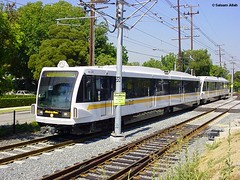
A look at the Gold Line in Los Angeles

Los Angeles Union Passenger Terminal - LAUPT- ...Image via Wikipedia
The Gold Line in Los Angeles has been beat up since its opening in 2003. Ridership has been disappointing and everyone is quick to point fingers including blaming light rail despite the extreme success of the other light rail lines in Los Angeles.

In a way, the Gold Line is near and dear to my heart. The line operates along the former right of way of the Santa Fe Railroad that was home to the Santa Fe's most famous passenger trains the Super Chief and El Capitan. For the first 19 years of my life, I lived most of them within a few blocks of this line and during high school the railroad went behind the home that my parents owned.

The best way to learn how to make a system successful is to look at what is done right and what is done wrong within a transit system.

First of all, the gold line travels from Union Station in Los Angeles to Sierra Madre Villa in Pasadena (I am only going over the original line, not the recently opened East Los Angeles extension). As mention the route travels along the former right of way of the Santa Fe railroad which was abandoned in 1994 for construction of the Gold Line.

The line starts at Los Angeles Union Station. While Union Station is an architectural marvel, it sits outside the main downtown area and requires a transfer to reach anyplace in the downtown area. Once of the big downfalls of the Gold Line presently is that there is no connection between itself and the Blue Line between downtown and Long Beach. While the Red Line does provide connecting service anyone wanting to travel from the Blue Line to the Gold Line must make two transfers to make the connection.

The Regional Connector project that will link up the Gold Line with the Blue Line and the under construction Expo Line will be a boon for the Gold Line allowing single ride and single transfer connections between the different light rail lines.

In addition even transferring at Union Station takes effort. Because the Red Line subway was designed before plans were made for the Gold Line, making connections between the two requires several trips down an escalator, a walk down a tunnel under the Amtrak and Metrolink station tracks, then up a ramp to the gold line station.

The next stop on the route is the Chinatown Stop. This stop is located in the more industrial part of the Chinatown area and is a couple of block walk to the main action in Chinatown. In addition the area looks run down and does not give the average person confidence if walking after dark. Metro also lists several buses that connect at this station but several of them are located a few blocks away.

Lincoln and Cypress is another stop that shows multiple bus routes serving them but most of the bus routes run on Figueroa which is a pedestrian unfriendly walk from the Gold Line Station. The best option would be to have routes 90, 91, 94, and 794 feed directly into the gold line once the regional connector is finished. To accomplish this the presently small parking lot will need to be replaced by a parking garage with a bus turnaround located at ground level.

Next up is the Heritage Square station. This route does have parking and is served by route 83. However METRO lists the station as being served by Route 81 but it is several blocks away. After the Heritage Square station comes the Southwest Museum stop. Yes, the stop serves the Southwest Museum plus the surrounding community but has no parking.

Highland Park is another station that shows being served by multiple routes but truly only has one route directly serving the station. The station also has parking available however the neighborhood is heavly gang infested so walking to the other buses or leaving a car in the parking lot would not be the best idea.

If you ride the line after the Highland Park Station you cross the Arroyo Seco on a spectacular bridge. Below you will see the Pasadena Freeway, one of the first freeways in the nation and one of the most hair raising experiences for a driver. It is not too bad when you get on where the freeway starts on the north or from the south but if you get on at most any other on ramps you are in for an experience. First you have to come to full and complete stop then accelerate into the freeway lane. There is no acceleration lanes, when you move from your stop you are in a main traffic lane with people coming at you at high speed.

The next stop is the single stop in South Pasadena. South Pasadena is best known for fighting the extension of the Long Beach freeway (I-710) through town. However, don't think that these people are some big transit supporters looking to stop a freeway, they are the ultimate NIMBY's. They just want the freeway moved to the lower income part of town (lower income by South Pasadena's standards, not the average person).

Metro shows there is parking available at the station but it is extremely limited. There is a neighborhood shuttle to the station during peak hours plus Metro line 176. The problem is that most residents of the city would have to access the station via car due to the lack of available transit service so it limits the number of potential riders at the stop.

All the remaining stations are in the Pasadena area. First up is Fillmore which for years has mainly been an industrial area. The street immediately to the east of the Fillmore and Del Mar station is Arroyo Parkway which becomes the Pasadena Freeway. The area around the station seems to be transforming since the coming of the Gold Line but still has a ways to go.

I talked about the Del Mar station when discussing TOD and TAD a few months back. Both the Del Mar and Fillmore Station do have service from ARTS and one Metro bus route with most of the other Metro lines located at least a block or more away. The next station at Memorial Park actually had an apartment complex built on top of the station back when it was still a mainline railroad but once again would probably be classified as Transit Adjacent Development not Transit Oriented Development.

The next two stations are both located in the center of the Interstate 215. The lake street station has seen some development nearby but both it and the Allen Station suffer from the problems of being in the middle of a freeway: hard to access, limited redevelopment possibilities and large amounts of noise for waiting customers.

The current end of the line is at Sierra Madre Villa. The station has a multi level parking garage and some recent development around it. However, once again the station is hard to access because of being in the middle of the freeway.

So what is keeping the Gold Line from reaching its full potential:

First of all, the lack of the regional connector from Union Station to the Blue line at the Flower/7th has been a major factor in the Gold Line not being the success it should be (although ridership is still adequate, just not what it should be). Once the regional connector is finished, it will be a major boon to the line.

Second factor hampering the Gold Line is Metro which has done a poor job of integrating bus service with the Gold Line. Transfers from bus to light rail should be seamless and easy for the customers. Metro has altered several bus lines to serve the Sierra Madre Villa station, however that is at the east end of the system and is of little help for people traveling to the main shopping and employment areas of Pasadena unless they want to back track. The number of buses serving the station will be very helpful once the line is extended to Azusa and beyond.

One idea would be to take Pasadena ARTS transit route 10 and modify it so that it would service the Del Mar light rail station and service the major retail and employements centers in the city. The route already does a good job of this but needs to be integrated with the light rail line to make it more effective.

Another long term problem facing the Gold Line is the lack of expansion capacity. Several stations were designed for only two cars trains and how many trains can be at the station at one time. The South Pasadena and Highland Park stations would be difficult to expand due to nearby streets but could be done. While capacity may not be an issue at the present time, looking long term capacity issues will need to be dealt with.

The final problem facing the Gold Line is the lack of parking. While the stations close to downtown do not need parking, the farther out you get from the center of the town, the larger need there is for parking. Yes, in a perfect world we would love to see the line be able to do without parking, but until we start seeing a fundamental change in development patterns, parking is going to be needed.

While the Gold Line does have issues, the line has the potential to become a super star. It is up to Metro and the cities involved to make it happen.

Enhanced by Zemanta

Wednesday, June 16, 2010

Good and Bad Density, TOD's and TAD's

One of the big issues around last year's city council election in the city of Holladay focused on density. The existing council promoting density including Holladay Village and the rebuilding (if it happens...) of the former Cottonwood Mall sight. On the other side were the people running against the incumbents who fear density, thinks it will bring in "those kind of people" and basically want to stick their heads in the sand wishing there little enclave of acre lots will never change.

One of the problems when you mention the word density is that people picture this:


This condo development located at the corner of Van Winkle and 1300 East is the perfect example of bad density. This complex does not in any way encourage the use of transit or walking. While people may walk out of the complex, the builders did not make it easy to do.

In addition there is nothing within easy walking distance of this complex. If you need anything you either have a very substantial walk (which people are just not going to do) so they are going to drive. A complex like this does nothing but increase traffic congestion which and this is what comes to most peoples minds when it comes to density.

Now take a look at this development in Pasadena, California.


This place is near and dear to my heart. Not only did I grow up four blocks from these buildings, but this complex is situated around the former Santa Fe passenger station that I spent a lot of time at growing up.

This is what is often referred to as Transit Oriented Development. It focuses residential and commercial development at a transit station in this case the MTA's Del Mar Gold Line station. Now there is some good and bad associated with this complex.

First the good.

Residents have easy access to transit. All they have to do is walk a few feet out of their apartments and they can board a Gold Line train to Los Angeles.

However that does not make good transit oriented development. What makes good transit oriented development is whether the complex reduces the number of short automobile trips. One of the benefits of this complex is that there is plenty of restaurants within walking distance. Even the former Santa Fe station has now been turned into a restaurant so residents do not have to jump in their car to get a bite to eat.

On the other hand, the downside is that there is no grocery shopping in the immediate vicinity. While there is a Trader Joe's a few blocks away, if you need to grab an item or two the only solution is driving. There is a convenience store located across the street but it has a very limited selection even by convenience store standards.

To make matters worse there is very little bus service in the area. Metro (MTA) has done a very poor job of coordinated bus service and rail service in the Pasadena area. The bus along Del Mar only runs hourly and you have to walk a couple of blocks to reach Colorado Blvd where most of the bus service exists.

Another term that has recently come into use is TAD or transit adjacent development. While TOD encourages the use of transit or walking, TAD is located near transit but does not encourage the use of transit.

Some extreme transit, pedestrian and bicycle advocates will paint anything that has parking as being TAD instead of TOD. However, the reality of today is that parking is still going to be needed and a complex will loose market share with out it. While it would be nice to be completely car free there is many people not willing to make that jump yet and 80 years of auto centric development has made it even more difficult. I applaud the people who have been able to become completely car free but right now they are a small minority.

Now that we have traveled from Holladay to Pasadena lets had back to the Salt Lake Region and look at this new complex going in:


This is the Meadowbrook Station complex going in near, you guessed it, the Meadowbrook TRAX station. However, is this complex going to be TOD, or is it more TAD?

At first glance things look positive. The complex is located within walking distance of the Meadowbrook TRAX station and is planning to have a retail element to it.

However, then there is the current downsides.

First of all, this complex is located in the middle of an industrial area. While the complex may eventually have retail and restaurants, at the present time there is nothing within walking distance of this complex. A person will have to use a car for most trips. In addition even bus service is hard to access because you have to walk to the far side of the TRAX station to even reach it.

In addition the complex still has a big focus on parking. Like I said you do not want to eliminate parking altogether but this complex (along with the new apartment complex at Daybreak) still focus too much attention and the parking lot and not making access to transit easier.

Hopefully, the area around the complex will eventually change and hopefully will create a transit oriented corridor all the way from the Meadowbrook Station down to the Murray North Station at Fireclay. Until that happens this complex will really have to be classified as TAD instead of true TOD.

Now here is an interesting building located right on State Street in downtown Salt Lake:


Notice at the bottom of the picture on the left the grocery store? That's right people in this complex and the surrounding area do not have to get in their cars in order to get a couple of items. They can just walk into this little store and get what they need. How many auto trips does this little grocery store eliminate by providing residents with an easy place to buy groceries?

Now back to Holladay and the issue of Holladay Village. Will Holladay Village be good density or bad density?

Well first of all it does have 3 bus lines servicing it from good bus service (45) , to barely adequate bus service (228), to useless bus service (223).

Second there will be shops available for residents to shop in and restaurants nearby so the complex could eliminate some automobile trips. Finally there is a grocery store located across the street so residents do not have to drive to the market. In fact by the time they go through the parking lot to their car they would be halfway to the Village area so why bother driving? ( I know many still would..).

So Holladay Village would not be a bad development. It could actually eliminate more auto trips that the new Meadowbrook Station complex.

Density, TOD, and TAD are complex emotional issues that you need to look beyond the surface and truly see how the development will function and be part of the community.
Enhanced by Zemanta

Saturday, August 02, 2008

Interesting Blog Posts from the Week...

A view of the Super Chief being serviced at th...Image via WikipediaHere is some of the interesting blog posts from around the transit blog world that caught my attention this week.

First off from Track 29 which is by a Washington DC resident, we have this one about the proposed gutting of transit funds for more highway funding:

Call Me Confused (But Not Surprised)

I already mentioned about the President's proposal and this blog talks a little more about the whole thing.

From Light Rail Photos comes some photos about the opening of the Gold Line in Los Angeles on its 5th Anniversary

Pasadena Gold Line opening

The Gold Line was built along the right of way of the former Santa Fe railroad that saw such famous trains as the Super Chief which was also referred to as the "train of the stars". I grew up not far from this line and during my high school years lived in a house whose back yard bordered this line.

Here is an off beat entry from the Transit Sleuth in Portland about the why the concept of Fare Free is a bad idea:

Hot Chicks on the MAX, TriMet Makes a Play...

Once again from California comes this entry from the Transbay Blog out of San Francisco talking about California's Complete Streets Proposal:

Complete Streets Act to Hit the State Senate Floor

Think we will ever see this in Utah? I won't hold my breath unless their is a rapture and people do start voting for the person instead of the political party in this state.

Curitiba is often used by BRT advocates as their nirvana example (I will talk about this more in the future) but here is a post from the Overhead Wire about their LRT plan:

Replay 5.21.07: Curitiba Transport Chief Throws BRT Under the Bus

Streetsblog Los Angeles has a couple of postings of interesting:

Plan for LA’s Central Park Showing at 7th and Fig

This is a proposal to cap the freeway that runs to the west of downtown Los Angeles. Seattle did this with a portion of Interstate 5 near downtown Seattle. Now if they had only put Interstate 15 in a trench like most rebuilt freeways through downtown Salt Lake because this same thing could have been done in Salt Lake, but its too late now.

Next there is this posting about Representative Earl Blumenauer's bill that would help transit agencies that are being hurt by the big diesel prices.

House Bill Makes Connection Between Transit Funding and Gas Price Relief

Blumenauer has been a big proponent of effective transit development and is a regular speaker at Railvolution and other similar programs.

One of the things I like about this bill is that there is a provision to boost housing near highways plus incentives for transit riders, cyclists, telecommuters and carpoolers.

Previously I have talked about the problems with the requirments for new schools that almost force students to be either bussed or driven to school or drive themselves in the case of High Schools. The Smart Growth Around America Blog has an entry talking about more about this and issues such as diesel prices is having on busing:

It all hinges on a key phrase: “If it’s possible.”

As the blog points out, it is great to encourage kids to walk to school but new schools are being built that makes that next to impossible.

That's it for the ones that stood out this week.


Zemanta Pixie

Thursday, December 06, 2007

Cause of Some High Cost and Long Planning Periods...

One of the problems we have here in the United States in building light rail lines is that it cost more than comparable lines in other countries.

Among the problems that causes that is that we build systems like tanks so to survive a crash instead of prevent the accidents, politicians putting pork into the project for such items as neighborhood improvements and what we would be talking about today planning.

While good planning is very important, over the last few years the Federal Government is requiring more and more items to be included in the planning. One example of that is the requirement that Bus Rapid Transit is required to evaluated on every project now. While at first this seems to make sense to study alternatives, let me give you some examples from Los Angeles where this is doing nothing but slowing down the process and increasing cost.

First of all I would like to thank Darrell Clarke of Friends of Expo for this information.

Downtown Connector: The two current light rail lines end at two opposite points of downtown. The Gold Line ends at Union Station which at the extreme northeast end of downtown while the Blue Line ends at the 7th/Metro MetroRail Station which is in the center west end of the downtown.

The two lines are currently connected by the MetroRail but requires two transfers are required. The downtown connector is designed to bring these two lines together so that trains can operate through. However, the Federal Transit Authority is requiring them to study BRT for this line instead of light rail. Now why would you connect two light rail lines by a short BRT? Not to mention that the lines are connected by overcrowded MetroRail already. Clearly the study of BRT is political and slows down the process.

Wilshire Subway: Extended the current MetroRail Subway from Western Avenue all the way to Santa Monica. Once again BRT is required to be studied as a possible alternative to the Subway. The problem with that? BRT already runs along with route and is beyond capacity. That is the whole reason the subway extension is being studied!

Expo Phase II: The first phase of the Expo line is now under construction and they are required to study BRT for phase II. This is equivalent to UTA building the first phase of the University line then having to build BRT to the Medical Center.

As you can see in these cases BRT is being used as a Red Herring and is doing nothing but increasing cost.

While we need GOOD planning, we do not need planning that is doing nothing but cost us money.